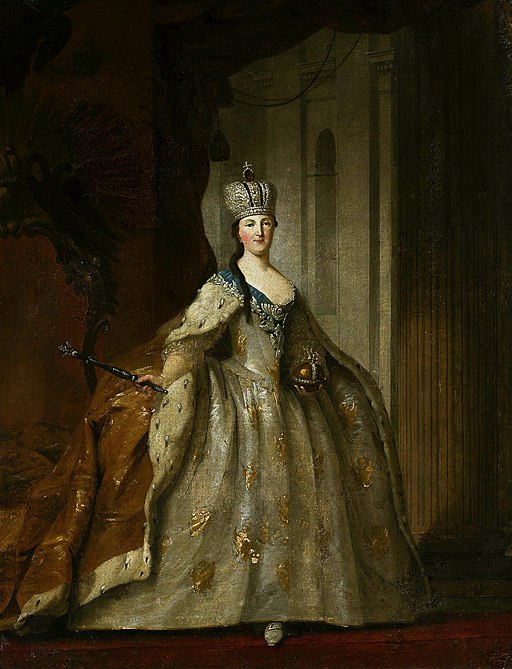
Catherine the Great By Ivan Argunov (Wikimedia Commons)
Catherine II, aka Catherine the Great, was one of the most dynamic and substantive monarchs of the eighteenth century. A wealth of contradictions characterized her reign. A reformer who corresponded regularly with the likes of Voltaire and Diderot, she was also a dedicated imperialist who divvyed up Poland in league with her neighbors and waged offensive wars to the south while colonizing as much of Siberia and Central Asia as she could. She seized power in a de facto coup, watched her rivals conveniently die, and embraced a Russian tradition of banishing unreliable or undesirable subjects, defined as those did not serve her interests, to Siberia. At the same time, she explicitly located the sovereignty of the nation among its people, sought to expand the number and classes of subjects with a role in administrative decision-making, and sincerely desired be seen as a what might be called a “democratic autocrat.”[1] So, one might expect Catherine’s Russia to have a mixed view of the American Revolution. As always, she was sure not to disappoint.
The years prior to Lexington and Concord were exhausting for Russia. In 1772, it completed the first partition of Poland in cooperation with Prussia and Austria. In 1774, it finally brought a six-year war with the Ottoman Empire to a successful resolution in the Treaty of Kuchuk-Kainarji, which expanded Russian territory in the south, giving it greater access to the Black Sea.[2] Throughout the period, Catherine dealt with a number of internal rebellions and uprisings built around phony claimants to her throne. By far the most dangerous was a Cossack uprising led by Emil Pugachev, who claimed to be Catherine’s deposed husband Peter III. He was caught at the end of 1774 and executed in 1775. When Britain’s North American colonies rebelled, it rated notice, but little attention in the Russian capital, St. Petersburg. Before too long Britain came calling, requesting 20,000 troops to suppress the rebellion. Catherine declined, but wrote a correspondent that she expected America to become independent in her lifetime.[3] Then her government turned toward its latest round of internal reform meant to improve the administration of its vast and growing territory. That might have been the end of it, but European politics intervened.
Compared to the rest of the literature on the American Revolution, the war at sea gets relatively little attention. Eric Jay Dolin has joined a small cadre of writers and historians trying to rectify that shortfall. In his latest book, Dolin takes on the privateering war, activities by privately financed vessels to wage war on British trade at the nominal behest of various states and the Continental Congress. Granting letters of marque, essentially a license to take foreign ships as prizes on the high seas, gave states a way of quickly tapping private capital to create sea power and attack an enemy on the ocean. It was an important innovation, one Britain and its colonies had used widely before the Revolution, and was often preferable to the expense of maintaining a large navy. The rebelling colonies first issues such letters, followed by Congress itself.
The status of privateers was controversial. Because the ships were privately financed, their owners and crews cashed in on prizes taken. Entire fortunes could be made at the same time the war impoverished others. For shipowners, the risks were manageable to secure such payoffs. Officers and crewmen could also expect a healthy payday from a successful cruise. Their risks, however, were substantial.
Britain, of course, did not recognize its colonies as independent states, which invalidated any letters of marque and made the privateersmen crewing the ships pirates subject to summary hanging. In practice, however, captured privateersmen were simply sent to prison, often the ship hulks floating in New York’s harbor. It could be the same as a death sentence. In America, some viewed them as a distraction from the main war effort created by greedy men lacking in public spirit.
Dolin thoroughly reviews all of these issues and comes to the conclusion that, on the whole, privateers and their crews materially hindered the British war effort while preventing coastal economies from collapsing in the face of Britain’s superior fleet and control of the seas. He backs the argument up by citing previous studies of economic losses. For example, the first Secretary of Lloyd’s of London, and dominant insurer, concluded that 3,386 British vessels were captured during the war, of which 1,002 were either recaptured or “ransomed.” (That figure includes captures made by naval vessels and America’s allies.) Dolin estimates the value of captures made by American vessels at between $1.4 and $1.6 billion today. In other words, the impact of privateering was substantial.
Dolin livens the story with narratives of ship encounters and individuals caught up in the war. Much like the privateering war itself, they are too episodic to hang together as an integrated narrative. But, he uses them effectively to underscore his broader points while helping the reader relate to the war at sea. Dozens of illustrations enrich the read.
Eric Jay Dolin is an excellent writer, straightforward with a style that keeps the book moving while thoroughly engaging the reader. Rebels at Sea is destined to become the starting place to understand the privateer war during the American Revolution.
On the morning of September 25, 1779 from the deck of his new prize, the British frigate Serapis, John Paul Jones watched his former ship, Bonhomme Richard slide beneath the waves off Flamborough Head on Britain’s east coast. It had been a brutal fight before the Americans prevailed over a well-handled, better-armed British vessel and became one of the most famous sea-duels in American history. A floating wreck, Serapis’ condition made it unfit to continue with Jones’ original plan of taking the war to England by cruising for prizes. Moreover, he was due in the Texel, a roadstead near Amsterdam where ships gathered for safer transit over waters regularly patrolled by the British fleet. The French had a convoy gathering there and wanted an armed escort. After spending days repairing Serapis, Jones, his small naval squadron (Alliance, Pallas, Vengeance), and his prizes (Serapis, Countess of Scarborough), reached Dutch shores on October 3.
Emerging Revolutionary War welcomes back guest author Drew Gruber.
Since Arnold’s raid in January the situation for Virginians in the Spring of 1781 was deplorable and growing worse. Keeping soldiers shod and fed (besides properly armed and equipped) proved difficult. For example, Gen. Baron von Steuben noted that despite receiving 100,000 cartridges the Virginians simply lacked cartridge boxes to store them or even an adequate number of muskets to fire them. In Virginia, a colony defined by its deep waterways finding vessels to move men and supplies was also a major piece of the puzzle.
The Chesapeake Bay and navigable rivers provided quick access into the interior of Virginia and both sides vied to control them. Previous campaigns in Virginia and along the Bay highlighted why towns like Portsmouth, near the confluence of the James River, and the Chesapeake Bay could help armies control large swaths of the largest and most prosperous colony. Of course, access to vessels of a variety of sizes was necessary to ensure the control of not only Virginia but Coastal North Carolina and Maryland.
Gloucester Point 1755, inset from original owned by the Mariners Museum.
Thankfully by March 1781 Virginians had an upper hand over their adversaries not only in the number of boats but the means to outfit, repair, and support an ad-hoc navy. It was the culmination of years of effort and ingenuity which began just after Virginia declared its independence.
Alongside Virginia’s establishment of a system of public stores and the creation of a standing army a shipyard was on the short-list of priorities for the fledgling independent state. In June 1776 the Virginia Committee of Safety empowered shipbuilder John Herbert to “examine all such places upon the James River or its branches…proper and convenient for erecting ship-yards…”1 Herbert selected a bend in the Chickahominy River just a dozen miles west of Williamsburg.
The Virginia State Navy appears to have been amorphous and inconsistently armed between June 1776 and the spring of 1781. At various points it consisted of about a dozen ships, although the term ‘ship’ may be generous descriptions for some of these vessels.2 According to Charles Paulin’s Navy of the American Revolution despite Virginia leadership’s zeal to fund additional ships, marines, and infrastructure to support coastal defense, the vessels were largely undermanned and poorly armed. To our modern sensibilities and perhaps to the men and women of the Revolutionary era the names of the “armed boats” which comprised Virginia’s navy are less than inspiring. For instance, the ships Experiment and the Dolphin don’t give off an air of martial prowess but still sound better when compared to my personal favorite, the Fly.
Still, the Virginia General Assembly pushed to create and maintain a more effective naval system and in 1777 appointed James Maxwell as Superintendent. He apparently oversaw the operation at the various shipyards, rope works, foundries and all the materials and men needed to create and maintain an effective navy. Maxwell’s base of operations at the Chickahominy yard included over 150 acres of stores, barracks, and other infrastructure essential to the maintenance and creation of a vast flotilla.
Although the Chickahominy yard was ably led and with copious old growth timber at their disposal the lack of manpower persisted. Maxwell reported to Virginia’s Gov. Jefferson that in outfitting two vessels they relied on volunteers.3 In the same letter to the governor, Maxwell noted that the term of service for the crew of the Jefferson expired and he was “detaining them Against their will.” Despite setbacks and the shortage of able bodies the shipyard kept Virginia float.
The information available in the papers of Williamsburg Public Store and the Calendar of State Papers provides a snapshot into the day-to-day operations in the naval yard.4 However, a letter written in February 1781 provides the best insight into the effectiveness of the operation. Capt. Beesly Edgar Joel wrote Gov. Jefferson from Williamsburg commenting that the Dragon (a much better name) was under water rendering it, obviously, unfit for service. Within five days it was floating and on day six was sailing down the James River.5 In an era obviously devoid of pneumatic lifts this quick turnaround speaks volumes as to the facility’s capabilities despite its handicaps.
Early American Shipyard, image from Abbot’s 1908, “American Merchant Ships and Sailors.”
Maxwell’s operation at the Navy Yard grew slightly by March 1781 as the state prepared for what was certain to be an intense spring campaign. Maxwell reported that he had 96 guns with the majority being four pounders but lamented that his full compliment of sailors should be 590 whereas he had 78 men to staff 7 ships. Two additional ships were ready but had no crew to speak of while 4 of his operable boats had less than 10 men serving on them.6 This would have to suffice.
That same month, reports flooded into Richmond from various points near the Chesapeake Bay that British reinforcements had arrived in Portsmouth to support Arnold. Within a few short days various Virginia arsenals, warehouses, and even shipyards were being instructed to police up their men and materials and move them west out of the possible path of destruction. Virginia could not afford another disastrous raid like the one they experienced in January.
As predicted, British Gen. Phillips left Portsmouth on April 18th, with over two dozen boats and approximately 2,000 men. It happened quickly. Virginian Rodham Kenner recalled their retreat as Phillips combined force sailed west up the James River.
“the whole of our little fleet which was in this part of the Bay was driven up James River a much Superior British force, and into the Chickahominy River to what was called the Ship Yard: whilst our little fleet composed of the following Vessels to wit the Ship Dragon, the Brigg Jefferson and the Thetis a 36 gun Ship”7
The following morning, on April 19, British Col. John Simcoe landed at Burwell’s Ferry with a force of Jagers, light infantry and the Queen’s Rangers. The Ferry, located at the confluence of the James and Chickahominy rivers sat scarcely a few miles from Maxwell’s shipyard. Phillips ordered Simcoe to “beat up any party who might be in ambuscade there.”8 Finding no ambush this elite force quickly marched across the Virginia Peninsula towards Williamsburg.
Burwell’s Ferry Landing, photo from “The Post Script” published in April 2020 by Kate Gruber
A small force of Virginians, apparently under the command of Maj. Armistead briefly skirmished with Simcoe’s men as they pushed east towards Williamsburg.9 Simcoe’s men continued east along the old Yorktown road as various Virginia militia units melted away before them eventually arriving in Yorktown itself. As this was unfolding British Lt. Col. Robert Abercromby (Ambercombie) with his light infantry paddled up the Chickahominy towards the shipyard. Over a dozen flat boats, supported by perhaps as many as a dozen additional vessels turned into the mouth of the Chickahominy River from the James River – a few miles of the shipyard.
Although few primary source accounts describe the British attack on the shipyard Virginia pensioner Joseph Saunders provided the best description so far. Although he was recalling the event almost fifty years after the fact, his deposition has a surprising amount of detail.
“They sent a number of gun boats up to our shipyard to destroy what was there. I had filled my galley with naval stores to take up the River to conceal them but wind and tide being against me could not go on, came to, put a spring on my cable, and awaited their arrival. It was not long before they came in sight and as soon as near enough I discharged my cannon at them, sunk my vessel, and made my escape to shore…”10
Arnold’s report to Henry Clinton is rather vague as was Virginia’s Lt. Governor David Jameson when he wrote James Madison seven days later on April 28. “When they went into Wbg some of their Vessels with the flat Bottomed Boats moved up to Chickahominy—while there they destroyed the Ship Yard, the Thetis, the Stores &c. &c.”11 Besides untold stores, and raw and finished materials, at least two large vessels were destroyed, either at the hands of their own crew or Ambercromby’s amphibious infantrymen. Besides the limited contemporary reports from soldiers, sailors, and Virginia legislators, myriad archaeological reports highlight the effectiveness of the British raid.
The inferno of the burning yard, ships, stores, and supplies was so large that it could be seen several miles away later that evening. James Innes, commanding Virginia militia who were fleeing west towards New Kent County, recalled in his letter to Thomas Jefferson that, “They possessed themselves of the Ship Yard about 4 o’Clocke yesterday, and I am apprehensive from the fire discoverd in that Quarter last night they have totally destroyed it.”12
According to William Lowrie, the Dragon was “burnt by the British at Chickahominy Ship yard.”13 Both Lowrie and Saunders have ties to the Dragon and it must have been difficult to watch the ship which had served the cause of liberty for almost five years slip beneath the surface. In fact, The Dragon was approximately 81 feet long and roughly matches the size of a one of the two vessels still sitting in the bottom of the bottom of the Chickahominy River today.14 The second vessel which has also been surveyed in myriad cultural resource reports is substantially shorter and has been hypothesized to be either the Lewis or Safeguard.15 In fact, on March 20th 1781 Saunders was placed in command of the Lewis which he scuttled almost a month later a few yards from the wharf at the shipyard.16
Artist interpretation of vessel Remains, “Historical and Arcehaological Investigation of the Chickahmoiny Shipyard Site,” a thesis by Jeffrey D. Morris, C. 2000., Pg. 109
Today the site of the shipyard is on private property and the underwater resources are protected by the Code of Virginia § 10.1-2214 which empowers the Virginia Marine Resources Commission with the authority to permit underwater archaeological investigations and makes recovery of underwater archaeological materials illegal without a permit. Trespassing on both land and water is unlawful which helps protect the known and unknown archaeological resources. Without stronger primary source materials like pensions, maps, and letters from soldiers and citizens artifacts become the key to understanding many Revolutionary War events like this one. Every button, nail, and cannonball when professionally recovered and systemically documented will provide us with the best chance to fully understanding how this shipyard contributed to the war for American independence.17
Maxwell’s shipyard never recovered however the Virginia State Navy has escaped wholesale destruction and would live to fight another day. As Phillip’s soldiers and sailors moved west up the James River, with the smoke from the Shipyard bellowing another naval showdown was brewing closer to Richmond.
Sources:
Naval Document of the American Revolution, Page 342
Paullin, Charles O., Navy of the American Revolution. (1906). Page 413
“Capt: Jas: Maxwell to the Governor, January 1, State Ship Yard.” Calendar of Virginia State Papers. Vol. 1., Page 409.
Williamsburg Public Store records, transcribed by Katherine Egner Gruber. Unpublished.
“B. Edgar Joel to the Governor, February 9, Williamsburg.” Calendar of Virginia State Papers, Vol. 1., Page 501. A day later, after hiring a pilot the Dragon ran aground and sat on the bar for three days and returned to the ship yard.
“To Thomas Jefferson from James Maxwell, 26 April 1781,” Founders Online, national Archives, last modified November 26, 2017
A letter from Thomas Jefferson to Benjamin Harrison on April 22nd notes the two ships in the Chickahominy as the Lewis and Safeguard.
To find out more about underwater archaeology check out the Maritime Heritage Chapter of the Archaeological Society of Virginia. https://maritimeheritageva.org/
Emerging Revolutionary War welcomes guest historian Dwight Hughes
The recent disastrous conflagration aboard the USS Bonhomme Richard (LHD-6) in San Diego harbor brings to mind the original warship by that name and its fiery fate, a tale excellently told in a previous post by Eric Sterner (“I Have not Yet Begun to Fight!” or Words to that Effect (September 23, 1779)). “Bonhomme Richard” means “good man Richard” in French. So, who is Richard? What was good about him? Why is his name on a man-of-war?
The United States Navy likes to carry forward the labels of famous vessels. This is one of the oldest and most revered monikers in navy history, originally assigned in 1779 by Captain John Paul Jones to a rather decrepit French merchantman armed with a motley collection of guns. The French government donated the former Duc De Duras to Jones to sail against their mutual enemies, the British.
John Paul Jones
Jones famously engaged the powerful frigate HMS Serapis on September 23, 1779 in English waters off Flamborough Head, Yorkshire. The ships grappled together and blasted away at point blank range. Both were battered and ablaze in sinking condition with many casualties when the British captain surrendered. With Bonhomme Richard going down fast, the Americans took over Serapis and managed to save her.
John Paul Jones became the “Father of the U. S. Navy” (or one of them). Bonhomme Richard entered legend as the warship that won and sank. She and her successors also represent those rare U. S. Navy vessels whose names are rendered in a foreign language.
Bernardo De Galvez, Governor of Louisiana (Wikimedia Commons)
Willing’s next target was the town of Manchack upon which he descended “so rapidly that they reached the Settlements without being discovered.”[1] On the 23rd, Willing’s advance parties captured the 250-ton British sloop Rebecca, with sixteen 4-pounders and six swivels.[2] It was a coup worthy of Navy SEALS. Rebecca was normally a merchant vessel, but had been armed and sent upriver to contest the Rattletrap’s advance by protecting Manchack. Instead, her presence had strengthened Willing’s force. Captured while lying against the levy opposite the town, she only had fifteen men aboard when an equal or superior force of Americans struck about 7 am.[3] With Manchack captured and the Rebecca renamed the Morris, Willing turned his attention to the end game at New Orleans, where he hoped to dispose of his booty and obtain supplies useful for the American war effort.
At New Orleans, the Congressional Agent, Oliver Pollock, was aware of Rattletrap’s advance and began making preparations to dispose of the property Willing and his raiders had taken, a growing portion of which constituted slaves. He organized a small force under his nephew, Thomas Pollock, to go up river and help Willing bring his vessels and cargo into port. Instead, Pollock and his men proceeded down the river, where they captured an English brig, the Neptune, eventually bringing her into New Orleans as a prize.[4] (The British would argue strenuously that Neptune and a private boat were not in fact legal prizes.)
Willing’s Marine Expedition, The Marines in the Revolution: A Pictorial History, (Washington, DC: United States Marine Corps/Government Printing Office, 1975)
In 1778, Captain James Willing and his crew sailed and rowed the bateaux Rattletrap down the Ohio River to the Mississippi. A “left” turn of sorts then took them down the Mississippi all the way to the Gulf of Mexico. Willing’s purpose was straightforward: secure the neutrality of residents along the Mississippi, obtain supplies from New Orleans, and return them to the new United States. It was as tall an order as the Ohio and Mississippi were dangerous. British rangers and their Native American allies closely watched both shores and would readily attack vulnerable river traffic. Willing’s only refuge lay in a string of forts the Americans had established on the Ohio, but they did not extend very far. He would have to make due with his crew and the two swivel guns that armed Rattletrap. Continue reading “Captain James Willing’s Mississippi Raid, Part 1”→
Benjamin Franklin, one of the Founding Fathers of the United States, could have contributed to a forgotten shipwreck narrative, according to new research.
Benjamin Franklin
Based on studies of Franklin’s early life as a printer, Dr Hazel Wilkinson claims there are clues which provide information about Benjamin Franklin’s activities during his first visit to London as an 18-year-old printer.
Happen to be around Boston this weekend? Or live within traveling distance? Check out the special event happening this weekend from Sunday, July 23rd through Monday, July 24th at the U.S.S. Constitution Museum and Charlestown Navy Yard.
The U.S.S. Constitution, the oldest commissioned naval vessel still afloat will set sail again. Launched in 1797 and named by President George Washington, the vessel is a wooden-hulled, three-masted heavy frigate. She has been dry-docked since May 18, 2015 but will return to the water on July 23rd.
“Old Ironsides” the U.S.S. Constitution, photo taken April 2016 (author collection)
The event, co-sponsored with the National Parks of Boston will have a full-plate of free, family-fun events starting at 4:00 p.m. on Sunday and continuing into the morning hours of Monday.
For a full-listing of these events, including information about the museum, and answers to a few frequently answered questions, click here.
For those that cannot make it live to the re-launch, the event will be live on Facebook video streams at 4:00 p.m. and 6:00 p.m. along with live video streams throughout the night of the major events. Check out the Facebook site for the museum by clicking here.




 Emerging Revolutionary War Era