How Did They Communicate?

Emerging Revolutionary War welcomes guest historian Robert “Bert” Dunkerly to the blog as the author of this post. 

It is well known that German troops (commonly called Hessians) fought alongside the British during the war.  One of the more intriguing questions of the Revolution remains; how did they communicate?  At any given time, German units could comprise from one third to one half of the larger British armies. They were also present in equal numbers in smaller detachments.

French was a common language that many European officers would have known, and there is evidence that German and English officers communicated in French during campaigns.  The language barrier also impacted daily army operations.  For example, Georg Pausch of the Hesse-Hanau Artillery requested an English officer who spoke German for a court martial.   Yet most of that procedure was conducted in French.

Written orders from General Phillips in Montreal in 1777 to Hessian Artillery units were given in French, suggesting that this was commonly done in these calm, routine situations.

It wasn’t a perfect system but it worked well enough. Adjutant General Major Bauermister of Hesse-Cassel, for example, notes that the English spoke poor French, when communicating with them. Yet what about among small units like companies or battalions?

030_30[1]
Re-enactors portraying the Hesse Kassel Jaeger Korps
Would mediocre command of a language suffice for communication in combat situations?  Often small groups of British and German troops operated together on patrols or raids.  Marching to Freeman’s Farm (Saratoga) in 1777 was a column that included Germans on the left, English on the right, and English troops as flankers. Such situations required close coordination.

Other times they were side by side on battlefields, such as at the Battle of Guilford Courthouse in 1781, where the German Von Bose Regiment was aligned next to the British 71st Highland Regiment. Close coordination in these cases was essential.

Still another example is from Brandywine, where Captain Johann Ewald wrote that in the army’s advance, were 60 jaegers on foot, fifteen mounted jaegers, a company of Highlanders, and a company of British light infantry.  All these troops worked in tandem to protect the army from ambush and clear the way for the advance. Yet Ewald was silent on how they did so.

Captain Ewald, also wrote of his experiences in Virginia, where, in the advance on Richmond, small numbers of troops were interspersed.   They marched into the town in this order: Jaegers, British dragoons, more jaegers, and British Light Infantry.  There are dozens of other examples.

Despite the many instances of German and British units mingling, there is precious little documentary evidence of how officers, or the common soldiers, communicated.  Perhaps they used a combination of French, translators who spoke either English or German, and hand signals or other agreed- upon methods.

Timing and clarity are key in close quarters combat, there is no chance to second guess in an ambush or a raid. There were likely instances of misunderstanding that may have led to mistakes and even led to friendly fire incidents.

Of the many accounts this author has researched, only a few mention how they communicated. Perhaps it was something so mundane, or so well understood, that they saw no need to comment on it in their writings. It is hoped that further research will shed light on this question.
Last Home of Jefferson Davis, Last Resting Place of Samuel Emory Davis

Over the Thanksgiving holiday my wife and I visited friends along the Mississippi Gulf Coast. The mutual friends knew about my keen interest in American history and had planned an excursion accordingly.

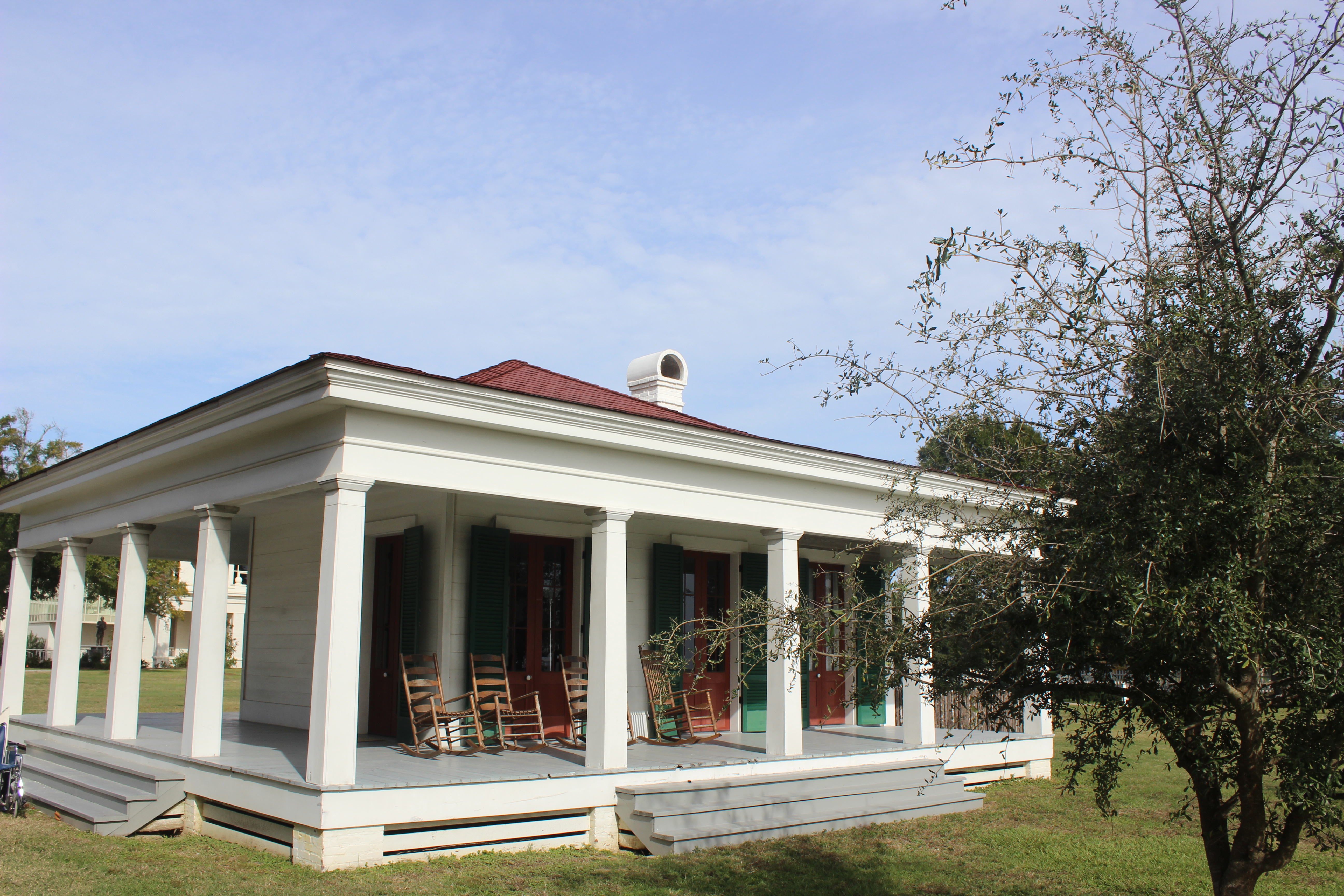
Within a fifteen-minute drive of where we were staying, sits Beauvoir, the last home of Confederate President Jefferson Davis. In 1877, the ex-Confederate president, looking for a quiet place to write his memoirs  of the Confederate cause in the  American Civil War, paid $50 a month to rent what is known as the “Library Pavilion” on the property. Davis became enamored with the property and purchased the house and grounds from the owner, a Mrs. Dorsey for the price of $5,500 in 1879.

The restored "Library Pavilion" The original was damaged by Hurricane Katrina.
The restored “Library Pavilion”
The original was damaged by Hurricane Katrina.


In the “Library Pavilion” Davis would write the majority of, The Rise and Fall of the Confederate Government. Ten years after purchasing Beauvoir, Davis was dead.

Although not buried on the property, hundreds of former Confederate soldiers are. Yet, there is one Davis is interred on the property now.

The Davis that is buried there is what struck my interest. With no surprise, according to my wife, I had researched what history sites were in that area of Mississippi and had circled Beauvoir as a place of interest. I did not realize that the friends we were visiting had also planned to take me there because they also knew I am a history nerd, err, enthusiast.

What had caught my attention and serves as the basis of this post is the other Davis.

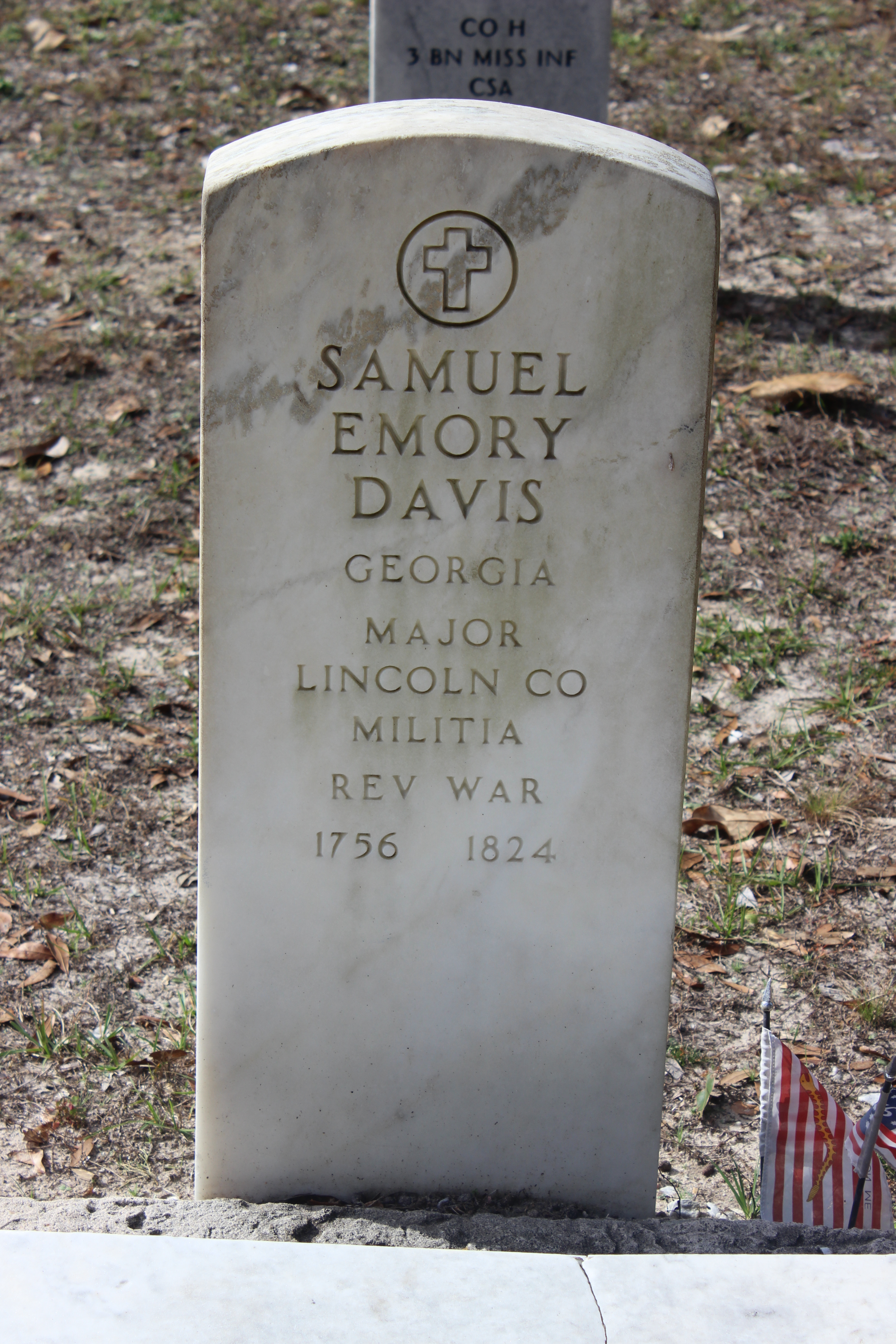
Samuel Emory Davis's Toombstone
Samuel Emory Davis’s Toombstone

Samuel Emory Davis.

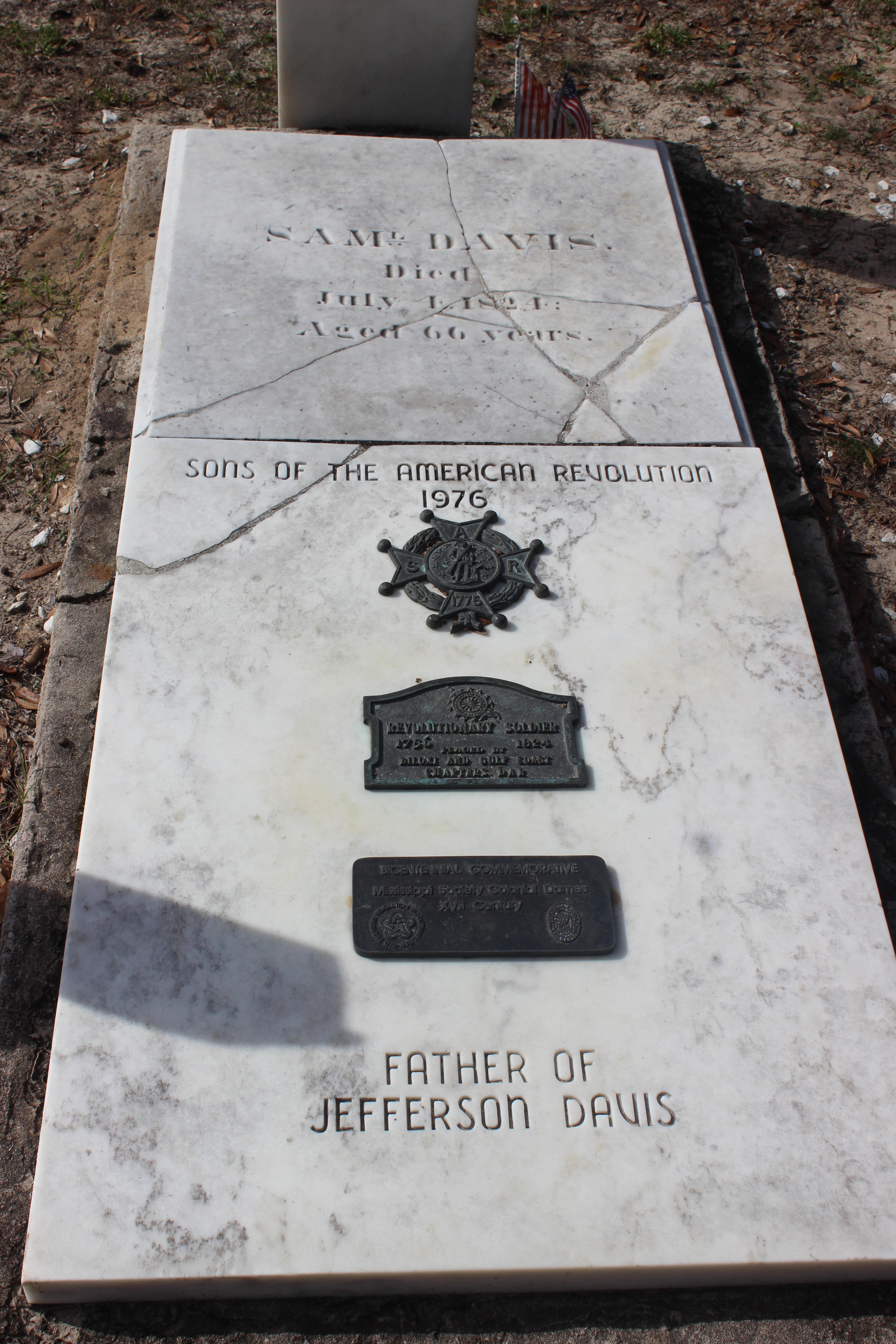
Samuel, the father of Jefferson Davis, lies buried in the cemetery. Originally buried below Vicksburg, Mississippi, the elder Davis’s remains were brought to the Gulf Coast to lie at rest at Beauvoir after the course of the Mississippi River was slightly altered.

The Sons of the American Revolution were responsible for saving the remains and having them re-interred.

Samuel Emory Davis, born sometime around 1756, served, like his half-brothers in the militia of Georgia. However, the records available lead to the fact that he served most of the war in South Carolina militia forces.

Furthermore, accounts, gathered by Rice University in conjunction with the Jefferson Davis Papers, have him serving in some of the major engagements of the American Revolution in Georgia, including the Battle of Kettle Creek on February 14, 1779 and the Siege of Savannah from September to October 1779, and lastly the Siege of Augusta between April and June 1781.

A little more research led to the fact that Samuel Davis might have even raised his own mounted force which may have led to the rank listed on his tombstone; major.

After independence, Davis moved his family to Kentucky, where Jefferson Davis was born, then to Mississippi, and finally to Louisiana. While visiting his oldest son, the old patriot died on July 4, 1824.

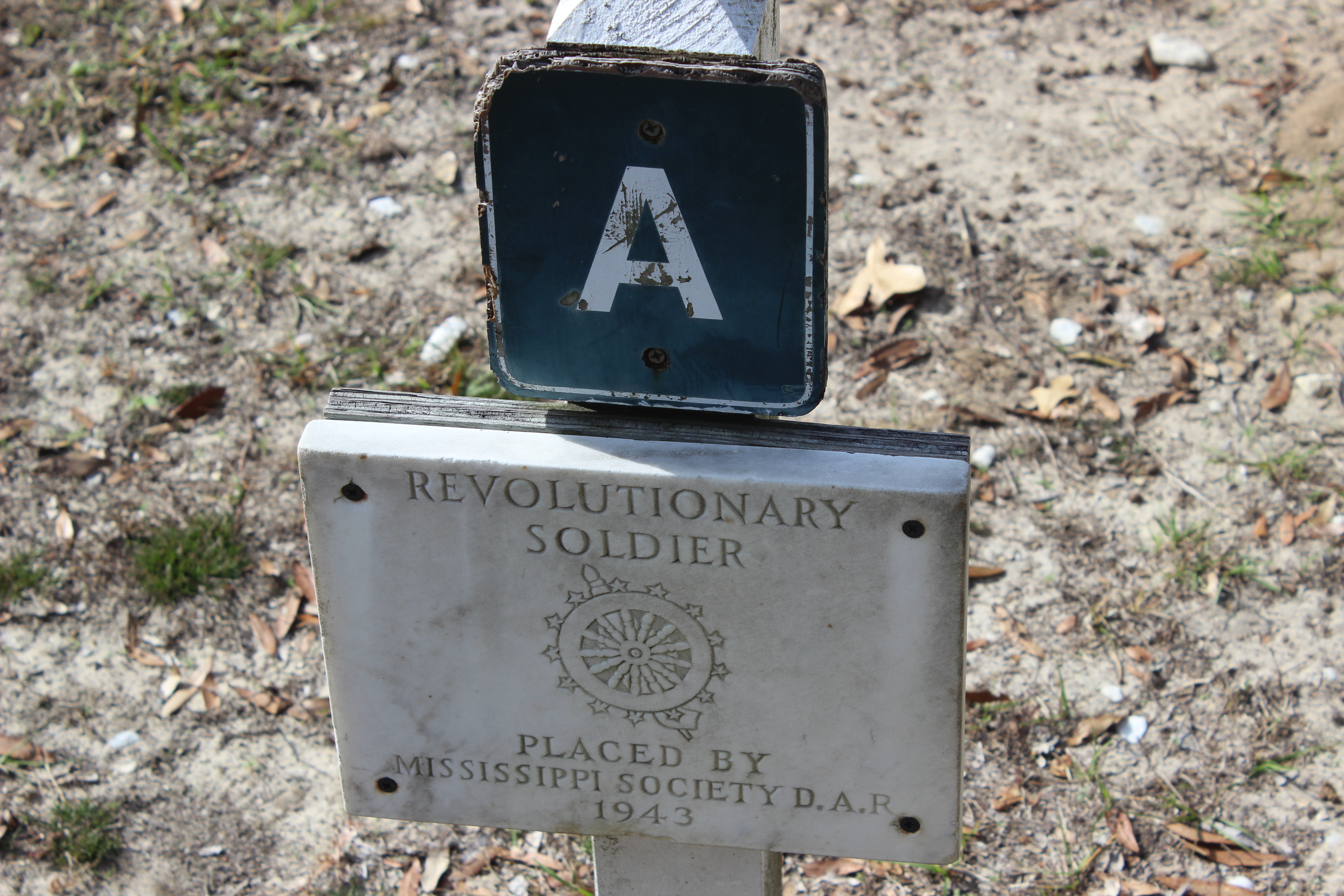
Marker beside Samuel Davis's grave stone.
Marker beside Samuel Davis’s grave stone.

And from 1943 to this present day the former militia officer and father of the only Confederate president, lies in the Beauvoir Confederate Cemetery.

Thus, the visit, which I am thankful for friends who coordinated it on a holiday weekend that Americans celebrate what we are thankful for, now leads to another thankful opportunity.

More reading and research into the American Revolution.

As I came to Beauvoir for the Civil War history connection. I left wanting to know more about the Davis that fought in the American Revolution.

IMG_6437