Nicholas Cresswell from the Frontispiece of his Memoir (Library of Congress)
For some Englishman, the political conflict between the United Kingdom and its American colonies was an afterthought that should not interfere with their plans to build a future based on American wealth. Nicholas Cresswell was one such person. He traveled to the colonies on the eve of the American Revolution and returned home in 1777, having kept an extensive diary of his travels, experiences, thoughts, and conditions in America during the war’s first years. Along the way, he met some of the most colorful and interesting people who played prominent roles in the war: George Rogers Clark, Delaware Indian leaders White Eyes and Killbuck, Thomas Jefferson, Patrick Henry, William Howe, Robert Rogers, and Charles Lee to name a few. Since its publication, Cresswell’s journal has become a touchstone for historians looking for insight into those people, how a loyal Englishman like Cresswell saw the world and the Americans around him interpreted events. In particular, he recounts the feelings and treatment of loyalists trapped in America during the war. With that in mind, reviewing Cresswell’s diary might help spread the word about a worthwhile primary resource.
Emerging Revolutionary War welcomes historian Vanessa Smiley to the blog.
The thing about Ninety Six National Historic Site is that it’s unassuming exterior hides a wealth of history. It’s also nowhere near a major highway, meaning you have to want to get there if you’re thinking of visiting. And when you do get there, you will realize that there’s more history per acre than its demur entrance lets on. Located in the back country of South Carolina, Ninety Six has a history that speaks to the stories of Native Americans, the American frontier of the 18th century, and the American Revolution.
Entrance to the park (courtesy of Ninety Six NHS, NPS)
The site at Ninety Six holds a treasure trove of study on these subjects. Native American, mostly Cherokee, activity was heavy in the area long before European settlers arrived. One of the earliest backcountry trading posts, established by Robert Gouedy in 1759, made Ninety Six a hotbed of trading activity thanks to its location at the crossroads of twelve different roads and paths, linking the area to nearly all parts of the colonies.
Emerging Revolutionary War (ERW) would like to highlight from time to time some of the lectures, presentations, talks, and events that our historians are apart of.
This month, ERW historians are giving the following presentations:
Bert Dunkerly
March 27th: “The Brown’s Island Explosion Victims” at the Virginia Forum, Richmond, Virginia
Kate Gruber
March 13th: “Tenacity: Women in Jamestown and Early Virginia” Shenandoah Lyceum Lecture Series, Harrisonburg, Virginia. For more information click here.
Crispus Attucks. Every American school child learned that name in a social studies or history class in grade school. On the night of March 5, 1770, Attucks, an African-American was one of the six Bostonians that was killed by British soldiers.
Known in American history as the “Boston Massacre” the tragic event was used as fodder by the Sons of Liberty and pro-revolutionary minded individuals to propel the colonies toward rupture with Great Britain.
Emerging Revolutionary War welcomes back guest historian Kevin Pawlak
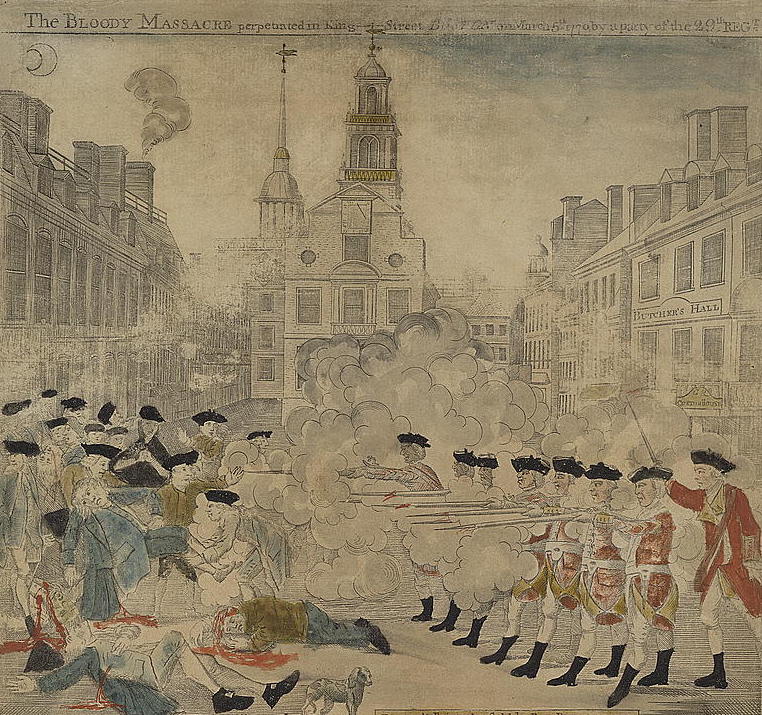
Every quest for liberty has its first martyr. Two-hundred and fifty years ago this evening, the cause of American liberty gained its first five when British soldiers fired on a crowd of Bostonians in an event immortalized as the Boston Massacre.
Boston Massacre depiction
The first to fall at the end of the British muskets was Crispus Attucks, a mariner of mixed African and Native American heritage. Bostonians paraded Attucks’ remains alongside the four other victims to a common grave but Attucks’ popularity did not grow until the next century when abolitionists used him as a symbol of patriotism. Abolitionists emphasized and stretched Attucks’ role. To supporters of abolition, Attucks was a household name.
A detail from Paul Revere’s print of the “Bloody Massacre.” This widely circulated image gave the impression that the British soldiers fired in unison on command into a peaceful assembly. (Library of Congress)
“Fire if you dare, G-d damn you, fire and be damned!” the crowd of hundreds of Bostonians yelled as they pressed in around the nine British soldiers guarding the Custom House in Boston on the evening of March 5, 1770. The violence that was about to erupt in downtown Boston had been brewing for almost two years when British regular soldiers first entered Boston in 1768. It had gotten especially bad after February 22, 1770, when Christopher Seider, an 11-year-old boy, was killed while protesting with a group in front of the home of a loyalist. Thousands of Bostonians turned out for the boy’s funeral and the tension and distrust between the civilians and the British soldiers grew larger.
The presence of British regular troops in the streets of Boston enraged colonists, who now felt they were being occupied by a foreign army. It was just eleven days after Seider’s death, on March 5, 1770 when Private Hugh White of the 29th Regiment of Foot took up a sentry post outside of the Custom House on King Street in downtown Boston. The Custom House had taken on symbolic meaning as the center of British taxation. As a young wigmaker’s apprentice, Edward Garrick, passed the sentry, he yelled at a British officer that he had not paid his bill for a wig. The sentry, White, reprimanded the young man. The two engaged in a heated conversation when Private White swung his musket at Garrick, hitting him on the side of the head.
Word traveled through the streets about the altercation and a large mob began to descend on the lone British sentry at the Custom House. As the mob of people began to grow larger and larger, the sentry called for reinforcements. Seven British soldiers of the 29th Regiment of Foot, under the command of Captain Thomas Preston, marched to the sentry’s defense with fixed bayonets. As the nine British soldiers stood guard near the steps to the Custom House, passions enflamed and dozens more people joined the crowd surrounding the soldiers. Bells began ringing in the city and more people came out of their homes and into the streets. The crowd was estimated to have grown to as many as 300 or 400 people. They were yelling at the soldiers, shouting profanities and insults at the soldiers. Others threw rocks, paddles, and snowballs at the besieged men. One of those protestors near the soldiers was a former slave named Crispus Attucks. The crowd continued to hurl verbal abuse and challenged the soldiers repeatedly to fire their weapons. Preston’s men loaded their muskets in front of the crowd.
Last week, Emerging Revolutionary War‘s Phillip S. Greenwalt wrote a review of the above mentioned book. To find that review click here. Recently, through email, Emerging Revolutionary War had a chance to interview the author. The questions and his responses are below.
Emerging Revolutionary War welcomes guest historian Jon-Erik Gilot. A short bio is attached at the bottom of this post.
Though perhaps more widely known as the birthplace of West Virginia during the Civil War, Wheeling and its environs retains several significant sites associated with the Revolutionary War. The name itself is translated from the Delaware language meaning “place of the skull,” legend having that the severed head of a white settler was placed on a pole by local Native Americans as a warning to others to stay away.
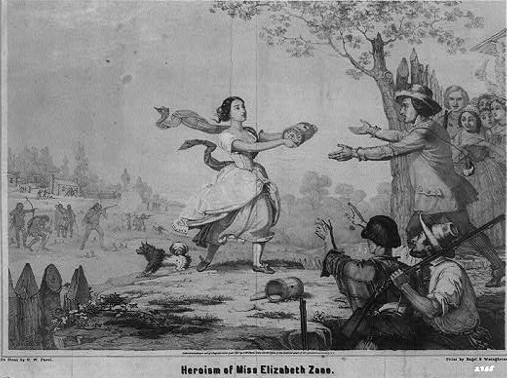
Betty Zane’s Run for Gunpowder during Second Battle of Fort Henry–1782 (image courtesy of Library of Congress)
Wheeling was founded in 1769 by Colonel Ebenezer Zane and his brothers Jonathan and Silas. Five years later in 1774 Fort Henry (originally called Fort Fincastle) was built overlooking the Ohio River to protect the growing numbers of settlers from attack. The fort was twice attacked during the Revolutionary War, first in 1777 and again on September 11 – 13, 1782, when a force of British loyalists (Butler’s Rangers) and Native Americans (under the command of outlaw Simon Girty) attacked the fort’s 47 defenders. The fort was besieged over two days, culminating in Betty Zane’s heroic run for gunpowder in a nearby cabin. The British and natives broke off the battle with the arrival of Virginia militia reinforcements. Fort Henry is acknowledged as one of the final battles of the Revolutionary War.
Thomas Jefferson, Marquis de Lafayette, two household names from the American Revolutionary War. One the author of Declaration of Independence and one of the great political minds of the era. The other, a Frenchman, enamored with the ideals of the rebelling colonies of British North America who risked a maritime crossing, was wounded at Brandywine, and served both on the field of battle and the international sphere to help achieve American independence.
That much is known about these two gentlemen, icons of history. How about their friendship, one that spanned decades and brought both men through times of personal and professional difficulties. Although years separated visits and both men were well into adulthood before making their respective acquaintance, the friendship helped cement the bond between countries, from aid during the American Revolution to a thankful nation celebrating the return of the Marquis in the mid-1820s.
This friendship has finally been captured in narrative form by historian Tom Chaffin, author of other historical works and biographies in a book published by St. Martin’s Press in 2019.
During George Washington’s lifetime and maybe because he was such a great man, he had two birthdays beginning in the 1750’s. Born under the Julian calendar, George was born on February 11, 1731/32. When the English Parliament decreed in 1750 that two years hence England would switch calendars and adopt the Gregorian, used by the majority of countries/states in Europe, there was a discrepancy. So, 11-days was added (some believe that the old calendar was off by a year and a eleven days thus the slash in “1731/32” above).
Regardless, Washington’s birthday was moved to what we, in the United States, are taught now, that it fell on February 22, 1732. Just don’t tell his mother, who believed to her dying day that he was born on the aforementioned date. And who argues with mothers?
What we cannot argue with is that certain birthdays were celebrated at Gadsby’s Tavern, in Alexandria (a city a young George surveyed and helped lay out), Virginia. On October 6, 1796, John Gadsby leased the City Hotel from John Wise and quickly became the epicenter of social and political discourse in Alexandria.
Today the Gadsby Tavern and Museum is open to the public and run by Historic Alexandria a department within the City of Alexandria. For more information and to plan your visit, a bite to eat, or celebrate a birth night ball like George click here.
The balcony where musicians would sit and play at Gadsby’s Tavern (author’s collection)The hall at Gadsby’s Tavern, which can still be rented out today for celebrations and ceremonies. (author’s collection)







 Emerging Revolutionary War Era