Emerging Revolutionary War is honored to welcome guest historian David A. Powell to the blog. A biography of David is at the bottom of this post.
The Hudson Valley in upstate New York is one of my favorite historical places – which might come as a surprise to some, given that my usual historical beat is the 1861-1865 time-frame. There are a handful of Civil War related sites along the Hudson, but not many.
But for two centuries before our war between the states, the region was the pathway for commerce, settlement, and conflict. The banks of the Hudson, Lakes George and Champlain, and the St. Lawrence are all dotted with crucial reminders of a violent historical past.
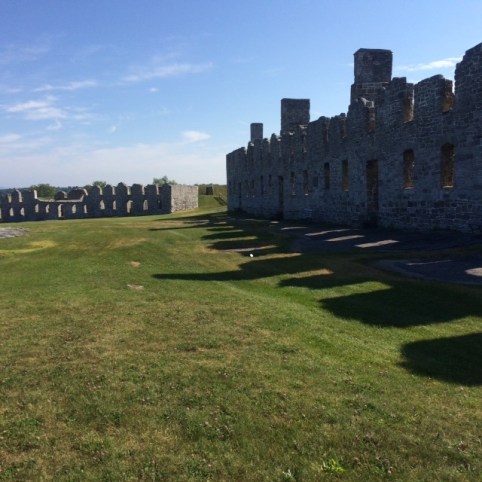
Ruins of Crown Point
I’ve been to most of these sites; West Point, Bennington and Saratoga battlefields, the site of Fort William Henry, Crown Point, and plenty of other locations. One of them, however, fixes my attention beyond all others:
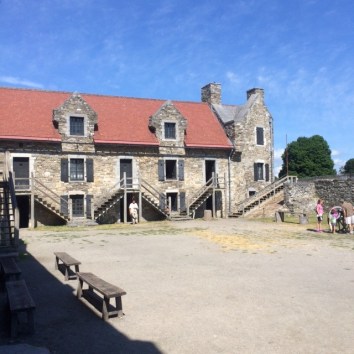
Interior of Fort Ticonderoga
Fort Ticonderoga.
The fort occupies a strategic place on Lake Champlain, were a land portage connects Champlain to Lake George, and ultimately, the Hudson River.
<Lake Champlain from Fort, looking south>
Originally called Carrillon by the French, who built it in 1755; the fort changed hands several times during the ensuing 25 years. It was unsuccessfully attacked by the British in 1758, and finally captured the next year, part of the British “Annus Mirabilis,” that string of decisive triumphs over the French that reached their crescendo with Wolfe’s victory at Quebec. Two decades later, it figured in the American Revolution; it was wrested from British control by Ethan Allen and Benedict Arnold in 1775. Its heavy artillery was sledged across many miles of Wilderness snow and ice to reinforce the Rebel army besieging Boston by Henry Knox, which forced the British to abandon that city. In 1776 Ticonderoga was a bulwark of the Patriot defenses on Lake Champlain. In 1777, it was easily re-captured by the British under Burgoyne, but returned to American control after Burgoyne’s disasters of Bennington and Saratoga.
Ticonderoga is fully restored now, owned and maintained by a private foundation that has done an outstanding job of presenting and preserving the Fort’s history. The town and the fort grounds are also dotted with interesting monuments, many erected by British regiments, mainly placed to honor their troops who fought in the Fort’s bloodiest single battle, that of 1758.
British General James Abercrombie led 17,000 troops – colonials and British regulars – against a much smaller garrison of between 4,000 and 5,000 French, Canadian Militia, and Indian Allies. The French, under the Marquis de Montcalm, defended an entrenched line outside of the fort walls, which Abercrombie obligingly assaulted. The British lost 2,000 men, and Abercrombie retreated.
My favorite monument at Ticonderoga is actually paired with another monument erected by the American Colonists in Westminster Abbey (left to right in picture below). They both commemorate the death of Lord George Howe, a Brigadier General in Abercrombie’s army (and elder brother to the Howes of Revolutionary War fame) who embraced irregular warfare.
Lord Howe Monument at Fort Ticonderoga
Memorial to George Augustus, Viscount Howe, in Westminster Abbey, London, England
Go spend an afternoon at Ticonderoga. You won’t be disappointed.
*David A. Powell is a graduate of the Virginia Military Institute (1983) with a B.A. in history. He has published numerous articles in various magazines, and more than fifteen historical simulations of different battles.
For the past decade, David’s focus has been on the epic battle of Chickamauga, and he is nationally recognized for his tours of that important battlefield. The result of that study was his first published book, The Maps of Chickamauga (Savas Beatie, 2009).
His latest book is Failure In The Saddle: Nathan Bedford Forrest, Joe Wheeler, and the Confederate Cavalry In the Chickamauga Campaign (Savas Beatie, 2011). He is currently working on a full length monograph of the battle of Chickamauga. The first volume of that work, entitled The Chickamauga Campaign: A Mad Irregular Battle, is scheduled for a 2014 release.
David and his wife Anne live and work in the northwest suburbs of Chicago, Illinois. He is Vice President of Airsped, Inc., a specialized delivery firm.
Whether you are about to enjoy a firework display, finishing up a family barbecue, or enjoying this holiday in some other form, the historians here at Emerging Revolutionary War wish all our readers and fellow historians a “Happy Independence Day.”
For those protecting our country on this day, around the world, a big “thank you” to go along with this July 4th, to you as well.
But, let’s not forget the true meaning of this day. When, in 1776, in Philadelphia, Mr. John Hancock, as president of the Second Continental Congress, affixed his signature to the document below, which declared to the world the break from Great Britain.
Declaration of Independence
From the words of Richard Henry Lee, “Resolved, That These United Colonies are, and of right ought to be, free and independent states,” to the quill of Thomas Jefferson, “When in the course of human events it becomes necessary for one people to dissolve the political bands which have connected them,” let us truly remember the history behind this day and the build-up to that fateful decision in Philadelphia.
On a recent trip to Boston, I was shown by fellow Emerging Revolutionary War historian Rob Orrison, Dorchester Heights. One of my favorite quotes of the entire American Revolutionary War was in reference to the Continental Army’s move to fortify the very heights at Dorchester.
“My God, these fellows have done more work in one night than I could make my army do in three months.” Uttered by General William Howe the morning after the Americans had used the night to build an entire fortification network on the commanding hillsides of Dorchester.
This move, conducted in the secrecy of the night, led to the British evacuation of Boston, after an aborted offensive by the British do a providential snowstorm. Less than two weeks after that influential night, on March 17, 1776, the British evacuated Boston, never to return.
I did not get to spend too much time on the heights but I was able to snap a few pictures, shown below. But, I did have the great fortune to be on the heights at night, looking out over Boston, which has grown just slightly since 1776. A few moments of silence ensued, where I had the chance to mull over what that view must have looked like and what the soldiers who hurriedly dragged the fascines and gabions, and shoveled dirt that night must have worried about as they feverishly tried to finish their duties.
Stone monument marking the spot where the cannon that Henry Knox brought from Fort Ticonderoga to Boston stood. You can see the lights of Boston in the background with the reflection of the lights on the water past the first row of houses in the foreground.
The cannon that bore down on Boston from the heights of Dorchester Heights were a product of one of the greatest feats of the entire war. Former Boston bookseller turned artillerist extraordinaire had brought the heavy armament on an arduous trek, through the late stages of winter from upstate New York to the Continental Army besieging Boston.
Henry Knox was the man behind the delivery and he would serve as George Washington’s Chief of Artillery before the war was over. Afterwards, Knox would become the first Secretary of War in Washington’s Administration. At Dorchester Heights, with Washington’s planning and Knox’s delivery the city of Boston was liberated without firing a shot.
A view of the monument
The heights retained its military importance through the end of the War of 1812. By the end of the 19th century, in 1898, the General Courts of Massachusetts had commissioned a monument to stand on what remained of the heights. The white marble Georgian revival tower that stands 115 feet, commemorates that night in 1776 that American soldiers did what British soldiers would take months to complete. By 1978, after a listing on the National Register of Historic Places, the monument and remaining hill site was handed to the National Park Service by the city of Boston. Dorchester Heights became part of Boston National Historical Park which was established in 1974.
When planning a visit to Boston National Historical Park and to Dorchester Heights, which is open to visitation, both during the day and at night please consult the website for the national park here. That way you can familiarize yourself with the regulations and how to make the most of your visit.
Washington Crossing the Delaware, by Emanuel Gottlieb Leutze The Metropolitan Museum of Art, http://www.metmuseum.org
One of the iconic images of the Revolutionary War is Emanuel Gottlieb Leutze’s 1851 painting, Washington Crossing the Delaware. It is the night of December 25, 1776. The Continental Army is being transported across the Delaware River to attack a Hessian garrison at Trenton, New Jersey, some nine miles to the south. In the foreground, anonymous men (and possibly one woman) of varying nationalities and races row an overloaded boat across the river, pushing great slabs of ice out of the way. Two of the boat’s occupants are not anonymous: General George Washington, standing resolutely near the bow, and young Lieutenant James Monroe, holding the stars and stripes.
Leutze’s painting is glorious–and wrong in almost every detail. The river resembles the Rhine more than the Delaware; the boat is too small and of inaccurate design; there is too much light for what was a night crossing; Washington did not cross standing up; the stars and stripes had not yet been adopted by the Continental Congress; and James Monroe was not holding the flag, not in the boat, and not even present with the army.
He was already across the river, and he was busy.
Washington’s plan for a surprise attack on Trenton was a risky attempt to reverse the sagging fortunes of the Patriot cause. During the summer of 1776 British forces, including Hessian mercenaries, had driven the Continental Army from New York across New Jersey and into Buck’s County, Pennsylvania. Expired enlistments and outright desertion had thinned the American ranks, and many of those who remained were despondent. Washington gambled that a successful attack against an isolated British outpost would boost the army’s morale and stiffen the resolve of Congress and the people.
Three Hessian regiments, comprising about 1,400 men, were stationed at Trenton under the command of Colonel Johann Rall (also spelled Rahl). Washington planned to bring 2,400 Continental soldiers across the river overnight at McKonkey’s Ferry, march to Trenton, and attack before dawn. Two other elements of the army were part of the plan. A 1,900-man force under Colonel John Cadwalader would make a diversionary attack against British troops at Bordentown, New Jersey. General James Ewing would lead 700 men across the Delaware at Trenton Ferry, control the bridge over Assunpink Creek, and intercept any Hessian troops retreating from Trenton. Bad weather prevented both of these deployments, meaning that everything would depend on the main body’s effort. The army’s password for the evening was “Victory or Death.”
Washington’s plan included sending a small detachment of troops over the Delaware first to secure the army’s route of march. James Monroe was with this contingent. In his autobiography (written in the third person late in life and not completed before his death), Monroe described the mission:
The command of the vanguard, consisting of 50 men, was given to Captain William Washington, of the Third Virginia Regiment . . . Lieutenant Monroe promptly offered his services to act as a subaltern under him, which was promptly accepted. On the 25th of December, 1776, they passed the Delaware in front of the army, in the dusk of the evening, at [McKonkey’s] ferry, 10 miles above Trenton, and hastened to a point, about one and one-half miles from it, at which the road by which they descended intersected that which led from Trenton to Princeton, for the purpose, in obedience of orders, of cutting off all communication between them and from the country to Trenton.
Monroe noted that the night was “tempestuous,” and that snow was falling. While manning their post, the detachment was accosted by a local resident who thought the Continentals were British troops. Describing the incident many years later at a White House dinner during his presidency, Monroe recalled that the man, whose name was John Riker, was “determined in his manner and very profane.” Upon learning that the soldiers were Americans, he brought food from his house and said to Monroe, “I know something is to be done, and I am going with you. I am a doctor, and I may help some poor fellow.” Dr. Riker proved remarkably prescient.
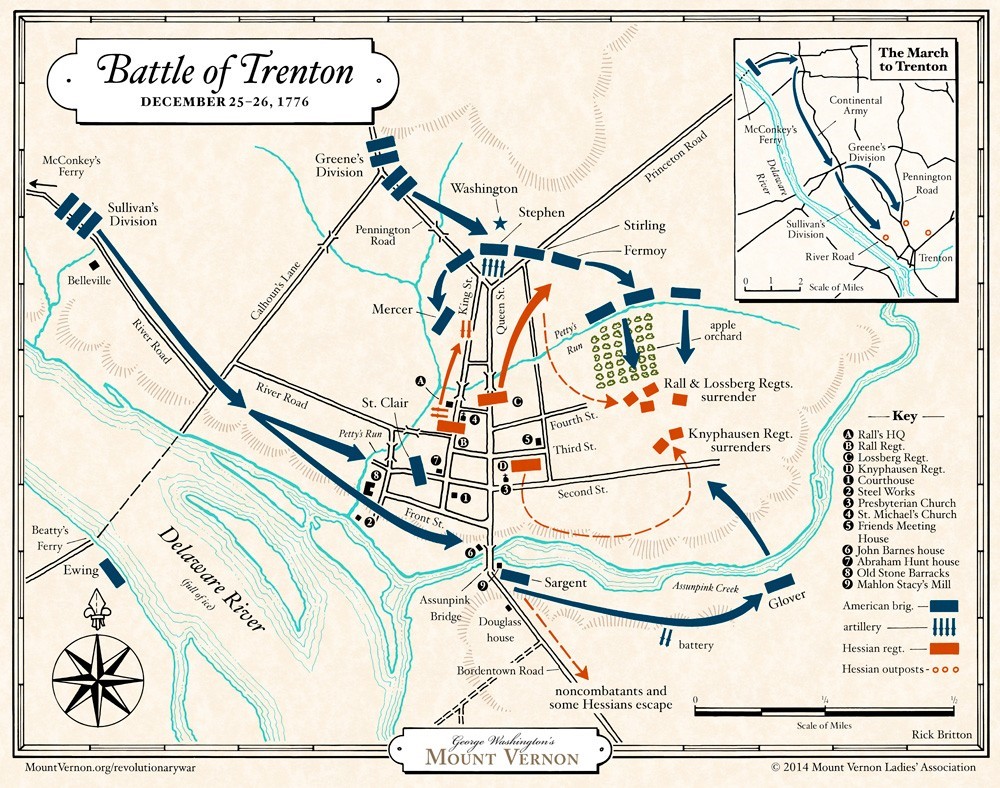
Battle of Trenton map courtesy George Washington’s Mount Vernon
The main army’s river crossing and march to Trenton took longer than planned, meaning that the attack would occur well after sunup. Outside the town Washington divided his force, sending a division commanded by Major General Nathaniel Greene to attack from the north while the other, led by Major General John Sullivan, attacked from the south. At 8:00 AM the assault began, and here we return to Monroe’s account from his autobiography:
Captain Washington then moved forward with the vanguard in front, attacked the enemy’s picket, shot down the commanding officer, and drove it before him. A general alarm then took place among the troops in town. The drums were beat to arms, and two cannon were placed in the main street to bear on the head of our column as it entered. Captain Washington rushed forward, attacked, and put the troops around the cannon to flight, and took possession of them. Moving on afterwards, he received a severe wound and was taken from the field. The command then devolved upon Lieutenant Monroe, who attacked in like manner at the head of the corps, and was shot down by a musket ball which passed through his breast and shoulder. He was also carried from the field.
The Capture of the Hessians at Trenton December 26 1776, by John Trumbull (Yale University Art Gallery) (James Monroe lies wounded on the ground at left center)
Monroe was brought to the same room where William Washington lay, and their wounds were dressed by the army’s surgeon general and Dr. John Riker. Riker’s prediction of helping “some poor fellow” came true as he repaired a damaged artery in Monroe’s shoulder. What neither man realized at the time was that the intrepid physician had saved the life of a future president.
George Washington’s gamble in initiating the Battle of Trenton paid off. The victory was complete, and came at a surprisingly small cost in terms of American casualties. Two enlisted men froze to death during the nighttime march, and two were wounded in combat. The only losses among officers were the nonfatal wounds sustained by William Washington and James Monroe. Washington followed up his success at Trenton with another at Princeton on January 3, 1777, where the Continental Army proved that it could prevail over regular British troops.
The best commentary upon James Monroe’s performance at Trenton, and his Revolutionary War service generally, comes from no less an authority than George Washington. Writing to an acquaintance in 1779, Washington noted Monroe’s “zeal he discovered by entering the service at an early period, the character he supported in his regiment, and the manner in which he distinguished himself at Trenton, where he received a wound.” The general concluded that James Monroe had “in every instance maintained the reputation of a brave, active, and sensible officer.”
Scott H. Harris is the Executive Directors of the James Monroe Museum in Fredericksburg, Virginia. Harris became director of the James Monroe Museum and Memorial Library in July 2011, following ten years as director of the New Market Battlefield State Historical Park (administered by Virginia Military Institute). From 1988 to 2001, Scott was the first curator of the Manassas Museum and later director of historic resources for the City of Manassas, Virginia. Prior to his work in Manassas, he was a consulting historian with the Association for the Preservation of Virginia Antiquities in Richmond and an historical interpreter with the Colonial Williamsburg Foundation. He has been a board member of the New Market Area Chamber of Commerce, Prince William County/Manassas Convention and Visitors Bureau, Shenandoah Valley Travel Association, and Virginia Civil War Trails, Inc. He is a past president of the Virginia Association of Museums and serves as a peer reviewer for the Museum Assessment and Accreditation programs of the American Association of Museums.
Scott received his BA with honors in History and Historic Preservation from the University of Mary Washington in 1983. In 1988, he received an MA in History and Museum Administration from the College of William and Mary. Scott is also a graduate of the Seminar for Historical Administration, the nation’s oldest advanced museum professional development program.
When I was completing my graduate degree in American history from George Mason University a few years back, I took on the challenge of trying to examine the motivations of American soldiers during the American Revolutionary War.
The basis was to examine, “why they fought” if I can borrow a line used frequently by Civil War scholars and historians.
Being a native Marylander, I narrowed my focus on soldiers from that colony/state.
Yet, I was struck by the continued emergence of one name in particular and this gentleman became a focal point of mine.
This gentleman became through the war and could not be ignored with any mention of Maryland and her patriotic citizenry’s service in the war. His name is Otho Holland Williams.
Otho Holland Williams
First a little background on Otho Holland Williams. Otho Williams’ early life mirrors that of many early American colonists. His parents, Joseph and Prudence Holland Williams were born and married in Wales before emigrating to the colonies and settling in Prince George’s County, Maryland.
Otho was born on March 1, 1749, one of eight children. The following year the family moved to western Maryland, settling near the mouth of Conococheauge Creek in Frederick County. Life on the frontiers of the British North American colonies could be rough and hard and before Otho reached adulthood, he lost his father. However, he showed enough promise and potential to be entrusted by a brother-in-law to a clerk position in Frederick County. Showing his ability to grasp a new skill, the young Williams rose to be given “final charge” of the clerk’s office before moving on to a clerk position in the larger town of Baltimore at age eighteen in 1757.
In Baltimore, Williams continued to enhance his reputation and business prospects. After seventeen years in the spiraling, busy port town situated on the Chesapeake Bay, Williams moved back to more familiar grounds in Frederick in 1774. With the move, he entered into the merchant trade, overseeing commercial enterprises in the growing town. Williams was building a respectable life and he would have been considered a gentleman.
However, nothing truly remarkable had happened to cause this ordinary British colonist in Maryland to be remembered by history. Events transpiring on both sides of the Atlantic Ocean soon reared an opportunity for Williams to change that.
Otho Holland Williams now 26 years of age, at the direction of the Committee of Observation of Frederick County, Md, on the 21st of June, 1775, would have heard of a letter from the Delegates of Maryland asking for the formation of two companies of “expert Riflemen to be raised” to join the army near Boston.
The gist of that correspondence is below:
“A letter from the Delegates of Maryland, and a resolve of the Congress enclosed therein, were read, requiring two companies of expert Riflemen to be furnished by this County, to join the army near Boston, to be there employed as Light-Infantry, under the command of the Chief officer of that Army
In the second company, Williams was elected one of three lieutenants and within the month was marching north to join the army, arriving in Cambridge in 22 days, marching over 550 miles, which needless to say gave a great first impression on the military officers and one that the future Commander-in-Chief George Washington would realize in New York.
George Washington was using this house as his headquarters when Williams and the Maryland riflemen arrived after a 550 mile trek to report for duty (courtesy of Mt. Vernon)
In January 1776, Capt. Price, of the rifle company, was promoted to major in Col. William Smallwood’s Maryland Regiment. The gentleman who replaced Price was Williams who succeeded him as captain. Williams’ star continued to rise and in June 1776 was appointed major in Colonel Hugh Stephenson’s newly organized rifle regiment. He was still a major in November when he saw action in New York.
While other Marylanders serving valiantly but unsuccessfully in the opening engagements of the battles around New York City, further the Hudson River stood Fort Washington and stationed there was the rifle company that Otho Williams was a member of.
Upriver from New York City the Americans had constructed two forts on either side of the Hudson River. On the island of Manhattan stood Fort Washington, named in honor of the commander-in-chief of the Continental Army. On the other bluff, stood Fort Lee named in honor of Charles Lee, a major general in the American army that had overseen the defense of New York City prior to the Continental Army’s arrival. Nathanael Greene, the very capable American general convinced General Washington that his namesake fort could be held and although of a different opinion initially, Washington relented to his subordinate. The decision would have dire consequences for Williams and the men in the rifle regiment.
Before discussing the role of Williams and his gallant band of riflemen in the defense of Fort Washington, one fact that cannot be looked over is the rapid rise that Williams had undertaken. The mere fact that a young boy, with no prior military experience, could rise to the rank of major was truly exceptional.
To rise to that similar rank in the British army would depend more on family prestige and the ability to pay the price for the commission. That this was not the case in the American army was a sign of the difference in ideals and make-up of the military. The American colonies were revolting against the aristocratic regime of Great Britain, so to imitate their promotion mechanisms would seem out of place with the republican ideals espoused by the aspiring new republic. Furthermore, the ability to navigate the command structure with the added benefit of superior’s being promoted or more morbid, die, allowed Williams to rise.
However, the previous mentioned attribute only tell a portion of the career so far of Williams. His commitment and perseverance to the cause had been duly noted and he would soon show the coolness and battlefield leadership that would cement his rise through the officer ranks.
Battle of Fort Washington, 1776
Williams commanded men of the rifle company occupied a portion of the outlying trenches that surrounded the fort because of a very grave insight the defenses in the environs of Fort Washington could not accommodate the number of American defenders. In their exposed position, the men from Maryland and Virginia would come into contact with their British and Hessian counterparts in the opening stages of the conflict on November 16, 1776. The action commenced in the morning and would be an all-day, drawn out conflict, the epitome of a “fight to the death” type battle. Part of the reason the affair turned out to be so relentless and bloody was the fact that the Americans had refused to surrender the fort initially and the ensuing action could quite possibly result in the British and their allies showing no quarter if the Americans suffered defeat.
History does not depict whether the men with Williams and under the command of Colonel Rawlings knew this fact, but what they did know was that they had been given an assignment to defend the fort and the men from Virginia and Maryland were prepared to do just that.
Map of Battle of Fort Washington (courtesy of Wiki)
Unfortunately, after facing overwhelming odds and the collapse of other sections of the American lines, Williams and his men were forced to fall back from their exposed positions. During the action Colonel Rawlings received a severe wound to the leg, resulting in a fracture of the bone. Serving as second in command, Williams assumed command of the rifle regiment, continuing to show his unwillingness to yield the field even after suffering a severe groin wound.
With the wound and the collapse of the American lines, he did not command for long. The survivors of the regiment, along with the rest of the fort’s garrison, surrendered to the British and German forces.
After the conflict, a Hessian survivor remarked about attacking the Maryland riflemen, in which Williams was most likely in command of; that “he had a hard time of it.” Another enemy soldier noted the inordinate number of wounded. Official casualty reports, listed 2,780 Americans, including Williams, as prisoners of war, and another 149 were killed and wounded. The British lost 458 killed, wounded, and missing during the day long fight.
Down the street from the Governor’s Palace in Colonial Williamsburg sits a two-story brick structure. Living historians, in first-person, debate the road to the American Revolution.
It will be hard to describe in modern terms the celebrity of Marie-Joseph Paul Yves Roch Gilbert du Motier de Lafayette, Marquis de Lafayette (aka LaFayette) in 18th century America.
The young Marquis was fascinated with the American ideal of revolution and against the wishes of the French monarchy, in 1776 he cast his lot with the American patriots. His relationship with George Washington and other American leaders played a major role in the American-French alliance that brought about American independence. Continue reading “The Return of L’Hermoine”→
Information. Communication. Solidarity. Linkage. Friendship. Point-of-view. Identity. Current Events.
These words describe reasons in the 20th century why people joined and continue to join social media platforms, especially Facebook.
Approximately 240 years before Facebook was launched in February 2004, the first major attempt at achieving all the proponents above was the job function of the various Committees of Correspondence established in the thirteen American Colonies. Continue reading “Committees of Correspondence = 18th Century Social Media?”→






 Emerging Revolutionary War Era