The Greatest Leaders of the American Revolution You Have Never Heard Of

When a historian, author, or student of the American Revolutionary War mentions the following three words, “Green Mountain Boys” there is usually one name that comes to the forefront.

Seth Warner is usually not that name. Yet, he is one of the two names that should be forever linked with the great history of the “Green Mountain Boys.”

For those that are drawing a blank, the other name usually associated with this famous unit is Ethan Allen.

aseth
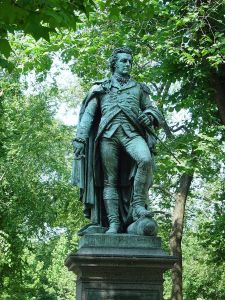
Seth Warner Statue (courtesy of The Monument & Markers of Vermont; http://historicsites.vermont.gov/)

Warner, born in hilly Woodbury, Connecticut on May 17, 1743, the fourth of ten children to Dr. Benjamin Warner and Silence Hurd Warner. The young Seth was a product of the western frontier, growing up on the fringes of the English world, and thus learning from an early age to live and survive in the woods, rivers, and hills of Connecticut and what would become Vermont.

He did attend what limited schooling was available and from his father, rudimentary medical practice. In an 18th century biography, Warner was remembered to have vast information on the nature and uses of indigenous plants.

During the French and Indian War, Warner served two summers fighting in the cause of the British and would serve as a captain in the “Green Mountain Boys” following the French and Indian War. One biography states that Warner was part of the famous ranger outfit known as Major Roger’s Rangers, yet there is no primary evidence that supports this biographical claim.

With war on the horizon following the action at Lexington and Concord, Warner was elected third in command, with Ethan Allen being elected in top command, on May 8, 1775 for the task of capturing Fort Ticonderoga in western New York.

Born where Native American still threatened the westward-minded colonists, with the training during two summers in the last major war on the American Continent, Warner would now play a major role in the upcoming American Revolution.

With that, Seth Warner and the “Green Mountain Boys” marched off to help make the dream of American independence a reality. Following Ethan Allen, Warner found himself embroiled in the first campaign outside the environs of Boston when on May 10, 1775 he took part in the American capture of Fort Ticonderoga in western New York. Following up the next day, Warner, serving as second-in-command, attacked and captured the British garrison at Crown Point, approximately 13 miles away from Fort Ticonderoga.  When news broke of the exploit, the “Green Mountain Boys” and subsequently Warner quickly became a household name for the patriot cause.

With the turn of the season to summer, Allen and Warner appeared in Philadelphia to appeal directly to the Continental Congress. Their aim was to achieve recognition as a regiment for the “Green Mountain Boys.” On June 23, 1775, the day the two men appeared in front of the governing body of the American cause, the Congress agreed and sent the endorsement to the state of New York. After some debate in provincial Congress of the Empire State, the endorsement was finally agreed upon.

With the ensuing vote of officers, surprisingly, Allen was not elected as commander, but Warner survived in an officer capacity, garnering 41 of 46 votes for lieutenant colonel. No reason or notes from this convention, held on July 6, 1775 has ever surfaced.

Before 1775 was out, Warner, who would lead the command, found themselves on the way to Canada. Initially stationed along the St. Lawrence River on the way to Montreal and near the end of October, Warner’s men repulsed an amphibious landing and attack by Sir Guy Carleton, the British Governor-General of Canada. With the repulse, at the Battle of Longeuill led to the surrender of Fort St. John on November 3, 1775.

Ten days later Montreal fell to the American forces and Warner and his “Green Mountain Boys” entered the fallen city later that same day. The American commander, General Richard Montgomery wanted this crack unit to continue with him by canoe to Quebec but because of the lack of winter clothing, the command was forced to head south, for supplies.

Not to stay in a support role for long, Warner’s men marched north shortly after the turn of the year in January 1776 to reinforce the Americans laying siege to Quebec. While there Warner showed the depth of his concern for the welfare of his men. With the smallpox epidemic ravaging the American ranks–in fact more American soldiers would die of that disease than any single other cause–Warner allowed his men to be inoculated, which was not not akin to what inoculations are like today.

Click this link, courtesy of Mount Vernon, on what smallpox inoculation was like in Colonial America.

After the return from Canada, on July 5, 1776, Warner was elevated to the rank of colonel and tasked with raising another regiment from the New Hampshire Grants (the area now comprising Vermont). Yet, it was one year and one day later that Warner showed how valuable his role as a general officer was.

During the Battle of Hubbardton, Warner oversaw the rearguard of General Arthur St. Clair’s retreating American forces. Outside this frontier settlement, Warner’s men suffered more casualties and eventually yielded the field to the British, but the toll extracted from the British (over 200 killed, wounded, and captured) was high enough to cause the British to stop their pursuit of the retreating American army.

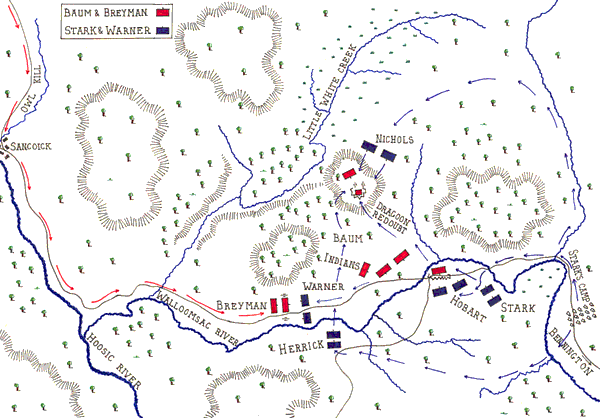
A month later, on August 16, 1777, Warner played another critical role in the American victory at Bennington. Under the overall command of General John Stark–another of the fiery, yet competent, and overlooked American general officers–Warner provided invaluable assistance because of his familiarity with the region. His home was a scant few miles from where the engagement would unfold.

Warner would oversee the left wing of the American assault and have as his goal the “Tory Redoubt” that fell on the east side of the Walloomsac River, which would be a dominant feature in the ensuing battle.
benington
Battle of Bennington (courtesy of British Battles)

The Americans routed the German, British, and Loyalist forces, even halting a 600-man reinforcement column under German Lieutenant Colonel Heinrich Breymann who arrived on the field in the latter stages.

Stark reported to Congress that Warner showed “superior skill in the action.”

Unbeknownst to Warner at the time, the campaign that culminated with British General John Burgoyne’s surrender at Saratoga, was the defining moment in Warner’s American Revolutionary War career. Warner would stay in the service, reaching the rank of brigadier general, bestowed upon him in 1778 by the new state of Vermont courtesy of the state legislature. That made him the only brigadier general in the newly formed state. On September 6, 1780 Warner received his only wound of the war, in an ambush by Native Americans outside Fort George in New York.

Unfortunately for the old “Green Mountain Boys” commander, the years after his retirement in 1780 were not kind. He fell out of favor with his former commander, Ethan Allen which led Warner to confront him in 1781 about contact with the British when Allen was a prisoner-of-war. This was all in conjunction with some contact Vermont had with British Canada about possible negotiations in reunifying Vermont with the British Empire. The extent of the negotiations and the seriousness of the idea has been in question by historians ever since.

Regardless, Warner, in failing health in 1784, returned to Woodbury, where he died on December 26, 1784, at the age of 41. Warner’s remains lay in Roxbury, Connecticut.


*For more information on the campaigns of New York in which Warner played a role in, consult Michael O. Logusz’s two-volume “With Musket and Tomahawk” series published by Savas Beatie LLC. at http://www.savasbeatie.com*

How Did They Communicate?

Emerging Revolutionary War welcomes guest historian Robert “Bert” Dunkerly to the blog as the author of this post. 

It is well known that German troops (commonly called Hessians) fought alongside the British during the war.  One of the more intriguing questions of the Revolution remains; how did they communicate?  At any given time, German units could comprise from one third to one half of the larger British armies. They were also present in equal numbers in smaller detachments.

French was a common language that many European officers would have known, and there is evidence that German and English officers communicated in French during campaigns.  The language barrier also impacted daily army operations.  For example, Georg Pausch of the Hesse-Hanau Artillery requested an English officer who spoke German for a court martial.   Yet most of that procedure was conducted in French.

Written orders from General Phillips in Montreal in 1777 to Hessian Artillery units were given in French, suggesting that this was commonly done in these calm, routine situations.

It wasn’t a perfect system but it worked well enough. Adjutant General Major Bauermister of Hesse-Cassel, for example, notes that the English spoke poor French, when communicating with them. Yet what about among small units like companies or battalions?

030_30[1]
Re-enactors portraying the Hesse Kassel Jaeger Korps
Would mediocre command of a language suffice for communication in combat situations?  Often small groups of British and German troops operated together on patrols or raids.  Marching to Freeman’s Farm (Saratoga) in 1777 was a column that included Germans on the left, English on the right, and English troops as flankers. Such situations required close coordination.

Other times they were side by side on battlefields, such as at the Battle of Guilford Courthouse in 1781, where the German Von Bose Regiment was aligned next to the British 71st Highland Regiment. Close coordination in these cases was essential.

Still another example is from Brandywine, where Captain Johann Ewald wrote that in the army’s advance, were 60 jaegers on foot, fifteen mounted jaegers, a company of Highlanders, and a company of British light infantry.  All these troops worked in tandem to protect the army from ambush and clear the way for the advance. Yet Ewald was silent on how they did so.

Captain Ewald, also wrote of his experiences in Virginia, where, in the advance on Richmond, small numbers of troops were interspersed.   They marched into the town in this order: Jaegers, British dragoons, more jaegers, and British Light Infantry.  There are dozens of other examples.

Despite the many instances of German and British units mingling, there is precious little documentary evidence of how officers, or the common soldiers, communicated.  Perhaps they used a combination of French, translators who spoke either English or German, and hand signals or other agreed- upon methods.

Timing and clarity are key in close quarters combat, there is no chance to second guess in an ambush or a raid. There were likely instances of misunderstanding that may have led to mistakes and even led to friendly fire incidents.

Of the many accounts this author has researched, only a few mention how they communicated. Perhaps it was something so mundane, or so well understood, that they saw no need to comment on it in their writings. It is hoped that further research will shed light on this question.

The Greatest Leaders of the American Revolution You Have Never Heard Of

A fisherman by trade before the war, the savior of the American Continental Army during the war on two occasions, and returned to civilian life with personal, physical, and economic hardships because of the war.

John Glover
John Glover

That one line could simply sum up John Glover of Marblehead, Massachusetts. Unfortunately, Glover has received scant attention; a few lines here, a page in this publication, or a reference in passing when talking about the engagements around New York or the Crossing of the Delaware.

Daniel Glover is more than well deserving of the epithet, “one of the greatest leaders of the American Revolution you have never heard of.”

Born on November 5, 1732 in what is now Danvers, Massachusetts, where he lived until the death of his father when he was just four years old. His mother Tabitha Bacon Glover moved young Daniel to Marblehead, on the coast of Massachusetts where he would apprentice, when he came of age, as a shoemaker. He eventually looked toward the sea and made a living as a merchant.

Daniel became well-entrenched in Marblehead society, he joined the local militia in 1759 and entered politics, aligning himself with the Whig party in 1760. By the time of the first shots on the Green of Lexington and the North Bridge at Concord, Glover was a colonel of militia in the Marblehead Regiment.

Although his regiment made the march to Boston and took part in the siege, Glover was away on detached duty when the Battle of Bunker (Breed’s Hill) was fought. When George Washington rode into Cambridge, Massachusetts and assumed command of the American forces, Glover lost his headquarters. A product of Glover’s fine taste, the Marblehead sailor had picked the home of a loyalist as his own command post. Washington chose the mansion, which now is a national historic site, as his own. Yet, a company of Glover’s Marblehead soldiers was also chosen to be the guard of Washington’s new headquarters.

Showing his importance and marshaling his background in shipping, Glover donated one of his own ships, the Hannah, named after his spouse, to build a hodgepodge navy for use by the Americans. One of the ships that made this volunteer navy actually captured a British ship, the brig HMS Nancy in which held as its cargo, 2,000 muskets, 30,000 rounds of artillery ammunition, and one brass mortar amongst other crucial military supplies much in need by Washington’s army.

After the siege of Boston was lifted with the evacuation of the British, Glover, with the rest of the Continental Army, headed south to New York City where another campaign and another chance to show his worth to the cause awaited.

On the night of August 29 and into the early morning hours of August 30, Colonel Glover and his able Marblehead regiment sailed the majority of Washington’s forces from Brooklyn across the East River to safety. Altogether, approximately 9,000 soldiers, plus artillery and supplies escaped from under British General Sir William Howe’s command. With Marylanders under Lord William Stirling launching ferocious rear-guard suicidal charges, Glover’s men saved Washington’s army that late August night.

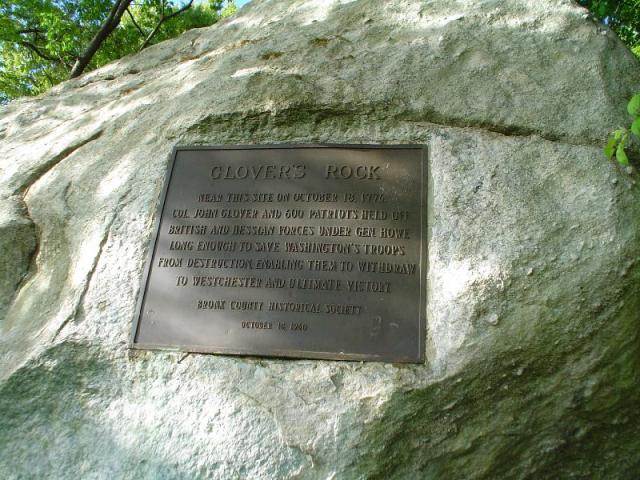
A month and a half later, on October 18th, Glover’s Brigade of Massachusetts soldiers held off a large contingent of British and Hessian mercenaries as Washington’s army retreated to safety. With approximately 750 men at his disposal, Glover’s rearguard action held over 4,000 enemy soldiers from threatening the retreat of the American forces.

glover rock
Glover’s Rock, commemorating the action at Pell’s Point

Showing his humility, Glover would write about seeing the enemy come ashore before the engagement at Pell’s Point, that his first inkling was to give “a thousand worlds to have General [Charles] Lee or some other experienced officer present.” Luckily for the Americans, Glover did not get his wish and led admirably.

Glover’s command stuck with Washington’s forces during their retreat across New Jersey and into Pennsylvania and eventually to the banks of the Delaware River. In the prelude to the pivotal “Crossing of the Delaware” the former Marblehead sailors and their 43-year old commander would prove crucial.

To complete the surprise, Washington had to get his men across the ice-clogged Delaware River and to Trenton, New Jersey. Washington laid his eyes on Glover and outlined his thoughts and the big issue at hand; how to ferry his men across?

The response to his commander in chief was simple; to “not be troubled about that, as his boys could manage it.” Another primary account said that Glover and his command showed “perseverance…accomplished what at first seemed impossible.”

With Washington’s daring plan and Glover’s practicality, the “impossible” happened and the Americans scored a cause rallying victory at Trenton on December 26, 1776 and another equally important victory at Princeton, New Jersey on January 3, 1777.

After these winter battles, Glover went home to care for his gravely ill wife, Hannah, but there was nothing he could do. After a year long struggle, Hannah died on November 13, 1778 leaving John with eight children, including the oldest John who was a captain in his father’s Marblehead regiment.

While at home, George Washington petitioned the Continental Congress to promote Glover to brigadier general. Congress agreed and on February 21, 1777 the former Marblehead merchant became a general in the Continental Army.

When Glover returned to active duty, he was given the task of escorting the British and Hessian prisoners captured at the Battle of Saratoga and also took part in the unsuccessful attempt to expel the British from Newport, Rhode Island in 1778.

The end of the war saw him still in service in the Hudson Highlands where most notably he was on the board of officers that sentenced British spy Major John Andre to death. At the very end of the war, on September 30, 1783, Glover received a brevet to major general.

800px-Glover-statue Boston
John Glover Statue Commonwealth Avenue, Boston

With the war over, Glover and his second wife, Francis Fosdick resided in Marblehead. However, Glover’s health and family were devastated by the war. Glover’s health was impaired by years of hard campaigning, including struggling with malaria in 1777. He lost his first wife Hannah during the war and his oldest son, John, disappeared as a prisoner-of-war while being transported over the Atlantic Ocean. Even his pre-war career, as a merchant, was greatly impacted by the seven-year conflict.

Glover rebounded as best he could and did serve in a few political positions, including in the Massachusetts State Legislature and as a Selectman for Marblehead.  One highlight of the post-war years was when President George Washington stopped over in Marblehead and was entertained by his former subordinate.

On January 30, 1797, Glover passed away from hepatitis at the age of 64 and became one of the greatest leaders of the American Revolution you have never heard of.