Emerging Revolutionary War welcomes guest historian Robert “Bert” Dunkerly to the blog as the author of this post.
It is well known that German troops (commonly called Hessians) fought alongside the British during the war. One of the more intriguing questions of the Revolution remains; how did they communicate? At any given time, German units could comprise from one third to one half of the larger British armies. They were also present in equal numbers in smaller detachments.
French was a common language that many European officers would have known, and there is evidence that German and English officers communicated in French during campaigns. The language barrier also impacted daily army operations. For example, Georg Pausch of the Hesse-Hanau Artillery requested an English officer who spoke German for a court martial. Yet most of that procedure was conducted in French.
Written orders from General Phillips in Montreal in 1777 to Hessian Artillery units were given in French, suggesting that this was commonly done in these calm, routine situations.
It wasn’t a perfect system but it worked well enough. Adjutant General Major Bauermister of Hesse-Cassel, for example, notes that the English spoke poor French, when communicating with them. Yet what about among small units like companies or battalions?
Re-enactors portraying the Hesse Kassel Jaeger KorpsWould mediocre command of a language suffice for communication in combat situations? Often small groups of British and German troops operated together on patrols or raids. Marching to Freeman’s Farm (Saratoga) in 1777 was a column that included Germans on the left, English on the right, and English troops as flankers. Such situations required close coordination.
Other times they were side by side on battlefields, such as at the Battle of Guilford Courthouse in 1781, where the German Von Bose Regiment was aligned next to the British 71st Highland Regiment. Close coordination in these cases was essential.
Still another example is from Brandywine, where Captain Johann Ewald wrote that in the army’s advance, were 60 jaegers on foot, fifteen mounted jaegers, a company of Highlanders, and a company of British light infantry. All these troops worked in tandem to protect the army from ambush and clear the way for the advance. Yet Ewald was silent on how they did so.
Captain Ewald, also wrote of his experiences in Virginia, where, in the advance on Richmond, small numbers of troops were interspersed. They marched into the town in this order: Jaegers, British dragoons, more jaegers, and British Light Infantry. There are dozens of other examples.
Despite the many instances of German and British units mingling, there is precious little documentary evidence of how officers, or the common soldiers, communicated. Perhaps they used a combination of French, translators who spoke either English or German, and hand signals or other agreed- upon methods.
Timing and clarity are key in close quarters combat, there is no chance to second guess in an ambush or a raid. There were likely instances of misunderstanding that may have led to mistakes and even led to friendly fire incidents.
Of the many accounts this author has researched, only a few mention how they communicated. Perhaps it was something so mundane, or so well understood, that they saw no need to comment on it in their writings. It is hoped that further research will shed light on this question.
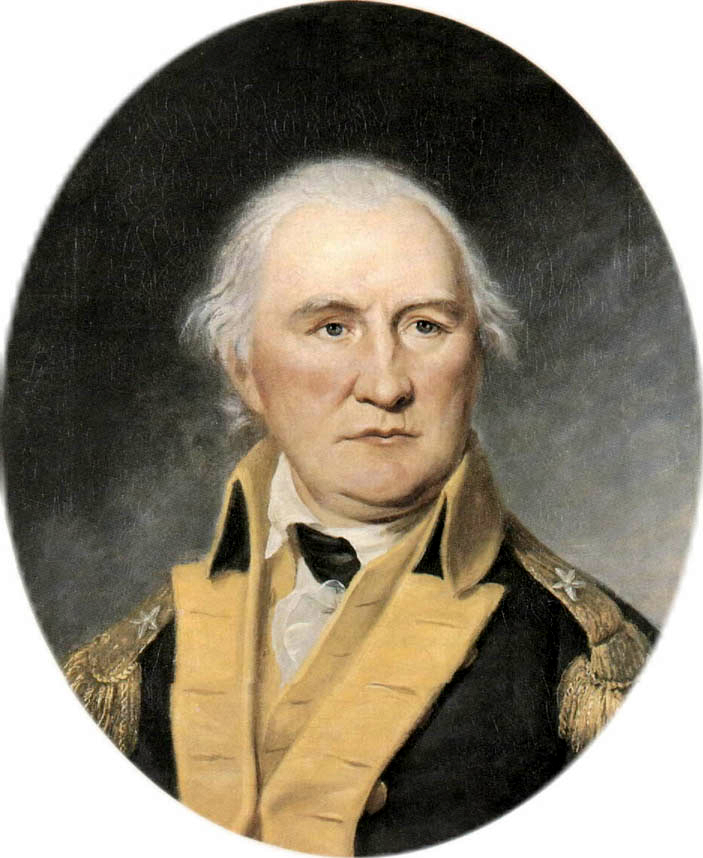
We welcome back guest historian Scott Patchan as he continues his series on Daniel Morgan.
When the situation deteriorated to outright rebellion against the crown, Morgan raised a regiment of crack riflemen from Frederick County, and marched them to Boston in twenty-one days to take part in the siege of Boston. There, he served under his former commander from the French and Indian War, General George Washington. Morgan learned the hard way that orders must be followed. He once allowed his riflemen to exceed orders in firing upon British positions at Boston. Washington called Morgan on the disobedience, and Daniel thought that he would be cashiered from the army. Washington, however, relented the next day, but Morgan had learned a valuable lesson about following orders.
Daniel Morgan in the American Revolution
In the fall of 1775, Washington sent Morgan as commander of three companies of Continental riflemen on a mission to capture Quebec from the British. Morgan’s command marched with the column of Colonel Benedict Arnold. They traversed the Maine wilderness, rowing up stream to the “Great Carrying Place,” where carried their canoes and bateaux for great distances overland to another series of streams and lakes that took them to Quebec. As the cold weather set in, sickness and hunger overtook the column and Arnold sent those unfit for duty back to the rear. After covering 350 miles, the American arrived in front of Quebec in early November, surprising the British.
Although Morgan wanted to attack immediately and utilize the element of surprise, he was overruled and the small American force besieged Quebec, waiting for another column under General Richard Montgomery to arrive from the Hudson Valley. When a British party sallied forth and captured one of Morgan’s riflemen on November 18, Arnold believed the British would come out and fight in the open. As such, Arnold drew up his army in front of the fortifications to meet them. They declined his offer and instead looked down on the ragamuffin Americans from the ramparts and exchanged taunts and catcalls. The overall situation frustrated the irascible Morgan, and when his men complained that Arnold was not giving the riflemen their fair share of rations, the “Old Wagoner” violently argued with Arnold, and nearly came to blows with the future traitor. Morgan departed Arnold, leaving him with angry warning about poor treatment of the riflemen. From that time forward, Morgan’s command always received their fair share of the army’s rations.
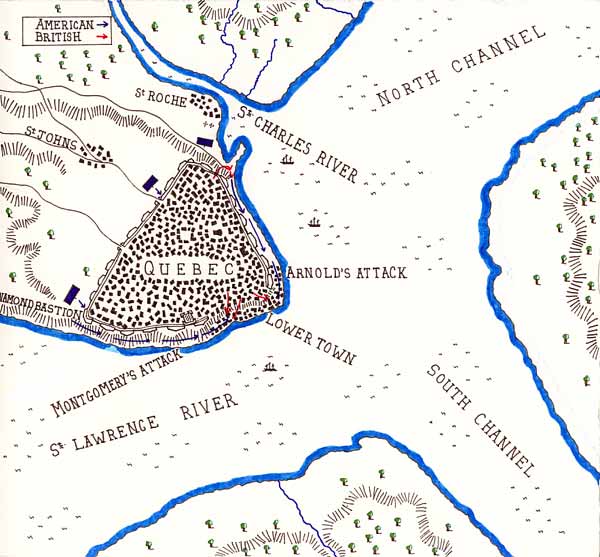
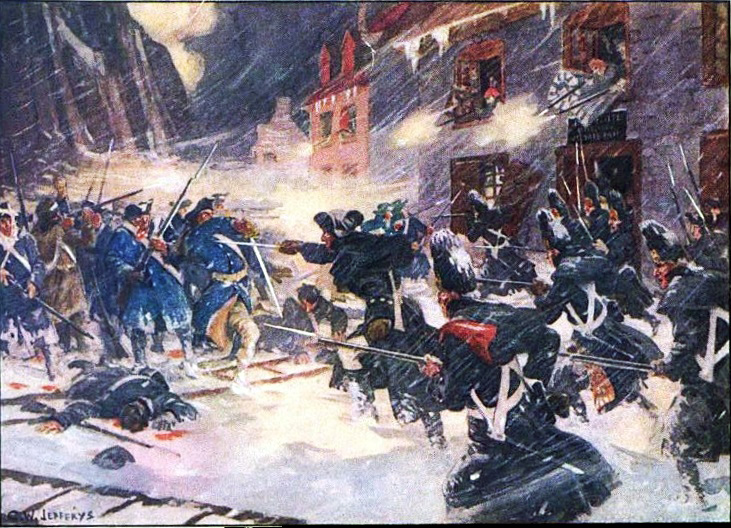
Montgomery’s column arrived on December 5, and the Americans commenced setting up his mortars and artillery outside of Quebec. The Americans finally attacked during a snowstorm in the early morning darkness of December 31, but their force numbered only 950 men. Arnold’s column came under fire as it moved toward the ramparts of Quebec, and a musket ball struck Arnold taking him out of action. Although Morgan was not the senior officer, the others insisted that he take command, having seen actual combat which they had not. Morgan later noted that this “reflected credit on their judgment.” At Morgan’s order, his riflemen rushed to the front, armed with both their Pennsylvania rifles and a spontoon for the assault while some carried ladders to storm the walls. They quickly drove a small force of British away and closed in on the walls.
Map of Battle of Quebec, 1775 (courtesy of British Battles)
Morgan ordered the men up the ladders and first one gingerly began the climb. Morgan sensed his hesitancy, pulled him down and scaled it himself, shouting, “Now boys, Follow me!” The men instantly complied, and Morgan reached the top of the wall where a volley of musketry exploded, knocking him back to the snow-covered ground. The burst burnt his hair and blackened his face; one ball grazed his cheek and another pierced his hat; but Morgan was otherwise unhurt. Stunned he laid motionless on the ground for a moment, and the attack stopped, his men thinking him dead. But he soon stirred and clambered up the ladder to the cheers of his men who followed suit. This time he stopped before reaching the top, and hurtled himself over the rampart into the midst of the enemy. He landed on a cannon and injured his back and found British bayonets levelled at him from all directions. While the British focused on Morgan, his riflemen poured over the wall and came to his rescue, driving off Morgan’s would-be impalers. Morgan kept up a close pursuit of the British who offered weak resistance to the attacking riflemen. Although Morgan had broken into Quebec, the main body of Arnold’s division failed to follow the riflemen over the wall and exploit the opportunity at hand. Morgan captured much of the lower portion of Quebec with only two companies of his riflemen. He later described the breakdown that occurred:
“Here, I was ordered to wait for General Montgomery, and a fatal order it was. It prevented me from taking the garrison, as I had already captured half of the town. The sally port through the (second) barrier was standing open; the guard had left it, and the people were running from the upper town in whole platoons, giving themselves up as prisoners to get out of the way of the confusion which might shortly ensue. I went up to the edge of the upper town with an interpreter to see what was going on, as the firing had ceased. Finding no person in arms at all, I returned and called a council of war of what few officers I had with me; for the greater part of our force had missed their way, and had not got into the town. Here I was overruled by sound judgment and good reasoning. It was said in the first place that if I went on I should break orders; in the next, that I had more prisoners than I had men; and that if I left them they might break out and retake the battery we had just captured and cut off our retreat. It was further urged that Gen. Montgomery was coming down along the shore of the St Lawrence, and would join us in a few minutes; and that we were sure of conquest if we acted with caution and prudence. To these good reasons I gave up my own original opinion, and lost the town.”
Montgomery never arrived; he had been killed in the first blast of musketry against his column, and his command broke. As time went on, the British regained their composure and pushed back against Morgan’s command. Morgan went back and brought up 200 New Englanders who joined the riflemen as they attempted to renew the attack. Now, the previously undefended point, was well manned, and daylight illuminated the paucity of Morgan’s numbers. Nevertheless, Morgan pressed them back further into the town to an interior fortification. A brave British officer led a counterattack, but Morgan personally shot him dead and disrupted the assault. Nevertheless, the time for action had passed. The British had become aware that Morgan’s was the only active American force in the city and closed in around him. In the meanwhile, additional British forces reoccupied the gates Morgan had initially taken and trapped him in the city. Morgan had no choice but to surrender his small command.
One artist’s depiction of the Battle of Quebec, 1775. Both forces are wearing blue overcoats. (courtesy of British Battles)
Morgan and the other officers enjoyed a liberal captivity with generous quarters in a seminary. The British officers visited them often and remained on friendly terms with the Americans. Morgan developed a dislike for some of his fellow officers whom he regarded as dishonest and scheming, and his fighting skills were brought to bear on at least one occasion when several men teamed up against big Dan Morgan. The imprisonment ended when the British returned the American officers on September 24, 1776, in New Jersey. Morgan returned to his wife and two daughters at his home outside of Battletown or Berryville, where he awaited his proper exchange. While there, he named his home “Soldier’s Rest,” as he recuperated from the trials of the taxing expedition to Quebec. The war was still young, and the Continental Army would soon be calling upon his services again. A special command of riflemen was being organized and Morgan would be its commander.
Why did Boston’s act of political vandalism lead to a British military expedition against small towns in Massachusetts sixteen months later?
How, exactly did evolving political tensions result in actual warfare?
How did Lexington and Concord become, as Ralph Waldo Emerson wrote, “the shot heard around the world.”
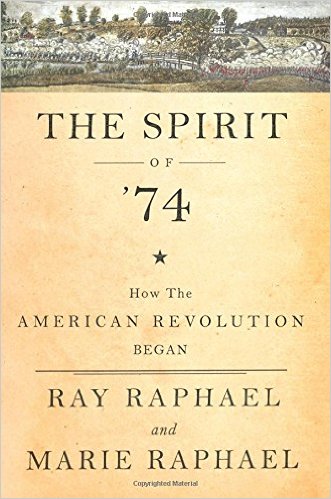
The Spirit of ’74, How the American Revolution Began by Ray Raphael and Marie Raphael
In a much-needed narrative, historians Ray and Marie Raphael fill in the movement toward those first shots at Lexington and Concord. In a primary source driven, easy to read history of that year before and leading up to 1775. However, “our story slows, pausing at additional markers that are often bypassed or slighted” (x).
Therein lies “only in a full telling is war a plausible outcome” (x).
The Raphael duo fluidly walks the reader through the build-up to that fateful April 1775 day. The book sheds light on developments in towns and counties across the colony of Massachusetts. A timeline in the beginning provides a good resource to remember the important dates as you read.
With the British response to the Boston Tea Party of December 1773, committed activists perceived that Britain had handed them a blueprint for disenfranchisement (44). What would be seen in the colony as the Coercive Acts, which, among other changes nullified the Charter of 1691 which colonists in Massachusetts held as sacrosanct. When the news of what the British government had did, which arrived in the harbor of Boston in May 1774 until the following April 1775, “resistance would mount, coalesce, and manifest itself in armed, relentless rebellion (44).
That coalescing would resemble an accordion, with Boston being one end and the countryside of Massachusetts the other end of the instrument. Both ends would reverberate the bellows as ideas, exchanges of opinions, passive and aggressive action, all marred the intervening months of 1774. Until as Abigail Adams wrote many months before April 1775, the”flame is kindled and like lightening it catches from soul to soul” (192).
The Raphael duo capture what the farmers in Berkshire set in motion, in accordance with capturing the attitude of townspeople in Worcester, Massachusetts at the same time. These various local uprisings, which put an emphasis on peaceful activities coalesced into the call for committees and eventually into the need for the Provincial Congress. This Congress acted as the de-facto governing body of Massachusetts in response to British measures to subdue and punish the intransigent rebels.
When viewed through the prism of the preceding years, what happened on the green of Lexington or the North Bridge at Concord becomes clearer as the pivot in which the simmering resentment in Massachusetts finally boiled over and led to the “shot heard around the world.”
Every once in a while a monograph is written that fills a necessary void in the field of early American Revolutionary history. This history is definitely one of those as it fills in that critical, yet overlooked, time period in the build-up to the fighting between British-American colonists and the redcoats that represented the mother country.
One cannot hope to understand the events of 1775 and beyond without knowing how the colonists of Massachusetts, so many that have unfortunately been lost to the passing of time, began the protests that led to independence, beginning in the years before.
Or as the authors more succinctly state; “and so begins a story we know” (214).
Book Information:
Publisher: The New Press, New York, NY
Pages: 219 pages plus acknowledgements, bibliography, index, and, timeline
When I was completing my graduate degree in American history from George Mason University a few years back, I took on the challenge of trying to examine the motivations of American soldiers during the American Revolutionary War.
The basis was to examine, “why they fought” if I can borrow a line used frequently by Civil War scholars and historians.
Being a native Marylander, I narrowed my focus on soldiers from that colony/state.
Yet, I was struck by the continued emergence of one name in particular and this gentleman became a focal point of mine.
This gentleman became through the war and could not be ignored with any mention of Maryland and her patriotic citizenry’s service in the war. His name is Otho Holland Williams.
Otho Holland Williams
First a little background on Otho Holland Williams. Otho Williams’ early life mirrors that of many early American colonists. His parents, Joseph and Prudence Holland Williams were born and married in Wales before emigrating to the colonies and settling in Prince George’s County, Maryland.
Otho was born on March 1, 1749, one of eight children. The following year the family moved to western Maryland, settling near the mouth of Conococheauge Creek in Frederick County. Life on the frontiers of the British North American colonies could be rough and hard and before Otho reached adulthood, he lost his father. However, he showed enough promise and potential to be entrusted by a brother-in-law to a clerk position in Frederick County. Showing his ability to grasp a new skill, the young Williams rose to be given “final charge” of the clerk’s office before moving on to a clerk position in the larger town of Baltimore at age eighteen in 1757.
In Baltimore, Williams continued to enhance his reputation and business prospects. After seventeen years in the spiraling, busy port town situated on the Chesapeake Bay, Williams moved back to more familiar grounds in Frederick in 1774. With the move, he entered into the merchant trade, overseeing commercial enterprises in the growing town. Williams was building a respectable life and he would have been considered a gentleman.
However, nothing truly remarkable had happened to cause this ordinary British colonist in Maryland to be remembered by history. Events transpiring on both sides of the Atlantic Ocean soon reared an opportunity for Williams to change that.
Otho Holland Williams now 26 years of age, at the direction of the Committee of Observation of Frederick County, Md, on the 21st of June, 1775, would have heard of a letter from the Delegates of Maryland asking for the formation of two companies of “expert Riflemen to be raised” to join the army near Boston.
The gist of that correspondence is below:
“A letter from the Delegates of Maryland, and a resolve of the Congress enclosed therein, were read, requiring two companies of expert Riflemen to be furnished by this County, to join the army near Boston, to be there employed as Light-Infantry, under the command of the Chief officer of that Army
In the second company, Williams was elected one of three lieutenants and within the month was marching north to join the army, arriving in Cambridge in 22 days, marching over 550 miles, which needless to say gave a great first impression on the military officers and one that the future Commander-in-Chief George Washington would realize in New York.
George Washington was using this house as his headquarters when Williams and the Maryland riflemen arrived after a 550 mile trek to report for duty (courtesy of Mt. Vernon)
In January 1776, Capt. Price, of the rifle company, was promoted to major in Col. William Smallwood’s Maryland Regiment. The gentleman who replaced Price was Williams who succeeded him as captain. Williams’ star continued to rise and in June 1776 was appointed major in Colonel Hugh Stephenson’s newly organized rifle regiment. He was still a major in November when he saw action in New York.
While other Marylanders serving valiantly but unsuccessfully in the opening engagements of the battles around New York City, further the Hudson River stood Fort Washington and stationed there was the rifle company that Otho Williams was a member of.
Upriver from New York City the Americans had constructed two forts on either side of the Hudson River. On the island of Manhattan stood Fort Washington, named in honor of the commander-in-chief of the Continental Army. On the other bluff, stood Fort Lee named in honor of Charles Lee, a major general in the American army that had overseen the defense of New York City prior to the Continental Army’s arrival. Nathanael Greene, the very capable American general convinced General Washington that his namesake fort could be held and although of a different opinion initially, Washington relented to his subordinate. The decision would have dire consequences for Williams and the men in the rifle regiment.
Before discussing the role of Williams and his gallant band of riflemen in the defense of Fort Washington, one fact that cannot be looked over is the rapid rise that Williams had undertaken. The mere fact that a young boy, with no prior military experience, could rise to the rank of major was truly exceptional.
To rise to that similar rank in the British army would depend more on family prestige and the ability to pay the price for the commission. That this was not the case in the American army was a sign of the difference in ideals and make-up of the military. The American colonies were revolting against the aristocratic regime of Great Britain, so to imitate their promotion mechanisms would seem out of place with the republican ideals espoused by the aspiring new republic. Furthermore, the ability to navigate the command structure with the added benefit of superior’s being promoted or more morbid, die, allowed Williams to rise.
However, the previous mentioned attribute only tell a portion of the career so far of Williams. His commitment and perseverance to the cause had been duly noted and he would soon show the coolness and battlefield leadership that would cement his rise through the officer ranks.
Battle of Fort Washington, 1776
Williams commanded men of the rifle company occupied a portion of the outlying trenches that surrounded the fort because of a very grave insight the defenses in the environs of Fort Washington could not accommodate the number of American defenders. In their exposed position, the men from Maryland and Virginia would come into contact with their British and Hessian counterparts in the opening stages of the conflict on November 16, 1776. The action commenced in the morning and would be an all-day, drawn out conflict, the epitome of a “fight to the death” type battle. Part of the reason the affair turned out to be so relentless and bloody was the fact that the Americans had refused to surrender the fort initially and the ensuing action could quite possibly result in the British and their allies showing no quarter if the Americans suffered defeat.
History does not depict whether the men with Williams and under the command of Colonel Rawlings knew this fact, but what they did know was that they had been given an assignment to defend the fort and the men from Virginia and Maryland were prepared to do just that.
Map of Battle of Fort Washington (courtesy of Wiki)
Unfortunately, after facing overwhelming odds and the collapse of other sections of the American lines, Williams and his men were forced to fall back from their exposed positions. During the action Colonel Rawlings received a severe wound to the leg, resulting in a fracture of the bone. Serving as second in command, Williams assumed command of the rifle regiment, continuing to show his unwillingness to yield the field even after suffering a severe groin wound.
With the wound and the collapse of the American lines, he did not command for long. The survivors of the regiment, along with the rest of the fort’s garrison, surrendered to the British and German forces.
After the conflict, a Hessian survivor remarked about attacking the Maryland riflemen, in which Williams was most likely in command of; that “he had a hard time of it.” Another enemy soldier noted the inordinate number of wounded. Official casualty reports, listed 2,780 Americans, including Williams, as prisoners of war, and another 149 were killed and wounded. The British lost 458 killed, wounded, and missing during the day long fight.
This is part two in the series by guest historian Drew Gruber. For part one, click here.
On the morning of October 3, 1781, British Colonels Tarleton and Thomas Dundas led another expedition north towards Gloucester Courthouse and away from the protection of their fortifications at Gloucester Point. Their command that day included some of the most renowned fighting men then in service. Cavalry and mounted infantry from Tarleton’s own British Legion, combined with a detachment of Colonel Simcoe’s Queen’s Rangers, elements of the 17th Dragoons, men from the 23rd Regiment (Royal Welch Fusiliers), German Jaegers and part of the 80th Regiment of Foot provided an impressive host for their American and French adversaries. Captain Johann Ewald, commander of the Jaegers commented after the war that he was sent out with “one hundred horse of Simcoe’s and the remainder of the jagers and rangers, which amounted to only sixty man in order to take a position between Seawell’s planatation and Seawall’s Ordinary. I was to form a chain there to protect a foraging of Indian corn.”[1]


![030_30[1]](https://emergingrevolutionarywar.org/wp-content/uploads/2016/02/030_301.jpg?w=640)



 Emerging Revolutionary War Era