“Commanding the respect of all who see him” George Washington Takes Command in Cambridge, MA – July 3, 1775

On July 3, 1775 George Washington formally took command of the Continental Army in Cambridge, Massachusetts. Appointed Commander-in-Chief by the Second Continental Congress on June 15, 1775, Washington arrived in Cambridge on July 3, 1775 and assumed command of a disorganized and poorly supplied force besieging British troops in Boston. His leadership would begin the transformation of colonial militias into a unified fighting force capable of challenging British military power.

Washington’s assumption of command occurred at a time when the American colonies were transitioning from protest to open rebellion. The battles of Lexington and Concord in April 1775 had already ignited armed conflict, and the Battle of Bunker Hill in June had demonstrated that colonial forces could stand up to British regulars, though at great cost. Washington understood the gravity of his new role. In a letter to the President of Congress, he wrote humbly, “I am truly sensible of the high Honor done me in this Appointment… I do not think myself equal to the Command I am honored with.” This characteristic modesty was paired with a strong sense of duty and resolve.
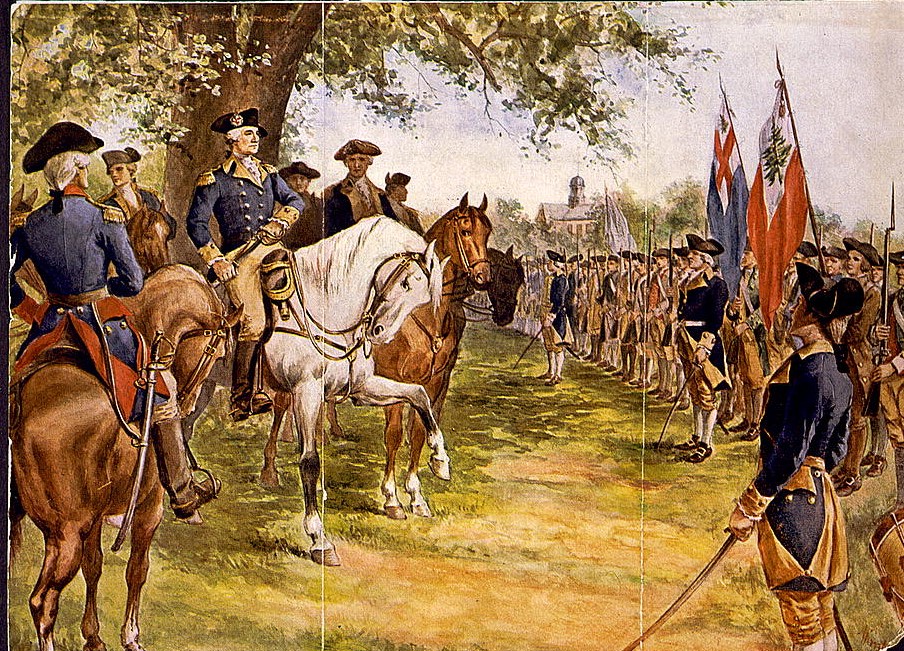
Washington assumes command at Cambridge, Courtesy Library of Congress

On July 3, Washington appeared before his troops on Cambridge Common, dressed in a blue coat with buff facings, signifying his Virginian roots. There is no official transcript of a speech he may have delivered that day, but contemporary accounts describe a solemn and determined atmosphere. One observer, Reverend William Emerson, noted in his diary, “General Washington… is a tall and noble-looking man, commanding the respect of all who see him.”

Washington immediately set to work imposing discipline, organizing supply chains, and creating a chain of command. Though former commander of the army, Major General Artemus Ward, worked hard on instilling discipline, he was not a man that instilled a lot of confidence. Washington was appalled by the state of the army, writing in frustration to Congress: “The Army… is in a very improper condition to carry on a vigorous War.” He introduced regular drills, uniform codes, and standardized procedures, striving to turn the disparate bands of militiamen into a functioning army. As historian David McCullough noted, “It was Washington’s presence alone that gave the army cohesion.”

Despite his military inexperience—Washington never commanded an army of this size—he brought a unifying vision and moral authority. His appointment was also politically astute, bridging the regional divide between New England and the southern colonies. A Virginian leading New England troops sent a clear message of unity in the face of British oppression.
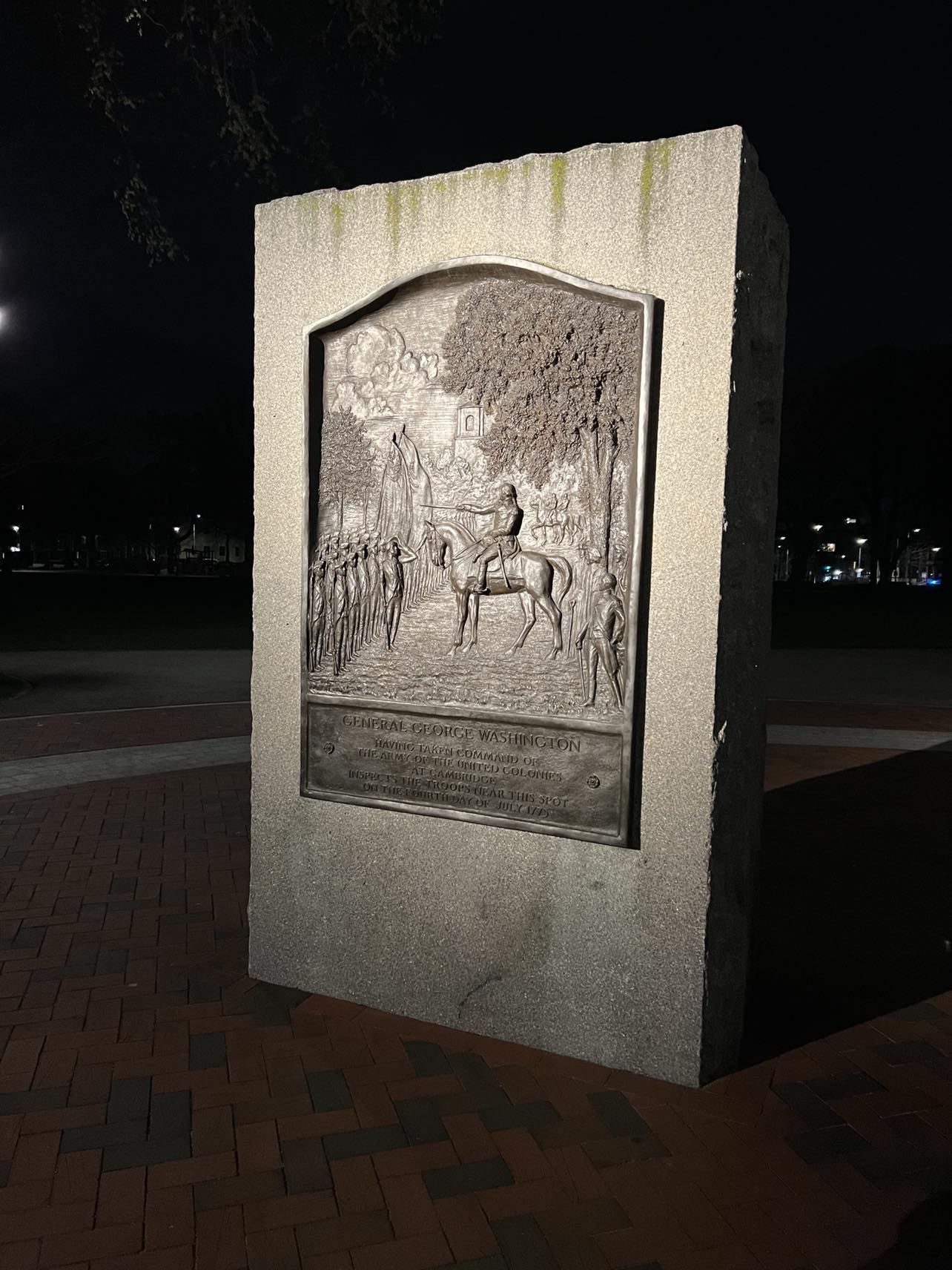
Marker commemorating Washington on the Cambridge Common, photo by William Griffith

The Cambridge encampment remained Washington’s headquarters until March 1776, when he successfully forced the British evacuation of Boston by fortifying Dorchester Heights with cannons brought from Fort Ticonderoga. This early strategic victory, achieved without major bloodshed, was a major morale boost and affirmed Congress’s faith in their commander.

In retrospect, July 3, 1775, was the beginning of an enduring legacy of leadership and a love of Washington by his men and officers. Through discipline, vision, and personal integrity, he began shaping a ragtag collection of volunteers into the Continental Army, laying the groundwork for American independence.
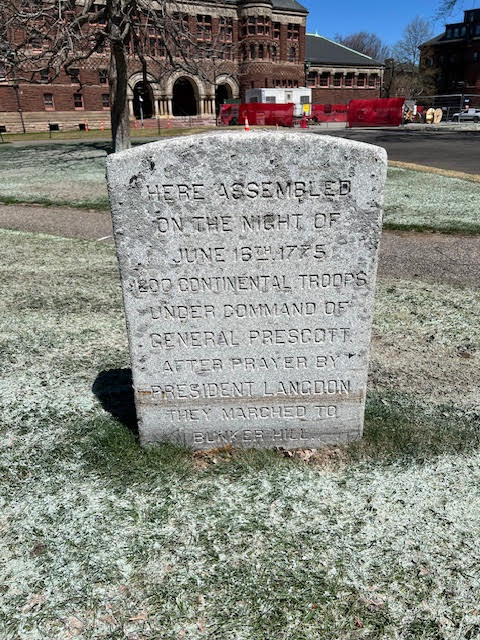
250 Years Ago…Right Now-ish

Shortly after 11 p.m. on the night of June 16, Colonel (although the monument calls him general) William Prescott led approximately 1,200 Massachusetts soldiers toward the Charlestown Peninsula from Cambridge Common. These men would spend the night fortifying Breed’s Hill before spending the majority of the next day defending the earthen redoubt from successive British attacks. Although forced to evacuate due to low ammunition and the British breaching the redoubt, the defeat had a positive impact on the morale of the “Grand Army” as the New England militia soon-to-be-Continental Army.

Washington’s First Headquarters

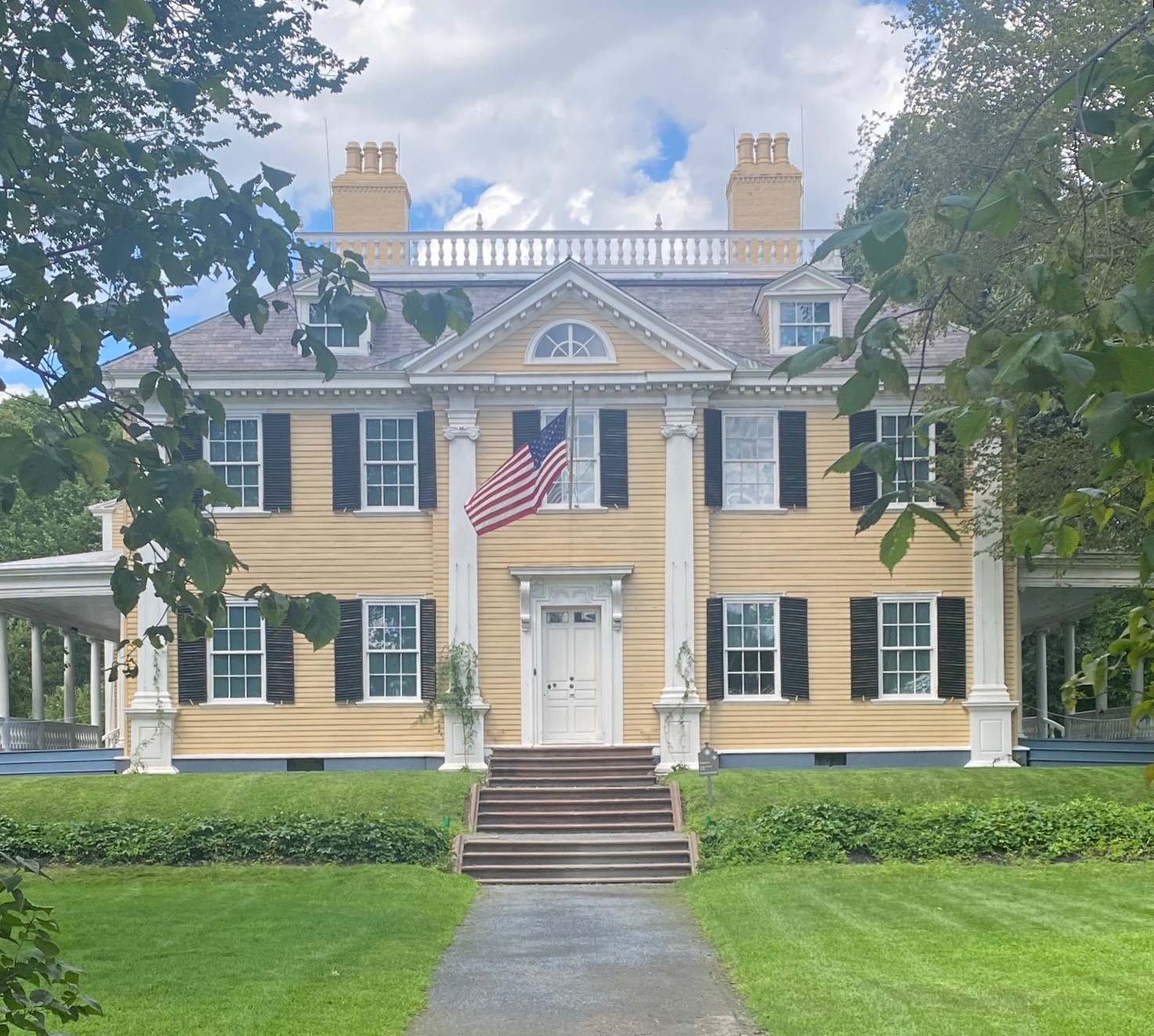
On June 15, 1775, George Washington was appointed by the Second Continental Congress as commander-in-chief of the Continental Army. Approximately a month later he rode into Cambridge, Massachusetts, to the house below, to assume command over that army. After he met the officers at Jonathan Hastings House near Harvard College campus, learning about operations and the siege. He was then directed toward an opulent residence standing about a mile away. Named the Vassall-Craigie-Longfellow residence, this place would become the focal point of the effort against the British in Boston. Washington moved in. He spent the next nine months in residence, overseeing the Siege of Boston and the British evacuation.

From this house, Washington began putting his footprints on the army and met some of the officers that became instrumental in securing American independence. This included the Rhode Islander Nathanael Greene and Massachusetts native and bookseller Henry Knox among others. Martha Washington, in December 1775, traveled over 440 miles from Mount Vernon to Cambridge to winter with her husband in this house. The making of Washington, the general, started here.

The power of place.

Today, the house preserved by the National Park Service today can be toured, click here for information.

The Great Butter Rebellion

Yes, this was a protest in Massachusetts in 1766.

No, “butter” is not a typo in the title.

Yes, this may be the first college student protest recorded in what became the United States of America.

No, this was not just about butter or butter substitutes.

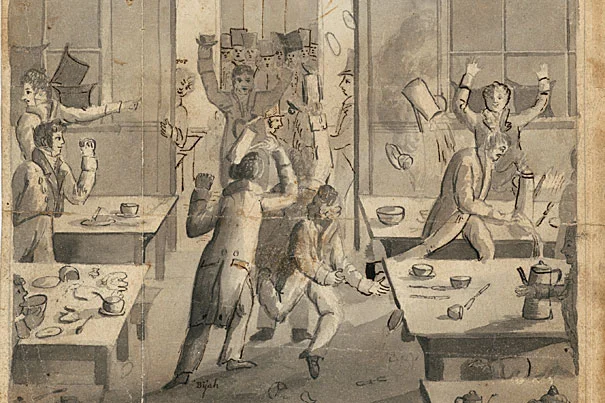
At Harvard College, in 1766, three students, all seniors at the institution, Asa Dunbar, Daniel Johnson, and Thomas Hodgson had had enough of the lack of fresh food being served to the student body. Dunbar, who may be best known as the grandfather of Henry David Thoreau, led the protest, stating that the butter served by the college was “stinketh” and he incited the student body to reject this rancid fare by jumping onto his chair and yelling

“Behold our butter stinketh! Give us therefore butter that stinketh not!”

Dunbar faced disciplinary action, being punished for insubordination and instigating a potential riot. After he received his punishment, the student body enacted another protest, by walking out of the hall, cheering loudly in Harvard Yard, and continuing into Cambridge to dine instead. To give some credit to the college, the adminstration acknowledged the butter ws rancid. With restrictions due to economic difficulties the availability of fresh food was limited however.

As Massachusetts moved closer to open rebellion in their remonstrances against British Parliament and the British crown their example was mirrored by the student body of Harvard. After a month of impassed including “insulting proceedings” the royal governor of Massachusetts, Sir Francis Bernard personally addressed the student body in the chapel on campus and the protests and insubordination of the student body concluded.

A depiction of a student protest
courtesy of The Harvard Gazette

Concluding, with a Butter Rebellion, a Tea Party, what food or drink would the colonists focus on next? For me, I think I will sip my Samuel Adams brew. Leave the butter and tea to the Massachusettans.

(Yes, I know that Samuel Adams beer was not around at the time of the American Revolution but I thought it was fitting. And beer and history go together anyways right?)

Sources:

Butter rebellion

Harvard’s long-ago student risings

Spread The Word: Butter Has An Epic Backstory

The Most Fateful Decision of April 19, 1775

RevWarWednesdays-header


Lord Hugh Percy, the 2nd Duke of Northumberland and holding the rank of brigadier general commanded the relief brigade that was ordered out from Boston by Sir Thomas Gage after Lieutenant Colonel Francis Smith had sent back a messenger asking for reinforcements.

Little did Lord Percy realize at the time that by the late afternoon of April 19th, one quick decision saved the lives of countless British Redcoats and hundreds of American militia and minutemen. Continue reading “The Most Fateful Decision of April 19, 1775”