

An October 1775 Birthday for the Continental Navy

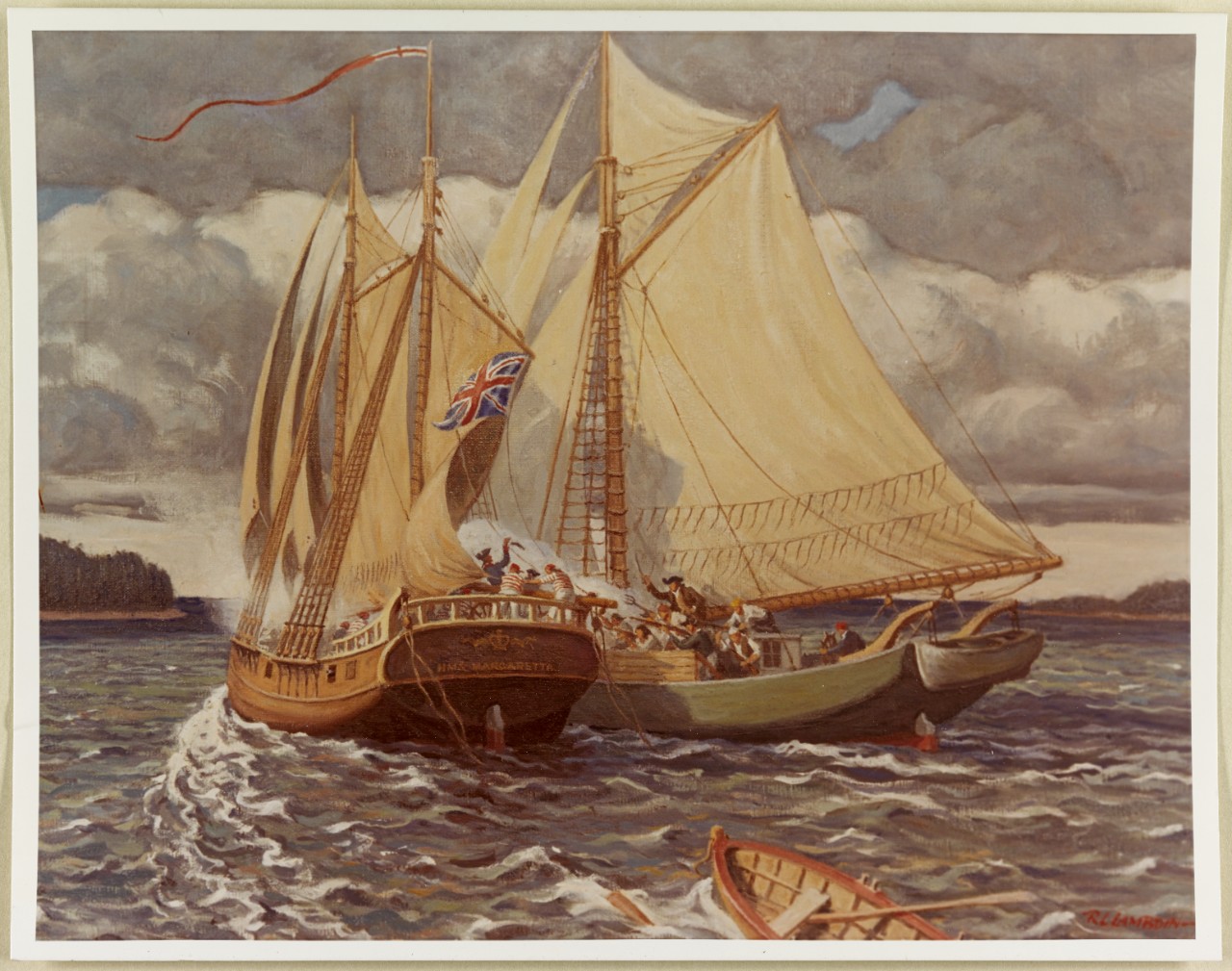
Unity vs. Margaretta, 12 June 1775 by Robert Lambdin (Naval History and Heritage Command). Margaretta was a Royal Navy vessel captured off Machias, then part of Massachusetts but now in Maine. The image illustrates the relatively small sizes of vessels involved in creating the early American navy.

During the first six months of the American rebellion, the colonies inched toward some means of dealing with Britain’s naval superiority.  Over the summer the Americans had already waged a sort of whaleboat war among the estuaries and islands around Boston, mainly to deprive the British army couped up there of forage and fodder.  Efforts escalated as the war continued.  A confrontation between small Royal Navy vessels and the Massachusetts town of Machias over the summer serendipitously resulted in a small Massachusetts Navy created by capture in June 1775.[1]  In June, Rhode Island’s General Assembly voted to charter two ships and outfit them for naval operations to protect the colony’s trade, essentially by contesting the Royal Navy’s control of Narragansett Bay.[2]  In September, Colonel John Glover in the Continental Army offered his fishing schooner, Hannah, as a charter to wage war on the sea.  George Washington naturally accepted, limiting its operations to capturing unarmed supply ships serving the British army.[3]  The army had essentially created its own navy out of necessity.
DON’T TREAD ON ME: The interesting history of an iconic American flag.

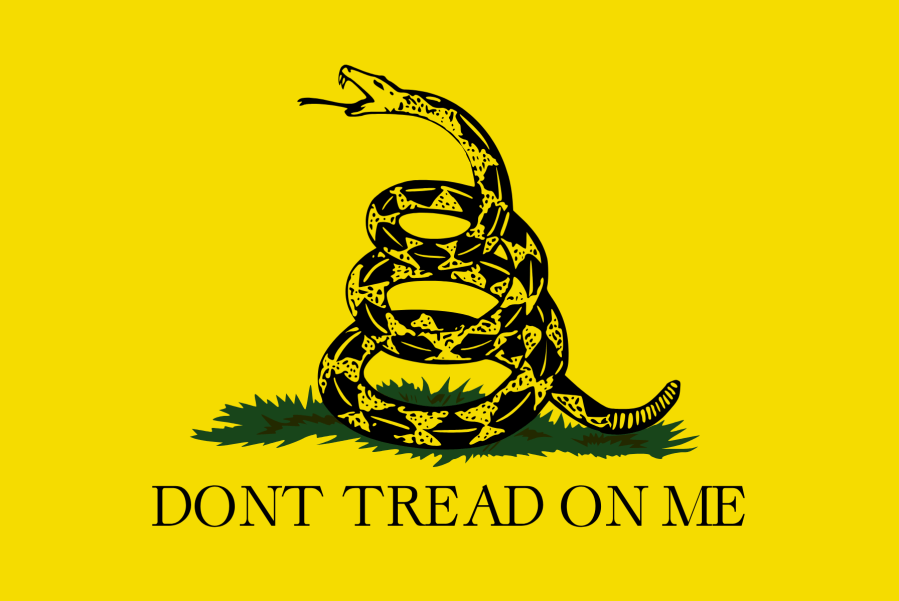
Every so often news stories arise about popular symbols of the American Revolutionary War that are used by various people to promote modern political agendas. One prominent symbol is the yellow flag with a coiled rattlesnake and the words “Don’t Tread on Me” below it. This flag, often referred to as the Gadsden flag, has a fascinating history dating back to the Revolutionary War.

The first real use of the snake representing the colonies begins before the Revolutionary War, during the French and Indian War, when Benjamin Franklin created a cartoon using a snake to represent the various colonies each separated from one another with the words “Join, or Die” under the image.  This was an effort to get the various colonies to unite for common defense during that time period.

By the time of the Revolutionary War in 1775, the symbol had become a solitary rattlesnake, coiled and ready to strike often accompanied by the warning “Don’t Tread on Me.” Christopher Gadsden, a prominent South Carolina patriot, served in the Continental Congress and designed the yellow flag as a naval ensign. Beginning in 1776 the flag was hung up in the room where Congress met in Philadelphia and because it was designed by Gadsden, it became known as the Gadsden flag.

Continue reading “DON’T TREAD ON ME: The interesting history of an iconic American flag.”

“I gave my parole once…”

On the morning of August 27, 1780 there was a knock on the door of the Charleston, South Carolina residence of Christopher Gadsden, lieutenant governor of South Carolina. He had stayed when the city capitulated to British forces in May. Gadsden had represented the civil government and handed the city over to the British commander, Sir Henry Clinton. He was released on parole.

Christopher Gadsden

Now, approximately three months later, Clinton was back in New York, and the new British commander Lord Charles Cornwallis had reneged on the parole agreement. Along with another 20 civil officers, Gadsden was led through the town to the docks to a waiting ship, set to sail for St. Augustine in British East Florida.

Upon arrival in the oldest city in European North America, Gadsden was given the opportunity by Governor Tonyn to avoid incarceration in Florida. This is when the 56-year old patriot probably uttered the phrase below.

“I gave my parole once, and it has been shamefully violated by the British Government: I shall not give another to people on whom no faith can be reposed.”

With that decision, Gadsden landed himself in Castillo de San Marcos the large coquina stone fortress that stood guard over St. Augustine. Not only was the South Carolinian kept in a cell, he was kept in solitary confinement for the next 42 weeks!

Upon his release in September 1781, Gadsden and the rest of the civil prisoners were sent by merchant vessel to Philadelphia. Gadsden wasted no time in hurrying southward to South Carolina and a return to the state House of Representatives. He served in various political roles, although he had to decline the governorship because of the affects of his imprisonment. He died in 1805. A grandson, James Gadsden would give his name to the Gadsden Purchase.

Gadsden was held in the cell to the right
(author photo)

Today one can visit Castillo de San Marcos, a national park unit within the National Park Service. When touring the Castillo you can view the cell where Gadsden spent his solitary confinement and read the accompanying exhibits.