

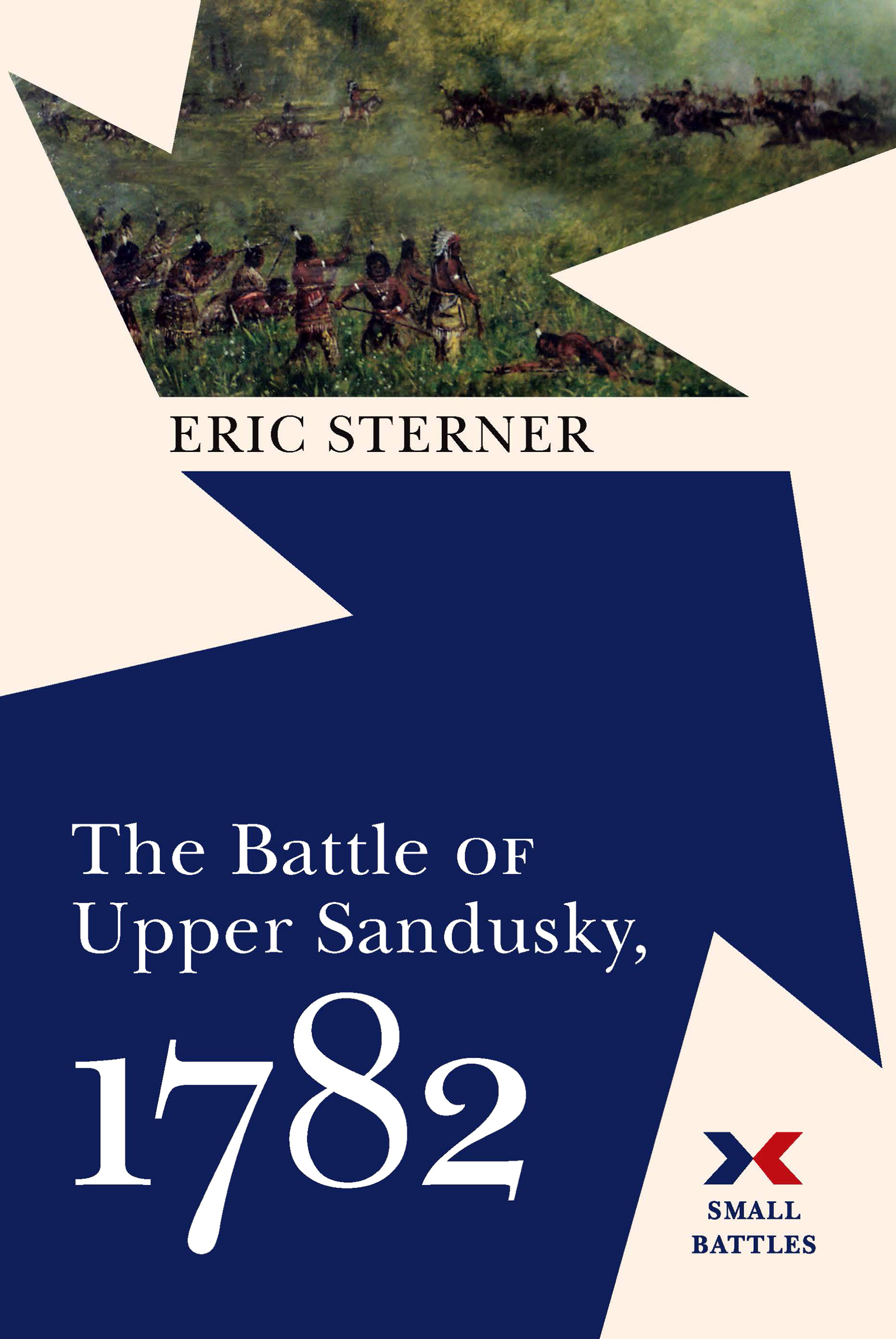
Serendipity, Genealogy, and the 241st Anniversary of the Battle of Upper Sandusky

We interact with history at a personal level in many ways.  We enjoy careers in the field, read, tour locations, work as living historians (or interact with them), dig through archives, trace our roots, visit museums, or simply stumble across some connection in the course of living our daily lives.  But, a fortuitous bit of family history struck on a recent weekend, just shy of the 241st anniversary of a battle.  

My wife and oldest daughter spent a Sunday morning with my in-laws to visit and record some family stories and memories.  They came back with a box of material.  The first document they perused was a 19thcentury application for membership in the Daughters of the American Revolution.  I was in a different room and suddenly heard yelling as my wife came to find me.  I assumed a snake had gotten into the house or we’d won the lottery without playing.  It turned out that the DAR applicant, a direct forebear of both my wife and daughter, was descended from Nicholas Dawson, who had fought in the Crawford Campaign, which happened to be the subject of my second book, The Battle of Upper Sandusky, 1782.  (Shameless bit of self-promotion: it just went on sale).  Talk about coincidence.

Many volunteer actions on the frontier during the American Revolution lacked troop rosters.  But, to stimulate volunteering for the Crawford campaign the county lieutenants for Pennsylvania’s Washington and Westmoreland counties offered to count the time on campaign against a volunteer’s legal militia obligations. So, they created rosters, some of which partially survived.  The Pennsylvania Archives published that material.  Sure enough, Nicholas Dawson shows up as a miscellaneous volunteer, meaning only that the roster didn’t include his company assignment.  The ever-helpful Fold3 database also holds pension debt certificates issued to Dawson on January 18 and 20, 1785.

Continue reading “Serendipity, Genealogy, and the 241st Anniversary of the Battle of Upper Sandusky”

The Crawford Campaign, 1782: Rout, Retreat, and Recovery

(part four of five)

As the night of June 5 gave way to a dark retreat on June 6, the militia struggled eastward, attempting to reimpose some order on their main body.  According to Rose, Crawford set out after one wayward company that had decided on a more circuitous route of retreat that separated it from the main body.  While he was gone, the Indians began firing into the militia camp in the dark.  At “that instant, every Body was pushing as if it had been a signal agreed for that purpose.”[i]

Rose fell in with a group of about fifty men, who pushed south back toward the abandoned Wyandot town on the Sandusky they had passed through just a few days earlier, seeking to avoid the Shawnee, and then rejoined Williamson with the main body of men as it returned the way the expedition had come.[ii]  In the rush, they lost track of Colonel Crawford.  They moved directly to the route east without much order, placing speed over the coherence of a fighting unit.  Williamson did manage to separate his best horsemen into a smaller group to contest any light horsemen they encountered on the Sandusky plain, but expected to find relative safety when they reached more heavily timbered areas.  On June 6, Rose had a close call.  Riding ahead while trying to keep the group from breaking up into smaller parties, mounted Indians charged him and his companions from a wooded area on the left.  Rose managed to make it back to the main body, which promptly counter-charged with the light horse Williamson had created.[iii] In the process, he lost contact with his two companions, Colonel William Harrison (Colonel Crawford’s son-in-law) and Mr. William Crawford, (Colonel Crawford’s nephew).[iv]

IMG_2448
The monument to the “Battle of the Olentangy.”  The battle was more of a skirmish, but marked the end of British pursuit of Williamson’s retreating force.  Native Americans continued to chase and harass the Americans.  (Author Photo)

Later that day, about 24 miles into their march, the militia paused to rest along Olentangy creek.  Their mounted pursuers promptly fired into the main body from behind and the militiamen detected a light screen moving into place ahead of them, the beginning of an encirclement.[v]  The militia started skirmishing while Rose rode to the rear, nearly through the Native Americans behind them, retrieved the rear body, which contained a substantial portion of the light horse, and sent them to clear the woods of enemy skirmishers in front.  The maneuver succeeded and the militia were able to enter the woods, losing three dead and eight wounded in the hour-long fight.  Despite anticipating a degree of relative safety there, pursuers continued to harass the flanks and the rear.  Simultaneously, the poorly organized militia lost still more cohesion as a fighting unit as the woods broke up formations and isolated men in small groups. To make matters worse, the skies opened up and a heavy downpour soaked everyone to the bone.[vi]

Continue reading “The Crawford Campaign, 1782: Rout, Retreat, and Recovery”

The Crawford Campaign, 1782: Birth of an Expedition

(part two of five)

Wiliam Crawford at 40 (Wikimedia Commons)
Colonel William Crawford (Wikimedia Commons)

In April, 1782 local leaders, in particular David Williamson, petitioned Irvine to lead a punitive raid to the Sandusky River aimed at the Wyandot and Hopocan’s Delaware.[i]  While he could provide no material support or leadership, Irvine approved the attack and laid down several conditions: that the expedition operate under laws governing the militia, that their purpose not extend beyond protecting the border, that the force assembled be large enough to accomplish the task, that the raiders equip and sustain themselves on horseback at their own expense, and that the expedition conduct the raid on behalf the United States with an eye toward bringing honor to the United States.  Perhaps he had the brutality of the Gnadenhutten raid in mind and sought to avoid a repeat.[ii]

This Sandusky raid did not reflect Irvine’s strategy of either reducing Detroit or bringing the tribes to battle; it was simply another American raid on Indian towns, which would likely be abandoned by the time the expedition arrived.  Irvine informed Washington that the expedition was going forward and did not seek permission.  Indeed, he may not have had the power to stop it given the restlessness of the local population on the frontier.  Rather that departing in early August, this raid would leave in late May, before the summer heat dried out the countryside.  Speed and surprise would be important, perhaps explaining Irvine’s requirement that every man be mounted, that the expedition dispense with artillery, and that it limit baggage and supplies to 30 days’ worth.[iii]  Irvine wrote Washington, “If their number exceeds three hundred, I am of opinion they may succeed, as their march will be so rapid they will probably in a great degree effect a surprise.”[iv]  But, it would be a risky enterprise.  Continue reading “The Crawford Campaign, 1782: Birth of an Expedition”