The Bloody Battle Road: Battle of Menotomy

ERW Welcomes Matt Beres, Executive Director of the Arlington Historical Society

On the morning of April 19, 1775, the first shot of America’s War for Independence was fired on the Lexington Green. Later that morning, Major John Buttrick, commanding the local Provincial forces, gave the order to fire on the British Regulars at the North Bridge. This act would later be remembered as the “Shot Heard ‘Round the World,” a phrase immortalized by Ralph Waldo Emerson.

As Lt. Col. Smith’s British Regulars began their retreat back to Boston, Governor Thomas Gage sent a relief column of Regulars, led by General Hugh Percy. Meanwhile, Provincial militias and minute companies from surrounding towns marched toward the conflict, firing on both sides of the main road leading back to Boston. The Battle was just beginning.

While Lexington is famous as the site of the “first shot” and Concord for the “Shot Heard ‘Round the World,” Menotomy (present-day Arlington) is known as the site of the largest battle of the day, where fierce fighting erupted between the retreating British forces and the growing Provincial forces. The following stories are from this Battle.

David Lamson

Earlier that day, a convoy of provisions and supplies, protected by a detachment of British Regulars, arrived behind the main force heading toward Lexington and faced difficulties crossing the Brighton Bridge. Before their arrival, the Committee of Safety had removed the planks, and the combination of heavy wagons and repairs to the bridge caused the convoy to become separated from the main force, rendering it vulnerable.

An alarm rider from Cambridge alerted locals, prompting men from the ‘exempt’ or ‘alarm’ list—those unfit for regular Militia or Minute companies—to gather at Cooper’s Tavern to plan to capture the convoy. Among them was David Lamson, a biracial French and Indian War veteran, whose experience and bravery made him a natural leader. The group quickly appointed him as their Commanding Officer.

According to a story derived from Lamson himself, they positioned themselves behind a stone wall near the First Parish Meeting House. As the convoy approached, they ordered it to surrender. When the drivers urged their horses forward, Lamson’s men fired, killing the driver and several horses, and wounding two Regulars. In panic, the remaining six Regulars fled toward Spy Pond, and discarded their weapons.

It is said they then surrendered to an old woman, Mother Bathericke, who was in the field picking flowers. The old woman forced them to the house of Ephraim Frost, Captain of the Menotomy Militia, and stated, “… you tell King George that an old woman took six of his grenadiers prisoners.”

Samuel Whittemore
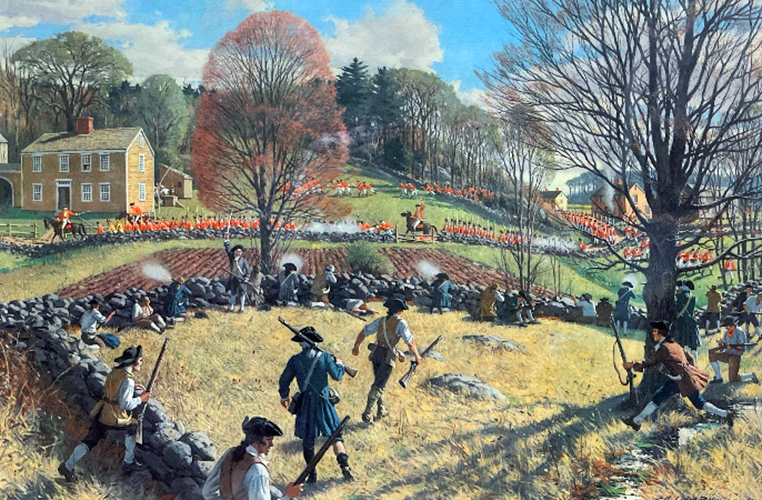
Aiden Lassell Ripley (1896-1969), Retreat from Lexington at the Foot of the Rocks. A.2.509. Arlington Historical Society Collections

Around 4:00 pm, the retreating British Regulars arrived at the village Menotomy. It was here where Samuel Whittemore, the oldest known combatant of the Revolutionary War, earned his fame. During the conflict, Whittemore took cover behind a stone wall. He reportedly fired at five soldiers but was soon overwhelmed. He suffered a gunshot wound to the cheek and a bayonet stab wound. When the Regulars continued their retreat, the locals carried him to Cooper’s Tavern, where Dr. Tufts of Medford treated his injuries.

Remarkably, Whittemore survived for another 18 years after suffering these life-threatening wounds. He lived long enough to see the birth of a new and independent nation.

Jason Russell

Later during their retreat, Gen. Percy ordered his men to enter the residences along Concord Road (now Massachusetts Avenue) to eliminate the Provincials who were firing from inside these houses. One notable example was the site of Jason Russell House.
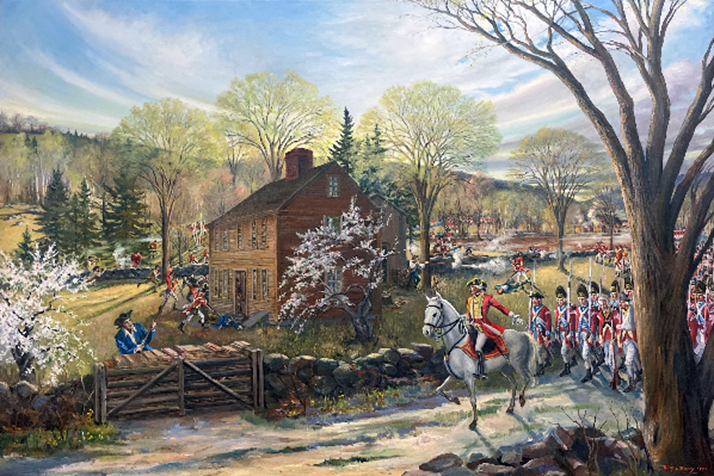
Ruth L. Berry, 1975. Jason Russell House in Battle With British Soldiers 1990.19.1. Arlington Historical Society Collections

Jason Russell was a middle-aged farmer who reportedly had a leg disability. He barricaded his property and refused to leave, asserting, “An Englishman’s house is his castle.”

As British Regulars surrounded his home, several Provincials from different towns sought refuge inside. Tragically, Jason Russell and several others lost their lives on his property.

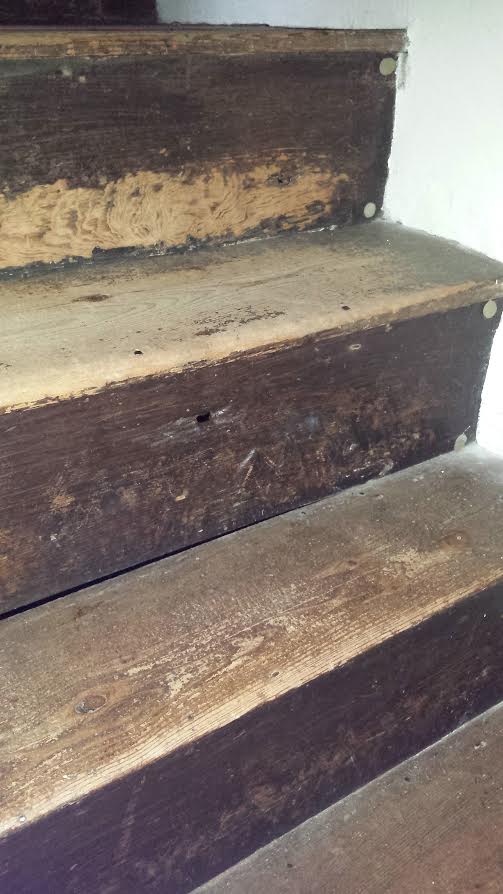
Today, the c. 1740 house, still bearing musket ball holes in the remaining structure from the fight, is at the heart of the Arlington Historical Society’s regional history museum, offering guided tours and engaging exhibits that highlight the lasting impacts of the American Revolution and Arlington’s broader history.

Explore more at: https://arlingtonhistorical.org/

Matt Beres

Executive Director

Arlington Historical Society
Rev War Revelry: The Battle of Menotomy and the Jason Russell House, April 19, 1775

The Fight at the Jason Russell House, bicentennial painting by Ruth Linnell Berry (1974). Appearing with permission from the Arlington Historical Society.

Though the American Revolution started on the green at Lexington and North Bridge in Concord, the bloodiest part of April 19, 1775 took place in the community of Menotomy (modern day Arlington). Join us as we welcome Matt Beres from the Arlington Historical Society. We will discuss the viciousness of the fighting on the afternoon of April 19th along the road back to Boston, including stories like the Jason Russell House, Cooper Tavern and more. Join us as we talk about the much overlooked part of April 19th, 1775 as we move towards the 250th anniversary. This episode is pre-recorded and will be posted on Sunday, November 24th at 7pm on our You Tube and Facebook pages.

2024 ERW Bus Tour Announcement – Lexington and Concord!

We are excited to announce our 2024 (fourth annual!) bus tour location will be Lexington and Concord on October 11-13, 2024. Join historians Phillip Greenwalt, Rob Orrison and Alex Cain as we tour the sites associated with the beginning of the American Revolution on April 19, 1775. The tour will cover events in Lexington, Concord and sites along the “Battle Road.” Tickets are $250 per person and includes a Friday night lecture, all day tour on Saturday and half day tour on Sunday (bus tour transportation and Saturday lunch included in cost).

Lodging is not included in the ticket fee. Our host hotel is the Courtyard Marriott – Waltham, a room block is set aside for $239 a night. For reservations contact 781-419-0900 or visit https://www.marriott.com/events/start.mi?id=1699298201894&key=GRP

Join us for our FOURTH annual tour as we take on the beginning of the American Revolution just a few months before the 250th anniversary. Learn about the dramatic events that led to the first shots for the Revolution and the bloody aftermath. We will visit Lexington Green, Buckman’s Tavern, North Bridge in Concord, Battle Road including Merriam’s Corner, Parker’s Revenge and the Jason Russell House. There is no better way to experience history than to stand in the footsteps of where it happened!

To register, visit: https://www.eventbrite.com/e/760200178197?aff=oddtdtcreator

For more questions, please email emergingrevolutionarywar@gmail.com.

Ankle Deep In Blood: The Jason Russell House

Emerging Revolutionary War is honored to welcome back historian Katie Turner Getty. Biography of Ms. Getty is below the post. 

On April 19, 1775, the placid farm of fifty-eight-year-old Jason Russell of Menotomy erupted into carnage when he, along with eleven other Americans, were shot and bayonetted by British soldiers in his home and yard.

Image1-KTGetty
Jason Russell House (author collection)

As American militia and minutemen poured in from surrounding towns, the British—fatigued yet furious—found themselves under increasingly heavy musket fire. As they pulled back from Concord and retreated to Boston, the main column passed near Russell’s house which stood near the battle road. Russell had just returned home after secreting his family at a nearby farm. Unbeknownst to him, American minutemen and British soldiers would soon converge upon his property and a desperate battle would occur within the walls of his own house.

Earlier that day, twenty-six-year-old Gideon Foster had set off from Danvers with a company of minutemen. The men had set a scorching pace and made the sixteen mile journey to Menotomy in four hours, running half the way.[1] Upon arriving, Foster’s men joined others from Lynn, Beverly, Salem, Dedham, and Needham.[2]  Some took cover behind trees and others in Russell’s yard, where a breastwork was constructed out of shingles.

Image3-KTGetty
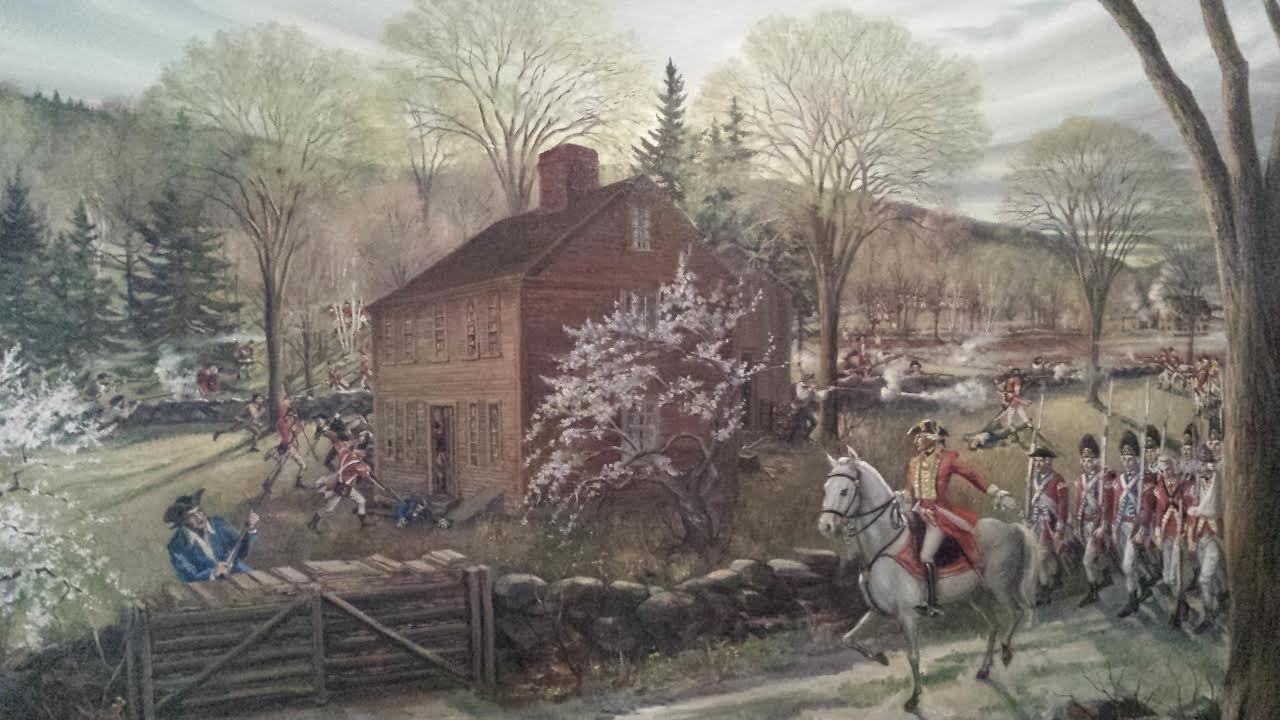
The Fight at the Jason Russell House, bicentennial painting by Ruth Linnell Berry (1974). Appearing with permission from the Arlington Historical Society.

The men focused their attention on the approaching main column of British troops and fired upon them. Capt. Israel Hutchinson, a seasoned French and Indian War veteran, warned that flank-guards would likely be traversing the fields alongside the road[3], helping the main column to pass unmolested. But before the men could reconsider their position or move to a more defensible location, the flank-guard was upon them, trapping the men against the main column.

In a frantic search for cover, many of the men bolted into Russell’s house. Jason Russell, too, attempted to dash inside but was slowed by his lame leg.[4] He was shot twice and fell on his doorstep. The soldiers tore inside the house in hot pursuit of the men, bayonetting Jason Russell’s body eleven times as they passed.

Once inside the house, the Americans had no choice but to fight for their lives in rooms with no egress, in very close quarters, against raging, bayonet-wielding soldiers. It was a bloodbath. With two rooms on the bottom floor, a narrow stairwell, and two rooms on the top floor, Jason Russell’s house offered very little refuge.  Soldiers outside the house hailed musket fire into the windows.

Image2-KTGetty
Sign depicting what happened at the Jason Russell House on April 19, 1775

With nowhere else to go, several men rushed into the cellar. What at first would seem to be an ill-advised hiding spot turned out to be the only sanctuary that Russell’s home could offer. Taking position near the bottom of the stairs, the men raised their muskets and shot dead the first soldier who descended.[5] Any other soldiers who attempted to follow were met with blazing musket fire. Holes left by musket balls are still visible in the stairwell, attesting to the firestorm.

Soon, the house grew quiet. All of the men who had sought safety in the house had been killed, with the exception of the men who took refuge in the cellar. The British ransacked the house then left.[6]

In 1835, sixty years after the bloodbath at Russell’s house, a memorial was erected in Danvers to commemorate the townsmen who lost their lives in Menotomy that day. Danvers lost the second highest number of men, after Lexington[7], and all of them at Jason Russell’s house. Foster, the commander of the company of minutemen who had ran halfway to Menotomy, was by then the last surviving Danvers veteran of the war. Aged eighty-six, he addressed the crowd assembled for the dedication of the monument and recounted the events of April 19th:

On that morning, more than one hundred of my townsmen hastened to the field of battle…ready to offer their lives on the altar of their liberties. Seven of those who thus started in the prime of life and vigor of manhood, ere that day’s sun descended in the west, were numbered with the dead.[8]  

Foster called the dedication of the memorial “One of the happiest days and most pleasing events of my life.”[9]

In total, twelve Americans were killed at Jason Russell’s house.  Jason’s wife, Elizabeth, returned home to find her husband dead. He and the other fallen Americans, their bodies riddled with musket balls and slashed by bayonets, had been laid out on the floor in the kitchen, the blood from their wounds pooling around them. Elizabeth later said that “the blood in the room was almost ankle deep”.[10]

Image4-KTGetty
Musket ball damage to the staircase of the Russell House


*Biography: Katie Turner Getty is a lawyer, history enthusiast, and lifelong resident of Boston. She holds an A.A. from Bunker Hill Community College in Charlestown, Massachusetts, a B.A. in History from Wellesley College, and a J.D. from New England Law Boston. She can often be found exploring historic sites both on and off the Freedom Trail.

*Sources*

The Jason Russell House is located at 7 Jason Street in Arlington, Massachusetts. Their website is http://www.arlingtonhistorical.org/visit/jason-russell-house/ 

[1] Daniel P. King, An Address Commemorative of Seven Young Men of Danvers. (Salem, 1835), 28.

[2] Arlington Historical Society http://www.arlingtonhistorical.org/learn/articles/the-battle-of-menotomy/

[3] J.W. Hanson, History of the Town of Danvers (Danvers, 1848), 107.

[4] Samuel Abbot Smith, West Cambridge 1775, 3rd ed. (Boston, 1864),  38. https://archive.org/details/westcambridge17700smit

[5] Ibid., 38.

[6] Ibid.

[7] Hanson, 91.   

[8] King, Appendix, 27.

[9] King, 28.

[10] Smith, 39.