

A Fleet Against One: The Continental Navy’s Embarrassing Clash off Block Island, April 6, 1776

Emerging Revolutionary War welcomes guest historian Bjorn Bruckshaw, a bio follows the post.
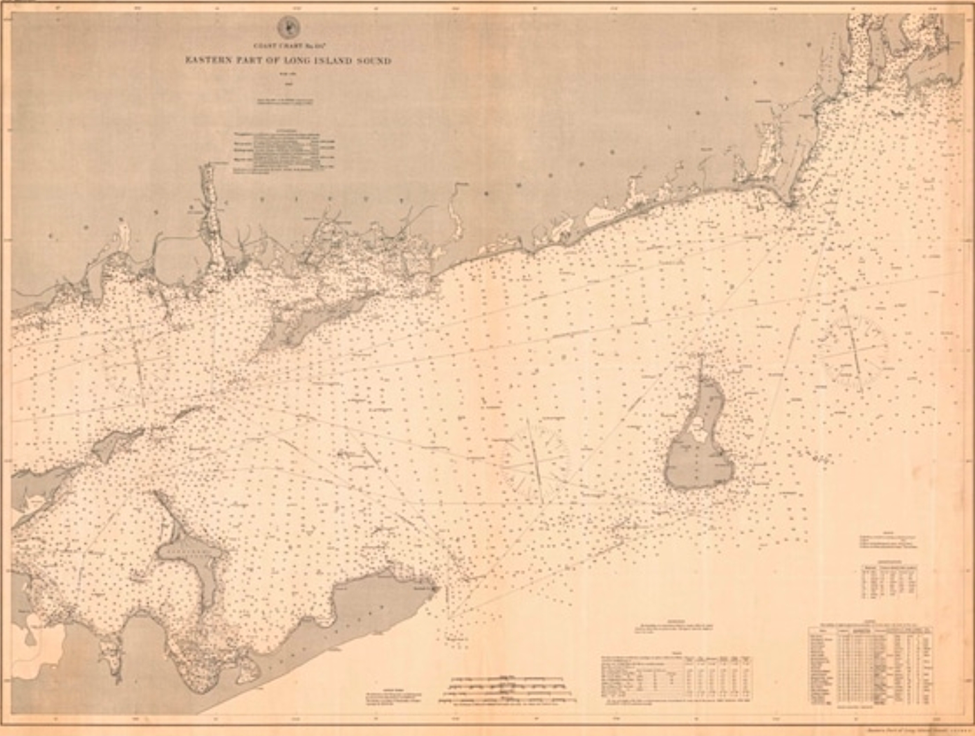
British nautical chart of the eastern portion of Long Island Sound showing the location of Block Island and the surrounding waters where the Continental Navy squadron encountered HMS Glasgow on April 6, 1776. Courtesy of the Library of Congress, Geography and Map Division. Public domain.

In the early morning hours of April 6, 1776, a lone British warship slipped through the moonlit waters southeast of Block Island. The twenty-gun frigate HMS Glasgow was carrying dispatches from Newport, Rhode Island, to the British fleet assembling off Charleston, South Carolina. Suddenly the ship’s lookout sighted sails on the horizon—then more sails behind them. Within minutes Captain Tyringham Howe realized the alarming truth: his single ship had encountered nearly the entire fleet of the newly created Continental Navy.¹

What followed should have been a decisive American victory. Commodore Esek Hopkins commanded a squadron of seven armed vessels, including the flagship Alfred, the brigs Cabot and Andrew Doria, and several additional ships. Against them stood only one British frigate. Yet by dawn the British ship had fought its way free and escaped. The encounter became one of the earliest—and most embarrassing—naval engagements of the American Revolution.²

The clash southeast of Block Island revealed the weaknesses of the young American navy: inexperienced crews, poor coordination between ships, and ineffective gunnery. Despite overwhelming numerical superiority, the Continental squadron failed to capture a single enemy warship. As one frustrated American officer later remarked, “A more imprudent, ill-conducted affair never happened.”³

The British vessel at the center of the encounter was HMS Glasgow, a sixth-rate twenty-gun frigate of the Royal Navy. In early April 1776 the ship had been tasked with delivering dispatches from Newport to the British fleet gathering off Charleston for an upcoming campaign against the southern colonies. That expedition would ultimately culminate in the failed British assault during the Battle of Sullivan’s Island in June 1776.⁴

Meanwhile the American rebellion had begun extending onto the seas. The Second Continental Congress had authorized the creation of a navy in late 1775 to challenge British control of American waters. By February 1776 the first ships of the fleet were ready for service, and Congress appointed Hopkins as commander-in-chief of the new force.⁵

Hopkins’s squadron consisted largely of converted merchant vessels hastily adapted for war. The fleet included the flagship Alfred, along with Columbus, Cabot, Andrew Doria, Providence, Wasp, and Fly. Among the officers serving aboard the fleet was a young lieutenant named John Paul Jones, who served aboard the Alfred and would later gain fame as one of the most celebrated naval commanders of the Revolution.⁶

Continue reading “A Fleet Against One: The Continental Navy’s Embarrassing Clash off Block Island, April 6, 1776”

John Paul Jones Endangers Dutch Neutrality

John Paul Jones (Wikimedia Commons)

On the morning of September 25, 1779 from the deck of his new prize, the British frigate Serapis, John Paul Jones watched his former ship, Bonhomme Richard slide beneath the waves off Flamborough Head on Britain’s east coast.  It had been a brutal fight before the Americans prevailed over a well-handled, better-armed British vessel and became one of the most famous sea-duels in American history.  A floating wreck, Serapis’ condition made it unfit to continue with Jones’ original plan of taking the war to England by cruising for prizes.  Moreover, he was due in the Texel, a roadstead near Amsterdam where ships gathered for safer transit over waters regularly patrolled by the British fleet.   The French had a convoy gathering there and wanted an armed escort.  After spending days repairing Serapis, Jones, his small naval squadron (AlliancePallasVengeance), and his prizes (Serapis, Countess of Scarborough), reached Dutch shores on October 3.  

Continue reading “John Paul Jones Endangers Dutch Neutrality”

What’s So Bonhomme about Richard?

Emerging Revolutionary War welcomes guest historian Dwight Hughes

The recent disastrous conflagration aboard the USS Bonhomme Richard (LHD-6) in San Diego harbor brings to mind the original warship by that name and its fiery fate, a tale excellently told in a previous post by Eric Sterner (“I Have not Yet Begun to Fight!” or Words to that Effect (September 23, 1779)).  “Bonhomme Richard” means “good man Richard” in French. So, who is Richard? What was good about him? Why is his name on a man-of-war?

The United States Navy likes to carry forward the labels of famous vessels. This is one of the oldest and most revered monikers in navy history, originally assigned in 1779 by Captain John Paul Jones to a rather decrepit French merchantman armed with a motley collection of guns. The French government donated the former Duc De Duras to Jones to sail against their mutual enemies, the British.

John Paul Jones

Jones famously engaged the powerful frigate HMS Serapis on September 23, 1779 in English waters off Flamborough Head, Yorkshire. The ships grappled together and blasted away at point blank range. Both were battered and ablaze in sinking condition with many casualties when the British captain surrendered. With Bonhomme Richard going down fast, the Americans took over Serapis and managed to save her.

John Paul Jones became the “Father of the U. S. Navy” (or one of them). Bonhomme Richard entered legend as the warship that won and sank. She and her successors also represent those rare U. S. Navy vessels whose names are rendered in a foreign language.

Continue reading “What’s So Bonhomme about Richard?”

“I Have not Yet Begun to Fight!” or Words to that Effect (September 23, 1779)

Bonhomme Richard (Naval History and Heritage Command)

During the night of September 23/24, 1779, Captain John Paul Jones led his frigate, Bonhomme Richard, into its legendary fight with Serapis. In the midst of a battle that was not going well for the Americans, British Captain Richard Pearson asked if Jones was ready to strike his colors and surrender. Jones offered one of the most famous replies in American naval history: “I have not yet begun to fight!” Or did he? Continue reading ““I Have not Yet Begun to Fight!” or Words to that Effect (September 23, 1779)”