Book Review: The American Revolution and the Fate of the World by Richard Bell

Have you ever thrown a rock into a pond? The ripple effect spreads outward for quite a distance along the surface of the water. The American Revolutionary War had the same effect in the late 18th century world as that pebble did to the body of water.

Historian, author, and University of Maryland professor of history, Dr. Richard Bell, focused on those fringes with this publication, bringing them into focus and discussion that was much needed in the historiography. Indeed, this is a new must-have addition to the bookshelf of American Revolutionary Era publications. His book, The American Revolution and the Fate of the World aim to “trace the sinews of the great war from its familiar epicenter outward to all those corners of the Earth” in which the conflict affected (pg. 9). Bell’s unique background, as he describes it, being an “English-born, American trained historian” is optimal to tackling this type of endeavor. As he elaborates, he attempts—successfully this reviewer’s estimation—to peel back the “amnesia…that has its own unique form” respectively on both sides of the Atlantic Ocean when discussing the history of the American Revolution. Between the two main antagonists, Great Britain and the rebelling thirteen North American colonies, “the ways individuals and communities, then as now, are entwined” will be the central theme running like a current through his book (pg. 2).
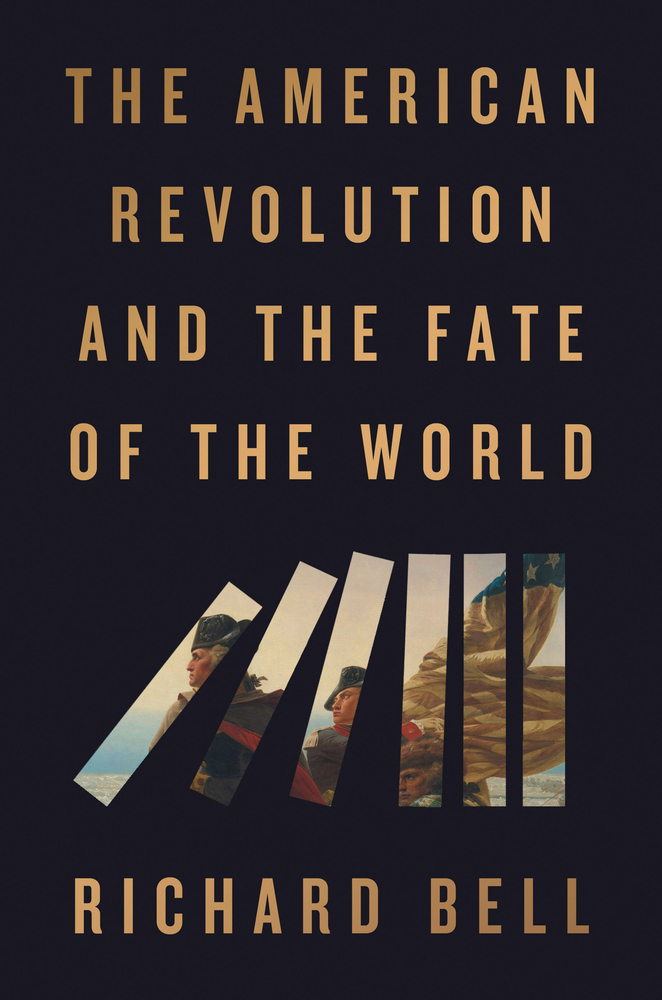
How does Bell aim to accomplish this approach and subsequent goal? Through seven core arguments, laid out briefly here. The American Revolution “stirred the mass migration and circulation of enormous numbers of people.” Second, the cost of the war was catastrophic, and victory was not certain for the patriots but a “highly contingent result of improbable choices and last-minute improvisations.” Naval power also played “an important key to military success” and “governments, soldiers, and civilians…often acted on the understanding that trade was power. The last two core arguments, patriot “struggle for self-determination stirred imperial authorities to increase oversight and security” on their remaining controlled territories and the American Revolution “was a conflict in which the call for liberty rang around the world as never before” (pg. 10).

Does he succeed? Admirably. By taking the reader through fourteen chapters that seem to be standalone essays but instead bring subjects usually forced to the fringes of histories of the period into focus. From female personas such as Molly Brant, the great leader for indigenous independence to using Peggy Shippen as the focal point for Loyalists and the throes of the great migration that followed the patriot victory in the American Revolution. From other exalted leaders, such as Baron von Steuben and King Louis XVI of France to ordinary citizens and the enslaved, trying to improve and sustain life during the conflict.

His astute insight and impeccable research acumen brings to life William Russell a privateer that might have some of the worst luck of any that sailed the Atlantic Ocean during the war to Bell, uncovering interesting snippets such as the twisted tale of tea. Americans are most familiar with the Boston Tea Party of December 1773, but did you know that by “the early 1800s, taxes levied on the tea trade had become a vital source of US government revenue and, ironically, “became a major contributor of funds to pay the nation’s war debts” (pg. 33).  

Did you ever think of the central importance of trade to war? Maintaining colonies and trade routes that kept soldiers, sailors, and citizens fed and government coffers filled? Bell rightly traces the integral connection as “cargo vessels laden with Cuban gold, Barbadian sugar, Irish meat, and Dutch munitions bound together the conflict’s several theaters just as tightly as troops transports and naval fleets…” (pg. 360).

This was a whirlwind synopsis of Bell’s seven core arguments and a sneak peek into the dept of his research and viewpoints. He has filled in the foundation of those fringes of the American Revolutionary War era history. Like those ripples from that proverbial rock, there is still more to discover that have direct ties to the defining era of the American Revolution. One example that he discusses in need of further study is “in the 250 years since 1776, rebels, separatists, and state makers on every settled continent have crafted more than a hundred declarations of independence in imitation of the American original” (pg. 361). Another ripple, started by Bell, that can be explored more fully. The fate of the world rested with the tremors started by the American Revolution, and one can argue the fate of the world still relies on those same tremors of a 21st-century variety today.

Book Information:

The American Revolution and the Fate of the World
Richard Bell
Riverhead Books (Penguin Random House, INC), New York, 406 pages with images
$35.00

On This Date in 1778: A Treaty with France

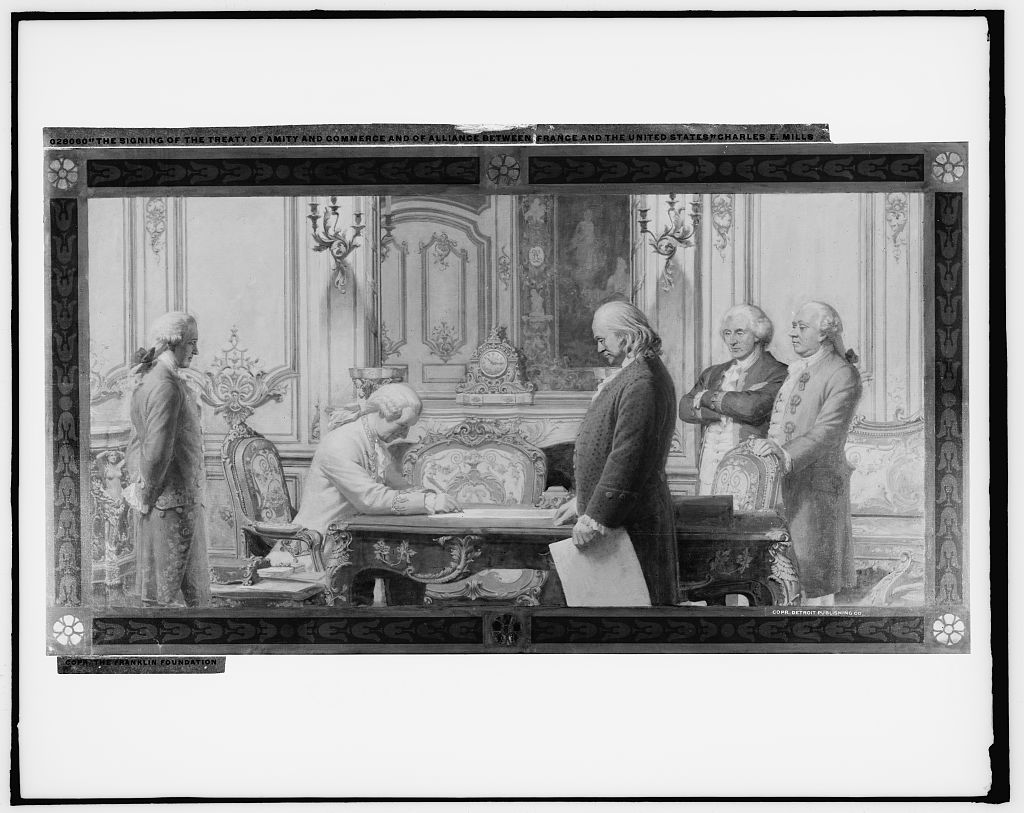
On this date in 1778, the fledgling American states officially found their great ally in France. The signings of the Treaty of Alliance and Treaty of Amity and Commerce gave new life to the cause of independence from Britain as Louis XVI pledged his support to the Americans.

An economic and military alliance with Britain’s age-old adversary had been long in the making.  Early in the conflict, the French were hesitant to openly support the rebellion, instead opting to provide covert aid in the form of ammunition, weapons, and clothing. Following the adoption of the Declaration of Independence in July 1776, Benjamin Franklin of Pennsylvania, Silas Deane of Connecticut, and Arthur Lee of Virginia, were dispatched overseas to Versailles to engage in diplomatic talks with the French foreign minister, Charles Gravier, comte de Vergennes. The success of these discussions would hinge on the battlefield performances of the American armies.

The following year was full of ups and downs for the Northern Army and Main Army. Although George Washington, commanding the latter force, had lost yet another major city when Philadelphia fell to the British in September 1777, his earlier victories at Trenton and Princeton had already impressed those on the other side of the Atlantic Ocean. Furthermore, in October, an audacious offensive by Washington against the British at Germantown, though ultimately a defeat, demonstrated promise to the French that the Americans could sustain the conflict. In the end, however, it was the Northern Army’s victory over General John Burgoyne at Saratoga and the subsequent surrender of over 6,000 British and German soldiers on October 17 that secured the alliance.

The Signing of the Treaty of Amity and Commerce and of Alliance between France and the United States. Photograph of a painting by Charles E. Mills. c[between 1900 and 1920], Library of Congress

When news arrived of the American triumph at Saratoga, Vergennes worked feverishly to persuade King Louis XVI that the time had come to openly support the fight against Britain. On February 6, 1778, the Treaties of Alliance and of Amity and Commerce were officially signed. At its conclusion, Deane and Franklin hastily penned a letter to President Henry Laurens of the Continental Congress to inform the governing body of the world-changing news:

Passy, near Paris, Feby. 8th. 1778.

Honourable Sir,                    

We have now the great Satisfaction of acquainting you and the Congress, that the Treaties with France are at length compleated and signed. The first is a Treaty of Amity and Commerce, much on the Plan of that projected in Congress; the other is a Treaty of Alliance, in which it is stipulated that in Case England declares War against France, or occasions War by attempts to hinder her Commerce with us, we should then make common Cause of it, and join our Forces and Councils, &c. &c. The great Aim of this Treaty is declared to be, to “establish the Liberty, Sovereignty, and Independency absolute and unlimited of the United States as well in Matters of Government as Commerce.” And this is guaranteed to us by France together with all the Countries we possess, or shall possess at the Conclusion of the War; In return for which the States guarantee to France all its Possessions in America. We do not now add more particulars, as you will soon have the whole by a safer Conveyance; a Frigate being appointed to carry our Dispatches. We only observe to you and with Pleasure; that we have found throughout this Business the greatest Cordiality in this Court; and that no Advantage has been taken or attempted to be taken of our present Difficulties, to obtain hard Terms from us; but such has been the King’s Magnanimity and Goodness, that he has proposed none which we might not readily have agreed to in a State of full Prosperity and established Power. The Principle laid down as the Basis of the Treaty being as declared in the Preamble “the most perfect Equality and Reciprocity,” the Privileges in Trade &c. are mutual and none are given to France, but what we are at Liberty to grant to any other Nation. On the whole we have abundant Reason to be satisfied with the Good Will of this Court and the Nation in general, which we therefore hope will be cultivated by the Congress, by every means that may establish the Union, and render it permanent. Spain being slow, there is a separate and secret Clause by which she is to be received into the Alliance upon Requisition; and there is no doubt of the Event. When we mention the Good Will of this Nation to our Cause we may add that of all Europe, which having been offended by the Pride and Insolence of Britain, wishes to see its Power diminished. And all who have received Injuries from her are by one of the Articles to be invited into our Alliance. With our hearty Congratulations, and our Duty to the Congress, we have the honour to be, very respectfully, Sir Your most obedient humble Servants

B Franklin

Silas Deane[1]

When news of the treaties finally reached the American army encamped at Valley Forge, Gen. Washington designated May 6, 1778 as a day for “rejoicing throughout the whole Army.”


[1] “Franklin and Silas Deane to the President of Congress, 8 February 1778,” Founders Online, National Archives, https://founders.archives.gov/documents/Franklin/01-25-02-0487. [Original source: The Papers of Benjamin Franklin, vol. 25, October 1, 1777, through February 28, 1778, ed. William B. Willcox. New Haven and London: Yale University Press, 1986, pp. 634–635.]

2022 Symposium Speaker Spotlight: Norman Desmarais

We are happy to welcome Norman Desmarais to our Third Annual Symposium on the American Revolution, co-hosted with Gadsby’s Tavern Museum, The Lyceum and Emerging Revolutionary War. This year’s theme is “The World Turned Upside: The American Revolution’s Impact on a Global Scale. We asked Norm to answer a few questions about their talk and their passion for history.

Mr. Desmarais is the author of The Guide to the American Revolutionary War series (six volumes about the war on land and seven volumes about the war at sea and overseas), as well as America’s First Ally: France in the American Revolutionary War and Washington’s Engineer: Louis Duportail and the Creation of an Army Corps. He is the former editor-in-chief of The Brigade Dispatch, the Journal of the Brigade of the American Revolution.

Norm translated the Gazette Françoise, the French newspaper published in Newport, Rhode Island by the French fleet that brought the Comte de Rochambeau and 5,800 French troops to America in July 1780. He also translated and annotated Louis-François-Bertrand du Pont d’Aubevoye, comte de Lauberdière’s journal, published as The Road to Yorktown: The French Campaigns in the American Revolution, 1780-1783 (Savas Beatie 2021). He has also completed the translation and annotation of Journal of a French Quartermaster on the March to Yorktown June 16—October 6, 1781 which hopefully will find a publisher before the conference.

Norm was inducted into the American French Genealogical Society French-Canadian Hall of Fame in 2015 and received the Albert Nelson Marquis Lifetime Achievement Award in 2019 and 2020.

What first attracted you to the study of early American history?

Watching the Walt Disney television miniseries The Swamp Fox and Davy Crockett with Fess Parker and Buddy Ebsen as a youngster captured my interest. Later, during the nation’s bicentennial, I attended some reenactments and my interest blossomed in a different direction.

When I was going through a period of writer’s block and looking for a project for my first sabbatical, I was speaking with one of my friends who suggested I consider following one of my interests and that brought me into the Revolutionary Era.

What keeps you involved in the study of this history?

Continually learning about our nation’s history. The best way to learn is by doing, so I’m involved with reenacting which feeds my research and gives me opportunities to share my knowledge with the public and other historians. It’s an educational experience like no other.

Do you find these things are the same or different?  

I think they’re different, but they are related.  They use the same sources in different ways for different objectives—sort of a repurposing of information.

Why do you think it is important for us to study the Revolutionary Era? 

People today go to great effort to do their family genealogy to discover their roots.  Going back to the Revolutionary Era is sort of like doing our national genealogy and going back to our national roots. If we don’t know where we come from, we can’t understand where we’re going as family members or as a nation.

What do you think was the most significant foreign impact on the American Revolution? 

The entry of France in the war. France began providing covert aid to support the war effort right from the beginning. However, once she officially entered the war, she could provide military assistance along with a lot of materiel the Continental Army needed so badly.  French artillery helped win the battle of Saratoga which was key to France joining the war.  Without French involvement, we could not have won at Yorktown. Three quarters of the allied force at Yorktown was French (army and navy).

What are some of the important lessons of the American Revolution do you think are still relevant today?

Logistics: Supplying and maintaining an army across an ocean is extremely difficult. Consider our experience in Vietnam, Syria and Afghanistan among others.

Morale: An army that has a will to fight for its independence, homeland or whatever can sometimes defeat a better supplied and trained army that has a lesser will to fight.

National support: Think of this as morale on the home front.  If the populace of a nation doesn’t support the war effort, it’s going to be very difficult to win.  Consider our experience in Vietnam and what Russia is experiencing in the Ukraine.

What was it about the American Revolution that elicited such global interest? 

First of all, it was inspired by the ideological principles of the Enlightenment which introduced some novel ideas and ways of thinking that inspired Europeans.

Second, there was great resentment about the increasing expansion of the British empire and its dominance in world politics and economy.

Third, Britain pretty much controlled the trade routes between Europe and the West and East Indies, in other words, the lucrative sugar trade and the tea and spice trade. The rest of Europe wanted to minimize Britain’s power and to obtain a share of that trade. Then there were the lucrative fishing rights off the coast of North America.

Fourth, People began to realize that the power of the monarchy resided in the willingness of the people to be governed by the monarchy. As they realized this and acted upon it, there arose a series of revolutions for independence and changes of government.

Join us for our Third annual Emerging Revolutionary War Symposium on September 24, 2022. Emerging Revolutionary War is excited to continue our partnership with Gadsby’s Tavern Museum and The Lyceum of Alexandria, VA to bring to you a day-long Symposium focusing on the American Revolution.

Registration fee is now only $60 per person and $50 for OHA members and students. If you feel more comfortable attending virtually, the fee is $30. To register visit: https://shop.alexandriava.gov/EventPurchase.aspx

2022 Revolutionary War Symposium: The World Turned Upside Down: The Impact on a Global Scale – Registration now open!

The link to register for the Third annual Emerging Revolutionary War Symposium on September 24, 2022 is now live! To register for this year’s symposium visit: https://shop.alexandriava.gov/EventPurchase.aspx

The Lyceum in historic Alexandria, VA

Emerging Revolutionary War is excited to continue our partnership with Gadsby’s Tavern Museum and The Lyceum of Alexandria, VA to bring to you a day-long Symposium focusing on the American Revolution. The theme for 2022 is “The World Turned Upside: The American Revolution’s Impact on a Global Scale.” The American Revolution created waves across the world with its lasting impacts felt even today. This symposium will study the effects of this revolution that transformed governments and the governed across the globe.

King Louis XVI

Our speakers and topics include:

Dr. Lindsay Chervinsky: “Peace and Inviolable Faith with All Nations”: John Adams, Independence, and the Quest for Neutrality.

Dr. Norman Desmarais: “Reevaluating Our French Allies”

Kate Gruber: “A Retrospective Revolution: England’s Long 17th Century and the Coming of Revolution in Virginia”

Scott Stroh: “George Mason and the Global Impact of the Virginia Declaration of Rights”

Eric Sterner: “Britain, Russia, and the American War”

We will be highlighting each speaker and their topics in the coming weeks. Registration fee is only $60 per person and $50 for Office of Historic Alexandria members and students. If you feel more comfortable attending virtually, the fee is $30. Again, to register visit: https://shop.alexandriava.gov/EventPurchase.aspx

Using the King’s Highway to Trap a King’s Army

A few weeks ago, heading to the airport after the first Emerging Revolutionary War symposium, fellow ERW historian Rob Orrison made a pit stop in a residential neighborhood in Prince William County, Virginia.

To the average traveler to the Ronald Reagan International Washington National Airport this slight detour would not be normal. Yet, for two historians of early American history, these detours are rarely common.

This particular detour took us to a portion of the King’s Highway that has been preserved by the Prince William County Historic Preservation Division. Along this stretch soldiers in the French Army under Comte de Rocambeau and Continentals under General George Washington traversed on their way to Yorktown to entrap the British under General Lord Charles Cornwallis.

Thus, one king’s soldiers, King Louis XVI took a route named for monarch to assist rebels in trapping the ground forces of another king, that of Great Britain by using a road named for the British monarch. Interesting to think about the naming of the road in those terms.

Portions of this route are still preserved today, other sections have been modernized and blacktopped to be Route 1.

Below are a few photos I snapped, including the size 14 Nike shoe belonging to yours truly, re-enacting marching down the thoroughfare like the patriots of 1781.

“Our clocks are slow” L’Hermione, Lafayette and the Franco-American Alliance

RevWarWednesdays-header

unnamed
Marquis de Lafayette

With the visit of the L’Hermione to the east coast of the United States this summer, there has been a heightened interest in the Franco-American alliance that won the American Revolution.  The French rebuilt the L’Hermione not only for its beauty but also its historical significance.  Most importantly, its mission and the passenger it contained when it arrived in Boston in the fall of 1780.

The spring of 1780 was a low point in the American cause of independence.  Stagnation in the north between Washington and British commander General Sir Henry Clinton combined with devastating defeats in the Southern Theater caused low morale among the patriots.  Cornwallis had complete control over the Southern colonies and no standing American force seemed to be able to stop his movements.  Continue reading ““Our clocks are slow” L’Hermione, Lafayette and the Franco-American Alliance”

The Return of L’Hermoine

RevWarWednesdays-header

It will be hard to describe in modern terms the celebrity of Marie-Joseph Paul Yves Roch Gilbert du Motier de Lafayette, Marquis de Lafayette (aka LaFayette) in 18th century America.

The young Marquis was fascinated with the American ideal of revolution and against the wishes of the French monarchy, in 1776 he cast his lot with the American patriots.  His relationship with George Washington and other American leaders played a major role in the American-French alliance that brought about American independence. Continue reading “The Return of L’Hermoine”