A special thanks to Stacey Fraser at the Lexington Historical Society for the update on the new exhibit described below.
If one asked what a buzzword for 21st century communication would be today, what would be your answer?
Text? Tweet? Snap?
(courtesy of Lexington Historical Society)
What if the follow up question was that some of the same buzzwords of the 21st century could describe the 18th century? Thanks to the Lexington Historical Society at Buckman Tavern, you can see the similarities yourself.
Opening on April 8th, the interactive exhibit is part of the admission ticket to the tavern. Titled #Alarmed! 18th Century Social Media “explores how news went viral 250 years ago” in addition to letting “visitors imagine how colonials might have made use of modern media tools to kick start a revolution. Continue reading “#Alarmed”→
Leading up to the anniversary of April 19, 1775, we will be sharing some short remembrances from a few people who are from Lexington and Concord.This installment is by Rich Gillespie, a native of Lexington, Massachusetts.
If you live in Lexington, Massachusetts, the beginning of the American Revolution is an essential piece of life. The Minuteman statue dominates the center of town, the village green where the Alarm List stood to face the Regulars is much as it once was, the Town Seal seen on your friendly snowplow quotes Sam Adams’ comment to John Hancock upon hearing the firing—“Oh, What a glorious morning for America!”, and the high school’s team is predictably the Minutemen. The British marched to and from Concord within 150 yards of my 4th grade classroom, and the spring field trip was to the key sites of Lexington and Concord. My first job (as was my sister’s) was guiding visitors on Lexington Green.
Hip-hip Huzzah-Haughty British troops leave Lexington (author collection)
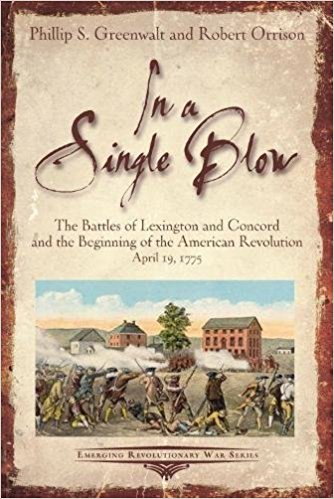
This summer Emerging Revolutionary War will launch its namesake book-series, the Emerging Revolutionary War Series published by Savas Beatie LLC, a military history book publishing company based in California.
The initial two volumes of the series will discuss the Battles of Lexington and Concord, the opening salvos of the American Revolution and also the Battles of Trenton and Princeton, two engagements that kept the cause of American independence alive in the bleak winter of 1776-1777.
Look for the the first two books in stores and online this summer. For a preview, courtesy of Amazon, click here for In a Single Blow. For Victory or Death, click here.
Emerging Revolutionary War is honored to welcome back historian Malanna Henderson.
Part One
N-7 Fredericksburg Gun Manufactory State Marker
Located at 200 Gunnery Road between Dunmore and Ferdinand Streets is the Old Walker-Grant public school. The three-acre campus is home to the Fredericksburg Regional Head Start educational program. Built in 1938, Walker-Grant was the first publically financed high school for black youth in Fredericksburg. The institution was named for Joseph Walker and Jason Grant.
Walker, born into slavery in Spotsylvania County in 1854, was freed after the Civil War and moved to Fredericksburg. Employed in a paper mill, Walker was self-taught and had a keen interest in expanding educational opportunities for black youth. He served as the sexton at St. George’s Episcopal Church for more than 50 years. Jason Grant was born free in Chatham, Ontario, Canada, in 1861 to a middle-class family. He attended Wilberforce Educational Institute in Ohio. He met an inspiring educator from Fredericksburg and decided to move there and teach. Grant taught at the county and city schools and also served as principal. His career spanned 42 years. Both Walker and Grant worked diligently to establish a learning institution for black children whose educational opportunities were marginalized by the social order of the day: segregation and racial discrimination.
Over two-hundred years ago, this location was once the site of the Fredericksburg Gunnery plant; the first government ran factory of its kind in the nation. Established in 1776, its existence was paramount to the victory of the Continental forces in winning the Revolutionary War.
By then, the colonists had interpreted an array of British economic policies as threatening their rights as Englishmen. When a slew of taxes were demanded of the colonists who were accustomed to governing themselves, their rebellious cry became, “no taxation without representation.” Until then, the planter-statesmen and other notables still felt they could reconcile with the mother country, despite the occurrences of the Boston Massacre in 1770 and the Boston Tea Party in 1773. However, in Virginia an odious act by the royal governor put the colonists on notice that the British were willing to spill more blood in an effort to vanquish the rebellion.
In the dead of night, on April 21, 1775, a mixed military unit of His Majesty’s Navy and Marines confiscated gun powder and armaments from the Williamsburg Magazine. This vital repository of weapons was stockpiled for the defense against Indian raids, slave revolts and riots. The action of the British soldiers left Virginia virtually defenseless.
John Murray, Fourth Earl of Dunmore and the last royal governor of Virginia ordered the raid. Many colonists saw this as the last straw. Dunmore had repeatedly rebuked the colonial statesmen’s demands, dissolving the House of Burgess and other political committees. An aristocrat, accustomed to having his word obeyed without question, Dunmore saw the burgeoning independence of the statesmen as an affront to his authority and responded by acts of retribution instead of compromise.
Blood had already been spilt at the Battles of Lexington and Concord a few days prior. Thus, disarming the colonists seemed a logical strategy to weaken their resolve. The shot heard around the world occurred in the north and in the south; the stealth act of a midnight raid struck a wedge between Britain and the American colonies that was irreparable.
The colonists had to arm themselves if they were going to war with England, whose military might seemed Herculean to the limited martial skills of the local colonial militias. There was no standing army. Each of the thirteen colonies had their own reservists, comprised of farmers, merchants and tradesmen who were needed sporadically for lawless incidents.
On July 17, 1775, the Third Virginia Convention convened in Richmond to create a working government structure. Delegates were elected to serve on the Committee of Safety, which replaced the Committee of Correspondence. Its powers were comparable to the defunct House of Burgess. The most important resolutions that sprung from those meetings were to raise two regiments, a total of sixteen companies of sixty-eight men each to serve one year tours. In addition, sixteen districts of Minutemen were planned. In all of the county militias, the remaining free white males between the ages of fifteen to fifty were to muster, eleven times a year. Below is a page from Colonel Lewis’s manual on military exercises and drills, dated 1777.
(Courtesy of The George Washington Foundation)
The last meeting of the convention took place on the 26th of August. An ordinance to build a gun manufacturing plant was enacted. One prominent Virginian intellectual described it as, a first step “in open defiance of British parliamentary law.”
The five commissioners appointed to operate the gun factory were Mann Page; William Fitzhugh; Samuel Selden; Charles Dick and Fielding Lewis, George Washington’s brother-in-law, husband to his sister Betty Washington. Lewis was elected chairman of the Committee. As it turned out, the only men who stayed the course was Charles Dick and Fielding Lewis.
Initially, the convention issued to Lewis 2,000 pounds to construct the gun manufacturing plant. Early in November, Lewis purchased a ten-acre tract of land located south of town. He also leased a nearby mill on four town lots.
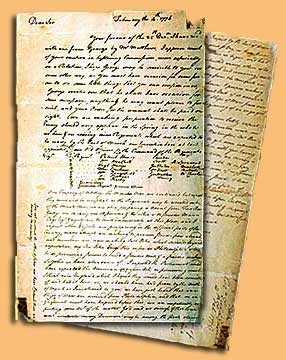
Knowing how desperate the Continental Army was for arms, Lewis penned a letter, on February 4, 1776, to George Washington in haste. Now the Commander-in-chief of the Continental Army, George received this letter from Fielding describing the developments of the factory and the formation of the army regiments they were establishing. Of note, in August of 1775, Patrick Henry was named Colonel of the 1st Regiment, and the 2nd Regiment was commanded by William Woodford with Alexander Spotswood serving as major. In January of 1777, Hugh Mercer was named Colonel of the 3rd Regiment.
(Courtesy of The George Washington Foundation)
“…our Gunn Manufactory is now beginning & expect by New Years day to have near fifty Men imploy’d who will make about Twelve Gunns compleat a Day…”
The gunnery was close to the Hunter Iron Works, an important supplier. James Hunter, the owner, added the manufacturing of muskets to his production output, independent of government funding. He also supplied regiments with axes, spades, shovels and mattocks.
The items produced at the Fredericksburg Gunnery were muskets, bayonets, flint locks, ramrods and more. The plant encompassed a main manufactory, a stone powder magazine, cartridge works, repair shops and a vegetable garden, for the benefit of the employees.
Charles Dick ran the day to day operations, hiring a master workman and artisans. Although, the very capable Mr. Dick never discussed his origins or even his birthdate; the self-made man wasn’t a member of the established gentry. However, he easily found his place amongst Fredericksburg’s leading citizens. Dick was a successful merchant, land owner, Mason and a well-respected member of the community. He served on several important civic organizations; the Committee of Correspondence and later the Committee of Safety. A business partner and personal friend of Fielding Lewis, Dick was godfather to Lewis’ first son.
On September 22, 1775 an advertisement for locksmiths was published, most likely in the Virginia Gazette. Dick needed gunsmiths, artisans and a variety of other laborers to make the gunnery productive. It was evident, early on, that there was a deficiency of expert gunsmiths ready for hire. The House of Delegates passed an apprentice act so Dick could train a class of artisans from the white youth in the area. The young men would be housed, fed and clothed; all paid for by the government. Dick forbade the drinking of beer and rum at the establishment, a drastic change from Eighteenth Century practices. Three black men were engaged to cook, bake and do an assortment of odd jobs. Whether they were slave or free is unknown.
In an emergency the aristocrats of the town, women, too, worked at the factory stuffing cartridges, etc., for the more than one hundred guns hastily readied for the Fredericksburg and Spotsylvania militia. The most commonly used weapon at the time was the British Brown Bess, a muzzle-loading smoothbore musket. It fired a single shot ball or a cluster shot which fired multiple projectiles like a shotgun. About four shots per minute was the typical output from most soldiers. By May of 1777, the factory produced similar muskets to the British Brown Bess by the rate of twenty per week.
On Wednesday, June 8, a signing ceremony marked the beginning of an agreement between First Parish in Concord, owner of the Wright Tavern, and the Concord Museum. Starting this fall, the Concord Museum will provide educational programming to school groups in the Wright Tavern and open the historic building to the public for commemorative events in October and April each year. On hand for the signing were representatives of the Concord Museum and First Parish as well as members of the Wright Tavern Exploratory Committee (WTEC), appointed last fall to develop a sustainable, strategic plan to showcase the Wright Tavern as a National Historic Landmark.
Plaque on the Wright Tavern (ERW collection photo)
“Opening the historic Wright Tavern to public and educational access will provide a true sense of place when learning about the historical events of the American Revolution,” said Mel Bernstein, member of WTEC and Chairman of the American Revolution Round Table of the Minute Man National Historical Park.
No building in this historic community was of greater consequence to the beginnings of the American Revolution than the Wright Tavern, built in 1747. The First Provincial Congress met in Concord at the Wright Tavern in October 1774, electing John Hancock as the Congress’s president and making provision for the collection of taxes. The Second Provincial Congress met there again in March and April 1775. Presided over by John Hancock with Samuel Adams and Dr. Joseph Warren in attendance, the Provincial Congress met in defiance of Royal and Parliamentary authority — creating a Massachusetts army, raising taxes, and performing other roles necessary to form its own government, independent of British authority. Then, in the early hours of April 19, 1775, Concord’s Minute Men assembled in the Wright Tavern before setting off to repel the advancing British troops at the North Bridge.
Since 1886, First Parish in Concord has owned and maintained this historic structure. “The Wright Tavern is certainly one of the most important Revolutionary War-era buildings in Concord,” explained Tim Jacoby, Chair of the First Parish Trustees of Parish Donations. “Although the building is owned by the church, we truly feel it belongs to the people of Concord and to the American people. This agreement with the Concord Museum will establish greater public accessibility to the Tavern.”
In 1961, the Wright Tavern was designated a National Historic Landmark by U.S. Secretary Fred Seaton, declaring it “an historical site of exceptional value in commemorating and illustrating the history of the United States.”
Margaret Burke, Executive Director of the Concord Museum, said: “The Museum is thrilled with this partnership to bring the importance of the Wright Tavern to the fore. Concord is home to invaluable historical and cultural resources, and this is a wonderful example of how organizations within the town are working together to promote this history and make it relevant to residents and visitors.”
Leah Walczak, the Concord Museum’s Director of Education and Public Programs, explained the role the Wright Tavern will play in educating visiting school groups: “The Museum currently provides specialized programming to over 10,000 school children each year. Along with hands-on history education using objects from the Museum’s collections, this agreement will allow us to provide programs within the setting of one of the finest historic buildings in Concord.”
This partnership was brought about through the work of the Wright Tavern Exploratory Committee, which convened from September 2015 through January 2016. Members included: John Boynton, Chair of the Exploratory Committee and a First Parish Trustee; Doug Baker, Sacristan and Curator of First Parish; Mel Bernstein, Chair of the American Revolution Round Table of Minute Man National Historical Park; Jim Cunningham, Project Manager for Barrett Farm Restoration, and Treasurer of Save Our Heritage; Sue Gladstone, Director of Development for the Concord Museum; Jayne Gordon, Public Historian for Robbins House, Thoreau Farm, and the Concord Museum; Tim Jacoby, Chair of the First Parish Trustees; Bob Morris, Chair of the Friends of Minute Man National Historical Park; and Tom Wilson, First Parish Treasurer.
A generous gift to the Museum from John and Johanna Boynton is funding this historic partnership.
*About the Concord Museum The Concord Museum is where all of Concord’s remarkable past is brought to life through an inspiring collection of historical, literary, and decorative arts treasures. Renowned for the 1775 Revere lantern and Henry Thoreau’s Walden desk, the Concord Museum is home to a nationally significant collection of American decorative arts, including clocks, furniture, and silver. Founded in 1886, the Museum is a gateway to historic Concord for visitors from around the world and a vital cultural resource for the town and the region. Visit www.concordmuseum.org.*
*For More Information, contact:
Barbara Rhines, Director of Marketing and Public Relations
978-369-9763, ext. 229
Email: brhines@concordmuseum.org
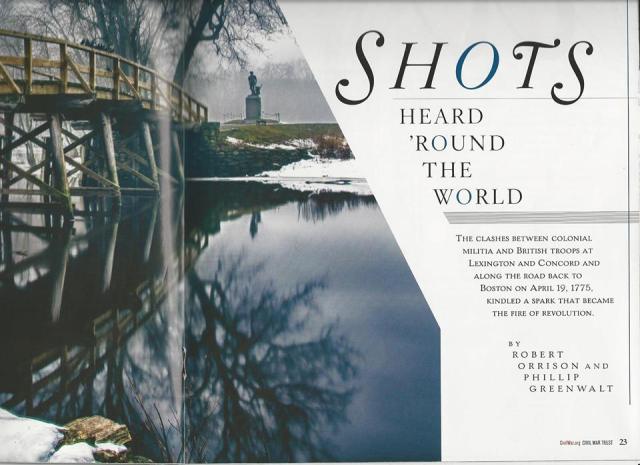
Recently Emerging Revolutionary War Era authors Phillip Greenwalt and Rob Orrison were featured in Hallowed Ground, the Civil War Trust’s quarterly magazine. Their article “Shots Heard Around the World” focuses on the events surrounding Lexington and Concord in 1775. As CWT President Lighthizer writes “the journey towards the stillness at Appomattox began with a shot heard ’round the world at Concord.”
As many of you know, the Civil War Trust has launched a new initiative called “Campaign 1776”, to preserve American battlefields that relate to the American Revolution and the War of 1812. Part of that initiative is funding the archaeology and preservation of land around the area known as “Parker’s Revenge.” Here, on the afternoon of April 19, 1775, Minutemen met the returning British column on its way from Concord to Boston. The Minutemen under Capt. John Parker, severely bloodied the British, in a “revenge” from their earlier meeting on the Lexington Green.
Also in the same issue of Hallowed Ground, ERW contributors Drew and Kate Gruber write about the how the American Revolution was on the minds of those who fought in the Civil War. Their article “So Doth History Repeat Itself” covers the “ancestral connection” that both sides had to the patriots of the revolution.
Be sure to check out Hallowed Ground and if you are not already a member of the Civil War Trust, be sure to join today. Their work in preserving American battlefields is unparalleled. We thank the staff of Hallowed Ground for including us in their latest issue. Look for more exciting ventures from Emerging Revolutionary War Era soon!








 Emerging Revolutionary War Era