St. Louis, Missouri is considered the gateway to the west for the United States beginning in the 19th century. In the 18th century, St. Louis was not on the radar of many in the burgeoning United States.
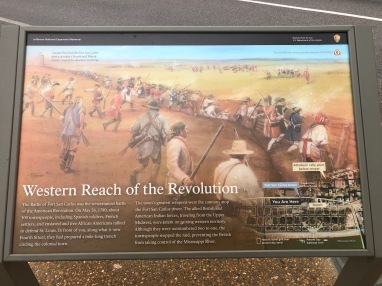
Western Reach of the Revolution, wayside informational tablet at Gateway Arch National Park (author collection)
However, the westernmost engagement of the American Revolution unfolded in the town of St. Louis, crushing British designs to conquer the territory from the Spanish, who were allied with the French and thus the United States.
Sketch of the Wabash River Made During Hamilton’s 1778 Campaign (Wikimedia Commons)
In the summer of 1778, Lieutenant Colonel George Rogers Clark of the Virginia militia launched one of the most daring American military operations of the Revolutionary War when he invaded the “Illinois country” and captured Cahokia and Kaskaskia in modern-day Illinois and Vincennes in southern Indiana, effectively neutralizing British power on the Illinois, Wabash, and Mississippi Rivers. Henry Hamilton, Lieutenant Governor of Quebec and Britain’s Superintendent for Indian Affairs in Detroit, could not allow such audacity to succeed, lest Britain’s influence with the western Indian nations wane. Learning of Fort Sackville’s fall at Vincennes on the Wabash River, he set out to recapture it.
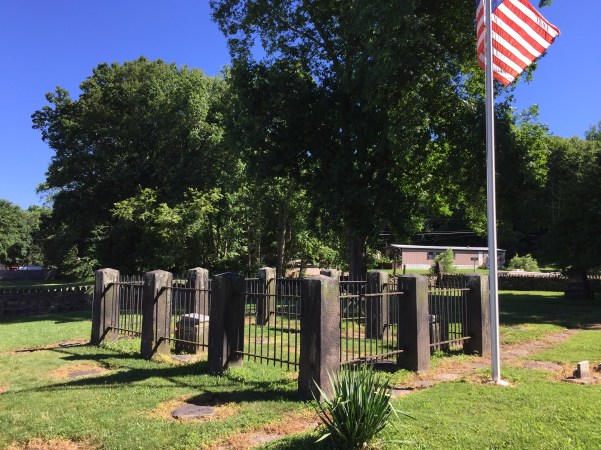
Over the summer, I took a family excursion to several Revolutionary War sites in Ohio, some of which I recently wrote about. In particular, I wanted to trace the experience of several Moravian missionaries and their congregations in the no-man’s land of the frontier. Traveling a back road along the Tuscarawas River between the villages of Gnadenhutten and New Schoenbrunn, we stumbled across the graves of David Zeisberger (1721-1808) and several notable missionaries at the crossroads of Goshen.
Last year I came across Dr. John Knight’s account of the torture and execution of Colonel William Crawford by members of the Delaware Indian tribe in 1782. It was a vicious execution, but not unheard of in the wars on the American frontier, where violence and brutality from both sides were common.
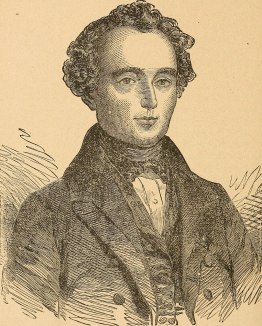
Crawford at about 40, twenty years before his execution (Wikimedia Commons)
Born in 1722, Crawford was a long-time business partner of George Washington, particularly in the acquisition of land in the Ohio River valley. A veteran of frontier conflicts, during the Revolution he had served as the Lieutenant Colonel of the 5th Virginia Regiment, commanded the 7th Virginia in the east, and then returned to the Pittsburgh area to raise the 13th Virginia. Sidelined during the war’s last years, he commanded local Pennsylvania militia and was largely retired by 1782. For years, settlers in the Ohio Valley had agitated for punitive raid against the Ohio Tribes along the Sandusky River in today’s northwestern Ohio. Their goal was to retaliate for Indian raids across the Ohio and spoil future raids. By the spring of 1782, they could not be restrained. After the militia massacred defenseless Christian Indians at Gnadenhutten in March, Brigadier General William Irvine, the Continental Commander at Pittsburgh, arranged for Colonel Crawford to lead the inevitable militia expedition, likely in hopes that Crawford could prevent a repeat. (Crawford had taken no part in the Gnadenhutten Massacre).
Few places in the American Revolution evoke sorrow like Gnadenhutten, Ohio. There, in March 1782, militia from Western Pennsylvania bludgeoned, scalped, and burned to death some ninety-six bound Indians who had adopted the Christian faith preached by missionaries from the church of the United Brethren. Thirty-four of the victims were children. Benjamin Franklin called the killings “abominable murders.”[1]
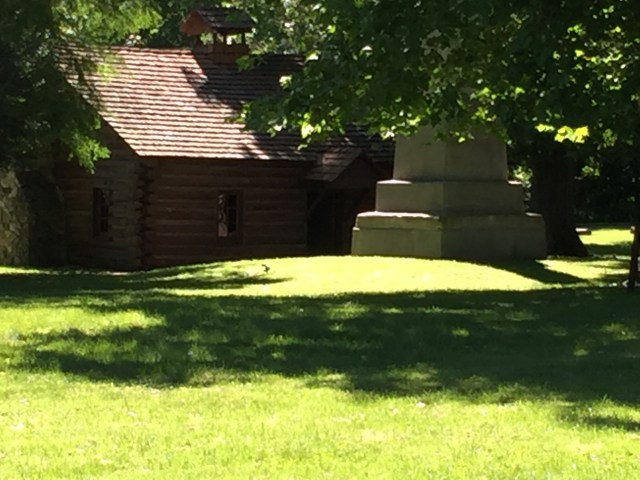
The Chapel at Gnadenhutten with the 1872 memorial. The Cooper’s Hut is to the right. (ES Photo)
Modern Replica of Fort Randolph in Point Pleasant, WV (Wikimedia Commons)
At Fort Randolph, erected on the old Point Pleasant battlefield, Captain Matthew Arbuckle decided to take matters with the Shawnee into his own hands. He was already suspicious of the Shawnee in general, and Cornstalk in particular. In 1776, he reported that Cornstalk had traveled to Detroit and was “Treating with the English.”[i] Of course, this was William Wilson’s attempt to preserve the neutrality of tribes nearer Detroit by inviting them to a pace conference. Cornstalk had gone on the mission to lend weight to Wilson’s voice with those tribes. Arbuckle did not know that. Continue reading “Chief Cornstalk’s American Revolution (part two)”→
Chief Cornstalk after an 1870 rendering (Wikimedia Commons)
The American Revolution on the frontier was brutal. Neutrality was difficult position to maintain, but some Native American tribes attempted it. In the Ohio River Valley, it was particularly challenging. But, for a time the Shawnee and Delaware tribes in modern-day Ohio sought to navigate their way between British power in Detroit and the Americans in Pittsburgh. Chief Hokoleskwa, known as Cornstalk among the whites, was a leader of the pro-peace factions of the Shawnee. Unfortunately, it got him killed. Continue reading “Chief Cornstalk’s American Revolution (part one)”→
Emerging Revolutionary War welcomes guest historian Eric Sterner.
In February 1778, Brigadier General Edward Hand, commanding Continental forces at Fort Pitt on the American frontier, launched what may be one of the oddest campaigns of the American Revolution, more famous for its fecklessness than any benefit to the American war effort. Born in Ireland, Hand arrived in the colonies with the 18th Royal Irish Regiment as a surgeon’s mate. He eventually left service in 1774 and set up a medical practice in Philadelphia. The siege of Boston found him among the besiegers as Lieutenant Colonel of a Pennsylvania Rifle Battalion. He fought under Washington on Long Island, at White Plains, and then Princeton, after which Washington successfully pursued the rank of Brigadier for him before sending him to Pittsburgh.[1] Hand arrived in June, 1777, finding just two companies of the 13th Virginia.[2] As was often the case on the frontier, Fort Pitt was under-garrisoned and Continental officers would have to scrounge constantly for troops, largely relying on local militia forces to defend the frontier.
General Edward Hand (courtesy of Ohio History Central)
Hand hoped to conduct a campaign to the west, driving toward British power at Detroit, but was unable to raise sufficient forces that fall. Instead, he settled for a trip down the Ohio to ensure local garrisons were in proper order.[3] Around Christmas, Hand received information that the British had established a small magazine on the Cuyahoga River, likely somewhere close to where it empties into Lake Erie in the current city limits of Cleveland.[4] As December gave way to January and February, Hand resolved to do something about it. At the beginning of the month, he wrote Colonel William Crawford, formerly of the 13th Virginia, currently of the Pennsylvania militia and a well-respected local leader, entreating the colonel to undertake an expedition: “As I am credibly informed that the English have lodged a quantity of arms, ammunition, provision, and clothing at a small indian Town, about one hundred miles from Fort Pitt to support the savages in their excursions against the inhabitants of this and the adjacent counties, I ardently wish to collect as many brave, active lads as are willing to turn out, to destroy this magazine. Every man must be provided with a horse, and every article necessary to equip them for the expedition, except ammunition, which, with some arms, I can furnish.”Continue reading “General Edward Hand: The Squaw Campaign”→
Now I know what you are thinking…the famous song by The Eagles. But, no.
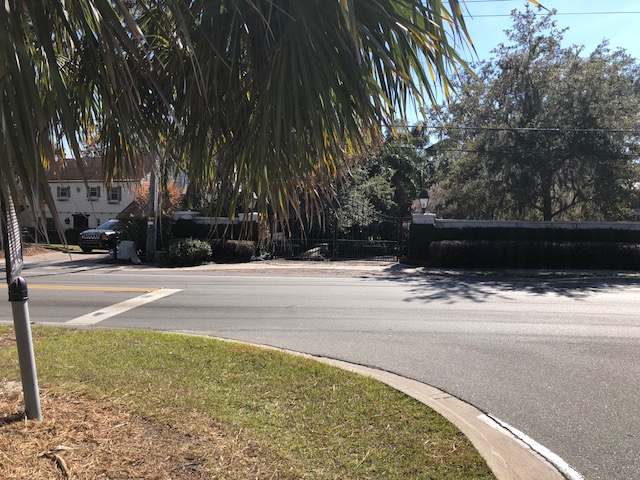
Corner where Fort Gatlin once stood, Gatlin Avenue is running left to right, South Summerlin is off the right of the photo. Historical marker sign on left side of photo, D.A.R stone marker across street (to the right of the Jeep in the driveway)
Continuing a theme from the last post, military history in Orlando, I did find myself standing on a street corner, South Summerlin Avenue and Gaitlin Avenue. That is when I noticed the small stone marker, placed by the Daughters of the American Revolution. Placed next to a hedge, on the corner of a driveway, sits until recently, the only reminder of this former military installation. Around this fort sprung a small county that became the county seat of Orange County, Florida by 1856. Which grew into Orlando.
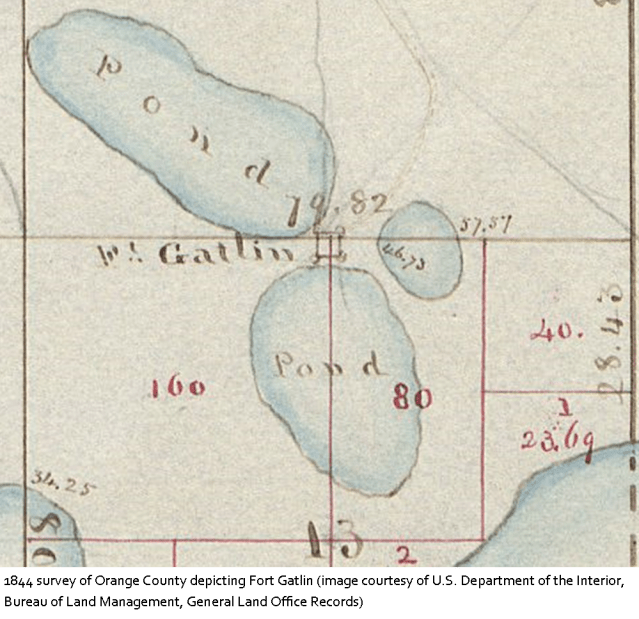
An 1844 survey of Orange County, depicting Fort Gatlin (courtesy of the Bureau of Land Management, General Land Office Records and The Florida Historical Society
Constructed on November 9, 1838, by Lieutenant Alexander Fanning and four companies of the 4th U.S. Artillery, the post was one of several built across the breadth of central Florida during the Second Seminole War. Named in honor of Dr. John S. Gatlin, who had been killed in Major Dade’s Massacre on December 28, 1835. After completing the post, which was situated on a rise that commanded three lakes, Lt. Fanning and three companies departed, leaving 1st Lieutenant F.E. Hunt.
After June 1839, the United States Army had abandoned the post, yet state militia continue to garrison the wooden ramparts. A brief return in October 1849 by the army led to it becoming an active post, briefly, until the soldiers left shortly thereafter.
One side of informational panel of the Eagle Scout project for Fort Gatlin
Abandoned, besides the stone marker, until recently. A great Eagle Scout project produced a wooden two-panel history of Fort Gatlin, Native American history, early settlers, and the 2nd Seminole War. This stands on the same corner as the Florida historical marker and across the intersection from the Daughters of the American Revolution stone marker.
Florida Historical Marker for the Site of Fort Gatlin
D.A.R. stone marker (FYI ADT sign is for the residence next door)
And standing for one day, a man on astreet corner, looking for history, a fine sight to see.
Reviewed by guest historian Robert “Bert” Dunkerly.
Lord Dunmore’s War remains one of the murkier events of the Colonial era. Historian Glenn F. Williams has produced a book that will set the standard for the study of this conflict.
Dunmore’s War, the Last Conflict of America’s Colonial Era by Glenn F. Williams
Dunmore’s War, The Last Conflict of America’s Colonial Era by Williams, explains the complexity of the conflict and goes into detail analyzing the intertwined diplomatic and military events. The late 1760s and early 1770s were a fascinating and complex time on the frontier. Violence from the French and Indian War and Pontiac’s War had subsided, tribes were shifting alliances, settlers were moving into the region, and the colonies were still adjusting to the new realities following the Treaty of Paris. The British regulations that would trigger colonial resistance were already coming, and tensions were slowly building. Yet the issues which dominated the attention of most colonists were inter colonial rivalries, such as that between Virginia and Pennsylvania.







 Emerging Revolutionary War Era