“The people here are Liberty mad…” Nicholas Cresswell and the American Independence

Emerging Revolutionary War welcomes guest writer, historian Kenneth Bancroft


Leesburg, Virginia. Tuesday, July 9, 1776. “…News that the Sanhedrim (1) had declared the
thirteen united Colonies Free and Independent States. That this was intended by the
Northern Colonies from the first, I am well convinced…” (2) These are not the words one
expects when talking about the Declaration of Independence, but to a 26-year-old
entrepreneurial Englishman caught in a revolution that he neither wanted nor supported,
this was the worst news ever. (3)

The Journals of Nicholas Cresswell is an informative source on the Revolutionary War from what could be considered a ‘Tory’ point of view. It is a personal account that shows that the struggle for freedom was not just on the battlefield but also in the streets and homes at the end of the colonial era. Nicholas Cresswell was an outsider from the moment he stepped on American soil in 1774 and heard news of the siege of Boston, noting that the colonists “talk as if they were determined to dispute the matter with the Sword.” (4) For two years, Cresswell observed the American colonies descend into rebellion, “The people here are Liberty mad, nothing but war is thought of.” (5)


When the colonies officially separated, Cresswell felt despair and anger instead of hope.
Cresswell’s intention was to set up life as a farmer, but misfortune and bad timing foiled his
plans. He blamed the “cursed Rebellion” for turning this “earthly paradise to a Hell upon
terra firma.” (6) Constantly under the suspicion of the local committees tasked with enforcing the
Continental Association as a suspected ‘Tory’ spy, he grew to despise the Continental
Congress as vile and hypocritical. “The Congress under the fallacious pretense of nursing
the tender plant, liberty, which was said to thrive so well in American soil, have actually
torn it up by the very root.” (7)

Cresswell could not help himself and always got into political discussions in the bars and
houses of Virginia. “At Dinner had a long dispute with Doctor Jacson about the origin of the
present proceedings…Most of the company agrees that I had the better of the argument.
But never so much embarrassed in my whole life.” (8) He even chided General Washington as a yeoman farmer “Negro-driver” (9) and a and was befuddled that he kept evading General Howe. Ultimately, he did decide that he was a decent General.


In the end, Cresswell decided that Virginia, for all of its bounty, was lost and returning to
England was his only option. After three years of surviving the storm of a revolution, he
made his slip to British lines. While technically not a Loyalist, (10) Cresswell provides critical
details on the otherwise missing narrative of Loyalism in the colonies, especially Virginia.
His last act dramatically involved him in a plot to free English sailors and soldiers from a jail
in Alexandria Virginia. Some of the conspirators were well known merchants in
Alexandria. (11) Thankfully Cresswell’s account exists to inform how a revolution hits the
home front and the profundity of independence at that time.

To learn more about Nicholas Cresswell, visit Kenneth Bancroft’s website at: https://nicholascresswell.wordpress.com/ and see his Rev War Revelry episode on Nicholas Cresswell on our You Tube Channel at: https://youtu.be/fyONRWmy6_I?si=-tIAEmJ69-GHv2BI


1 Cresswell’s derisive term for the Continental Congress. It refers to the Sandedrim, or Jewish Supreme
Council. “Sanhedrim,”McClintock and Strong Biblical Cyclopedia, accessed June 2, 2026
https://www.biblicalcyclopedia.com/S/sanhedrim.html. 2 Nicholas Cresswell, The Journals of Nicholas Cresswell, 1774-1777, (North Charleston, South Carolina:
reprinted 2024, 117. Free online version at the Library of Congress https://tile.loc.gov/storageservices/service/gdc/lhbtn/30436/30436.pdf. 3 See: “An Englishman’s Journal of the Revolutionary War: The Journals of Nicholas Cresswell 1774-1777,”
Emerging Revolutionary War, October 20, 2025, https://emergingrevolutionarywar.org/2025/10/20/anenglishmans-journal-of-the-revolutionary-war-the-journals-of-nicholas-cresswell-1774-1777/. 4 Cresswell, 16. 5 Ibid, 77. 6 Ibid, 197.
7 Ibid, 198.
8 Ibid, 99.
9 Ibid, 193. It is interesting that that turn of phrase is famously used by Samuel Johnson, an avowed Tory who
despised what the American colonies were doing. See: Interview, “Gordon S. Wood: How the American
Revolution “infused into our culture our noblest ideals and highest aspirations,” Library of America, accessed
June 7, 2026 https://www.loa.org/news-and-views/639-gordon-s-wood-how-the-american-revolutioninfused-into-our-culture-our-noblest-ideals-and-highest-aspirations/. 10 McGill … Cresswell was more of an immigrant who still had cultural ties to his homeland. 11 William Buckner McGroarty, “Loyalism in Alexandria, Virginia, The Virginia Magazine of History and
Biuography, 52, no. 1 (January 1944), 42-43, accessed March 11, 2026 https://www.jstor.org/stable/4245269.

Rev War Revelry: “this was intended by the Northern Colonies from the first…” The Story of Nicholas Cresswell with historian Ken Bancroft

Join us this Sunday at 7pm on our Facebook page to view the American Revolution and the Declaration of Independence through the eyes of an English traveler who visited Virginia from 1774-1777. Nicholas Cresswell’s daily diary is a researchers dream into daily life during the American Revolution and understanding an Englishmen’s point of view. We welcome historian and blogger Ken Bancroft as he talks about Cresswell’s life and his reaction to hearing about the Declaration of Independence. Ken Bancroft manages the website “The Journals of Nicholas Cresswell – Celebrating the 250th Anniversary Every Day” found at: https://nicholascresswell.wordpress.com/ . This Revelry is pre-recorded and will be posted to our Facebook page on Sunday, July 12th at 7pm and then to our You Tube Channel.

An Englishman’s Journal of the Revolutionary War: The Journals of Nicholas Cresswell 1774-1777

Emerging Revolutionary War welcomes guest historian Kenneth Bancroft

“Nothing but War is talked of…This cannot be redressing grievances, it is open rebellion…1

250 years ago on October 20, 1775 a 25 year old Englishman wrote these words in Alexandria, Virginia, noting that “everything is in confusion…soon they will declare Independence.”2.Nicholas Cresswell had arrived in America a year and a half prior to that entry in a journal that he kept to chronicle his venture to “shape his course in the world” and set up a new life inVirginia, “as I like the situation of that Colony the best.”3 He was aware of grumblings from colonials, but his focus was on land and his adventure had him traveling and trading with the Native Americans in the Ohio country and experiencing the slave culture in the colonies, especially the horrific sugar plantations in Barbados.

But what his journal is most known for is his observations and critique of the revolutionary world from Virginia to New York in 1774 through 1777. Cresswell’s misfortune, among others, was that he arrived in America seeking opportunity just as the Imperial Crisis over the Intolerable Acts had began. News of, and reaction to the closure of the port of Boston frequently disrupted his schemes and social life. As an Englishman still loyal to the Crown, his Revolutionary War journal offers a unique outsider look at the costs of the conflict in the country and towns as opposed to the more common tomes of soldier life.

“No prospect of getting home this winter, as I am suspected of being a Spy.”4 Cresswell’s tenure in America was tenuous. Unsuccessful in trying to establish himself with land and basically broke, he blamed his misfortune on the “Liberty Mad”5 political climate that considered him a ‘Tory’ who would not commit to the cause. His penchant for getting into drunken political arguments did not help and kept getting him in trouble with local Committees of Safety.

“Am determined to make my escape the first opportunity.”6 By that point Cresswell knew it was time to forgo his quest and return to England, but the question was how, especially with non- importation measures and the war closing ports. What followed next for Cresswell was an amazing account of encounters with revolutionary notables and locations such as Thomas Jefferson, Patrick Henry, and British General Howe in Philadelphia, Williamsburg, and New York respectively. Ultimately, Cresswell was able to secure passage back to England where he reluctantly picked up where he left off by order of his father to “shear or bind corn.”7

1 Nicholas Cresswell, The Journals of Nicholas Cresswell, 1774-1777, (North Charleston, South Carolina: reprinted 2024), 97.

2 Ibid, 97.

3 Ibid, 3.

4 Ibid, 101.

5 Ibid, 47.

6 Ibid, 143.

7 Ibid, 214.

The Journals of Nicholas Cresswell was first published in 1924 and offers a candid account of the American Revolution from a viewpoint not typically explored. Its accounts of mustering militia, salt shortages, political pulpits, and anti-Tory riots and fights add color to our revolutionary origins. Add to that Cresswell’s experiences with the Native Americans in the Ohio country and the plantations in Barbados which further inform our understanding of our colonial past. Join Cresswell’s journey! To read more about Cresswell’s journey click here. The blog is an online platform and resource to follow his daily posts as they occurred 250 years ago. Keyword search features and research links are featured as well. Follow along on Facebook, too, at Nicholas Cresswell Journals.

The Journal of Nicholas Cresswell, Part 6


Vale of Edale (Photo by Atomviz, Wikimedia Commons)
Vale of Edale, Cresswell’s Home, the Beginning and End of His Adventures.  (Photo by Atomviz, Wikimedia Commons)

Skirmish in New Jersey

Cresswell found cheap lodging in New York and reunited with Joseph Brewer, who had fled Philadelphia himself, leaving his wife behind.  “The persecution against the friends of Gorvernment was too violent for a man of his warm temper to stay any longer amongst them with safety either of person or property.”[1]  While in New York, he watched the buildup of forces that Howe would later take on the Philadelphia campaign, but his focus remained on securing passage home.  It would take months, but Cresswell found ways to kill time, including watching a skirmish with the Americans he had so frequently cursed.

Continue reading “The Journal of Nicholas Cresswell, Part 6”

The Journal of Nicholas Cresswell, Part 5

Escape from America

Finally, in the spring of 1777, Cresswell again decided to try returning to England.  Thomson Mason, who had already intervened with two Committees of Safety to protect the Englishman, offered to help with Virginia authorities once more, provided that Cresswell swear not to join the British Army.  Cresswell did.  The best plan was to leave Leesburg, travel overland to Alexandria, then take a schooner down the Potomac and Chesapeake for Williamsburg and Hampton, where it might be possible go aboard a ship bound for British-occupied New York.  As he made his preparations, the local Committee of Safety arrived on April 16 to search his possessions for treasonable items.  They seized a shot pouch, powder horn, and bearskin he acquired from the Delaware Indians.  Cresswell decided not to contest the seizure lest it complicate his departure.

Continue reading “The Journal of Nicholas Cresswell, Part 5”

The Journal of Nicholas Cresswell, Part 4

A Loyalist under House Arrest

Having failed to reach the British Army in New York, Cresswell spent a miserable autumn and winter of 1776/1777 in northern Virginia, often arguing with his host, James Kirk, a Patriot and the only man who had ensured the Englishman could keep clothes on his back and a roof over his head.  Cresswell’s loyalist proclivities and extensive travels were widely known and on November 28, three men of the Committee of Safety in Alexandria “waited on me and informed me that the committee did not think it prudent to let me go out of the Country at this time and hoped that I would give  my word of honour not to depart this Colony for three months.  Otherwise they would confine me.  I was obliged to do the first as the lesser evil of the two.  They were polite enough not to search my chest.”[i]  Depressed as ever and suspecting Kirk of arranging the entire affair in order to keep him in Virginia, Cresswell did what he usually did when he was unhappy.  He got drunk.

Continue reading “The Journal of Nicholas Cresswell, Part 4”

The Journal of Nicholas Cresswell, Part 2

An Englishman on the Frontier

Part 1 click here.

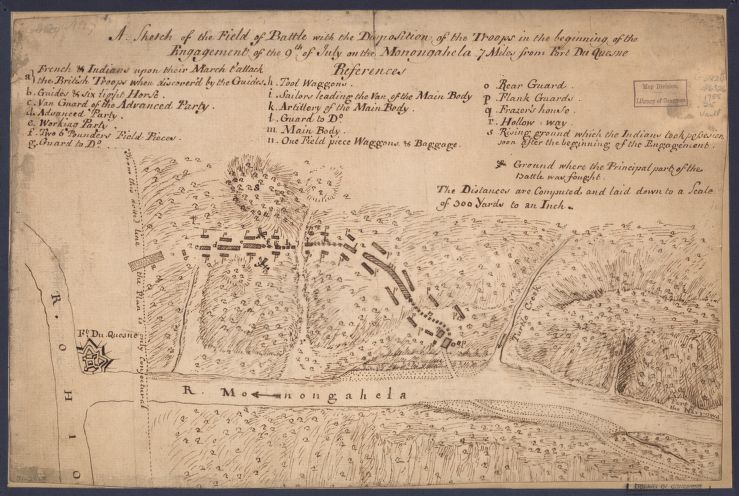
Nicholas Cresswell left Alexandria for the Illinois Country on March 16, 1775, his correspondence as yet unknown to the local Committee of Safety.  The Ohio River served as a highway to the west, so he headed for its origin at Pittsburgh.  Along the way, he stopped to visit the battlefield where French and Indian forces defeated Major General Edward Braddock in July, 1755.  Cresswell and his traveling companions found “great numbers of bones, both men and horses.  The trees are injured, I suppose by the Artillery…the greatest slaughter seems to have been made within 400 yards of the River…We could not find one whole skull, all of them broke to pieces in the upper part, some of them had holes broken in them about an inch diameter, suppose it to be done with a Pipe Tomahawk.”[i]

Monongaela Battle (Library of Congress)
Initial Dispositions of the Battle of the Monongahela.  Cresswell walked the battlefield on his way to Pittsburgh in 1775.  (Library of Congress)

Continue reading “The Journal of Nicholas Cresswell, Part 2”

The Journal of Nicholas Cresswell, Part 1


1BF5561D-F286-4DDD-BCEC-272C39979E49_1_201_a
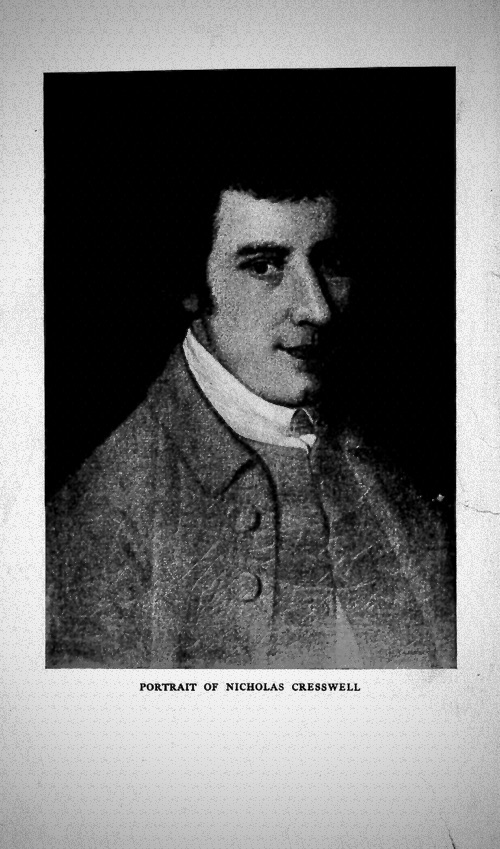
Nicholas Cresswell from the Frontispiece of his Memoir (Library of Congress)

For some Englishman, the political conflict between the United Kingdom and its American colonies was an afterthought that should not interfere with their plans to build a future based on American wealth.  Nicholas Cresswell was one such person.  He traveled to the colonies on the eve of the American Revolution and returned home in 1777, having kept an extensive diary of his travels, experiences, thoughts, and conditions in America during the war’s first years.  Along the way, he met some of the most colorful and interesting people who played prominent roles in the war: George Rogers Clark, Delaware Indian leaders White Eyes and Killbuck, Thomas Jefferson, Patrick Henry, William Howe, Robert Rogers, and Charles Lee to name a few.  Since its publication, Cresswell’s journal has become a touchstone for historians looking for insight into those people, how a loyal Englishman like Cresswell saw the world and the Americans around him interpreted events.  In particular, he recounts the feelings and treatment of loyalists trapped in America during the war.  With that in mind, reviewing Cresswell’s diary might help spread the word about a worthwhile primary resource.

Continue reading “The Journal of Nicholas Cresswell, Part 1”