In June 1778, the Continental army marched out of their winter encampment in Valley Forge, Pennsylvania and headed toward New Jersey in pursuit of the retreating British army. The past six months, from December 1777 to June 1778, ushered in a period of suffering, renewal, and change.
Valley Forge is imprinted into the psyche of Americans as the the toughest winter of the entire American Revolution. In fairness, it was one of many tough winters that the Continental army survived. However, the reasons why this winter stands out will be part of the discussion of this Sunday evening’s “Rev War Revelry” which can be found on Emerging Revolutionary War’s Facebook page at 7 pm. EDT.
This week’s historian happy hour includes a discussion with Philip S. Greenwalt author of the recently released Emerging Revolutionary War Series title, The Winter that Won the War. This is the fourth volume in the series, with previous ones covering Lexington and Concord, Trenton and Princeton, and Monmouth.
Greenwalt will discuss how the Valley Forge winter was the intersection of various issues and how the decisions made and the determination of survival by the army made this the winter that won the war.
Tune in as well to hear how you can purchase a copy of this book to take with you as you plan that summer trip to Valley Forge and the Philadelphia area!
On this date, in 1778, the Continental army, under the command of General George Washington broke winter camp and began the spring campaign. Their objective was to catch the British army, under Sir Henry Clinton, retreating across New Jersey to the safety of New York City.
Nine days later, in the last major action in the northern theater, Washington’s forces would engage their adversary in the Battle of Monmouth. The army that fought this engagement in one of the hottest recorded days of any battle in American history, was a much improved military organization. Not perfect but much improved from the force that marched into Valley Forge six months prior.
During that half-year, from December 19 to June 19, the army saw an improved quartermaster department, the formation of a military handbook and tactical training, and the news that a powerful European nation had agreed to become allies in the quest for American independence.
Much is made of turning points or the critical importance of an event so I do not want to retread that argument here. However, what happened at Valley Forge was significant in the path to eventual American victory and the formation of the United States of America.
There is an old saying that even the greatest fiction writers cannot envision a story that is unbelievable as actual events can be. Or to sum it up more succinctly, a coincidence. After delays due to the pandemic, the latest volume of the Emerging Revolutionary War Series was released, in time for the 243rd anniversary of the end of the winter cantonment at Valley Forge.
The book is authored by yours truly and can be found via the publisher’s website by clicking here or through your favorite bookseller or by emailing Emerging Revolutionary War.
Then follow in the footsteps of Washington’s forces to Monmouth.
During the winter encampment at Valley Forge, as thousands of men huddled around drafty wooden cabins, with dwindling supplies, and battled boredom and disease, a relief effort was organized hundreds of miles away.
George Washington, ensconced at the Potts House in the heart of the Valley Forge encampment, was very aware of the dire straights that his forces were exposed to. Throughout the winter he sent missives, directly and through intermediaries, discreetly asking for more aid, for supplies, for changes to military bureaucracy. He even consented to a delegation of congressmen to visit Valley Forge and see first-hand the situation in the winter of 1777-1778.
In a proverbial sense, he did not leave any stone unturned to try and ease the plight of his forces or continue to stay abreast of British designs, less than twenty-miles away in Philadelphia, Pennsylvania.
After hearing of the contributions of the Oneidas and Tuscaroras at the Battle of Oriskany in New York, Washington sent a letter of invitation for the Native Americans to visit his army. Approximately 50 warriors along with supplies made the few hundred mile journey from upstate New York to eastern Pennsylvania. They left their villages on April 25 and arrived on May 15,1778 in Valley Forge. The leaders of the Oneida party dined with Washington. Five days later some of the warriors participated in the engagement at Barren Hill under the Marquis de Lafayette. Six of the warriors gave their life in service to their ally.
In 2007 historian Joseph T. Glatthaar published a book about the Oneidas and their contributions to the American victory in the war. The title, in part, is Forgotten Allies. A fitting testament to the service and sacrifice this tribe underwent in their partnership with the fledgling American nation.
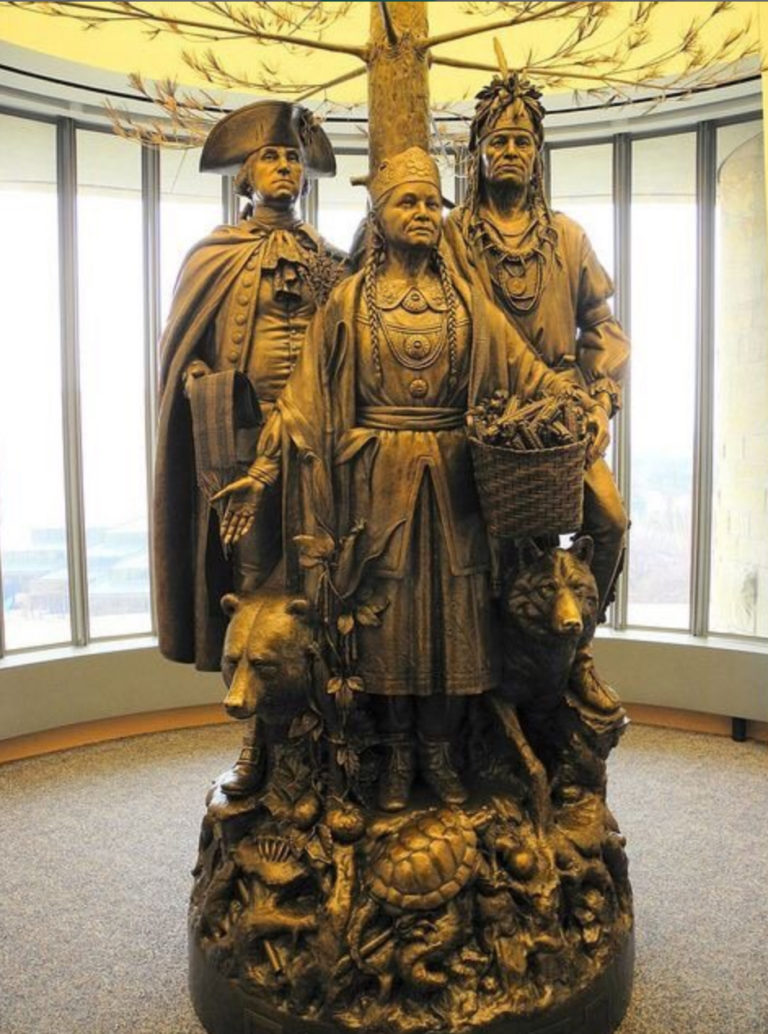
In 2004 a sculpture was completed of Polly Cooper, Chief Skenandoah, and George Washington (courtesy of King of Prussia Historical Society)
If the Oneidas were the “forgotten allies” than in the winter encampment at Valley Forge there was a forgotten woman that tramped south with her fellow Oneidas. Her name was Polly Cooper.
Along with the warriors, whom Washington wanted to serve as scouts, the Oneidas brought much needed supplies, including bushels of white corn. While the leaders dined at the Potts House, Cooper established a de-facto cooking show. She handed out the white corn to the soldiers and taught them how to use husks to make soup and ground grain to make it palatable.
This much needed food sources, along with an improved supply chain under quartermaster Nathanael Greene rounded out the bleak winter with the glimmer of hope for better supplies in the upcoming campaign season.
The Oneida, including Polly Cooper for her services, refused any and all payment. Friends help friends in need is what the Oneida told Washington and his officers. However, a tradition exists in the history of the Oneida nation. That story, passed down orally from generation to generation, highlights that Marth Washington, in her gratitude for what Polly Cooper did for the rank-and-file of the Continental army, presented the Oneida heroine with a shawl and bonnet.
Another account reads that Cooper was gifted a black shawl that she saw for sale in a store window. The Continental Congress appropriated the money for the clothing item and gifted it as their thanks to her. This shawl is still in the ownership of her descendants and has been loaned to the Oneida cultural center from time to time.
The black shawl that Polly Cooper received for her services to the Continental Army at Valley Forge (courtesy of the Oneida Indian Nation http://www.oneidaindiannation.org)
On the morning of August 27, 1780 there was a knock on the door of the Charleston, South Carolina residence of Christopher Gadsden, lieutenant governor of South Carolina. He had stayed when the city capitulated to British forces in May. Gadsden had represented the civil government and handed the city over to the British commander, Sir Henry Clinton. He was released on parole.
Christopher Gadsden
Now, approximately three months later, Clinton was back in New York, and the new British commander Lord Charles Cornwallis had reneged on the parole agreement. Along with another 20 civil officers, Gadsden was led through the town to the docks to a waiting ship, set to sail for St. Augustine in British East Florida.
Upon arrival in the oldest city in European North America, Gadsden was given the opportunity by Governor Tonyn to avoid incarceration in Florida. This is when the 56-year old patriot probably uttered the phrase below.
“I gave my parole once, and it has been shamefully violated by the British Government: I shall not give another to people on whom no faith can be reposed.”
With that decision, Gadsden landed himself in Castillo de San Marcos the large coquina stone fortress that stood guard over St. Augustine. Not only was the South Carolinian kept in a cell, he was kept in solitary confinement for the next 42 weeks!
Upon his release in September 1781, Gadsden and the rest of the civil prisoners were sent by merchant vessel to Philadelphia. Gadsden wasted no time in hurrying southward to South Carolina and a return to the state House of Representatives. He served in various political roles, although he had to decline the governorship because of the affects of his imprisonment. He died in 1805. A grandson, James Gadsden would give his name to the Gadsden Purchase.
Gadsden was held in the cell to the right (author photo)
Today one can visit Castillo de San Marcos, a national park unit within the National Park Service. When touring the Castillo you can view the cell where Gadsden spent his solitary confinement and read the accompanying exhibits.
Merriam-Webster’s two two definitions of inspiration are “an aspiring agent or influence” and “the quality or state of being influenced.” Being a military historian that has spent a portion of his graduate school and adult life studying the American Revolution, there are a multiple examples of people, events, or circumstances that would fit that Merriam-Webster definition.
The 56-men who affixed a signature to the Declaration of Independence in the summer of 1776 and the gravity of what that meant.
Thomas Paine’s The American Crisis comes to mind during the bleak December 1776 days as George Washington’s army hurriedly moved through New Jersey.
George Washington’s personal heroics, at Princeton in January of 1777 and Monmouth Court House in June 1778, defying his own personal demise to rally the troops he led.
The tales of suffering, at Valley Forge, Morristown, and through the heat of a Carolinas campaign by the common soldier, many whose names are lost to history.
Recently, I have been looking for inspiration, I think most of us are, with how 2020 ended and the beginning of 2021, but this post is not about straying into current politics, viewpoints, or stances on the pandemic. This is more personal.
The pandemic has afforded me the opportunity to read more, as I am sure my fellow history enthusiasts and bookophiles can relate to. Those readings reawakened a question I tried to tackle as a graduate student a decade ago at George Mason University.
What inspired the men from Maryland to fight for American independence?
Or more accurately:
What did not inspire the men from Maryland to fight for American independence?
I ruled out pay, patriotism (at the start), and other tangible benefits. I gleaned from some of the primary sources that have survived, the chance to create a new life, for the soldiers themselves or their loved ones at home was a major motivator to serve. Family was the spark of inspiration.
On this date, that is something I can really relate to. My father, who will be celebrating his 71st trip around the sun, is battling dementia. He will know that this date, February 8, is his birthday, but will struggle to remember anything else. Yet, he was surprised to see his name in a book recently, one that I sent to him, one that I had helped in the editorial process. To see him reading it, cherishing it, and tearing up with happiness at the simple recognition of his name and mine, is an inspiration to myself.
So, he was and is an inspiration, half the duo of sparking my passion of American history (any guesses on the other half)?
What or who is your inspiration as we enter the second month of 2021?
Happy Birthday Dad, from the history enthusiast you helped create.
If curious, he is reading A Handsome Flogging: The Battle of Monmouth, June 28,1778 by William R. Griffith IV
The War of 1812 is considered by some historians as the end of the American Revolutionary Era. From the conflict, the United States will find a war hero and future president, Andrew Jackson and a poem by lawyer Francis Scott Key that turns into our national anthem.
But, the origins of the war, the military actions that spread around the United States, from Louisiana to the nation’s capital, to the invasion of Canada, and on the high seas are largely overlooked. There are numerous reasons for this.
That, in part, is why, this Sunday, at 7pm EST, on ERW’s Facebook page, the next historian happy hour “Rev War Revelry” will be focused on this important conflict. Join ERW historian Phillip S. Greenwalt along with the following guest historians for an hour-ish discussion of the three-year war.
Joining Phill will be;
Dan Davis, of the American Battlefield Trust, who has lectured on Andrew Jackson and the Battle of New Orleans. He is also a full-time historian with Emerging Civil War.
Also, formerly of Fort McHenry National Monument and Historic Shrine, and now working for the National Park Service in the Washington D.C. area, guest historian Jim Bailey will be the second of three guest historians.
Leaving the best for last, okay pun intended, as all three guest historians are great. But in all seriousness, the third guest historian joining for this revelry will be George Best. He is a park ranger for the National Park Service at Harper’s Ferry National Historical Park and volunteers as the Communications Coordinator for the Friends of Maryland’s War of 1812.
We look forward to you joining with your thoughts, comments, and questions this Sunday on our Facebook page (there will be an event post for you to use as a reminder) as we discuss this three-year conflict that had reverberations for many years afterwards.
I recently needed to look up a quote from a British politician in the House of Commons during the American Revolutionary War. I went to my personal library (like to call it a study but since I have not found a desk to “study” on in there, I’ll continue to call it my library).
I grabbed Don Cook’s book The Long Fuse, How England Lost the American Colonies. A great read about the opposing side in the American Revolution. I found what I needed, but, as many of you probably do, that took me down a reading tangent.
Disclaimer; those of us under stay-at-home orders have some additional free time to explore more of our personal libraries. Those who can relate know what I am talking about. You pick up a book looking for something specific, which leads you to finish that book, then find one in the same genre or another micro-study of the same topic, until you have consumed multiple tomes within a matter of days, weeks.
Cook’s book led me to The Men Who Lost America: British Leadership, the American Revolution, and the Fate of the Empire. I gained a different appreciation for King George III, Lord Frederick North, and other British leaders from their perspective, filling in the gaps of historical scholarship that more America-centric volumes do not have the word count or inclination to fill.
I then went deeper down the proverbial rabbit-hole. Delving into With Zeal and With Bayonets Only: The British Army on Campaign in North America, 1775-1783, I went on a reading campaign with the British in the colonies.
Which now leads me to this blog post, what else would you recommend? What are your go-to books on the British perspective in the American Revolution?
Side note, I may delve into the loyalist viewpoint histories next, as I came across an interesting fact; the largest diaspora in the 18th century was American citizens that chose loyalty to the British crown who left or were forced to evacuate during and after the end of the American Revolution. So, as any history enthusiast will do, I will do more research….reading I mean.
Multiple tomes grace bookshelves in libraries, book stores, and personal residences that depict various aspects of George Washington’s life and legacy. Historian Colin G. Calloway’s “The Indian World of George Washington” deserves a space on that bookshelf.
Long overdue, this volume about Washington fills a void, as “nothing was more central than the relationship between the first president and the first Americans” (pg. 4). From his first appearances in the greater colonial world in the early 1750s to the last years of his presidency, “a thick Indian strand runs through the life of George Washington as surely as it runs through the history of early America” (pg. 4).
George Washington retired from public life at the end of his second presidential term on March 4, 1797. Twenty months and ten days later he died on December 14, 1799. In between Washington was also the first in the United States to be a former president, first to deal with securing his legacy as both a military hero and political figure, and having to see the country he sacrificed so much to create, lurch forward without him having an active part in it.
Until now, these years have been either excluded, glossed over, or an anti-climatic ending to a Washington biography. Until now. Joseph Horn, a former presidential speechwriter and the author of The Man Who Would Not Be Washington lends his talent to a new biography of Washington, examining those last few years in-depth.
The author has a valid point when he argues that, “for too long, the story of Washington’s last years has been squeezed into the margins of manuscripts, if included at all” (pg. 14). Channeling the method of famed Washington biographer Douglas Southall Freeman, Horn writes this biography in the “fog of war” style that affords the reader the opportunity to read the history “through the eyes of those who made it rather than through the hindsight of historians” (pg. 14).
On this date, in 1775, Virginian Patrick Henry, a delegate to the Second Virginia Convention from Hanover County, Virginia sat in on the ongoing debate at St. John’s Episcopal Church in Richmond, Virginia.
Patrick Henry
The 28-year old then stood to give his defense of his proposed amendments to the petition then being debated. Below is the last few lines of his now famous statement, with the last sentence being the one most remembered;
“If we were base enough to desire it, it is now too late to retire from the contest. There is no retreat but in submission and slavery! Our chains are forged! Their clanking may be heard on the plains of Boston! The war is inevitable and let it come! I repeat it, sir, let it come.