Captain James Wallace’s Tumultuous June 1775 in Narragansett Bay

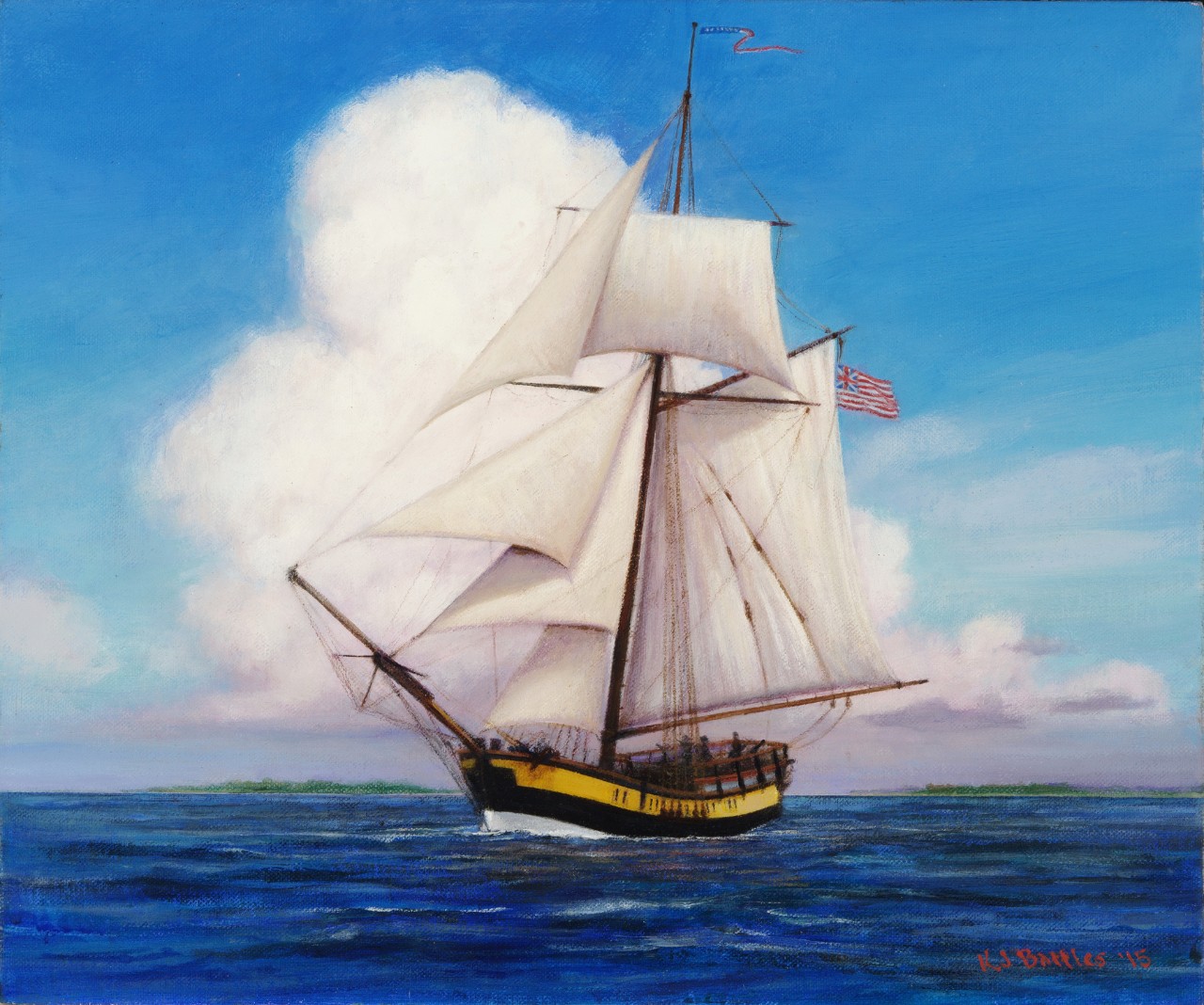
Katy in her later service as the Continental Navy ship Providence. “Sloop Providence under Sail by Kristopher Battles” (Naval History and Heritage Command)

Since his brief visit in November 1774 and his longer term stay commencing in December, Captain James Wallace of the British ship Rose (20 guns), had patrolled Narragansett Bay to enforce the Coercive Acts and prevent Britain’s rebellious colonies from importing gunpowder and armaments.  Loyalists had taken heart and rebels had been frustrated with his presence.   Not only were his patrols interfering with local commerce by seizing ships and their cargos—his main mission—but he created a more visible symbol of Britain’s ability and willingness to force its colonists to comply with Parliament’s laws.  

                One of the loyalists encouraged by the Royal Navy presence in Narragansett Bay was a Newport merchant named George Rome.  Wallace had visited Rome and was dining with him when a breathless messenger warned the captain that a mob was out to tar and feather him back in December, 1774.  In the moment, nothing came of it, but Governor Joseph Wanton warned Wallace that the town was not safe for British officers, sailors, or loyal subjects.  Things remained at a low simmer that winter and spring, including the initial weeks after the Lexington and Concord.  Tensions, however, could not help but rise.  Diarist Ezra Stiles, recorded on May 23 that some 90 Rhode Island soldiers under the command of Captains [John] Topham and [Thomas] Tew marched from the Newport courthouse and through town beating up volunteers to join the nascent American Army.  Wallace was dining in town that day and no doubt heard the racket.[1]  Stiles wrote, “The Tories were greatly mortified to see the daring Boldness of the Rebels as they called them.   The Tories had said that the Men o’War would fire the To[wn] if any Soldiers were raised in it.  But there was no Molestation.”  From Stiles’ version of events, the march appears as nothing less than a provocation to determine whether the rumored threat of Wallace and his ships to Newport proper was a bluff.  The lack of an immediate response may have demonstrated that it was.  In truth, a significant portion of Newport’s population opposed the rebels and voluntarily supplied Wallace and contracted for grain to provide to the British army.

Continue reading “Captain James Wallace’s Tumultuous June 1775 in Narragansett Bay”

“I Have not Yet Begun to Fight!” or Words to that Effect (September 23, 1779)

Bonhomme Richard (Naval History and Heritage Command)

During the night of September 23/24, 1779, Captain John Paul Jones led his frigate, Bonhomme Richard, into its legendary fight with Serapis. In the midst of a battle that was not going well for the Americans, British Captain Richard Pearson asked if Jones was ready to strike his colors and surrender. Jones offered one of the most famous replies in American naval history: “I have not yet begun to fight!” Or did he? Continue reading ““I Have not Yet Begun to Fight!” or Words to that Effect (September 23, 1779)”

The Battle of the Kegs (January 5th, 1778)

Francis Hopkinson
Francis Hopkinson, Signer of the Declaration and Satirical Lyricist

The Philadelphia Campaign did not end well for the Continental Army after three separate defeats at Brandywine, Paoli, and Germantown followed by the British occupation of the new nation’s capital.   Among other things, however, it would produce an amusing little ditty commemorating an attack on the British on January 5, 1778 for American audiences eager to poke fun at the British.

When informed that the British had occupied his adopted hometown, Benjamin Franklin reportedly waved off his concern and replied, “No, Philadelphia has captured Howe.”[i]  Franklin was more militarily astute than many politicians observing the war.  When his army captured Continue reading “The Battle of the Kegs (January 5th, 1778)”

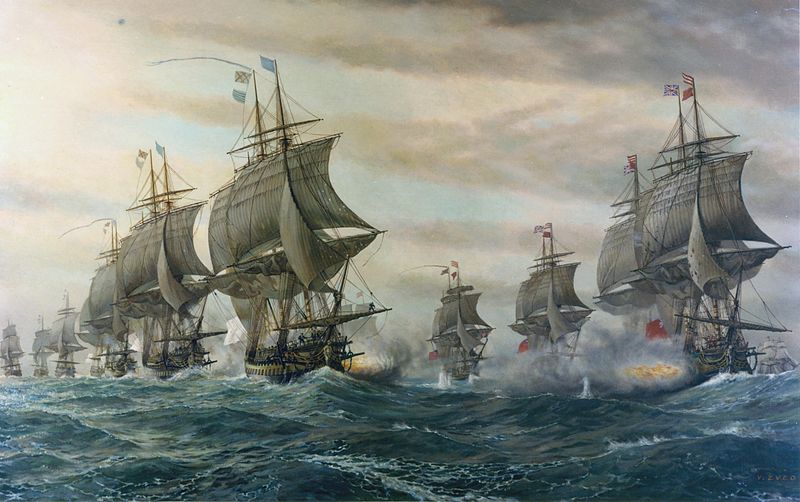
The Virginia Capes, Jutland, and American Destiny

At the end of last month and the beginning of this, I was in Britain marking the centennial of the Battle of Jutland, World War I’s largest naval battle. My great-grandfather was there as part of the Royal Navy, and it was meaningful in the extreme for me to be present at the commemorations.800px-BattleOfVirginiaCapes

The National Museum of the Royal Navy interpreted Jutland as “The Battle that Won the War,” and based its argument on the fact that the battle’s outcome led directly to German resumption of unrestricted submarine warfare, which in turn brought the United States into the war, with all the resulting titanic effects. In other words, a naval battle which didn’t feature a single American had a profound impact on U.S. history.

If that sounds familiar to Revolutionary War scholars, that’s because the same description applies to the 1781 Battle of the Virginia Capes. Let me explain.

Continue reading “The Virginia Capes, Jutland, and American Destiny”