Emerging Revolutionary War Series 2019 Releases

erws-logo

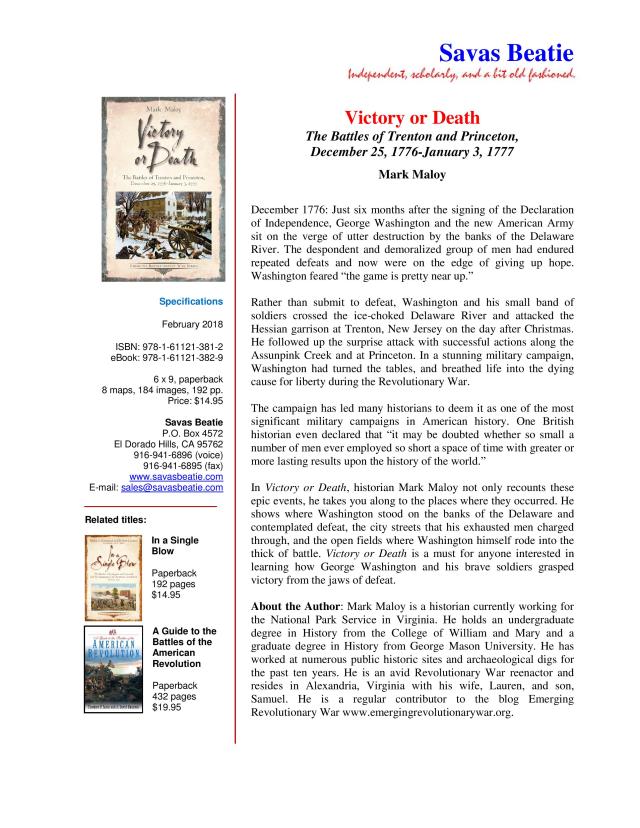
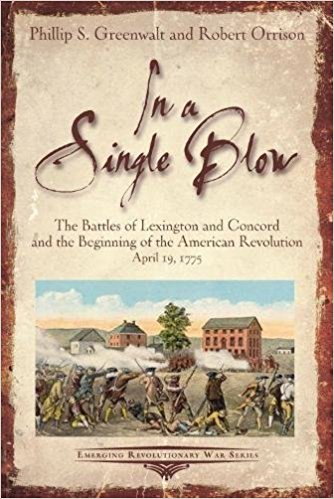
In 2018, the inaugural two volumes, of the Emerging Revolutionary War Series published by Savas Beatie, LLC. Those first two volumes were; A Single Blow, The Battles of Lexington and Concord and The Beginning of the American Revolution and Victory or Death, The Battles of Trenton and Princeton.

In 2019, the series is set to release the next two volumes. The Winter that Won the War, The Winter Encampment at Valley Forge, 1777-1778 and A Handsome Flogging, The Battle of Monmouth, June 28, 1778. This past week, the covers of both were released by Savas Beatie so get a sneak peak below.

Both titles are scheduled for a release later this year. Stay tuned for updates!

Inspiring Books of the American Revolutionary War Era

The start of a new year seems to be coupled with new resolutions and fresh beginnings, naturally. If your list includes looking for that one book to start 2019 with or looking to dive into the American Revolutionary Era with a reading list or you were casting around to settle on a new interest to begin the year with, Emerging Revolutionary War has you covered!

With 2018 coming to a close, Emerging Revolutionary War asked its cadre of historians to share their answers to the following question;

“What was the one book that most influenced you and sparked your interest in this time period of history?”

Their answers are below! Continue reading “Inspiring Books of the American Revolutionary War Era”

Book Review: A Battlefield Atlas of the American Revolution by Craig L. Symonds

ERW Book Reviews (1)

As a young history buff, I remember well wearing out the pages of the original A Battlefield Atlas of American Revolution by Craig Symonds. Though I have no idea where that well worn out book is today, I am happy to see that Symonds has revised and re-released his encompassing atlas, published by Savas Beatie Publishing.917TV+p0UsL.jpg

Symonds, using his experience as a lifelong teacher, approaches the war from the viewpoint of an educator. Breaking the war into four parts chronologically, Symonds provides a short narrative at the beginning of each section giving an overview of the action in each region and year. The battle descriptions for each map are thorough and give a great account of the action and the impact each event had on the overall campaign or war effort.

Symonds should be commended for covering lesser known campaigns and battles of the American Revolution such as Valcour Island, Fort Stanwix, Oriskany, Newport, Penobscot Bay and others. This enhances the work as it shows where these battles took place and speaks to the depth that Symonds took to comb the entire continent to include these minor yet important engagements in the atlas. For many readers, this will be the first time these actions have been visualized through maps.

As in his previous work, cartographer William Clipson provides easy to read and clear maps. The maps provide a good mix of detail and broadness to appeal to the casual history buff and dedicated researcher. As in his other atlases, the text flows well with the map as Symonds has numbers in the text that relate to specific parts of the map.

Though I enjoyed this book, there are two critiques of this volume. First, the size of the text which is very small and condensed. The font style and size selected could prove to be hard for some people to read. Secondly, a few of the maps have been cropped to the point where parts of the maps and text have been cut off, making them incomplete.

This book is a great addition to any library or better yet, in the glove box of your car as you visit these battlefields. It is a perfect companion in the field that allows one to understand the action and provides just enough of an overview to fill in for those battlefields that do not have any signage or interpretation. The information is detailed enough to give you a clear understanding of the battle and campaigns and the maps provide a great visualization of the action.




Review: Brandywine, A Military History of the Battle that Lost Philadelphia but Saved America, September 11, 1777 by Michael C. Harris

ERW Book Reviews (1)

In southeast Pennsylvania on September 11, 1777, the largest battle, by number of combatants, was fought between the British forces under Lord General William Howe and the Continental and militia forces under General George Washington. After the day long engagement, one of the bloodiest of the entire American Revolution, approximately 1,900 men were killed, wounded, or captured. Washington lost 8% of his entire force that day, Howe 4%.

61DmCqGVtrL._SX335_BO1,204,203,200_
Brandywine, A Military History of the Battle that Lost Philadelphia but Saved America, September 11, 1777

Yet, the Battle of Brandywine has been eclipsed by the history that followed shortly thereafter the bloody engagement. Fifteen days after the battle along Brandywine Creek, Howe’s British and Hessian forces will capture Philadelphia and Washington’s army will spend the pivotal 1777-1778 winter at Valley Forge. Although the battle has been the subject of a few histories and folded into larger campaign studies, Michael C. Harris’s book-length treatment is the first to take an analytical and discerning eye to the engagement and separate myth from fact. Published by Savas Beatie, LLC, in 2014 in hardcover, the book has now been released in paperback.  Continue reading “Review: Brandywine, A Military History of the Battle that Lost Philadelphia but Saved America, September 11, 1777 by Michael C. Harris”

Announcement: Emerging Revolutionary War Series

This summer Emerging Revolutionary War will launch its namesake book-series, the Emerging Revolutionary War Series published by Savas Beatie LLC, a military history book publishing company based in California.

The initial two volumes of the series will discuss the Battles of Lexington and Concord, the opening salvos of the American Revolution and also the Battles of Trenton and Princeton, two engagements that kept the cause of American independence alive in the bleak winter of 1776-1777.

Look for the the first two books in stores and online this summer. For a preview, courtesy of Amazon, click here for In a Single Blow. For Victory or Death, click here.

51YZDafuylL._SX332_BO1,204,203,200_ 51GqdvdQhGL._SX332_BO1,204,203,200_


Announcing the New Emerging Revolutionary War Series

ERWS logoAlthough it’s been nearly 250 years since America’s founding, the Revolutionary era continues to capture people’s imaginations. To explore that story even further, the editors of Emerging Revolutionary War have partnered with publisher Savas Beatie, LLC, for a new book series that will highlight the key events, people, and stories of America’s foundational experience.

The Emerging Revolutionary War Series will offer overviews of battles, politics, and biographies aimed at general audiences. Each book will be supplemented with dozens of original photos and all-new maps.

“These books are modeled after our highly popular Emerging Civil War Series,” explains publisher Theodore P. Savas. “The books are reader-friendly, and offer the perfect introductory-level chance to explore some great stories.”

Continue reading “Announcing the New Emerging Revolutionary War Series”

ERW Weekender: The Brandywine Battlefield: A History & Visiting the Field

RevWarWednesdays-header


Emerging Revolutionary War and Revolutionary War Wednesday is pleased to welcome guest historian and author Michael C. Harris this week. 

The Battle of Brandywine was fought on September 11, 1777.  Visiting the battlefield to commemorate what took place there began just three years later.  On his way to Virginia in 1780, the Marquis de Lafayette made a point of stopping for day at the battlefield where he was wounded and giving a tour to the officers that were travelling with him.  An older Lafayette returned in 1825 during his celebrated 15-month tour of America.

However, it would not be until after the American Civil War during the golden age of preservation that any kind of markers or monuments began to appear around the ten-square-mile landscape.  During the 1877 centennial, artillery pieces were placed to mark the fighting near Sandy Hollow.  Eighteen years later, a monument was dedicated along Birmingham Road supposedly marking the spot where Lafayette was wounded.  Had Lafayette been alive, he would have been able to put out the error in location.

Continue reading “ERW Weekender: The Brandywine Battlefield: A History & Visiting the Field”