The Road to Waxhaws: British Moves after the Capture of Charleston

Lieutenant General Henry Clinton, New York Public Library

With the Charleston in British hands, Clinton believed that all he had to do was establish outposts in South Carolina stationed with British regulars. This be believed would put down what was left of the rebellion in the state. These posts assisted the recruitment and training of the thousands of Loyalist troops he believed would now rally around the King’s Colors. To take the best advantage of his Regular troops, Clinton determined to establish three major outposts in the South Carolina backcountry. Clinton established these posts at Augusta (Georgia), Ninety-Six, and Camden. While these posts were to be centers for the British army, the local Loyalist militias were to serve as the pacification forces in South Carolina while the main British force was freed up for larger strategic goals. 

To recruit, enlist, and train the large, expected influx of Loyalist militia, Clinton named Maj. Patrick Ferguson as Inspector of Militia. Ferguson was ordered to enlist younger men, preferably unmarried, into companies that would form battalions. He was instructed to recruit from Georgia to North Carolina and offer short enlistments if necessary. Clinton believed that having the colonists maintain their own law and order (via Great Britain’s authority) would cause less apprehension with those that were mostly undecided about to whom they should throw their support, the Patriots or the British. 

By mid-May, the British army set out for their destinations in the back country. Clinton’s second in command, Lieut. Gen. Charles Lord Cornwallis, marched to Camden while Ferguson moved to Ninety-Six. Without much resistance, Clinton’s plan to conquer South Carolina was working perfectly. Patriot leaders scrambled to find ways to organize their resistance. The only organized Continental force remaining in South Carolina was a small force of Virginians under Col. Abraham Buford that was on its way to Charleston when the city surrendered. Ordered by Brig. Gen Isaac Huger to reverse course and make his way north toward Hillsborough, North Carolina. There along with the North Carolina militia, he could be the core of American defense in North Carolina.  

On May 27, Cornwallis ordered Lieut. Col. Banastre Tarleton with 300 of his dragoons and mounted infantry in pursuit of Buford. Tarleton’s British Legion was mostly composed of Loyalist recruits, so many in his force were from America. Tarleton pushed him men and horses hard, many horses falling out along the way. Buford was aware of a possible British pursuit but underestimated the speed in which Tarleton closed the gap. On May 29, Tarleton caught up with Buford in a region near the South and North Carolina border called the “Waxhaws.”  

Lieutenant Colonel Banastre Tarleton, New York Public Library

The events that took place next are still debated today. Tarleton under a flag of truce tried to get Buford to surrender. Writing to Buford, Tarleton wrote “Resistance being vain, to prevent the effusion of human blood, I make offers which can never be repeated.” Tarleton was already creating an image of himself as an aggressive and brutal fighter. Buford, however, refused, replying, “I reject your proposals, and shall defend myself to the last extremity.” With that, Buford continued his march north towards North Carolina as did Tarleton’s pursuit. Around 3:00 p.m. the lead elements of Tarleton’s force wiped out Buford’s small rearguard, forcing Buford to stop and deal with Tarleton.  

Buford decided to create a single battle line east of the Rocky River Road. Tarleton, ever the aggressive commander, ordered his horsemen to charge the Virginians. Here, Buford made what would be a devastating blunder. He ordered his men to not fire until the British cavalry was within ten yards of the American line. This would not allow the Americans a chance to fire another volley before the British charge was upon them. The Virginians fired, taking out some of the British dragoons and horses (Tarleton himself became briefly trapped under his horse), but most charged through Buford’s line, wielding their sabers and cutting down the Virginians. Total chaos ensued, and many of Buford’s men attempted to flee. Some tried to surrender by throwing their arms to the ground, but American accounts state that the British were offering “no quarter” and killing everyone that tried to surrender. Other accounts report that Buford sent a white flag to Tarleton, but probably because he was injured, it was never received, and the fighting continued. Accounts differ widely between the Americans and British on the fighting, but the fact cannot be argued that Buford’s command was destroyed. 

Waxhaws Grave and Monument, photo and flags courtesy of the author

American casualties were estimated at 350, 113 men killed, 147 wounded, 50 captured, and 2 six-pound artillery pieces and 26 wagons captured. Buford himself was able to escape the field. Tarleton only suffered 5 killed and 12 wounded, a complete victory. What has become known as “Buford’s Massacre” was not referred to as a massacre at all in many period accounts. Tarleton himself blamed the “slaughter” on the fact that his men thought he was killed in the battle and sought revenge. The disparity in numbers and the reports of indiscriminate British slaughter of Americans led to the creation of “Tarleton’s Quarter.” Patriot leaders quickly pounced on this and began to spread stories about Tarleton’s brutal tactics. This proved to be a public relations coup for the Patriot cause, as it energized their side and led to a more robust recruitment of militia and partisan forces to take on the British who now faced no organized opposition in South Carolina or Georgia.

Stay Tuned for the Emerging Revolutionary War Series newest book releases “To the Last Extremity: The Battles for Charleston, 1776-1782” by Mark Maloy and “All That Can Be Expected: The Battle of Camden and the British High Tide in the South, August 16, 1780” by Rob Orrison and Mark Wilcox to learn more abou the 1780 Southern Campaign. Both releases are published by Savas Beatie Publshing: https://www.savasbeatie.com/american-revolution/

Rev War Revelry Tackles the Myth of the Battle of Waxhaws

The Battle of Waxhaws, fought on May 29, 1780, was a lopsided British victory by Lieutenant Colonel Banastre Tarleton’s British cavalry over American Colonel Abraham Buford’s Continental forces in Waxhaws South Carolina. Buford lost 316 of 350 men with the British losing less than 20. Known popularly as “Buford’s Massacre,” Continental leaders used the battle as a propaganda tool against the Crown forces in the south. But, was it really a massacre?

Join us as we welcome historian and author Dr. Jim Piecuch as we discuss his research and theory about the Battle of Waxhaws and its aftermath. Dr. Piecuch has written several books on the Southern Campaign of the American Revolution including his book “Blood Be Upon Your Head: Tarleton and the Myth of Buford’s Massacre.” This Rev War Revelry will be pre-recorded and posted on May 28th at 7pm. Grab a drink and a good seat and enjoy this great presentation on one of the most controversial battles of the American Revolution.

“Rev War Revelry” Author Interview: Andrew Waters

Like a modern-day Nathanael Greene or Edward Carrington, Andrew Waters spends his days trekking the waterways of the Carolina high country. Just like those famous military leaders, Andrew Waters does the surveying of these waterways and their tributaries for his day job; as a land and water conservationist.

During this career, Waters first learned about the “Race to the Dan” the pivotal retrograde movement in 1780 that saved Greene’s army from the pursuing British force under Lord Charles Cornwallis. Having the unique perspective from his training and an interest in the history of the time period, he had the perfect combination to pen a complete history of the “Race to the Dan.” Published by Westholme Publishing in October 2020, the title, To The End of the World, Nathanael Greene, Charles Cornwallis, and the Race to the Dan fills a much needed gap in the historiography of the the American Revolution in the southern theater.

This Sunday, at 7p.m. EDT, on Emerging Revolutionary War’s Facebook page, join us in an interview with Waters, discussing this book, Nathanael Greene’s leadership, and any questions you may have about this subject. Remember that favorite beverage and we look forward to you tuning as we welcome historian and author Andrew Waters to the next installment of the “Rev War Revelry.”

There Will Be Bloody Bill

Emerging Revolutionary War welcomes guest historian Andrew Waters

Appearing this month at the Journal of the American Revolution (JAR) is an article I wrote on William “Bloody Bill” Cunningham and his infamous raid known as the “Bloody Scout.” The article attempts to provide a single-source narrative of the Bloody Scout and some of the contexts for it, although it is based on a previous article I wrote (though never published) that attempted to explore more deeply its sociological implications.

            Anyone who comes to western South Carolina and has any interest in the American Revolution will soon encounter Bloody Bill. As I attempted to explain over at JAR, “without veering too deeply into sociological speculations, I can only say that his (Cunningham’s) presence is still palpable here, embedded in the cultural DNA. Though he may be only a curiosity in other parts of the United States, if he is known at all, in the South Carolina Upstate, it seems there will always be Bloody Bill.”

Continue reading “There Will Be Bloody Bill” →

“I gave my parole once…”

On the morning of August 27, 1780 there was a knock on the door of the Charleston, South Carolina residence of Christopher Gadsden, lieutenant governor of South Carolina. He had stayed when the city capitulated to British forces in May. Gadsden had represented the civil government and handed the city over to the British commander, Sir Henry Clinton. He was released on parole.

Christopher Gadsden

Now, approximately three months later, Clinton was back in New York, and the new British commander Lord Charles Cornwallis had reneged on the parole agreement. Along with another 20 civil officers, Gadsden was led through the town to the docks to a waiting ship, set to sail for St. Augustine in British East Florida.

Upon arrival in the oldest city in European North America, Gadsden was given the opportunity by Governor Tonyn to avoid incarceration in Florida. This is when the 56-year old patriot probably uttered the phrase below.

“I gave my parole once, and it has been shamefully violated by the British Government: I shall not give another to people on whom no faith can be reposed.”

With that decision, Gadsden landed himself in Castillo de San Marcos the large coquina stone fortress that stood guard over St. Augustine. Not only was the South Carolinian kept in a cell, he was kept in solitary confinement for the next 42 weeks!

Upon his release in September 1781, Gadsden and the rest of the civil prisoners were sent by merchant vessel to Philadelphia. Gadsden wasted no time in hurrying southward to South Carolina and a return to the state House of Representatives. He served in various political roles, although he had to decline the governorship because of the affects of his imprisonment. He died in 1805. A grandson, James Gadsden would give his name to the Gadsden Purchase.

Gadsden was held in the cell to the right
(author photo)

Today one can visit Castillo de San Marcos, a national park unit within the National Park Service. When touring the Castillo you can view the cell where Gadsden spent his solitary confinement and read the accompanying exhibits.

History of the Horn Work and the Siege of Charleston

Press Release from our friends at American Battlefield Trust and their Liberty Trail Initiative

In 1757, during the French and Indian War, Lieutenant Emanuel Hess, a Swiss engineer serving in the British 60th Regiment of Foot, designed a series of fortifications to surround Charles Town, South Carolina. Central to this plan was Charles Town’s Horn Work, a large gate flanked by horn-shaped half-bastions covering three city blocks. Before this plan could be fully executed, the threat of a French attack on Charles Town was contained by British victories in Canada and funding for building the fortification system was withdrawn.

However, the Revolutionary War brought a new threat to Charles Town — this time from the British, and work to fortify the city was resumed by determined Patriots. The Horn Work, with its 30-foot-high walls constructed from an oyster-shell cement called tabby, became the centerpiece of the city’s defensive line and the headquarters for American commanding officers.

Beginning in late March 1780, the British laid siege to Charles Town and trapped the American forces in the city. On May 12, 1780, American Generals Benjamin Lincoln and William Moultrie — standing under the Horn Work’s arched gateway — surrendered to the British, in what was the largest American surrender of the war. The fight for American independence looked bleak on that day, but the resolve of the Patriots in the coming months would turn the tide toward victory.

Modern-Day Archeology

In the years following the Revolutionary War, the tabby walls of the Horn Work were dismantled to make way for the growth of the city. Today, all that remains above ground of the once towering structure is a small remnant in Charleston’s Marion Square — a vibrant urban park located in the heart of downtown Charleston and named for Revolutionary War general and backcountry tactician, Francis Marion. Yet, just a foot under the surface of Marion Square, there is much more to discover about the Horn Work.

In February of this year, graduate students from the Clemson/College of Charleston Historic Preservation program, working on behalf of the American Battlefield Trust and South Carolina Battleground Trust’s Liberty Trail, commenced an archeological study to fully document the exact footprint of the Horn Work for the first time. This study was undertaken in partnership with many organizations, including the Charleston County Library, the Charleston Museum, the South Carolina Institute of Archaeology and Anthropology and the Washington Light Infantry and Sumter Guards.

More than 250 years after work began to build the Horn Work, these graduate students utilized modern technology, including ground penetrating radar, to ensure the protection of this important historic resource and enhance future endeavors to tell its story.

Charleston Gateway

While no period drawings or plans of the Horn Work are known to have survived, the findings of this archeological study, together with historical research on comparable tabby fortifications built in the same area and time by the same engineer, have made it possible to create a rendering of the Horn Work for the first time. With this rendering complete, we are now able to explore a variety of opportunities to interpret the Horn Work in the very place it once stood.

Our goal is to create an outdoor exhibit in Marion Square utilizing an array of interpretive techniques, including physical signage, in-ground markers tracing the footprint of the Horn Work, and Augmented Reality — all designed to bring the Horn Work and the Siege of Charleston to life for visitors. Augmented Reality, in particular, presents a chance to use cutting-edge 21st Century technology to tell this 18th Century story.

Just as the Horn Work was the gateway into Charleston before and during the Revolutionary War, we now seek to create a gateway into the Liberty Trail through Marion Square, which will encourage visitation to battlefields throughout South Carolina and beyond.

For more information on this subject, click here.

Thank you to Catherine Noyes, Liberty Trail Program Director for bringing this to our attention,

“Rev War Revelry” Stays in South Carolina…

After last week’s riveting discussion on the pivotal battle of Kings Mountain, Emerging Revolutionary War decided to stay in the Palmetto State again this week. We have two special guests and historians joining “Rev War Revelry” so set a reminder to tune in on this Sunday, on our Facebook page, at 7pm EST.

From the American Battlefield Trust Catherine Noyas will join the revelry and discuss land acquisition in regards to the American Revolution around Camden, including the new visitor center that will open in spring 2021. She will give highlights on the work being done and the history behind the various initiatives.

From the South Carolina Battlefield Preservation Trust comes historian Doug Bostick. Their mission coalesces with the American Battlefield Trust with the shared goal of preserving the hallowed ground of the Palmetto State. Along with promoting the military history of the state as well.

There will also be mention of the Liberty Trail, so tune in to learn more about that program as well!

We hope you can join us for a chat on preservation, interpretation, and military history on Sunday evening.

“Rev War Revelry” Heads to Kings Mountain

On October 7, 1780, patriot militia, some coming from over the Appalachian Mountains descended on a Loyalist militia force in northwest South Carolina. This pro-British force, commanded by the only British regular on the field that day, Major Patrick Ferguson retreated onto Kings Mountain.

American fought American.

On that hilltop one of the pivotal battles of the American Revolutionary War unfolded. The ramifications reverberated through the southern theater of operations, played a part on the psyche of civilians and militia, and added luster to the burgeoning backwoods, frontier American persona.

Emerging Revolutionary War focuses in on the Battle of Kings Mountain this Sunday, on the next “Rev War Revelry.” Join us on our Facebook page at 7 p.m. EST for a historian happy hour, as we discuss, dissect, imbibe, and provide commentary on this strategic battle, the national park there, and the campaigns that decided this theater of operation.

(courtesy of NC Encyclopedia)

“He was everything an excellent officer should be…” Remembering Baron de Kalb

On this day, in 1780, Baron de Kalb, died at 59 years old. He had commanded admirably at the Battle of Camden, on August 16, 1780, overseeing the right of the American line where he received his mortal wounds.

Marker on the Camden Battlefield, although not in the “exact spot” that Baron de Kalb fell (author collection)

Below are a few excerpts about the German-born de Kalb.

On his deathbed, as noted by his aide, the Chevalier du Buysson, de Kalb wanted it known that:

His most affectionate compliments to all the officers and men of his division; he expressed the greatest satisfaction in the testimony given by the British army of the bravery of his troops….and the exemplary conduct of the whole division gave him an endearing sense of the merit of the troops he had the honor to command.

Although just a child, at seven years old, in August 1780, Mary Kershaw remembered the day de Kalb was buried in Camden. She lived until 1848 but would regale people with her reminiscences.

She also witnessed the burial of Baron de Kalb, with his sword at his side, between two British officers. It would later be found that “he lay, it seems, in the ‘custom of knighthood’ as last of his race, buried in his armor, that is to say his helmet, his sword, and his spurs were in the grave with him.

Original grave location for de Kalb in Camden (author collection)

General Horatio Gates, who commanded the American forces at Camden, penned the following to General George Washington, upon the news of de Kalb’s passing.

Too much honor cannot be paid by Congress to the memory of Baron de Kalb; he was everything an excellent officer should be, and in the cause of the United States he sacrificed his life.

Lastly, the French ambassador and former staff officer of de Kalb, the Duke de la Luzerne, wrote:

The fall of that excellent Officer, the Baron de Kalb–so much to be regretted by France and the United States…

Yet, the spirit of de Kalb. the resolute soldier, would live. Both within his former division and in the reconstituted Continental forces in the southern theater, as these regular army soldiers (and militia) would see the cause through to a successful conclusion.

For more information and the source of these excerpts please consult:

“De Kalb, One of the Revolutionary War’s Bravest Generals” by John Beakes

Stolen Honor in Georgia

Emerging Revolutionary War welcomes back guest historian Gabriel Neville.

Thirty years ago, Dutch Henderson was “stomping through the woods” near Lake Sinclair in central Georgia when he stumbled upon an old gravestone. Some might have thought it an odd spot for a grave, but Dutch knew the history of the area and it made sense. In fact, the setting told him the man six feet under had played an important role in American history.

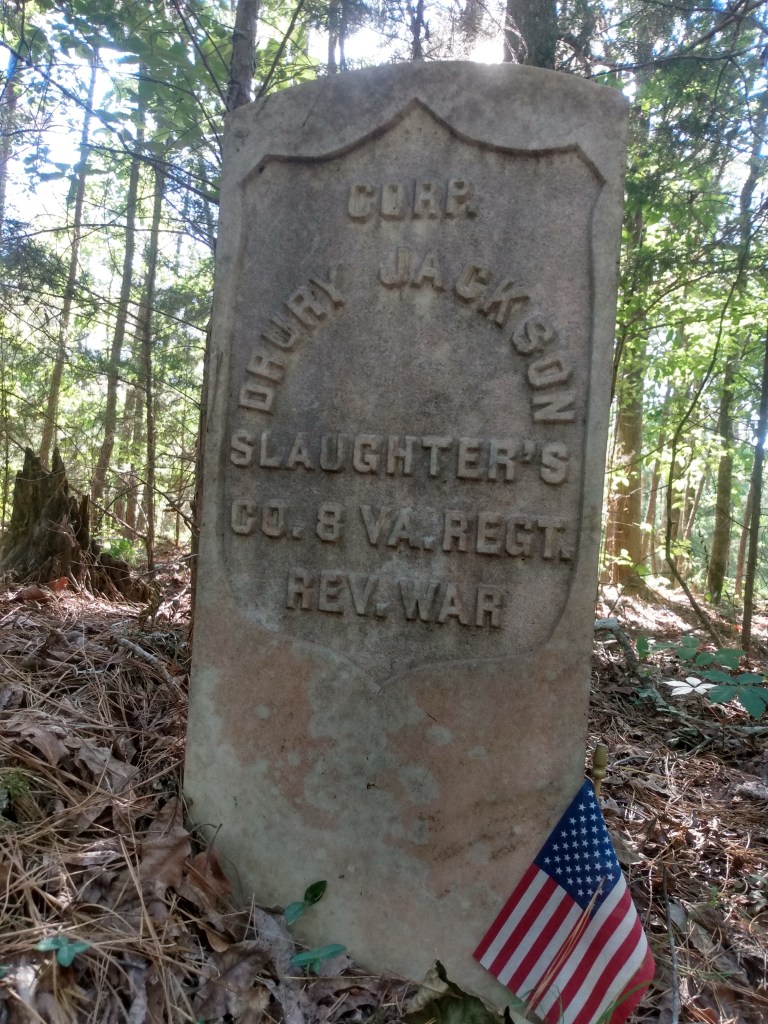
The inscription on the marker read: “CORP. DRURY JACKSON, SLAUGHTER’S CO. 8 VA. REGT. REV. WAR.” Why was this headstone for a Revolutionary War soldier all alone in the woods near a lake? Time changes things. Neither the lake nor the woods were there when Drury Jackson died. Back then the grave was on cleared ground overlooking the Oconee River. Depressions in the soil still reveal to the trained eye that Drury was buried in proper cemetery. The river became a lake in 1953 when it was dammed up to create a 45,000-kilowatt hydroelectric generating station. When Dutch found the grave, the cemetery had been neglected and reclaimed by nature. Today it is in a copse of trees surrounded by vacation homes.

The mysterious headstone for veteran Drury Jackson provides no dates to help us identify the man in the ground. (Dutch Henderson)

Dutch spends his free time studying local history and conducting archeology. He has made some important finds, including a string of frontier forts along what was once the “far” side of the Oconee. He’s pretty sure that Drury’s burial in that spot is an important clue to his life in the years following the Revolutionary War. From there, however, things get complicated.[1]

A genealogy site sporting a photo of the headstone tells us that Drury Jackson was born in Brunswick County, Virginia on February 2, 1745, married Lucy Dozier and then Nancy Ann Kennedy, and died in Wilkes County, Georgia before 1794. This seems possible, but Wilkes County is about seventy miles northeast of the grave. Another source tells us that Drury Jackson was born in 1767 in Franklin County, Tennessee, married Lucy B. Myrick, and died in Baldwin County, Georgia in 1823. This seems more likely, since the grave is in Baldwin County.

So, which of the two men is the right Drury Jackson? The easy assumption is that the stone properly belongs to the one who died nearby. The grave marker itself is of no help. It provides neither the date of his birth nor the date of his death. Moreover, it is the kind of marker that was issued after 1873 by the federal government for the graves of veterans of the Civil and Spanish-American wars (and the unmarked graves of veterans of earlier wars). It is clear that the marker was placed there long after the man’s death by descendants or others in the community.[2]

Continue reading “Stolen Honor in Georgia” →