A Venezuelan Connection

Emerging Revolutionary War welcomes guest historian Dr. Nathan Provost

With the recent rumblings about Venezuela, it is important to remember that Venezuela’s independence began with a veteran of the American Revolutionary War. Francisco de Miranda was born on March 28, 1750, in Caracas, Venezuela. At the time, Venezuela and much of the Americas were under Spanish control. Born into a life of luxury, Miranda attended prestigious institutions of higher education, including the Royal and Pontifical University of Caracas. He later continued his education in Spain, eventually raising enough money to purchase his rank of Captain in the Princess Regiment. His first experience of combat was in North Africa against the Moors of North Africa. Upon returning to Spain, Miranda waited for another military operation to accompany. An ambitious young soldier, he sought adventure, wanting to see the world through military service. In 1780, Miranda reported to the Regiment of Aragorn; their destination was Havana, Cuba. Their objective was to concentrate with Major General Bernardo de Galvez’s men at Pensacola, Florida.
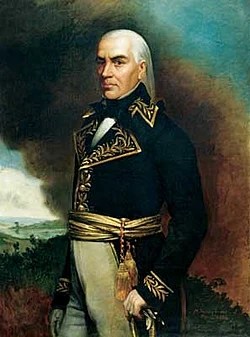
Francisco de Miranda

Spain was no ally of the recently independent United States; rather, their alliance with France was much more significant. After France entered the conflict following the American victory at Saratoga, Spain declared war on Great Britain in 1779. Spain had its own goals, hoping to reclaim territory in Florida lost during the Seven Years’ War. The Spanish were fortunate to possess a brilliant military officer, Bernardo de Galvez. He already captured what is now Baton Rouge, Louisiana, and Mobile, Alabama. All that was left was Pensacola on the Florida Coast. Galvez took several warships and many more transports filled with 3,701 men to lay siege to Pensacola, Florida. Inclement weather and Choctaw resistance interrupted their initial movements, but Galvez pressed on and established his army outside the walls. The number of troops was insufficient to make any headway against the British fortifications, despite the construction of a series of entrenchments and artillery positions. Then, on March 24, much-needed Spanish reinforcements arrived, among whom was Francisco Miranda. 

Upon landing, Miranda noted Galvez was there to meet them. Miranda observed several entrenchments already constructed, but a few hundred men were already out of commission since the siege began. Upon learning this information, he knew that Galvez desperately needed these reinforcements. It was not until April 24 that all the soldiers disembarked at Pensacola.  During the siege, Miranda personally inspected the siege lines and terrain and reported back on this reconnaissance to Galvez. Miranda and his men, entrenched outside the fort, often came under fire from the British artillery. There were also several skirmishes outside the breastworks in which the Spanish sustained some casualties. In one particular episode, Miranda and five companies of his men engaged in a firefight with some Native Americans. The fighting lasted roughly an hour and a half, with six of the Spanish wounded, but a Frenchman deserted the Natives and went over to the Spanish after the fight. In each of these skirmishes.

Continue reading “A Venezuelan Connection”

The Revolution’s Southwest Front

Emerging Revolutionary War is honored to welcome back historian Robert “Bert” Dunkerly. 

During a trip to Mobile, Alabama for some Civil War research, I came across a fascinating and lesser-known aspect of the American Revolution.  When I travel, I always keep my eye out for unusual finds and hidden history.  I was rewarded on my trip to Mobile with a great discovery.

Ft C
Fort Conde (author collection)

One of the main historic sites in downtown Mobile is the reconstructed Fort Conde.  This brick fort interprets the early history of Mobile and the region under the flags of France, Spain, and the United States.  Just outside the fort is a marker discussing the battle of Fort Charlotte.

Mobile was originally the capital of the French Louisiana Territory until the close of the French and Indian War.  As part of the settlement of that conflict in 1763, this French territory passed to the British.  Fort Conde, built in 1723, was renamed Fort Charlotte by its new owners.

Map
Map of Ft. Conde superimposed over modern Mobile streets, (photo by author)

Most of us know that the French were anxiously watching the American Revolution when the conflict broke out, hoping to score revenge against their English adversaries. Also watching with interest were the Spanish.

The British garrisons along the Gulf of Mexico coast (Pensacola, Mobile, Baton Rouge) were quite small and vulnerable.  The Spanish had been providing material aid and funds to the Americans, but finally declared war on Britain in 1779.  The Spanish were ambivalent about American independence, and unlike the French, did not recognize the United States, but did agree to help militarily.

Even before Spain’s entry into the war, New Orleans was a source of aid smuggled in for the American effort.  The Crescent City, and all the land west of the Mississippi, had been awarded to Spain at the close of the French and Indian War.  From here, supplies moved up the Mississippi to Fort Pitt at Pittsburgh, PA.  And from New Orleans, Governor Bernardo de Galvez attacked British posts up the Mississippi and along the Gulf Coast.

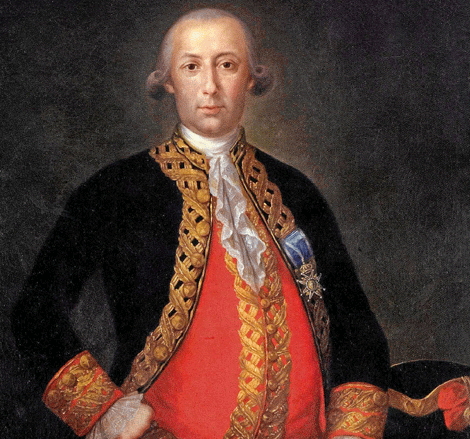
bernardo
General Bernardo de Galvez, (artist unknown)

A statue of the Spanish general who did much to wrest the Mississippi and Gulf coast areas away from the British stands near the World Trade Center in New Orleans.  A gift from Spain to the city of New Orleans, the statue is a reminder of this important but neglected aspect of the war.  A group known as Granaderos y Damas de Galvez are dedicated to preserving his memory and that of the Spanish role in the Revolution.

Oliver Pollock was a Philadelphia merchant with close ties in Cuba and New Orleans.  When the war broke out, he used his connections to aid the Revolutionary cause from the Crescent City.  In 1777 he was appointed “commercial agent of the United States at New Orleans” and used his fortune to finance American operations in the west, such as General George Rogers Clark.  When Spain entered the war he served as an aide to General Bernardo de Galvez.

Moving up from New Orleans, a force under General de Galvez, that included Spanish troops, American volunteers, Acadian settles, and free blacks, attacked and captured the British outpost of Fort Richmond at Baton Rouge on September 21, 1779.  Today a memorial with plaques and a cannon marks the site.

In February, 1780, Spanish troops and American volunteers under Governor Bernardo de  Galvez laid siege to the 300 British in Fort Charlotte at Mobile.  The siege lasted a month.  The garrison’s surrender gave the Spanish control of this important site, and removed all English military forces from the Gulf region.

This was one of the few actions of the war in which Spanish and American troops fought side by side.  Spain declared war on Britain but did not recognized the United States, their primary interest being to settle scores with the British.


For more information on these fascinating events, check the following websites: 

http://www.museumofmobile.com/ft_conde.php

http://granaderos.org/