The Burning of “Madam Souchong” and the Women of Providence Who Burned Her

Emerging Revolutionary War welcomes back guest historian Bjorn Bruckshaw

On a chilly but sunlit afternoon in Providence, smoke began to rise over Market Square—not from hearth fires meant to warm the town, but from a blaze built in defiance. As the smell of burning tar and tea drifted through the streets, cheers and shouts of defiance echoed through the square. Nearby, a man moved quickly from shop to shop, brush and lampblack in hand. One by one, he painted over a single word on storefront signs: TEA. This was no act carried out in secret. According to the Providence Gazette, he was “a spirited Son of Liberty,” and he worked in full view of the town as a crowd gathered around the growing fire.¹  

Just beyond him, the protest had already begun.

Earlier that day, a town crier had moved through Providence announcing that a quantity of India tea would be burned in the Market Square that afternoon, calling upon “all true friends of their country, lovers of freedom, and haters of shackles and hand-cuffs” to assemble and cast the tea into the flames.² By the appointed hour, the square was filled. This was no spontaneous outburst. It was organized, deliberate, and intended to be seen.

At the center of the gathering, flames climbed upward as a barrel of tar was placed upon the fire. Into it were thrown not only tea—hundreds of pounds of it—but also printed copies of Lord North’s speech and other “obnoxious English papers.” ³ the destruction was more than economic protest. It was a public repudiation of British authority itself. And then came the moment that set Providence apart.

These were not men disguised as Mohawk Indians, shrouded in secrecy under the cover of night as in Boston. This was something different—an open, public act carried out in daylight. At its center stood the women of Providence, dressed in everyday clothing, without disguise, stepping forward with the same patriotism and candor to cast the tea into the flames before the gathered town.⁴

In that moment, the Providence Gazette captured one of the most remarkable features of the event, noting that the tea was “fed to the fire by the women of the town.”⁵ Women, long central to colonial resistance through boycotts and the management of household consumption, now stood in the public square, actively participating in the destruction itself. This was not quiet resistance confined to the home. It was visible, communal, and unmistakable.
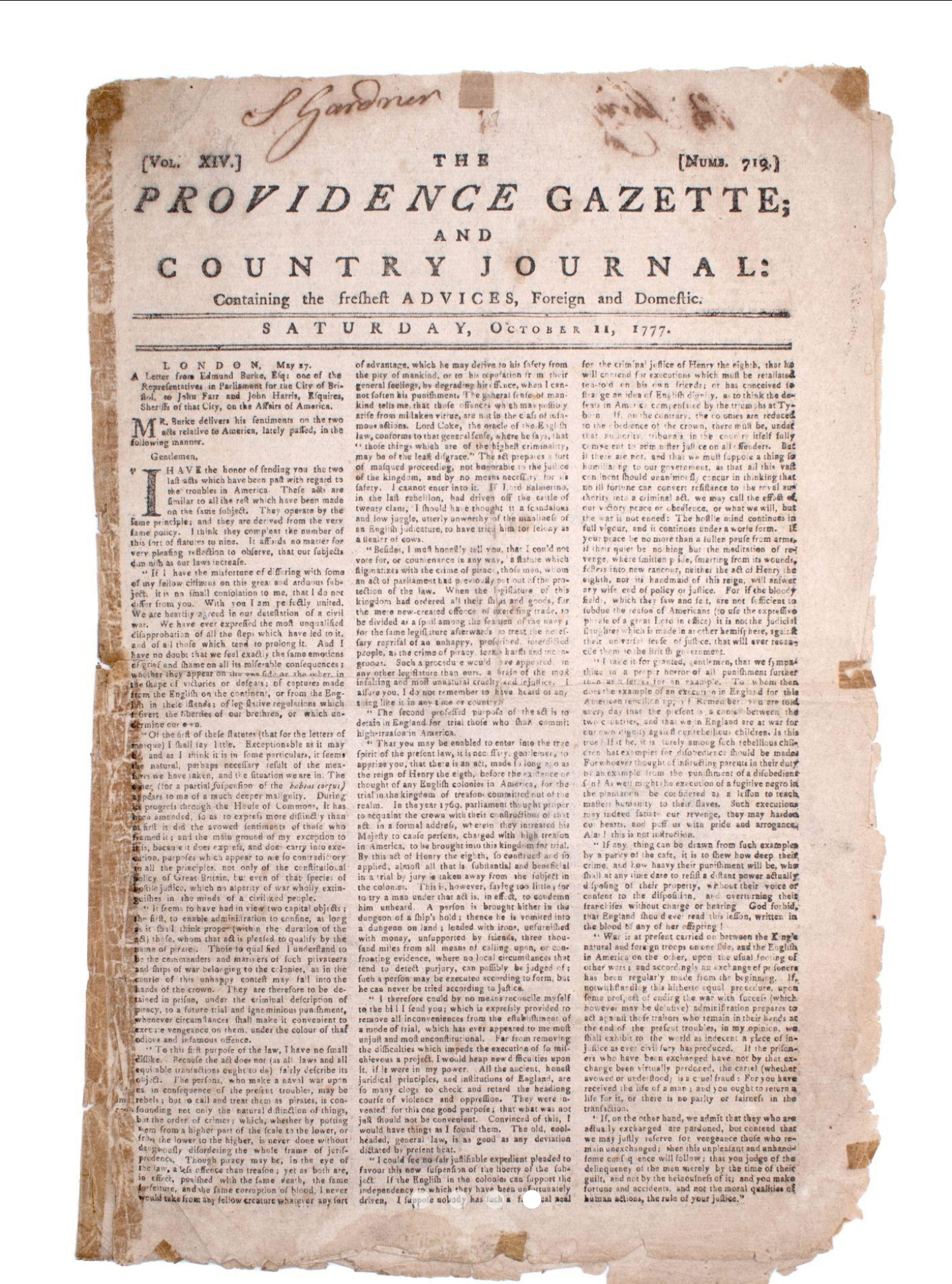
The prominence of women in the Providence protest did not go unnoticed beyond Rhode Island. In Virginia, the event was reported in the Virginia Gazette, where the destruction of tea was described in strikingly gendered and satirical terms. The article referred to the event as the “funeral of Madam Souchong,” personifying the tea as a female figure while simultaneously reinforcing contemporary stereotypes about women.⁶ In doing so, the report transformed the protest into a symbolic spectacle, revealing how acts of resistance in one colony could be interpreted—and reshaped—by observers in another.

Rhode Island had already established itself as one of the most defiant colonies in British North America. Its long-standing resistance to imperial regulation, fueled by its maritime economy and frequent clashes with customs enforcement, made it a persistent source of frustration for British authorities. Loyalist observers took note. Writing during the conflict, Peter Oliver described resistance in New England as the work of “lawless men” driven by mob influence, portraying their actions as rooted in disorder rather than lawful opposition.⁷ British officials expressed similar concerns in the aftermath of the Gaspee Affair, viewing the destruction of the customs schooner as a “daring insult to the authority of the Crown” and evidence that resistance in Rhode Island had reached a dangerous level.⁸ In June 1772, that defiance became unmistakable when local patriots burned the Gaspee, a British vessel sent to enforce imperial law.

The British response only deepened colonial fears. Officials threatened to transport suspected participants to England for trial, raising concerns about the erosion of traditional rights and legal protections.⁹ In Rhode Island, the lesson was clear: British authority was not only intrusive but increasingly dangerous.

Continue reading “The Burning of “Madam Souchong” and the Women of Providence Who Burned Her”
Stepping Onto Long Wharf and Into History: The Day the British Came To Boston

Emerging Revolutionary War is honored to welcome guest historian Katie Turner Getty. A short biography is at the bottom of the post. 

In terms of historical significance, few American cities rival Boston, where shades and shadows of the Revolution can be found around every corner. By walking the city’s famous Freedom Trail, one can follow in the literal footsteps of the inhabitants who left such an indelible mark on the city. Indeed, many heroes of revolutionary Boston—Revere, Adams, Otis—lie in their eternal repose in burying grounds mere steps from busy thoroughfares.

The presence of those revolutionaries still looms large in Boston and many of their old stomping grounds still stand. Several buildings located on the Freedom Trail played unforgettable parts in the revolution. From the fiery speeches at Old South Meeting House on the eve of the tea party to the blood shed by those massacred outside the Old State House*, these sites are popular and are frequently visited.

But there is one site not located on the Freedom Trail that is yet imbued with great historical import. Indeed, it is the site of the 1768 arrival of British warships in Boston Harbor and the troops who first took those fateful steps into Boston for the purposes of occupying the city.

katieturnergettyphoto1
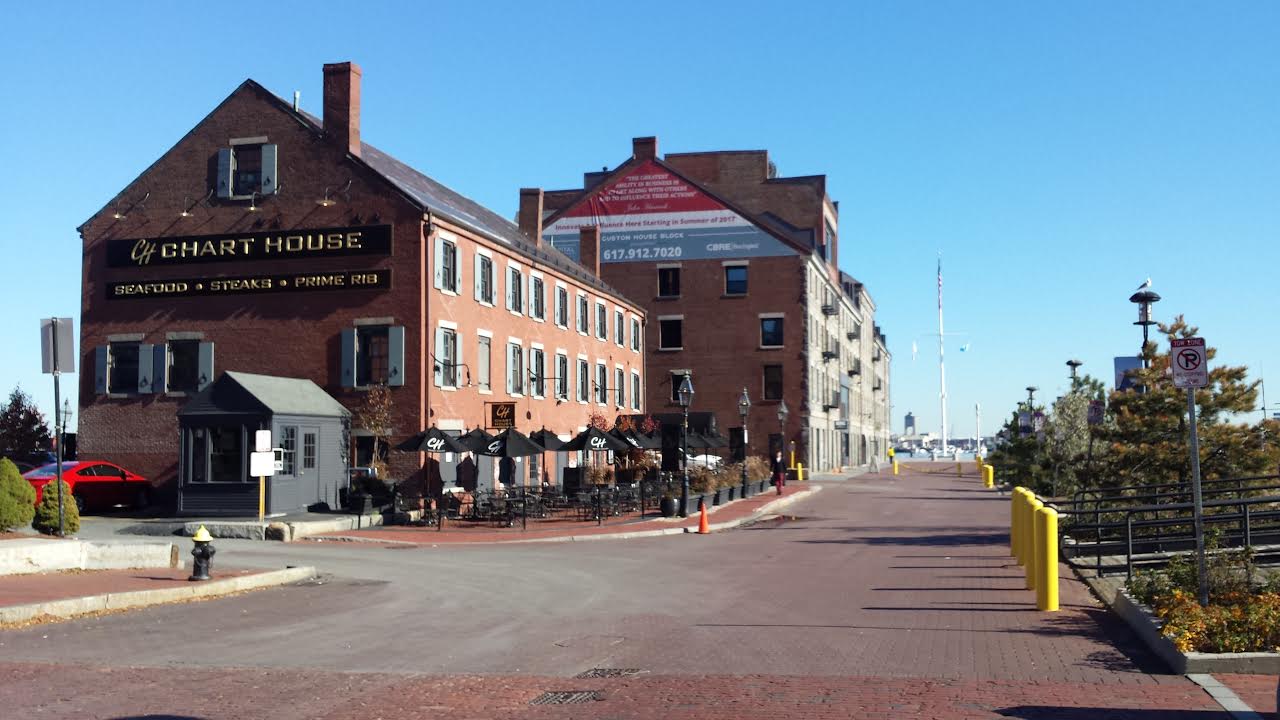
East-facing view of Long Wharf and John Hancock’s office and counting house, built in 1763, and now the Chart House restaurant.

The name of this site, so often overlooked, is Long Wharf.

Long Wharf has stretched into the Atlantic from Boston for 300 years, serving as the world’s great doorway to the city. It was the longest wharf in Boston, extending 1,586 feet into the deep water of the harbor allowing up to 50 ships to dock at one time[1]. It would have been a place of great bustle—the loading and unloading of cargo by longshoremen, transporting of such cargo to the busy warehouses and shops that lined the wharf, and then the purchase of such goods by local people.

katieturnergettyphoto2
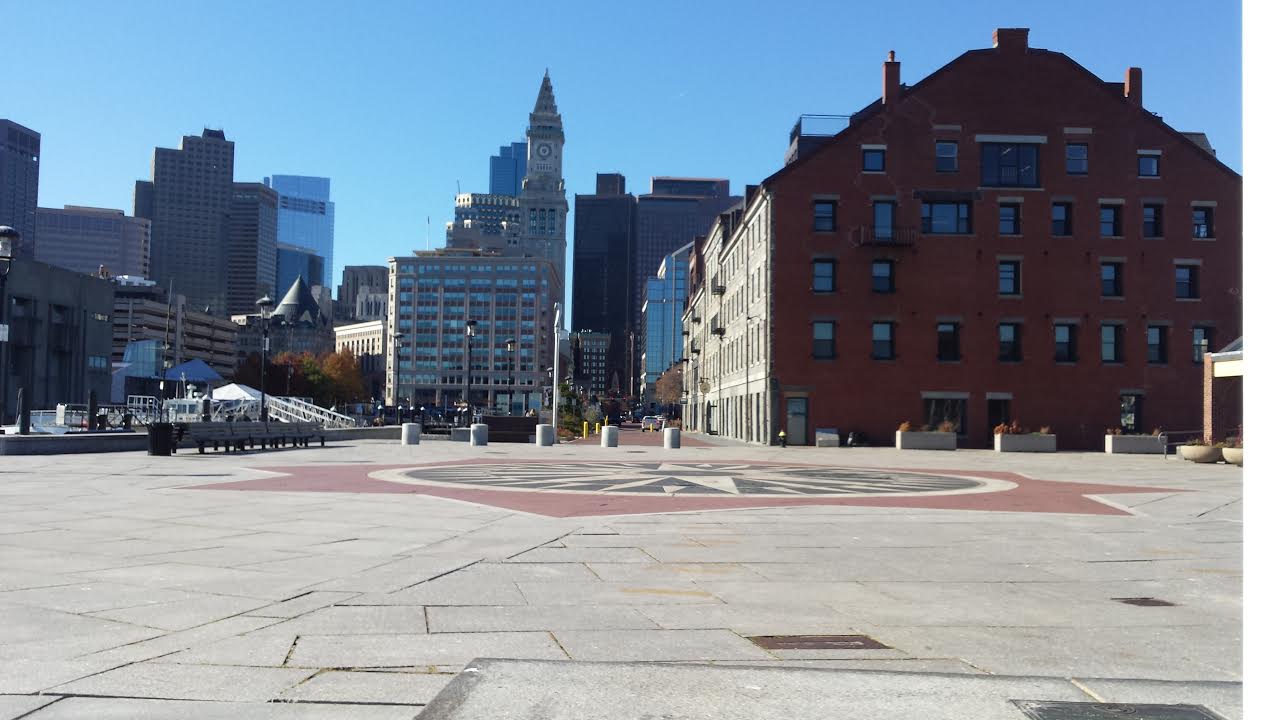
West-facing view toward Boston, from the end of Long Wharf. The Town House (now known as the Old State House), built in 1713, is in the distance.

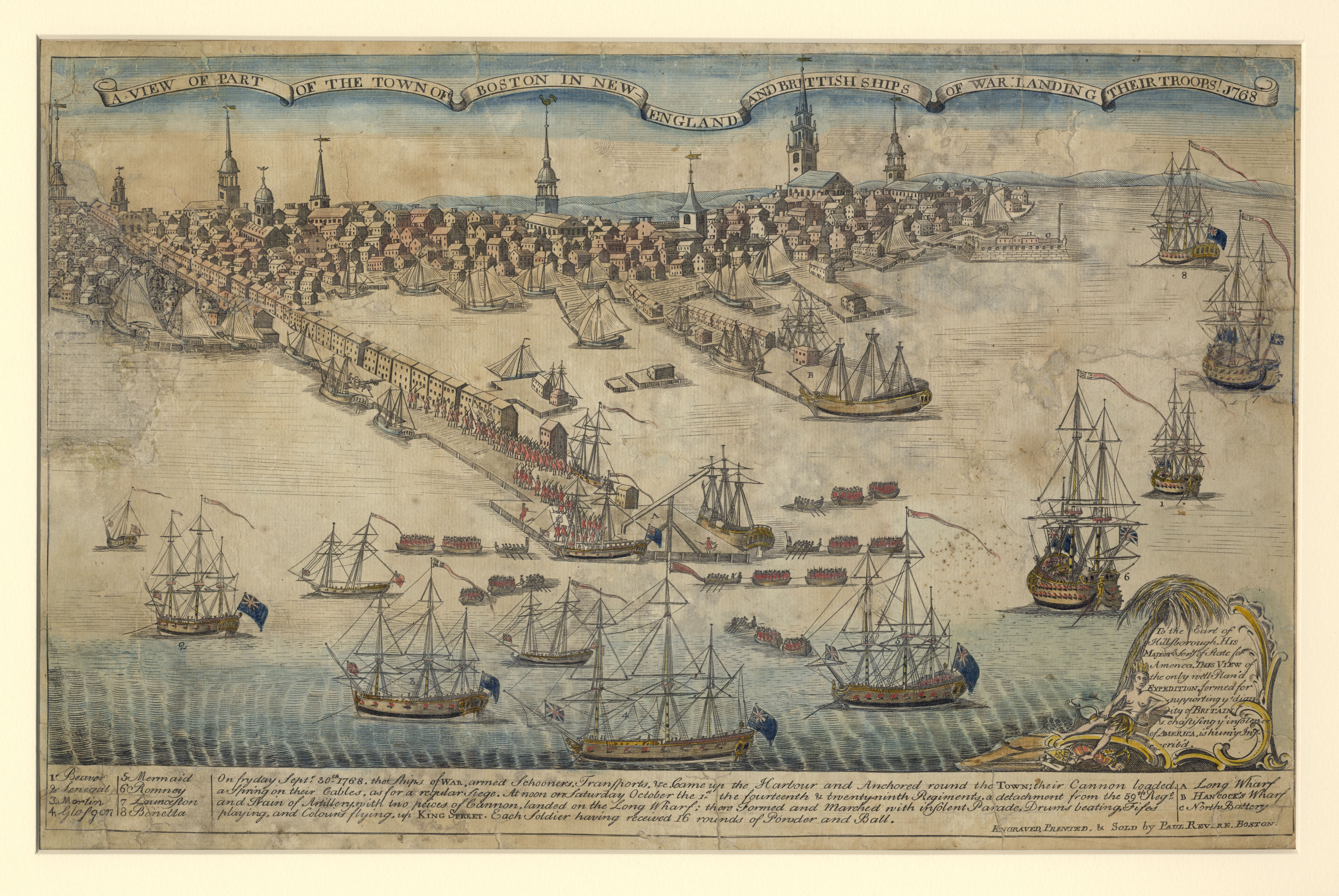
On Friday, September 30, the Beaver, the Senegal, the Martin, the Glasgow, the Mermaid, the Romney**, the Launceston, and the Bonetta anchored in the harbor. On board the ships were “the 14th and 29th Regiments, a detachment from the 59th regiment, and an artillery train”.[2]  The next day, Bostonians warily watched as “the war ships maneuvered closer to the town and ranged themselves as if for a siege.”[3] Then, carried off the warships by small boats, British troops stepped onto Long Wharf and into American history.

These ships and troops had arrived in the port of Boston as a response to colonial opposition to the Townshend Acts which were enacted by Parliament in 1767 in an effort to enforce their sovereignty over the colonies and raise revenue. The Townshend Acts imposed a tax on imports such as tea, glass, paper, and paints, as well as instituted a Customs board to help enforce British trade regulations and deter smuggling activity. Many Bostonians were opposed to the Townshend Acts and protested by gathering in mobs and harassing officials.

katieturnergettyphoto3
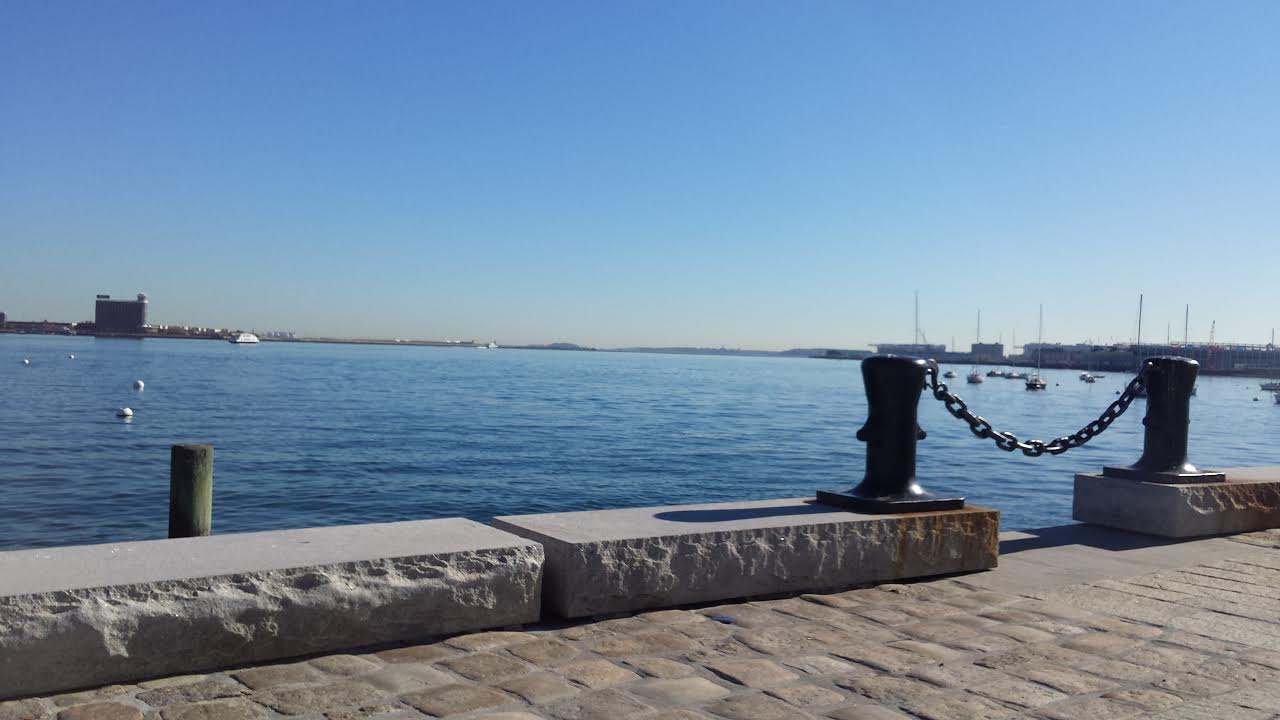
View of the Atlantic Ocean from the very end of Long Wharf.

Paul Revere immortalized the landing of the troops in an engraving entitled “A View Of Part of the Town of Boston In New England And Brittish [sic] Ships of War Landing Their Troops! 1768”. The image depicts the eight British ships of war arrived in the harbor, with smaller boats carrying red-coated soldiers to Long Wharf. Some troops are already amassed on the wharf, gathering into formation.

katieturnergettypaulrevereengraving
“A View of Part of the Town of Boston In New England And Brittish [sic] Ships of War Landing Their Troops! 1768” (courtesy of American Antiquarian Society http://www.americanantiquarian.org/Inventories/Revere/b2.htm )
Revere’s engraving also shows many buildings running along the north side of Long Wharf in an uninterrupted line toward the town. They were warehouses, counting houses, shops, and dwellings. One of these buildings was John Hancock’s Counting House, which still stands on Long Wharf today. Currently incarnated as a restaurant called the Chart House, it is the oldest extant building on Long Wharf, built in 1763. John Hancock’s original wall safe is actually still set in the red brick wall of the second floor dining room. The safe is not off-limits; visitors may freely open and close the safe’s inner and outer doors or even run a hand over the smooth metal.

katieturnergettyphoto4
John Hancock’s original safe, still fixed in the wall of his Counting House.

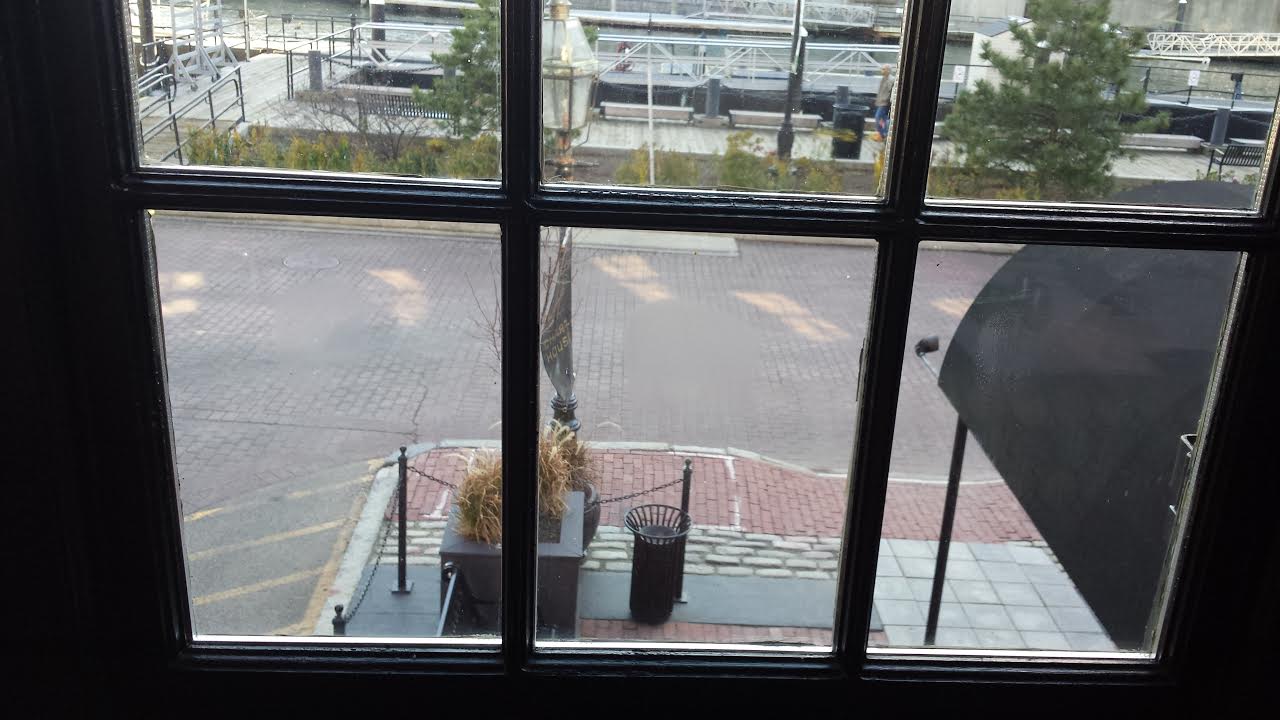
When standing at the wall safe, take a few steps to the right and look out the front windows of the building. Look down to the ground level to see the path of the troops as they passed right by Hancock’s Counting House, “with insolent parade, drums beating, fifes playing, and colours flying, up King Street” as they headed down the wharf and into the town. The soldiers were marching to the Town House, at the base of King Street. And beyond that, to Boston Common.

katieturnergettyphoto5
View out a second floor window of Hancock’s Counting House, a few steps from the wall safe. The viewer is looking down at Long Wharf where the British troops marched past on October 1, 1768.

Long Wharf at the time (as it is today) was really just an extension of King Street, which ran all the way from the Town House (later to become the site of the Boston Massacre), down to the shoreline, then continued along in the form of a wharf, out into the harbor. After the Revolution, King Street was (perhaps appropriately) renamed State Street and is known by that decidedly more American moniker today.

The soldiers’ route may be traced today by any perambulating history enthusiast. Walk out past Hancock’s Counting House, to the terminus of Long Wharf and stand where the British soldiers disembarked. As you gaze out across the cold gray Atlantic, feel the stiff sea breeze rolling in off the water just as they did. Then turn your gaze away from the Atlantic and look back toward the city. The view is the same as in 1768—the Town House will be in your direct line of sight. As the soldiers marched down the wharf in a straight line, they too would have seen the Town House quite clearly.

A pamphlet published by the Boston Redevelopment Authority in the 1980s reveals that although the wooden timbers of Long Wharf are experiencing decay, the 17th and 18th century granite bulkheads beneath the wharf are still intact.[4] It is a thrill for any revolutionary history enthusiast to walk out to the end of Long Wharf, knowing that deep beneath his or her feet are the very same granite blocks, impervious to time and history, that bore silent witness to the arrival of the British soldiers who stepped onto Long Wharf and into history when they came to occupy Boston.

*The building known today as the Old State House was known in the 1770s as the Town House.

**The Romney actually arrived in Boston Harbor in May 1768 to help enforce customs and discourage the flouting of trade regulations, attempting to seize John Hancock’s ship, Liberty.
*Katie Turner Getty is a lawyer, history enthusiast, and lifelong resident of Boston. She holds an A.A. from Bunker Hill Community College in Charlestown, Massachusetts, a B.A. in History from Wellesley College, and a J.D. from New England Law Boston. She can often be found exploring historic sites both on and off the Freedom Trail.


Sources:

[1]  National Park Service, “Long Wharf and Custom House Block,” Maritime History of Massachusetts, accessed October 28, 2016, http:// https://www.nps.gov/nr/travel/maritime/lon.htm%20

[2] Paul Revere, A View of Part of the Town of Boston in New England and Brittish [sic] Ships Landing Their Troops! 1768, circa 1770, engraving, 26 x 40.5 cm, American Antiquarian Society, Worcester, Massachusetts http://www.americanantiquarian.org/Inventories/Revere/b2f1.jpg

[3] Richard Archer,  As If An Enemy’s Country (Oxford: Oxford University Press 2010), xiv.

[4] Boston Public Library, “Long Wharf”, Sasaki Associates, Boston Redevelopment Authority, 1980, accessed October 24, 2016  https://archive.org/details/longwharf00sasa