The Adams Family Memorials in Quincy’s Merrymount Park

I want to take a moment to give a shout out to the Quincy Historical Society in Quincy, Massachusetts.

For my upcoming ERW Series book on John Adams in the Revolution, Atlas of Independence, I included an appendix that highlights a number of Adams-related sites in his hometown of Quincy: his birthplace; the home he first lived in with Abigail; his later-in-life home, Peacefield; the “Church of the Presidents,” which includes his crypt; and several other cool spots.

One of the places I direct people is to Merrymount Park, which features two monuments to Adams and members of his family. The newer of the two consists of a statue of John that stands across a small plaza from a dual statue of Abigail and a young John Quincy. The distance symbolizes the distance between John and his family for much of his public life.

Sculptor Lloyd Lillie created the Abigail and John Quincy statues first, in 1997. They stood together in downtown Quincy along Hancock Street. John was installed across from them in 2001, separated by traffic. When the city redesigned downtown and created the new Hancock-Adams Commons in 2022, the statues were relocated to Merrymount Park to join an older monument already standing there.

That older monument was a little harder to investigate.

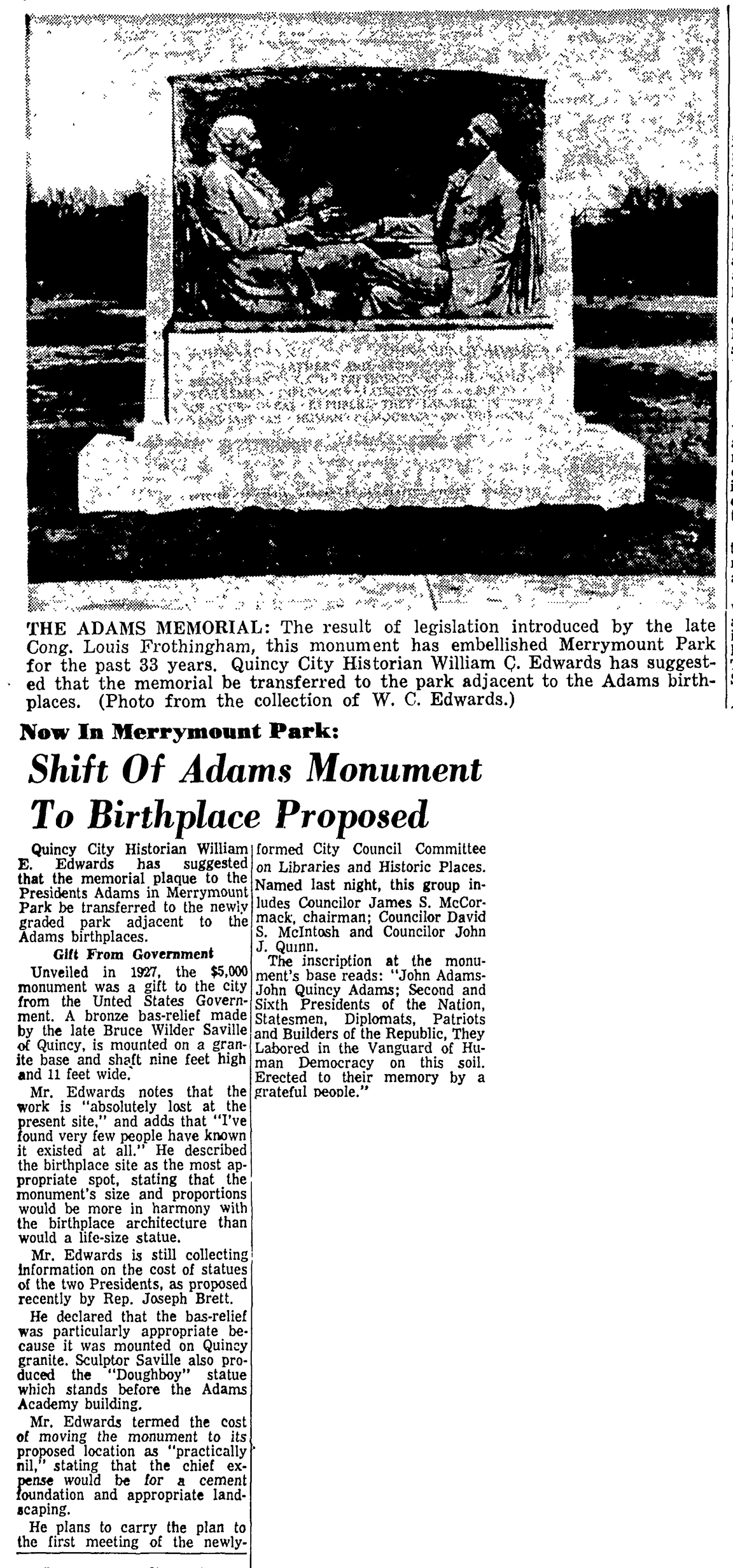
The monument itself is made from Quincy granite, a longtime staple of the local economy. A bas relief bronze tablet mounted on the granite shows John and an adult John Quincy—both as presidents—seated together for an imagined conversation with each other. An inscription reads: “Father and Son, Second and Sixth Presidents of the Nation, Statesmen, Diplomats, Patriots, and Builders of our great Republic, they labored in the vanguard of human democracy on this soil.”
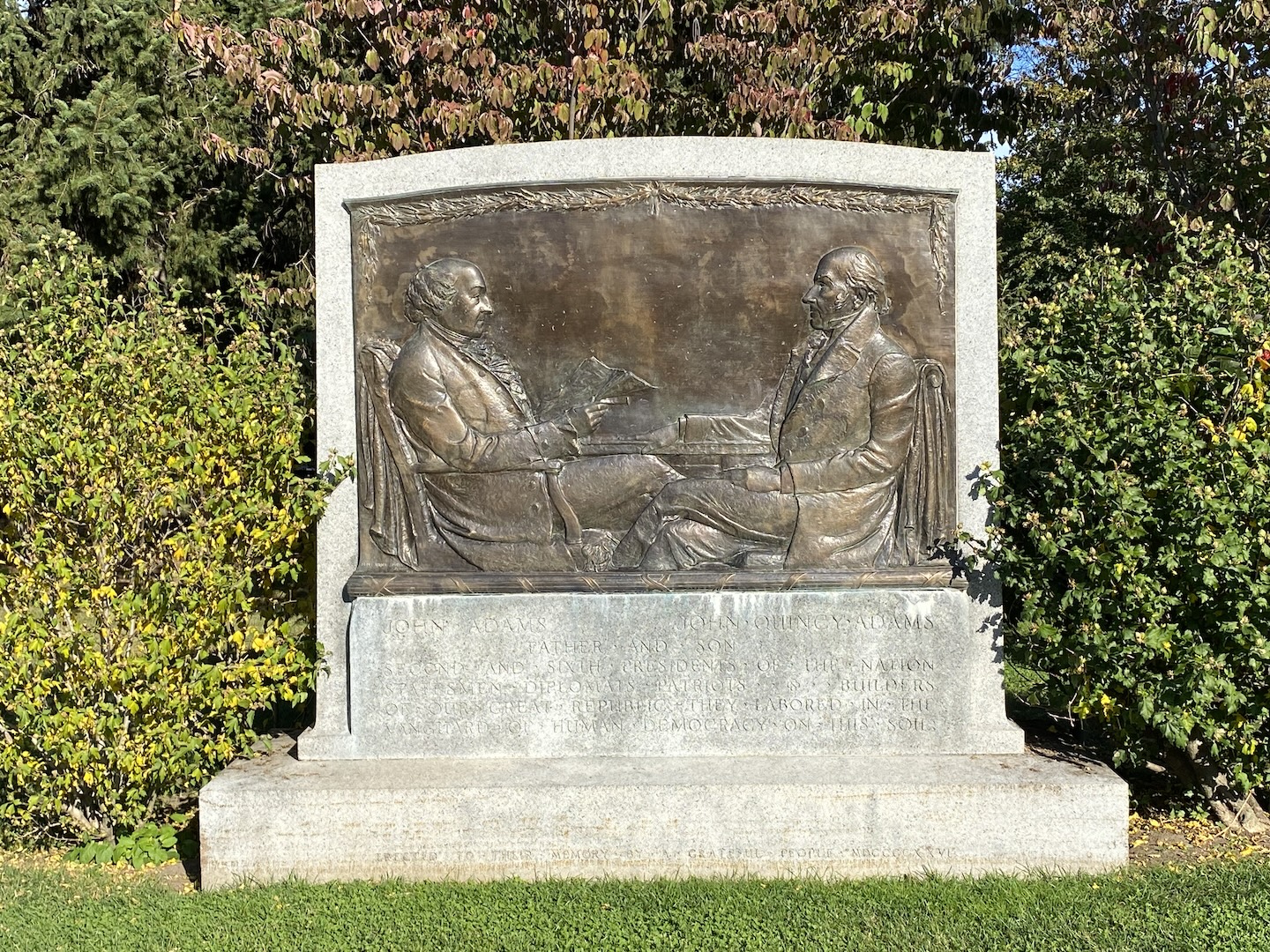
Beyond that, I knew the memorial had once been moved to the site where the John and John Quincy birthplaces stand along Franklin Street, but I didn’t know when and I didn’t know when the monument came back to Merrymount. I couldn’t even find the year of the monument’s dedication or the name of the sculptor. The internet didn’t seem to know these things, and none of my reference materials referenced them.

And so it was that I reached out to the Quincy Historical Society to see if they might have anything in their archives that could help me out.

Archivist Mikayla Martin went above and beyond to assist, sending me a neat little bonanza of stuff! Since she sent me more material than I had room for in the book, I thought I’d take the opportunity to share my windfall here so that you, too, could benefit from the Quincy Historical Society’s kindness.

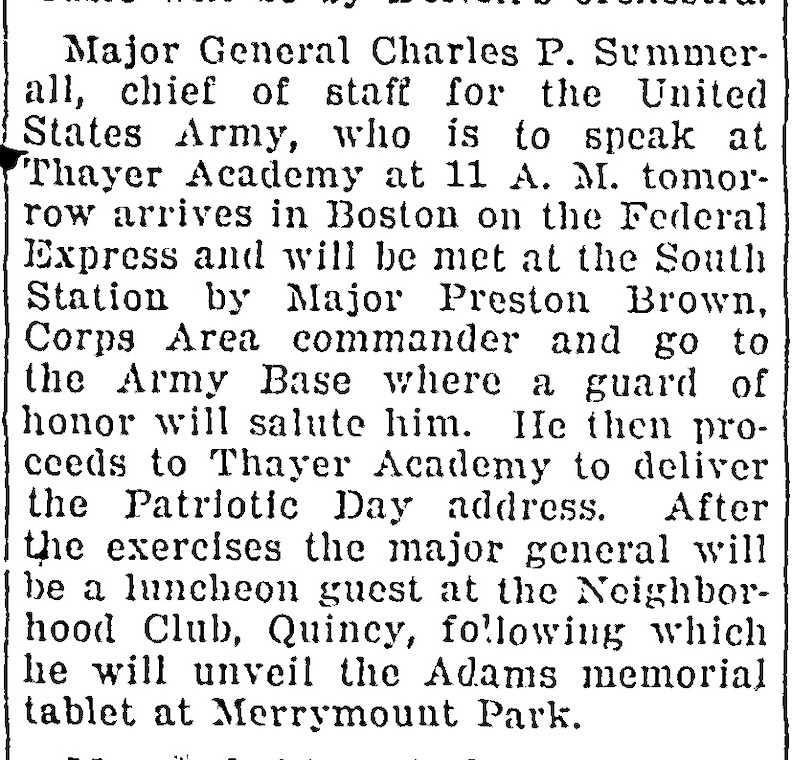
The memorial, as it turned out, was dedicated in 1927. The chief of staff of the United States Army at the time, Maj. Gen. Charles P. Summerall, served as master of ceremonies for the event, according to a clipping from the Patriot Ledger the historical society sent me:
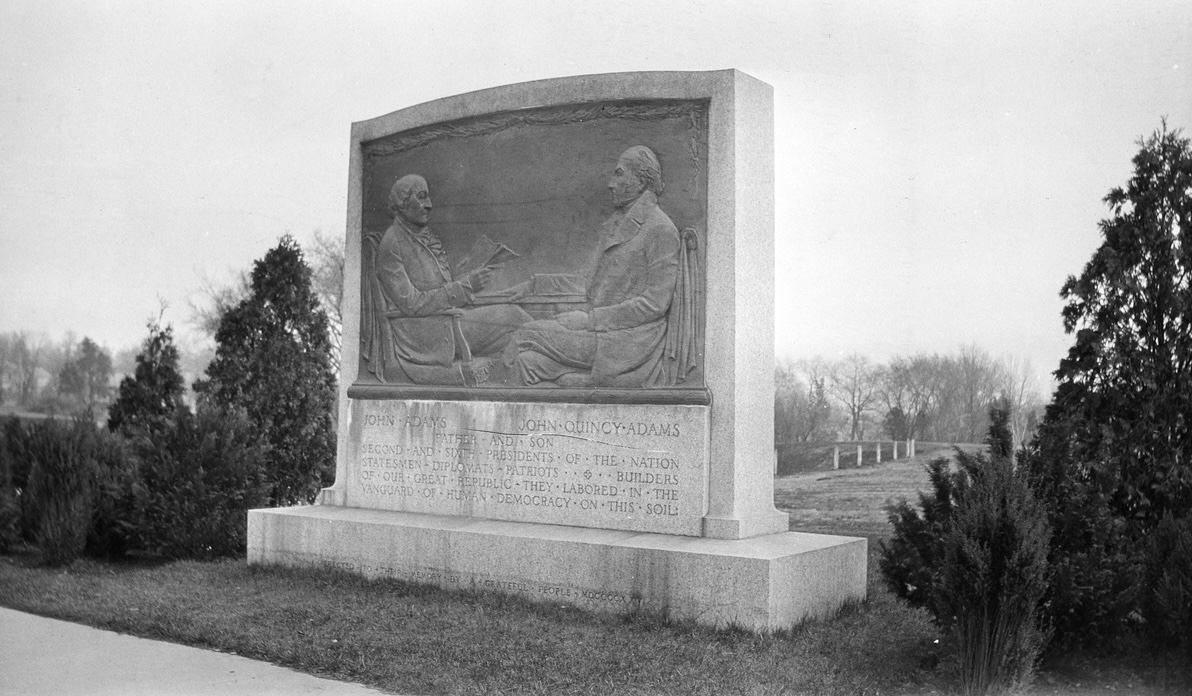
Photographer Warren S. Parker captured this image of the Adams Memorial on April 18, 1929. (courtesy of the Quincy Historical Society)

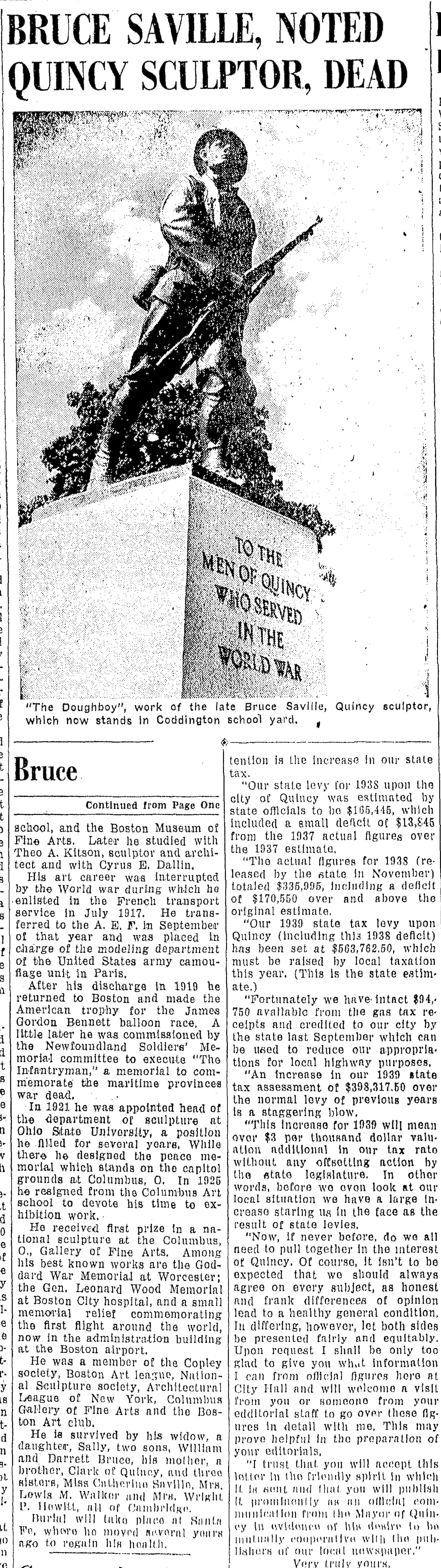
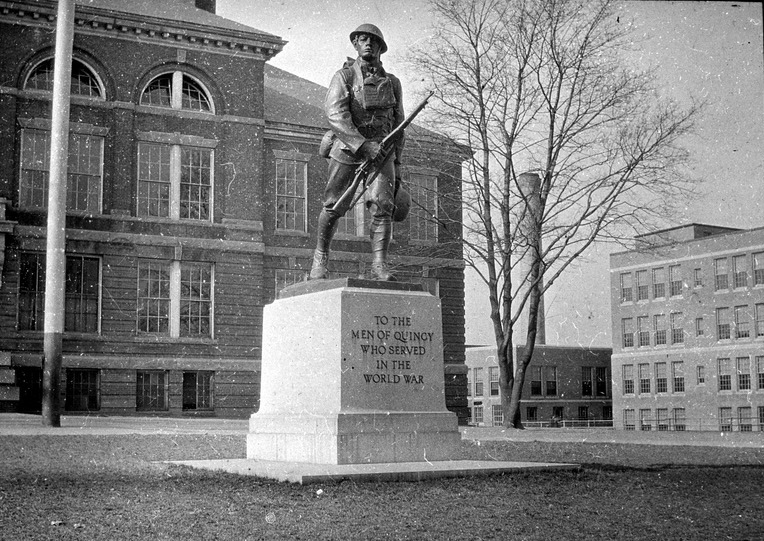
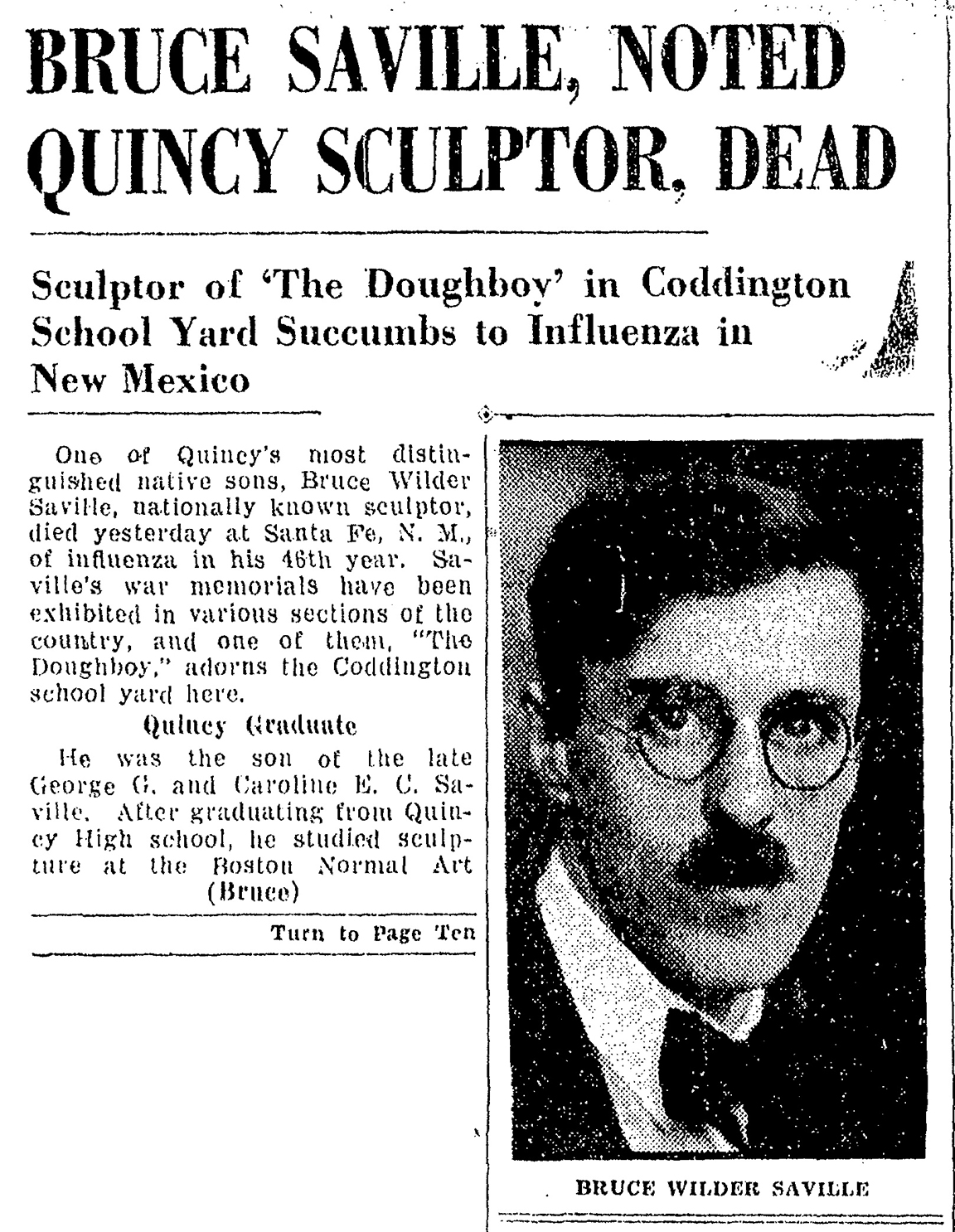
The Patriot Ledger hailed the memorial’s sculptor, Bruce Wilder Saville, as “One of Quincy’s most distinguished native sons.” Saville was best known in town for another of his works, the WWI “Doughboy” Memorial that stood in front of the Coddington School. The Quincy Historical Society included Saville’s obituary from the Patriot Ledger, which I’ll reproduce below, along with a photo of the Doughboy Memorial that the society sent me.

Another newspaper clipping revealed that the $5,000 memorial was a gift to the city of Quincy from the U.S. government. In 1961, city leaders voted to move the monument to the Adams birthplaces, but when the NPS took over management of the site 1979, the city returned the monument to Merrymount Park. I’ll reproduce a newspaper article related to that, as well (see below).

Every monument and memorial has a story of its own, and I find those stories fascinating. They can tell us a lot about the people they honor as well as the people who are doing the honoring.

Please consider supporting your own local historical society (and, if you’re so inclined, please consider supporting the Quincy Historical Society while you’re at it). Organizations like this provide invaluable services to researchers everywhere, but more importantly, they carry the torch for the history in your own back yard.
Virginia 250th Events

Momentum for the 250th Anniversary is really picking up steam, as seen with recent special events in Virginia. On Sunday, March 23, St. John’s Church in Richmond observed the 250th anniversary of Patrick Henry’s “Liberty or Death” speech.

The church held three reenactments of the meeting of the Second Virginia Convention, each sold out. In attendance at the 1:30 showing (thought to be about the time of the actual meeting), were filmmaker Ken Burns and Virginia Governor Glenn Youngkin. Outside the church, reenactors greeted visitors, and representatives from several area historic sites had displays, including Mount Vernon, Wilton House Museum, Red Hill, the VA 250 Commission, Richmond National Battlefield Park, Tuckahoe Plantation, and the Virginia Museum of History and Culture. Mark Maloy, Rob Orrison, Mark Wilcox, and Bert Dunkerly of ERW were all present.

St. John’s Church. Author photo

That afternoon park rangers from Richmond National Battlefield Park gave a special walking tour through the neighborhood focused on Henry’s speech and the concepts of liberty and citizenship through time.

That evening Richmond’s historic Altria Theater hosted the very first public premiere of Ken Burns’ new documentary, The American Revolution. A sellout crowd of over 3,000 saw snippets of the video, along with a panel discussion with Burns and several historians. The documentary will air nationwide starting on November 15.

Then, Monday, Tuesday, and Wednesday, Colonial Williamsburg hosted a gathering focused on 250th planning called, A Common Cause To All. The event featured about 600 representatives from historic sites, museums, and state 250 commissions. In all forty states were represented. Attendees discussed event planning, promotion, upcoming exhibits, educational opportunities, and more.

In his speech on March 23, 1775, Patrick Henry noted that “the next gale that sweeps from the north will bring to our ears the clash of resounding arms.” True enough, just a few weeks after his speech, word arrived of the fighting at Lexington and Concord. And soon, our readers will hear about the special events commemorating this anniversary in Massachusetts.

Guest Book Review: Thomas Jefferson and the Virginia Statute for Religious Freedom: Faith & Liberty in Fredericksburg 

Among America’s Founding Fathers, Thomas Jefferson is among the most well-known. Author of the Declaration of Independence, Governor of Virginia, Minister to France, and the third President of the United States, Jefferson’s public career is familiar to many Americans. Of his many accomplishments, his authorship of the Statute of Virginia for Religious Freedom is perhaps less well-known among the public, but was one of which he was supremely proud. In Thomas Jefferson and the Virginia Statute for Religious Freedom: Faith & Liberty in Fredericksburg, Michael Aubrecht expertly delivers the story of the creation of this remarkable document and its relationship to the city in which it was written.

The Virginia Statute for Religious Freedom was written in Fredericksburg, Virginia in January 1777. Jefferson and four other men had been appointed to a Committee of Revisors tasked to examine Virginia’s existing laws and redraft them as necessary for the newly independent Commonwealth. Jefferson’s Statute, originally known simply as Bill 82, was only one of more than a hundred bills cataloged by the committee, but its significance has certainly been profound. Aubrecht’s narrative goes beyond telling how Jefferson wrote the document, however. Indeed, historians are not sure as to when exactly that occurred during the week that the committee met at Weedon’s Tavern in Fredericksburg. Instead, Aubrecht expertly places the story of the document’s creation within the context of the time and place it was written.

Each of the book’s thirteen chapters is essentially a vignette, concisely covering the man who wrote the statute, his and the nascent country’s views towards religion and religious practice, and the city and tavern in which it was written. The author also covers topics related to statute’s legacy, including its commemoration, and civic organizations, such as the Jefferson Institute, that perpetuate that legacy. Thus, while the story of the writing of the Virginia Statute for Religious Freedom can be and, indeed has been, quickly and effectively described on interpretive signs and monuments, Aubrecht effectively focuses on the sentiments and character of the man and locations that shaped the document.

Thomas Jefferson was not a one dimensional figure and Aubrecht does not whitewash his chief character. Jefferson was a man with many virtues and talents, but also possessed his share of faults. Aubrecht, like many other historians of the Colonial and Early Republican eras, observes and notes the contradiction between Jefferson’s views on liberty and the fact that his way of life was entirely dependent on slavery. Such objectivity only serves to strengthen the credibility of Aubrecht’s work.

Aubrecht’s work is masterfully researched. As is the case with any effective work of history, the work is truly based on extensive primary source research, chiefly the papers and correspondence of Jefferson. Scholars examining topics relating to religion in Colonial and Early America will find value in mining Aubrecht’s bibliography. Michael Aubrecht’s Thomas Jefferson and the Virginia Statute for Religious Freedom: Faith & Liberty in Fredericksburg will be of interest to anyone interested in Early American history and is a must read for scholars researching religious attitudes during this fascinating and complex period.

Review by: Timothy Willging, Fredericksburg, Virginia.

Touring the Sites of Lexington and Concord

Last weekend, Emerging Revolutionary War wrapped up our fourth annual bus tour. Our previous tours covered Trenton, Princeton, Monmouth, Valley Forge, and Charleston. This year we went to where the whole war started: Lexington and Concord on the eve of the 250th anniversary of the battles. We had a jam-packed weekend with a fully sold out 56 passenger bus. As most places close down in November in Massachusetts, we chose to move this year’s tour from our usual Veterans Day weekend, to Columbus Day weekend. Here is a brief overview of how the weekend went:

Continue reading “Touring the Sites of Lexington and Concord”

Announcing our 2025 ERW Bus Tour…. Philadelphia Campaign of 1777 with Michael Harris!

We are excited to announced our FIFTH annual ERW bus tour will be on November 7-9, 2025 and will cover the 1777 Philadelphia Campaign.

Author and historian Michael Harris will join us as we cover the fall of 1777 campaign. The British Army under Gen. William Howe made a concerted effort to take the American capital of Philadelphia. George Washington and the Continental Army fought major actions at Brandywine and Germantown in an effort to hold and take back the city. The tour will cover sites associated with the Philadelphia Campaign, such as Brandywine, Germantown, Paoli and others.

Tickets are $250 per person and will include Friday night lecture at the host hotel, all day bus tour on Saturday and half day bus tour on Sunday. A lunch is included for Saturday.

Our host hotel is the Holiday Inn Express and Suites – King of Prussia. Lodging is NOT included in the registration fee. A room bloc has been established under the name of “Emerging Revolutionary War.” A link will be provided in the future for hotel lodging.

Join us for our FIFTH annual tour as we take on the beginning of the American Revolution just a few months before the 250th anniversary. Learn about the dramatic events that led to some of the bloodiest days in the American Revolution. There is no better way to experience history than to stand in the footsteps of where it happened!

To register, visit: https://www.eventbrite.com/e/battles-for-the-capital-1777-philadelphia-campaign-bus-tour-tickets-1048228358237?aff=oddtdtcreator

For more questions, please email emergingrevolutionarywar@gmail.com.

Honor and Victory: The Battle of Sullivan’s Island, June 28, 1776

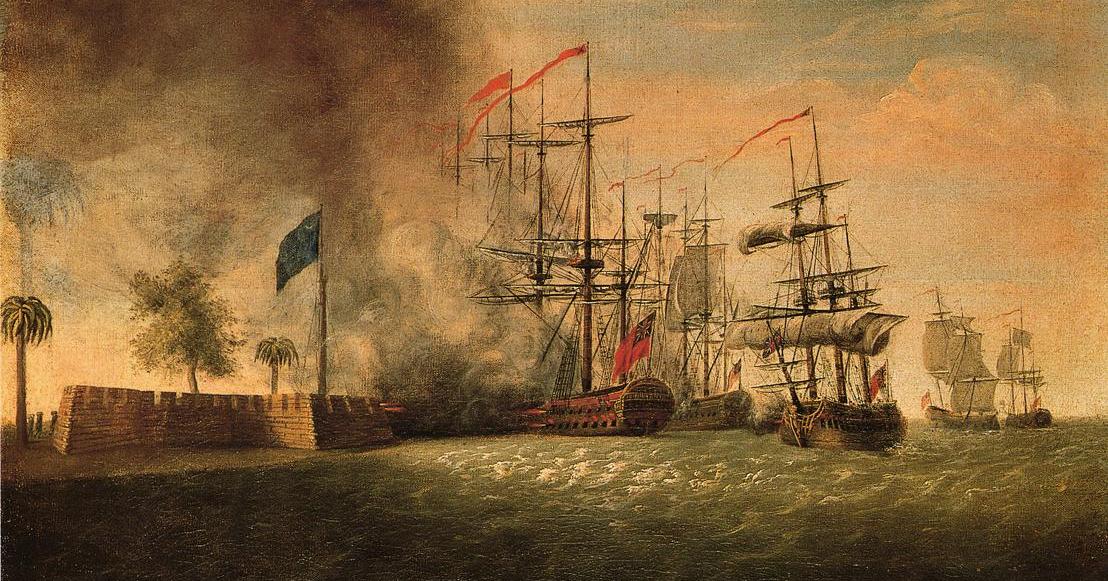
On June 28, 1776, nine British warships under the command of Sir Peter Parker weighed anchor and began moving toward Sullivan’s Island outside of Charleston, South Carolina. Col. William Moultrie, commanding the 2nd South Carolina Regiment in an unfinished palmetto log fort, ordered his men to their posts to prepare for a defense. The first four British ships moved into position and anchored 400 yards from the fort. In an amazing display of British firepower, the British ships began to fire broadsides, simultaneously firing all the cannon from one side of the ship. The broadsides were deafening as hundreds of British cannonballs screeched through the air and slammed into the palmetto walls of the fort. Local newspapers later described the cannonade as “one of the most heavy and incessant cannonades perhaps ever known.”

As the walls of the fort shook violently, Moultrie’s men coolly manned their cannon and returned the fire as best they could. A continuous roar of cannon fire from hundreds of artillery pieces belched forth, quickly filling the harbor with the sight of white smoke and the smell of burning sulfur. The crash of the cannonballs mixed with the screams of wounded men filled the air.

As the British cannon boomed away, their solid shot hit the walls of the palmetto fort. But the soft, spongy wood of the palmetto (and the 16 feet of sand behind them) absorbed the shock and the balls either buried themselves into the wall or bounced off and fell harmlessly to the ground. Meanwhile, the British ships endured terrible damage from the American shore batteries. American cannonballs smashed into the oak of the British ships, causing havoc and bloodshed.

Continue reading “Honor and Victory: The Battle of Sullivan’s Island, June 28, 1776”