

Emerging Revolutionary War welcomes guest historian Drew Palmer. A biography follows at the end of this post.
What does it look like when veteran soldiers do not want to fight anymore? When morale plummets and the realities of war take their toll on men. This is exactly what happened to 150 men in the Maryland Line of the Continental Army in the late summer of 1780.
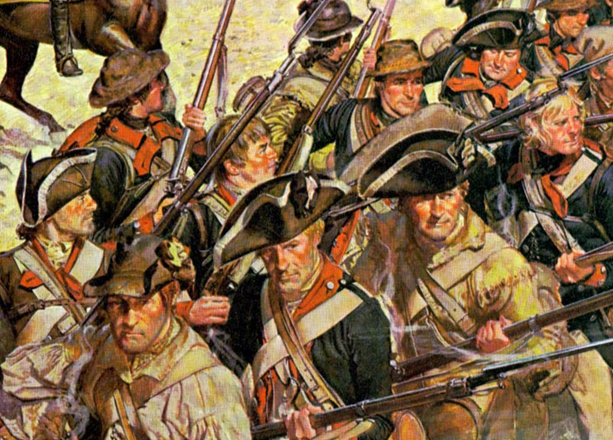
The continental regiments of Maryland that made up what became known as the “Maryland Line” or “Old Line State” had earned the reputation as a reliable, brave, and disciplined fighting force as early as 1776 after their actions in the Battle of Long Island.1 At the Battle of Camden on August 16, 1780, the 1st and 2nd Maryland Brigades offered a stout defense as Gen. Charles Cornwallis’s British force crashed into Continental soldiers from Maryland and Delaware. In the end, though, Maj. General Horatio Gates’s Southern Continental Army was completely routed from the field, with many of the Maryland Continental troops taken prisoner and held in the small village of Camden after the battle.2
The village of Camden, South Carolina, was an unpleasant place to be after the battle. The crowded conditions and brutal summer climate of South Carolina began to produce sickness amongst Cornwallis’s men and the American prisoners that were held in Camden. To prevent further sickness from spreading, Cornwallis decided to split the American prisoners held at Camden into divisions of around 150 men. These divisions were guarded by small detachments of the British army and marched from Camden to Charlestown, South Carolina.3 One detachment of the British 63rd Regiment of Foot escorted 150 prisoners of the 1st Maryland Brigade captured at Camden. The division made it to Thomas Sumter’s abandoned plantation at Great Savannah, about 60 miles northwest of Charleston. As the Maryland prisoners and their British guards halted for the night, militia commander Francis Marion received word from a Loyalist deserter that the Marylanders were nearby and decided to ambush the British element in hopes of freeing the Maryland prisoners.4 In the early morning hours of August 25, 1780, Marion’s militia attacked.
The complete surprise of Marion’s attack had freed the Maryland prisoners in a matter of minutes, leaving British soldiers of the 63rd Regiment of Foot completely unable to mount a resistance.5 Marion likely expected the Maryland men to happily fall under his command, as he was looking to fill the ranks of his newly created militia. Conversely, the Continental Army’s trusted veteran “old line” soldiers from Maryland were anything but reliable. The newly freed Marylanders had numerous grievances and outright refused to cooperate with Marion. Marion, who still held the rank of Colonel of the Second South Carolina Continental Regiment, was surprised by the Marylanders’ unexpected and cold reception.6
The Marylanders were completely worn out by the war. Many of the men had endured a harsh winter in New Jersey before marching South with limited provisions, only to deal with a humiliating defeat at Camden and the unbearable South Carolina heat.7 Particularly, the defeat at Camden had turned most of the men against further fighting. At Camden, the Marylanders had fought in brutal hand-to-hand combat as the North Carolina and Virginia militia immediately crumbled and fled upon a British charge. The Marylanders, along with the Delaware Continentals, were left to face the brunt of the British force. Outnumbered, the Maryanders hung on until they were forced to flee; hundreds were captured. Colonel Otho Holland Williams, commander of the Sixth Maryland Continentals and Adjutant General to Horatio Gates, reported a staggering 832 casualties from the Maryland Line alone, of which 500 Maryland Continentals were taken prisoner by the British force.8 The American outlook appeared bleak after Camden, as the Southern Continental Army ceased to exist. After their experiences at Camden, the Marylanders stressed to Marion the hopelessness of continuing the fight and emphatically turned down his invitation to join his militia. 9
An equally important grievance was the Marylanders’ refusal to fight alongside the militia, let alone take orders from the militia. The Marylanders knew their reputation and had pride in their brigade and state. They informed Marion that they would not serve under militia officers or officers not from the state of Maryland.10 It made complete sense why the Marylanders refused to join Marion. After the militia retreated on their left flank at Camden, the Marylanders likely had no wish to fight alongside the militia. Marion’s force was small; their appearance alone would have corroborated past stereotypes about the unreliability of militia.
Marion began to question what to do with the liberated Marylanders. He was successful in gathering more men, but unsuccessful in getting them to fight. He wrote Gates that, “I should be glad to hear from you and what I shall do with the Continentals I retook. I could wish you could send some officers to take charge of them, as they are much dissatisfied. I am certain that they will desert, to a man, without it. Several have already gone off, and it was not in my power to prevent it, as the militia are not under any command and some days I have not more than a dozen with me.” 11 Marion’s Maryland debacle continued to cause a nuisance, so much so that his adversary, General Cornwallis, received news of the uncooperative Marylanders.
In late August 1780, Cornwallis was just beginning to learn Francis Marion’s name, but he knew all too well about the Maryland Line. After learning of the small ambush at Great Savannah, Cornwallis reported that after the successful American ambush, “all but twelve of the [British] escort made their escape from them [Marion’s force], and to our great surprise 85 of the prisoners, all Continentals, refused to go with them and insisted on proceeding to Charlestown. This is a pretty good proof of the affection of their army, and I think the accident a very fortunate one.” 12 Cornwallis was just as surprised by the dissatisfaction of the Marylanders as Marion was. Though fortunes would eventually turn against Cornwallis, he must have enjoyed this small victory, knowing that his army’s actions at Camden had likely been the main cause of the Marylanders’ demoralization.
Whether the primary cause for the Marylanders’ behavior was the defeat at Camden, the unwillingness to serve in the militia, or maybe a bit of both, only three of the 150 Marylanders decided to join Marion’s force. Most of the Marylanders were so discouraged that many insisted on continuing to Charlestown to remain as prisoners rather than taking up arms again. Marion eventually decided to send the men to North Carolina, where they were expected to rejoin Continental units; yet most deserted while with Marion and on the way to North Carolina.13 The largely unknown actions of the 150 Marylanders freed by Marion’s force speak to the exhaustive mental and physical toll war can have on even its most hardened, seasoned soldiers. This toll turned the Marylanders’ veteran pride into hardened resentment and disillusionment with their further participation in the conflict.
Endnotes
1. Ryan Polk, “Holding the Line: The Origin of the ‘Old Line State’”, Maryland State Archives, 2005, accessed February 9, 2026. https://msa.maryland.gov/megafile/msa/speccol/sc2900/sc2908/html/oldline.html.
2. South Carolina American Revolution Sesquicentennial Commission, The Francis Marion Papers, Volume One, 1759–1780, ed. David Neilan, G. Richard “Rick” Wise, and Benjamin H. Rubin (South Carolina250, 2025), 195-96. https://southcarolina250.com/wp-content/uploads/2025/02/Francis-Marion-Papers-Volume-One.pdf.
3. Cornwallis to Clinton, August 29, 1780, Ian Saberton, ed. The Cornwallis Papers, Vol. 2: The Campaigns of 1780 and 1781 in the Southern Theatre of the American Revolutionary War (Naval & Military Press, 2010), 2:37.
4. Lt. Col. Francis Marion to Maj. Gen. Horatio Gates, August 29, 1780, Francis Marion Papers, 201.
5. Wemyss to Cornwallis, September 3, 1780, The Cornwallis papers, 2:213.
6. Weems, Francis Marion, 54.
7. John Oller, The Swamp Fox: How Francis Marion Saved the American Revolution ( Grand Central Publishing, 2018), 55.
8. Neilan, Wise, Rubin, Francis Marion Papers, 195-196.
9. M. L. (Mason Locke) Weems, The Life of General Francis Marion: A Celebrated Partisan Officer in the Revolutionary War Against the British and Tories in South Carolina and Georgia, accessed January 15, 2026, 54. http://public-library.uk/ebooks/105/32.pdf.
10. Lt. Col. Francis Marion to Maj. Gen. Horatio Gates, August 29, 1780, Francis Marion Papers, 201.
11. Lt. Col. Francis Marion to Maj. Gen. Horatio Gates, August 29, 1780, Francis Marion Papers, 201.
12. Cornwallis to Cruger, August 27, 1780, The Cornwallis Papers, 2:172.
13. Oller, The Swamp Fox, 56; Cornwallis to Cruger, August 27, 1780, The Cornwallis Papers, 2:172; Lt. Col. Francis Marion to Maj. Gen. Horatio Gates, August 29, 1780, Francis Marion Papers, 201; Lt. Col. Francis Marion to Maj. Gen. Horatio Gates, September 15, 1780, Francis Marion Papers, 205.
Biography:
Drew Palmer is a Revolutionary War historian and U.S. high school history teacher from Baltimore, Maryland. He is the creator of Revolutionary Maryland, an educational website and blog that focuses on Maryland’s role in the Revolutionary War. Click here. He has also worked at multiple public history sites, such as Fort Ticonderoga, Fort McHenry National Monument and Shrine, and Adams National Historical Park.
 Emerging Revolutionary War Era
And yet later at Cow Pens and Guilford Courthouse, the Maryland Continentals under command of Howard fought extremely well. Gates was a fool, put the Maryland Continentals in an impossible situation, and came close to losing the war. Even the best troops, poorly led, have limits beyond which they will not go.
LikeLike