

Emerging Revolutionary War welcomes back guest historian Ben Powers. Bio follows the article.
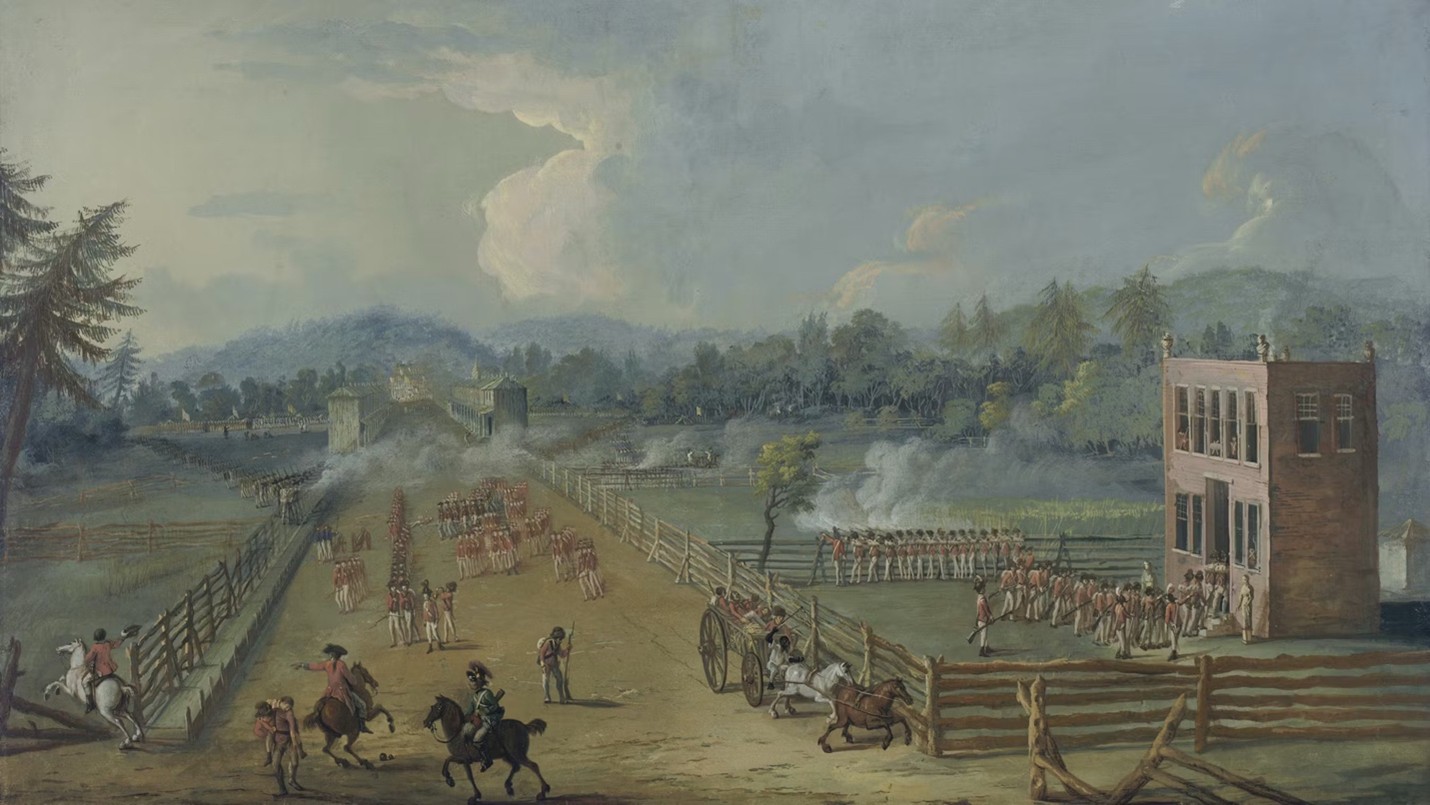
Painted by Xavier della Gatta, 1782
https://www.amrevmuseum.org/collection/battle-of-germantown
Was the Battle of Germantown an American failure or a British success? Did the Continental Army lose due to an overly complicated plan, environmental factors such as fog, and poorly applied military judgment, or was the British Army’s resistance a decisive factor? The defense of the Chew House demonstrates that the British were professional, tenacious, and courageous, rather than the fortunate recipients of the fruits of an American blunder. Led by Lieutenant Colonel Thomas Musgrave, the men of the 40th Regiment of Foot established a strongpoint that disrupted American momentum and derailed the attack. Musgrave and the 40th Regiment of Foot transformed the Chew House into an obstacle that delayed the American advance long enough for British forces to reform and counterattack. This episode reveals the significance of British leadership and discipline under severe conditions, thereby reframing the context of the Battle of Germantown.¹
Germantown occurred at a time when the Continental Army was undergoing a transformation from an amateur to a professional military. American officers engaged in self-directed study of “books upon martial science” and were known to carry such texts among their baggage and haversacks when on campaign.² In this manner, Continental officers sought to emulate their European counterparts.³ One officer known to have made a detailed study of the art and science of war was Washington’s Chief of Artillery, Henry Knox.⁴ At the time of Germantown, the officers of the Continental Army had been at war for over two years and had learned many practical lessons; however, many officers, including Washington, continued to hold Knox’s auto-didactic military education in high esteem. The gap between knowing theory and its practical application would become apparent, to the detriment of the Continentals, at Germantown.
In contrast, the British Army officer corps had been fully engaged in a minor military enlightenment through the latter half of the eighteenth century. While British officers engaged in self-study programs similar to Knox’s, they could more readily share the results of their study within an established army, comparing and contrasting ideas and adopting best practices.⁵ The British Army was able to synthesize the best practices from both theory and combat experience into regulations that informed the training and operational deployment of all its formations.⁶
Early interpretations of the battle frequently emphasized confusion and poor execution, particularly the American decision to attack the Chew House. Yet the battle was “very much more than a contest… for the possession of a country house.” More recent scholarship describes the plan for the attack on Germantown as a sophisticated maneuvering scheme that nearly succeeded. Its subsequent failure owes more to British action than American incompetence.
William Howe entered the 1777 campaign season planning to take the American capital of Philadelphia. Washington suspected Howe would take the initiative but lacked sufficient information to determine his intentions. Howe elected to make use of British naval power, embarking his army on transport ships to move south toward Pennsylvania. This maneuver placed his army beyond the limits of Washington’s reconnaissance capabilities and denied Washington the opportunity to interpose the Continental Army between the British Army and its objective.⁷
Howe’s force disembarked at Head of Elk, Maryland, on August 25, 1777. Washington moved to place the Continental Army in a defensive array between the landing site and Philadelphia. He chose to defend along the line of the Brandywine Creek, placing his army directly in Howe’s path. Howe attacked on September 11, 1777. The Continental Army fought well, but a British flanking maneuver turned the American right and forced Washington to withdraw.⁸ The British advanced, struck at Paoli, and occupied Philadelphia by September 26.
Despite the loss of the capital, Washington was determined to inflict a defeat on Howe before the end of the campaign season. Howe established a series of outposts, including one at Germantown. Washington considered Germantown a target of opportunity and planned an attack similar in concept to Trenton and Princeton. His plan involved a night march by multiple independent columns to launch coordinated attacks at dawn.⁹
Washington’s forces experienced great initial success. American forces attacked and routed British pickets shortly after sunrise. A second column experienced similar success. British forces fell back in disorder, abandoning baggage.¹⁰ The American assault achieved surprise and pushed British units back several miles.
Lieutenant Colonel Thomas Musgrave, commanding the 40th Regiment of Foot, covered the British withdrawal and took refuge in the Chew House. He immediately prepared the position for defense.¹¹ The Chew House was a naturally strong position, possessed of stone walls, and the British supplemented its advantages by stockpiling ammunition.¹² Musgrave ensured his troops did not waste ammunition, enabling them to maintain a steady fire throughout the fight.
The Chew House quickly became a point of contention for American leadership. Sullivan initially elected to bypass the strongpoint to maintain momentum, a decision supported by Thomas Pickering.¹³ Henry Knox contradicted this course of action, insisting that leaving a fortified enemy position in the rear was unmilitary.¹⁴ Washington sided with Knox and ordered an assault on the Chew House.¹⁵
While attention focused on the Chew House, Washington’s battle plan began to unravel. Elements of Sullivan’s column continued to advance but became confused by firing in their rear. In the fog and smoke, units mistook allies for enemies. Troops began to withdraw. Greene’s column encountered confusion and exchanged fire with Sullivan’s men. British forces counterattacked, forcing Greene to withdraw.¹⁶
Washington’s plan was now in shambles. Two columns were withdrawing, the others were ineffective, and ammunition was running low. Washington ordered a general retreat.
Germantown should not be interpreted as an amateur blunder but as a failed professional maneuver conducted by an army in transition. Lieutenant Colonel Thomas Musgrave’s defense of the Chew House illustrates the role of British regimental professionalism. Musgrave organized the interior, assigned firing positions, and regulated ammunition. His men maintained disciplined fire under pressure. Contemporary observers described the position as formidable and capable of delaying a superior force.¹⁷
The decision to halt the American advance to attack the Chew House proved critical. Washington’s plan depended on momentum, and delay threatened the operation. The delay allowed British forces to regroup and restore cohesion.
Germantown, therefore, stands as a professional engagement shaped by leadership, environmental conditions, and disciplined resistance. The defense of the Chew House demonstrates how British professionalism translated into battlefield effectiveness. The battle should be understood not simply as an American failure, but as a contest in which disciplined British resistance disrupted a complex and nearly successful American attack.
Endnotes:
- Charles Henry Hart, “The Battle of Germantown,” Proceedings of the American Antiquarian Society, April 1887.
- Sandra L. Powers, “Studying the Art of War…,” Journal of Military History 70, no. 3 (2006): 781–814.
- Jason W. Chandler, “The Continental Army and Military Europe…,” Journal of Military History 84, no. 3 (2020): 747–772.
- William C. Pruett, “Artillery Professionalism…” (Master’s thesis, 2011).
- Huw J. Davies, “Author Interview…,” Aspects of History.
- “The Manual Exercise… 1764,” American Battlefield Trust.
- Michael C. Harris, Brandywine (2014), 149.
- Harris, Brandywine, 364.
- George Washington, “General Orders,” Founders Online.
- Michael C. Harris, Germantown (2020), 282.
- Charles Henry Hart, “The Battle of Germantown.”
- Harris, Germantown, 325.
- Thomas Pickering, “Account of the Battle of Germantown.”
- Ibid.
- Harris, Germantown, 327.
- Harris, Germantown, 359.
- Johann Ewald, Diary of the American War (1979).
Bio:
Ben Powers is a retired U.S. Army Lieutenant Colonel and student of Revolutionary War history, with a focus on leadership and the professionalization of the Continental Army. He co-hosts Rogue Island, a newly launched YouTube channel focused on the Revolutionary War. He lives in Texas with his wife, KC, and their four children, Arthur, Michaela, Emma, and Jordan.
 Emerging Revolutionary War Era