

Do you remember those 1970s-era TV commercials for Heinz ketchup? A young boy, with his glass ketchup bottle turned upside down over a hamburger, waits for the ketchup to flow. In the background, Carly Simon sang, “Anticipation”: “It’s making me wait. It’s keeping me way-yay-yay-yay-yay-yay-yayting.”
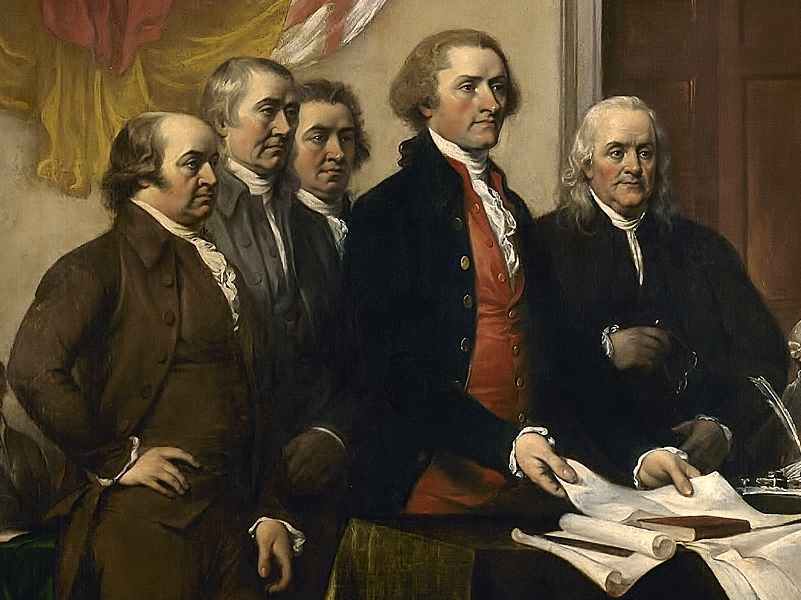
Had Carly Simon been alive 250 years ago, I have no doubt her song would have been playing in the background for Thomas Jefferson on June 29, 1776. The day before, June 28, he and his four colleagues on the “Committee of Five” had formally submitted their draft of the Declaration of Independence. Congress accepted the draft, but delegates were not yet ready to take up the document as a piece of business. They would not do so until July 1.
What might those days of limbo have felt like?
As with so much else about the Declaration’s origins, those days of anticipation remain undocumented. We don’t know—but can reasonably guess, however—how some of the committee’s members felt during that time.
John Adams, for his part, probably felt impatience moreso than anticipation. We know he felt confident in the days leading up to debate. “There Seems to have been a great Change in the sentiments of the Colonies . . .” he wrote on the morning of July 1 to a former colleague from Georgia, Archibald Bulloch, predicting final resolution to the great question. “This Morning is assigned for the greatest Debate of all. A Declaration that these Colonies are free and independent States, has been reported by a Committee appointed Some Weeks ago for that Purpose, and this day or Tomorrow is to determine its Fate.”[1]
He expected passage, writing as though the vote were a fait accompli: “May Heaven prosper, the new born Republic,—and make it more glorious than any former Republic has been.” If he was feeling that good on the morning of July 1, I suspect he was feeling pretty good about it in the days previous, as well.
But I suspect Jefferson felt notably less so. We know, during the July 3 debate about the draft document, that he squirmed in near silence while the Congress line-edited the Declaration. Anyone who has suffered through “editing by committee” knows what a dreadful experience that process typically is. For someone like Jefferson, who possessed a strong sense of “pride of authorship,” the experience must have been especially agonizing.
Benjamin Franklin, a former author and publisher, was an old hat when it came to the relationship between authors and editors. During the July 3 debate, he was amused by and sympathetic to Jefferson’s discomfort. He seems to have been the most placid member of the committee during those days, understanding the high stakes but also benefitting from a more grandfatherly patience. To comfort Jefferson, he told the Virginian the apocryphal story of John Thompson, a hatmaker who tried to make a sign for his haberdashery only to have a number of editorial suggestions whittle his idea down to nothing more than a picture of a hat. That prompted someone to ask Thompson, “Why have a sign with a picture of a hat when people can just look in your shop window and see what you’re selling?”
One must consider that same pride of authorship as we think about Jefferson on June 29, 1776. It’s possible the July 3 debate brought Jefferson’s anxiety to a head and so, perhaps, he wasn’t as anxious in those last days of June. Perhaps the anticipation didn’t wear on him or grate on his nerves. But I can’t imagine an entirely placid Jefferson, either. All I can hear is Carly Simon in his background.
We know how the story turned out, but as we creep through these last sweltering days of June, invite yourself to sit in the unresolved moment with Jefferson, Franklin, Adams, and company.
Heck, would it even be possible to “sit” with those men in these anticipatory days of limbo? I could see Franklin inviting us to pull up a chair and share a pint. But would Jefferson have been too anxious to sit? How about Adams, ever an engine of energy and motion, even on a normal day—could he sit?
The “greatest debate” of all loomed. The new-born Republic awaited. Pride of authorship was on the line—not just of the Declaration, but of the Republic itself.
[1] “John Adams to Archibald Bulloch, 1 July 1776,” Founders Online, National Archives, https://founders.archives.gov/documents/Adams/06-04-02-0141. [Original source: The Adams Papers, Papers of John Adams, vol. 4, February–August 1776, ed. Robert J. Taylor. Cambridge, MA: Harvard University Press, 1979, pp. 352–353.]
(And, yes, that’s a very young Corey Feldman in the ad.)

