

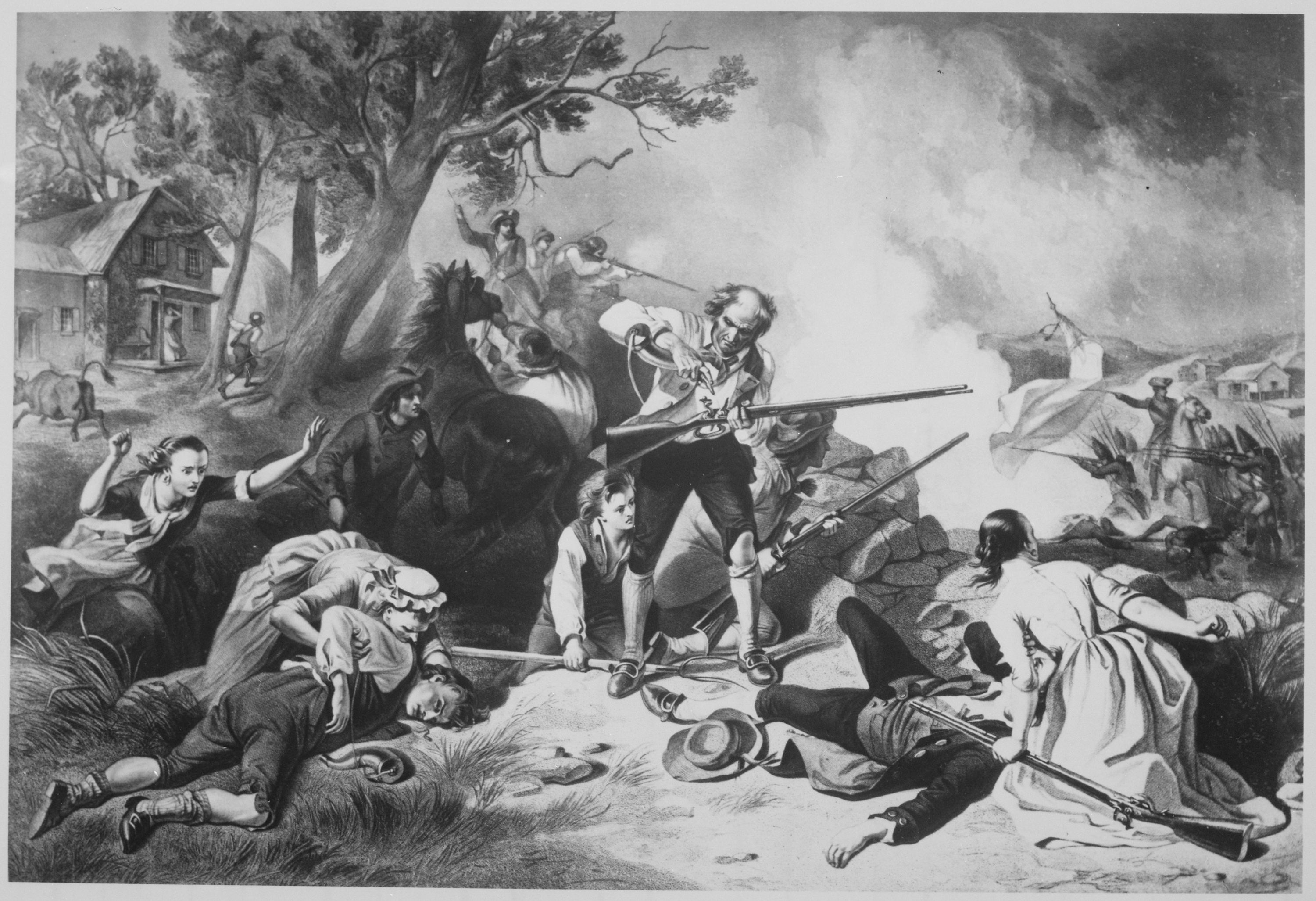
There is a sense in the American military tradition that the Republic has relied on citizen-soldiers in times of crisis to bolster its army rather than maintain a large standing force. While the modern American military, post-1945, has increased in size and power to accommodate the global commitments incurred in the wake of World War II, for the bulk of American history, the United States sought to make do with a small professional force, bolstered with militias called to arms and volunteers when war threatened. While this arrangement for national defense was in part driven by fiscal concerns, as a large standing army incurs a cost to the treasury, another aspect concerned how the United States perceived itself. The early Republic, and before its establishment, the thirteen original colonies, inherited from England a distrust of standing armies and a faith in community militias. Historian John Galvin’s The Minutemen posits that the colonial militia, especially in New England, had a long tradition of active training participation, evolving organization, and combat experience prior to the commencement of hostilities on 19 April 1775, and that it was the progenitor of the American citizen-soldier who won the American Revolution.[1] In contrast, James Kirby Martin and Mark Edward Lender argue in A Respectable Army: The Military Origins of the Republic, 1763–1789 that commitment to militia duty was honored largely in the breach in the American colonies prior to the revolution, that the militia performed unevenly during the War for Independence, and that ultimately the Continental Army achieved the victory that cemented America’s freedom.[2] Martin and Lender conclude that the American tradition of a sturdy yeoman militiaman is more legend than fact and used to justify maintaining a small regular army during the early days of the republic.
The notion of the American militiaman responding to an alarm to defend his own appears repeatedly in the literature on the Revolutionary War. John Shy, in his 1962 paper on colonial military systems, described the notion underlying the efficacy of the militia system as “only when free men must themselves fight to maintain their liberty are they likely to remain free.”[3] According to Fred Anderson Berg in his encyclopedia of Continental Army forces, the militia systems of the American colonies evolved from English tradition, and were geographically organized around townships and counties, and were designed to serve for short periods, without pay, and in proximity to their homes. The intent was for them to be an “in extremis” force designed to protect their own neighborhoods. Anderson’s entry on the militia in the American Revolution paints their performance in a favorable light and does nothing to contradict the idea that militia units contributed significantly to securing American Independence.[4] David Hackett Fischer reinforces these points in his analysis of the events of April 1775, providing a brief summary of the martial qualities of the men of Massachusetts Bay Colony, specifically noting that at least once a generation between 1689 and 1763, the militia answered the call to arms in operations against indigenous peoples or French colonial opponents, either separately or in combination.[5] Despite these descriptions of militia origins, motivations, or performance, none of the writers delved into what made militia troops effective, as John Galvin did in his book The Minutemen, The First Fight: Myths and Realities of the American Revolution. Galvin first appears as an unlikely proponent of the militia tradition. He spent his career as a professional soldier, having graduated from the United States Military Academy, served multiple tours in Vietnam, and ultimately retired as a General Officer as the Supreme Commander of Allied Forces in Europe.[6] Upon closer examination, his motivation for doing so becomes apparent. Galvin was a native of Massachusetts and keenly interested in the military history of his home state. He grew up learning the myth that when the King’s troops departed Boston to collect military supplies stored in Concord, every day farmers left their homesteads, banded together against the invaders, and chased them back to whence they came. The take did not make sense to Galvin precisely because of his military training and combat experience. Such a performance in battle suggested organization, command & control, and logistical forethought rather than a spontaneous response to a threat.[7]
Galvin set out to learn the facts behind the myth and discovered that the Massachusetts troops that responded to the alarm of 19 April 1775 enjoyed substantial advantages. He learned, contrary to legend, that the colonists benefited from significant logistical and preparation and training, political support, and a highly organized administrative structure that turned the colony’s country structure into a regimental system capable of rapidly assembling combat power when required. Gavin found that this level of sophistication was the product of an evolving system of alarm companies and other community-based defensive systems dating back to the late 17th century, combined with a renewed emphasis on readiness dating from the fall of 1774, when Massachusetts Committees of Safety began preparing in earnest for what they felt was an inevitable clash with the British troops occupying the colony.[8] This combination of tradition, commitment, and anticipation resulted in a system that could be activated as required, with each participant trained and equipped for action, knowledgeable of their leadership, with an overarching command structure prepared to lead once the men took the field.[9]
Galvin paints a picture of a highly prepared and motivated militia force and documents how the Massachusetts colonists achieved this level of readiness. In contrast, James Kirby Martin and Mark Edward Leander postulate that the militia tradition had to be modified to enable the Americans to field a long-service professional force capable of meeting the British Army in sustained combat.[10]
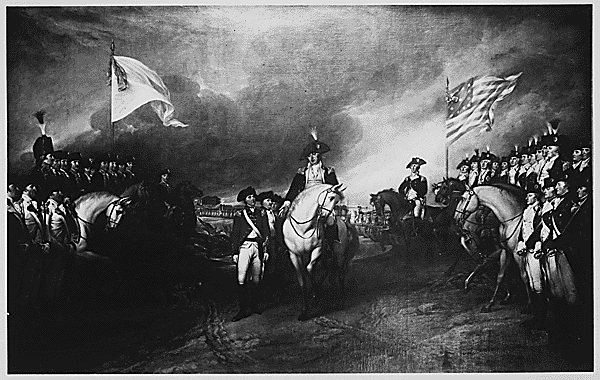
Surrender of Cornwallis. Painting by John Trumbull. (Library of Congress)
In A Respectable Army, The Military Origins of the Republic, 1763-1789, Lender and Martin do not seek to contradict Galvin, but to show that the Massachusetts militia structure was not replicated throughout all thirteen colonies in the spring of 1775, nor were even the Massachusetts militia inclined to remain in the field for prolonged operations.[11] The authors make an effective case that the militia earned an uneven reputation throughout the war, with experienced officers such as Nathaniel Greene arguing that men “coming from home with all the tender feelings of domestic life were not sufficiently fortified with natural courage to withstand the shocking scenes of war.”[12] Greene’s point is that long service in the field, under discipline and consistent training, molded men into effective combat soldiers. Lender and Martin argue that this is precisely the hardening that the Continental Army provided. The authors point out that after the opening battles of the war, the militia’s performance against British regulars was uneven at best. Militia forces provided the bulk of Washington’s troops during the ill-fated battles around New York City in the summer and fall of 1776, in which the British and Hessian troops under Howe forced Washington to evacuate the city and retreat across New Jersey to Pennsylvania by the end of the year. Despite retrieving his fortunes with lightning strikes at Trenton and Princeton in December 1776 and January 1777, Washington’s fortunes were at a low ebb, and he sought to rebuild his Army into a more professional force capable of holding its own in the field. Lender and Martin document that he was able to do just that, relying more on long-service volunteers than short-service militia to achieve his ends. The reality of Continental Army service clashed with the myth of the virtuous citizen-soldier: Washington’s troops were not yeomen protecting home and hearth, but men on the margins of society hoping to improve their fortunes through military service. They were available to serve precisely because they did not have a large stake in the day-to-day running of their home communities.[13]
Galvin presents a contrasting argument to Martin and Lender regarding the militia’s contribution to victory in the American Revolution. While Galvin’s arguments are well-documented, his focus is narrowly oriented toward the Massachusetts colony and the events of April 1775. He does not extrapolate his conclusions to the militia’s overall contribution throughout the war, whereas Martin and Lender demonstrate that militia quality was uneven, combat performance was lacking, and that the military leaders of the United States sought to create a more professional force to achieve military success.
Bibliography
Berg, Fred Anderson. Encyclopedia of Continental Army Units: Battalions,
Regiments and Independent Corps. Harrisburg, PA: Stackpole Books,
1972.
Fischer, David Hackett. Paul Revere’s Ride. New York: Oxford University
Press, 1994.
Galvin, John R. The Minute Men: A Compact History of the Defenders of the
American Colonies, 1645–1775. New York: Hawthorn Books, 1967.
Martin, James Kirby, and Mark Edward Lender. A Respectable Army: The
Military Origins of the Republic, 1763–1789. Arlington Heights, IL:
Harlan Davidson, 1982.
Shy, John. A People Numerous and Armed: Reflections on the Military
Struggle for American Independence. New York: Oxford University
Press, 1976.
[1] John R. Galvin, The Minute Men: A Compact History of the Defenders of the American Colonies, 1645–1775 (New York: Hawthorn Books, 1967), 59-67.
[2] James Kirby Martin and Mark Edward Lender, A Respectable Army: The Military Origins of the Republic, 1763–1789 (Arlington Heights, IL: Harlan Davidson, 1982), 45.
[3] John Shy, A People Numerous and Armed: Reflections on the Military Struggle for American Independence (New York: Oxford University Press, 1976), 31.
[4] Fred Anderson Berg, Encyclopedia of Continental Army Units: Battalions, Regiments, and Independent Corps(Harrisburg, PA: Stackpole Books, 1972), 76-77.
[5] David Hackett Fischer, Paul Revere’s Ride (New York: Oxford University Press, 1994), 151.
[6] Galvin, The Minute Men, vii.
[7] Galvin, The Minute Men, 3-5.
[8] Galvin, The Minute Men, 73.
[9] Galvin, The Minute Men, 206.
[10] Martin and Lender, A Respectable Army,
[11] Martin and Lender, A Respectable Army, 46.
[12] Martin and Lender, A Respectable Army, 45.
[13] Martin and Lender, A Respectable Army, 212.

