

ERW welcomes back historian Keith J. Muchowski for a two part series in honor of the 250th anniversary of the New York Campaign and the Battle of Long Island.
Thousands of New Yorkers turned out in Brooklyn’s Prospect Park on Saturday August 28, 1926 to commemorate the Battle of Long Island, the one hundred and fiftieth anniversary of which had fallen the day before. Prospect Park was a natural location for the sesquicentennial commemoration given that much of the battle had taken place on that site in 1776 when it was still rural farmland. An organization called the Kings County Historical Society was largely behind the sesquicentennial commemoration of the Battle of Long Island; Kings County is the portion of Long Island that encompasses the borough of Brooklyn. The group had been founded fifteen years previously and was comprised primarily of longtime Brooklyn residents whose ancestors had emigrated from Holland to New Netherland in the seventeenth century. The Brooklyn Daily Eagle reported on the Kings County Historical Society’s founding in its February 14, 1911 edition, explaining that the group had been established the previous evening with the mission of preserving Brooklyn’s old Dutch homesteads and historical records. The Eagle added that the society’s twenty-six founders were “mostly members of the old Flatbush families.”1 Charles Andrew Ditmas was the driving force behind the Kings County Historical Society, and he served as its first president for more than a quarter of a century until his death in 1938. Ditmas was indeed a member of an old Flatbush family; he could trace his lineage in New Netherland back to the arrival in approximately 1647 of Jan Jansen.2
Two other figures were significant to the founding and evolution of the Kings County Historical Society: Charles Higgins and Georgia Fraser. Charles Michael Higgins was newer to Brooklyn than Ditmas. He and his family arrived from Ireland at around the start of the American Civil War when Charles was about six. In the early 1880s, he made a fortune through the invention and manufacturing of Higgins American India Ink, a writing and drawing fluid which still exists today. Higgins’s passion for history, along with his sizable pocketbook, proved invaluable to the work of the Kings County Historical Society. Georgia Fraser never became a member of the Society. Instead, she was novelist, poet, and historian with roots in New England whose writing on Early American history however did much to inspire interest in the Battle of Long Island.
Remembering what? New York’s 1776
A century and a half prior to this commemoration, British redcoats and their Hessian allies pushed George Washington and his Continental Army troops almost to the breaking point, nearly ending the American Revolutionary War before it had truly begun. It took the herculean efforts of some four hundred men—mostly Marylanders—making a last-ditch stand at an old farmhouse along the Gowanus Creek to enable General Washington’s men to retreat and form a defensive perimeter in what is today Brooklyn Heights. A few days later on the night of August 29, 1776, Washington and the 9,000 soldiers under his command climbed noiselessly into a flotilla of small boats and slipped across the East River, avoiding total annihilation and living to fight another day.
New Yorkers have long had a reputation for ambivalence to their past, especially their Revolutionary War past . The Battle of Long Island had after all been a huge patriot defeat, followed immediately in the late summer and fall of 1776 by an equally humiliating string of losses in the struggle for control of Manhattan. Then came the harsh British occupation that lasted the remainder of the war. The agony of the British occupation included the deaths of some 11,000 prisoners of war detained on floating jails moored in Brooklyn’s Wallabout Bay. These captives succumbed to starvation and disease and were then buried in shallow graves on the Brooklyn shoreline. In the decades after the war Brooklyn recovered quickly, with urban sprawl changing the topography not just of the industrial areas along the Brooklyn waterfront close to where the prison ships had once been moored but in the growing bedroom communities within easy commuting distance to Manhattan. In the mid-nineteenth century editor and historian Benson J. Lossing lamented in volume two of his influential Pictorial Field-Book of the Revolution that “Over all the sites of Revolutionary fortifications, near Brooklyn, the modern city is rapidly spreading. Streets and avenues reticulate the whole area, and it is difficult now to identify the consecrated places.”3
Americans writ large became increasingly interested in the history of the Revolution during and just after the Civil War. In 1895, the Maryland Society of the Sons of the American Revolution erected a monument designed by Stanford White in Prospect Park, dedicating it to the so-called Maryland 400 who had taken the stand at the old farmhouse. New Yorkers themselves saved a number of Revolutionary War Era structures, including the Van Cortlandt House Museum (1897) in the Bronx and the Morris-Jumel Mansion in Upper Manhattan (1904), both of which General Washington had used as headquarters during the war. The Sons of the Revolution in the State of New York purchased and renovated Fraunces Tavern, the place where Washington bade farewell to his officers in December 1783 before surrendering his commission to the Continental Congress several weeks later in Annapolis. The Sons of the Revolution opened the structure as a meeting place and museum in 1907. The following year in September 1908 “A few of the descendants of the original families of Brooklyn” incorporated the New Utrecht Liberty Pole Association.4 Liberty poles dated back to the repeal of the Stamp Act in 1766 and became synonymous with resistance to British rule in the lead-up to the Revolution. Since its founding more than a century ago the New Utrecht Liberty Pole Association has maintained several successive edifices on the grounds of the New Utrecht Reformed Church. In November 1908, New York governor Charles Evans Hughes and President-elect William Howard Taft joined as many as 20,000 New Yorkers in dedicating yet another Stanford White-designed edifice, the Prison Ship Martyrs’ Monument, in Brooklyn’s Fort Greene Park, serving as a memorial to the 11,000 men who had perished aboard the hell ships and been thrown with such little regard or dignity into the makeshift graves.
(Image via Charles M. Higgins’s Brooklyn’s Neglected Battle Ground)
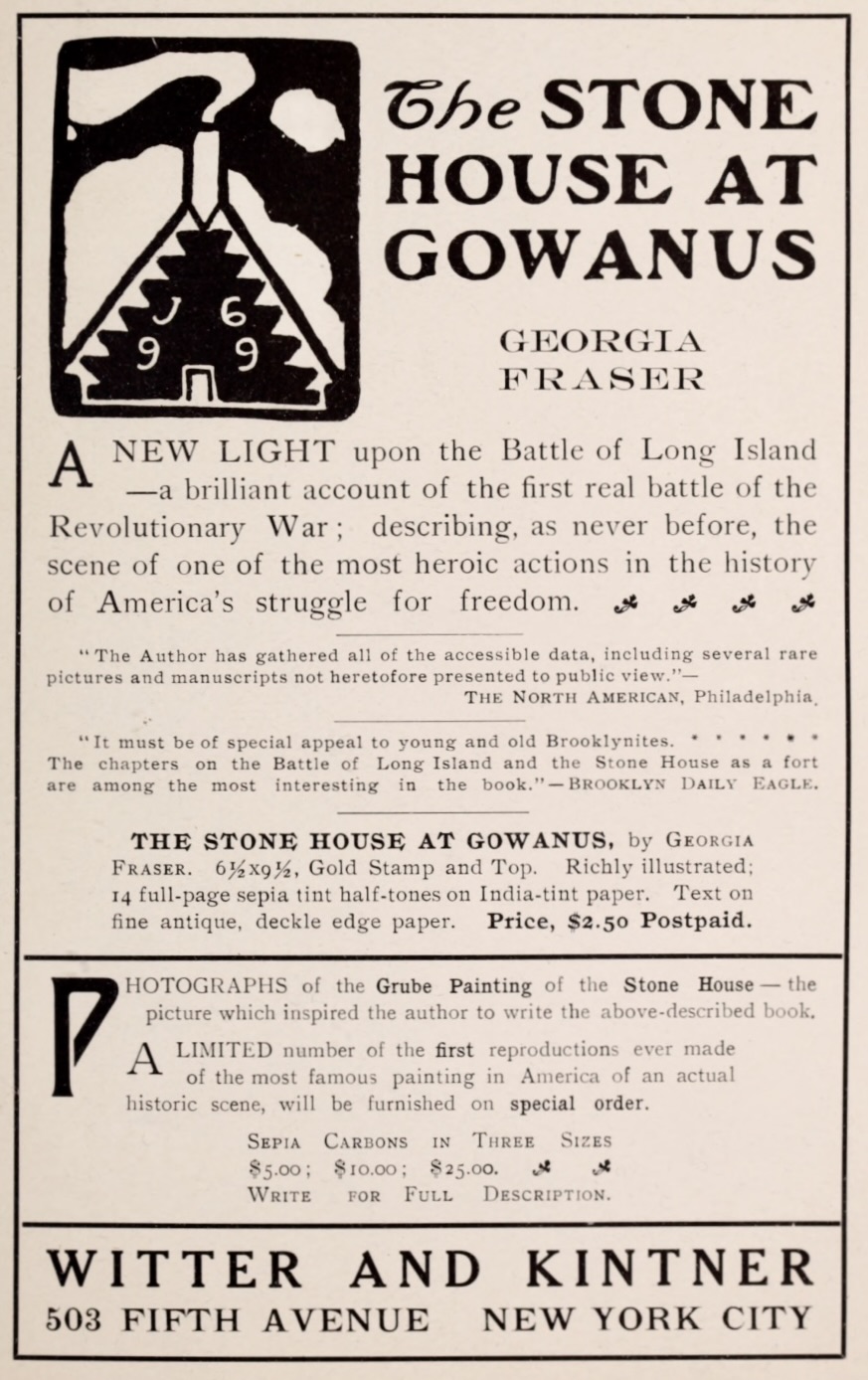
It was in the milieu of this renewed interest in Revolutionary War history and civic engagement that Charles Ditmas, Georgia Fraser, and Charles Higgins each authored works relating to Brooklyn past. Charles Ditmas’s self-published Brooklyn’s Garden: Views of Picturesque Flatbush (1908) was a small collection of postcard-like images of some two dozen historic structures and landscapes across the borough. One year later he followed up with the more ambitious Historic Homesteads of Kings County. In this again self-published work, Ditmas focused primarily on historic residences, many of them dating back prior to the American Revolutionary War. Ditmas’s monograph included vignettes on events of local interest along with genealogical sketches of the families who in some cases still owned and lived on the homesteads. Fraser in 1909 published The Stone House at Gowanus, a brief history of the Battle of Long Island with a focus on the events taking place in and around the sturdy structure where the Maryland 400 had made their stand. The stone house at Gowanus was not one of the still-standing homesteads of Kings County; it had been torn down a decade previously in the mid-1890s. Built by the Vechte family in 1699, it was sold to another family, the Cortelyous, in 1790. It passed to others in 1852, and in the ensuing decades served numerous functions, including as the clubhouse for the baseball team that became the Brooklyn Dodgers. The demolition of the Vechte-Cortelyou House was a heavy blow for the borough, city, and nation; the Battle of Long Island was one of the largest of the American Revolutionary War; more than 30,000 Americans, British, and Hessians had taken part and events at the house were a major part of the engagement. As Benson Lossing had noted over half a century earlier in his Pictorial Field-Book, there was already so little physically remaining in Brooklyn from the period. Now one more site was gone. For some residents its loss was personal; many of the old families had ancestors who had served either as patriots or loyalists in the Revolution. The Battle of Long Island unfolded on properties that in some cases were still in family hands. Rebuilding what was now being called the Old Stone House would become a priority of the Kings County Historical Society.
Founding the Society
On February 8, 1910 Charles M. Higgins spoke at the Montauk Club to a gathering of the Prospect Heights Citizens’ Association. Higgins’s speech was a plea to his well-heeled audience for assistance in rebuilding the Old Stone House. For months he had been purchasing bulk orders of Fraser’s monograph and distributing copies to anyone who he thought might help. Eight days later on February 16th, a series of lithographs, engravings, and photographs from Fraser’s personal collection on the history of the Old Stone House and Battle of Long Island went on view at the Manhattan gallery of art dealer J.C. Witter. In addition to being a gallerist James Caldwell Witter was one half of Witter and Kintner, the publishing concern that had issued Fraser’s The Stone House at Gowanus the previous year. Witter and Kintner now published Higgins’s Brooklyn’s Neglected Battle Ground, a pamphlet of the address the ink-manufacturer had given to the Prospect Heights Citizens’ Association that February. Mincing no words, Higgins titled his address “Brooklyn’s Patriotic Sacrilege and Historic Shame.” The following year, the twenty-six Brooklynites met at Savoy Hall to observe Abraham Lincoln’s birthday and convene the first ever meeting of the Kings County Historical Society.
- “New Society Formed to Save Old Landmarks,” Brooklyn Daily Eagle, February 14, 1911, 22. ↩︎
- Lila James Roney, “Charles Andrew Ditmas,” The New York Genealogical and Biographical Record 70, no. 1 (1939): 1. ↩︎
- Benson J. Lossing, The Pictorial Field-Book of the Revolution (New York: Harper & Brothers, 1852), 2:805. ↩︎
- “A Patriotic Society. Descendants of Brooklyn’s Early Settlers Organize the New Utrecht L.P.A.,” The Brooklyn Citizen, September 22, 1908, 10. ↩︎
 Emerging Revolutionary War Era