

ERW welcomes back historian Keith J. Muchowski as he concludes his series.
A new Brooklyn, a new century
This all happened at a moment of great economic, political, and demographic transformation in Brooklyn. For many residents of Dutch colonial heritage, life had changed surprisingly little since the seventeenth century. Well into the twentieth century, families like the Lotts, Bergens, Kouwenhovens, and Remsens and others lived comfortably in houses built by their ancestors. Some even continued farming the same fields that their forbears had tilled centuries earlier.1 Besides enjoying a domestic life that would have been recognizable to their ancestors, many worshipped in the same Dutch Reformed Churches those ancestors had built. When the time came, they often buried their loved ones in plots beside family members who had been resting there for centuries.
Yet by the turn of the twentieth century, modernity was encroaching on the charming rural life still to be found in the outermost reaches of Brooklyn. The Consolidation of 1898 had subsumed the independent municipality of Brooklyn into the industrializing metropolis of New York City. Consolidation brought a considerable loss of power, status, and control for Brooklyn residents. Transportation was also changing Brooklyn. The first subway came to the borough in 1908, adjacent to Borough Hall. Service quickly expanded throughout much of the remainder of the borough in the following years, opening up such previously remote neighborhoods as Gravesend and New Utrecht to commercial and residential development.
The population of Brooklyn itself rose from 1.1 million in 1900 to 1.6 million by 1910.2 This was a seismic change, and source of anxiety for many members of the old families. Besides the sheer volume of newcomers, most new Brooklynites were decidedly not of Old Dutch heritage. Instead, many of the immigrants who came through Ellis Island were from Eastern and Southern Europe, and they often competed with more established Brooklynites for jobs and wages. Their foods, languages, and entertainments were literally foreign to the old Knickerbockers whose families had been living uninterrupted in Kings County throughout the Dutch, British, and now American periods. These anxieties were clearly a factor in forming of the Kings County Historical Society. “We live in a community,” Ditmas lamented at the first meeting of the organization in February 1911, “surrounded by historic conditions and yet have no shrine of patriotism that dying we may bequeath a rich legacy unto our issue.”3 Ditmas returned to this theme frequently, advocating for “a true Americanism” in his president’s report published in the January 1917 issue of the Kings County Historical Society Magazine, the official periodical of the Society.4 In this he sounded like another New Yorker of Dutch heritage, Theodore Roosevelt, who in a 1915 speech to the Knights of Columbus at Carnegie Hall decried what he called “hyphenated-Americanism,” a term the former president aimed at newcomers he alleged were unwilling to assimilate.
Saving old homesteads and preserving Dutch genealogical records were top priorities of the Kings County Historical Society. Still, they were not the only missions of the group. The Kings County Historical Society involved itself in a variety of undertakings, such as public talks and lectures; exhibits and fairs; teas and socials; banquets and dinners; and dances for adults and youths alike. It also engaged in public history, interpreting the heritage of Kings County and Long Island for lay audiences. Commemorating the American Revolutionary War, especially the Battle of Long Island, was a significant part of that project. They also published the aforementioned Kings County Historical Society Magazine.
Members of the Kings County Historical Society got down to work immediately. In June 1911 they commemorated the 275th anniversary of the 1636 purchase of Long Island land from the Native Americans at Kings County Historical Hall. For Ditmas, the location was convenient because he had been born and still lived at the nearby Ditmas Homestead. For the 275th anniversary, families such the Bergens donated items from their personal collections, including linens, crockery, old almanacs, and even flax grown locally in Flatlands.5 Ditmas noted proudly that with over four hundred items listed in its catalog, the exhibit contained more items than any exhibit of its type ever shown in Brooklyn.6
Five years after its founding, the Kings County Historical Society organized one of its biggest events to date, a commemoration of the 140th anniversary of the Battle of Long Island. This hugely popular event was held in Prospect Park and quickly became an annual Brooklyn tradition. When the United States entered the First World War, the Kings County Historical Society raised funds in a Liberty Bond drive. In reference to their ancestors who had donated to the cause of the American Revolutionary War, and as an inspiration and model for themselves and others to emulate, they also compiled a list of several dozen Long Islanders who had “contributed to the ‘Great Liberty Loan of 1777-1783.’”7
Members of the society also continued writing. Ditmas and Higgins both authored articles that appeared in the Brooklyn Daily Eagle on the day of the 1916 commemoration. Higgins authored a more extended piece for the August 1916 edition of the Kings County Historical Society Magazine titled “Brooklyn and Gowanus in History: The Battle of Long Island, August 27, 1776: The Past Historic Neglect and the Present Historic Duty of Brooklyn.” The title articulated the article’s thesis. In 1920, the Society also published a small monograph written by Ditmas titled The Life and Service of Major-General William Alexander, also called the Earl of Stirling about the officer under whose command the Maryland 400 had fought.
Brooklyn Enters the Jazz Age
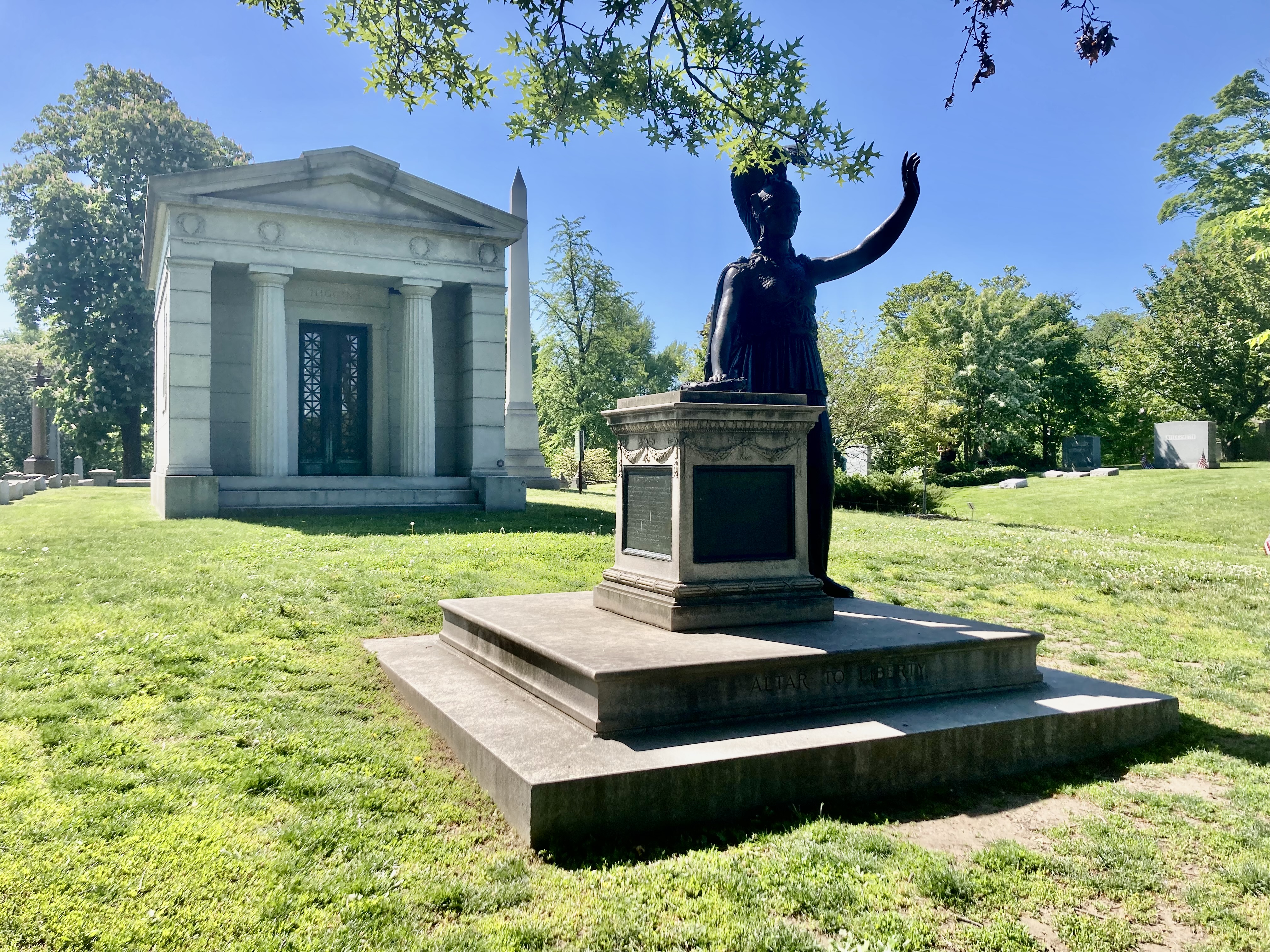
On August 27, 1920, the 144th anniversary of the Battle of Long Island, the Kings County Historical Society completed what would be one of its most significant and enduring projects: the erection and dedication of the bronze statue of Minerva and the Altar to Liberty atop Battle Hill in Green-Wood Cemetery. The monument was largely funded by Charles Higgins. Governor Alfred E. Smith and Assistant Navy Secretary Franklin D. Roosevelt were two of the VIPs who attended the dedication. Higgins understood the historical significance of Battle Hill, which is why he worked so hard to make the Minerva statue and Altar to Liberty a reality. He also understood the significance of Green-Wood Cemetery itself, which did not exist at the time of the battle. The garden cemetery opened in 1838 and by the twentieth century had become perhaps the most desirable resting place in the five boroughs. This is why Higgins also arranged for a mausoleum to be built upon Battle Hill directly behind Minerva and the Altar to Liberty, ready for him to be laid to rest when his own time came.
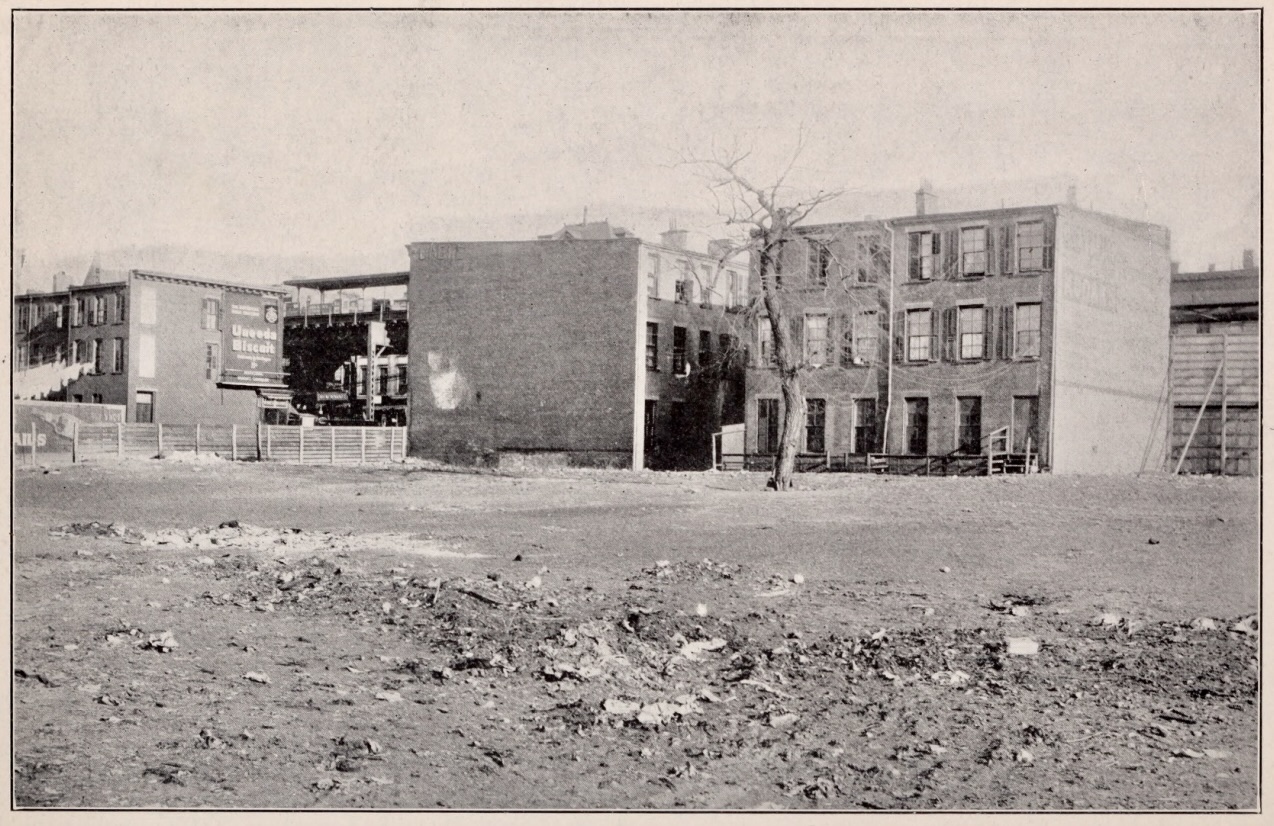
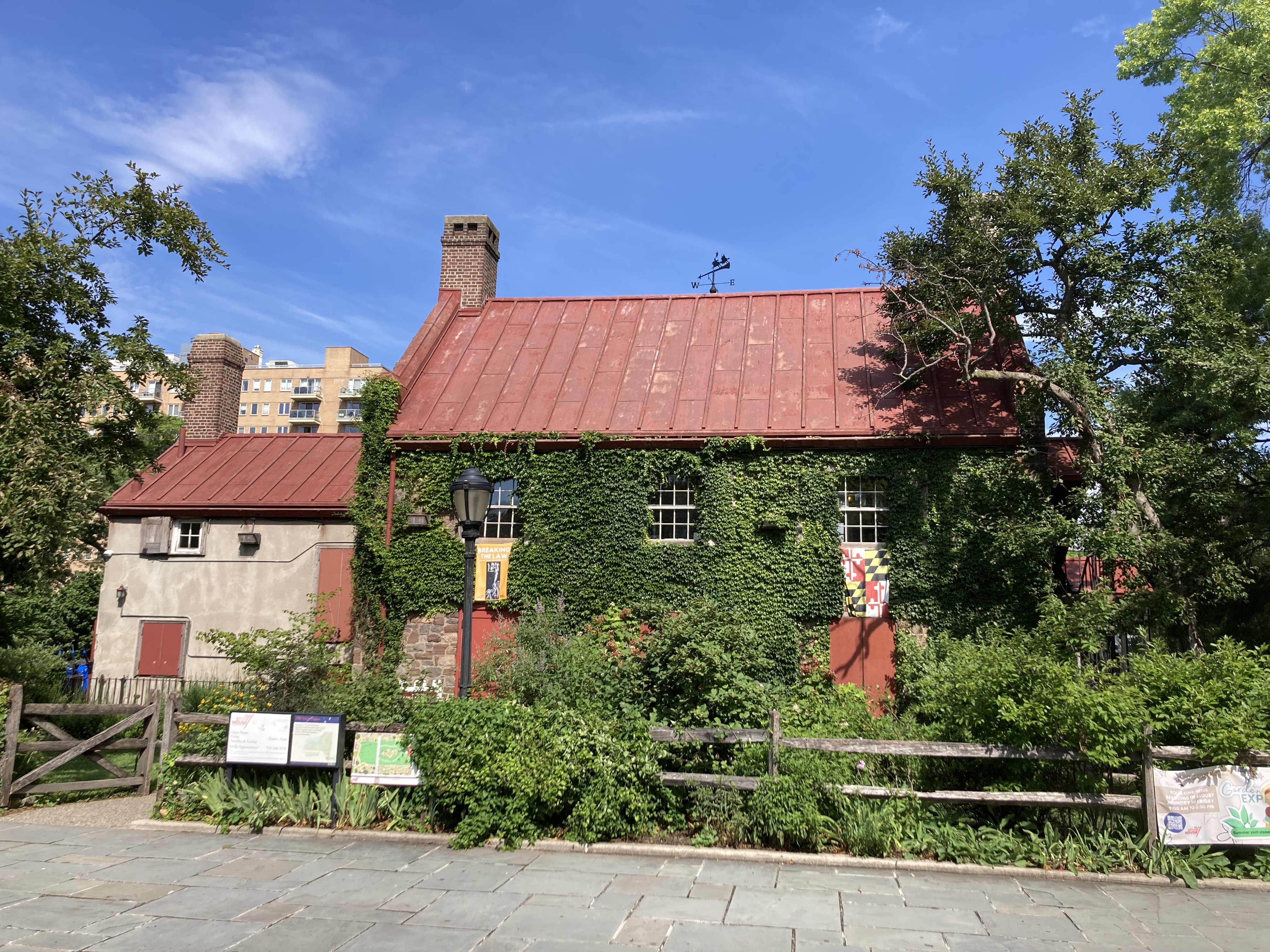
After this victory, the Kings County Historical Society focused more intensely on reconstruction of the Old Stone House. The first task was finding its remnants, which was easier said than done. When the Old Stone House had been demolished in the 1890s, the debris had been tossed into the foundation and the area then razed, graded, and paved over. In 1922, the Brooklyn Edison Company purchased the block of land upon which the Old Stone House had once stood and had big plans for the site. Still, Ditmas, Higgins, the Kings County Historical Society, and other civic organizations remained hopeful that the city could acquire the site and have the buried house rediscovered, excavated, rebuilt, and incorporated into a new local park. After a few years of wrangling, lawsuits, and condemnation proceedings, New York City acquired the land in 1925. The foundation of the Old Stone House was discovered on May 4, 1933. On August 11, 1934 two thousand Brooklynites—most of them schoolchildren—watched Mayor Fiorello La Guardia cut the ribbon on the park on Third Street between Fourth and Fifth Avenues. Meanwhile reconstruction of the Old Stone House within the park continued into the following year and the building dedicated on May 19, 1935.
Rebuilding the Old Stone House was one of the major triumphs of the Kings County Historical Society. Charles Higgins however did not live to see it; he died in October 1929 and was entombed in the mausoleum he had had built for himself atop Battle Hill in Green-Wood Cemetery. Charles Ditmas died nine years later on July 30, 1938 in the very house in which he had been born on Amersfoort Place. Longtime member Wheeler N. Voorhees assumed the presidency after Ditmas’s death, but the activities of the Kings County Historical Society slowed down considerably under his leadership. The Dutch houses and farms so loved by Charles Ditmas were largely gone by the 1950s and 1960s as the last of the old Flatbush families sold them. These homesteads made way for apartment buildings, highways, and tract housing. Georgia Fraser, whose The Stone House at Gowanus had done so much to highlight the significance of the Battle of Long Island, died in 1960 and is buried in the North Burial Ground in Providence, Rhode Island.
A forgotten legacy
The Kings County Historical Society is largely forgotten today but its legacy remains in what it left behind. Its archive of publications and other materials is a trove for scholars and held by the Brooklyn Public Library’s Center for Brooklyn History. Its annual commemorations of the Battle of Long Island, which started with the 140th anniversary in 1916 in Prospect Park, became a staple of American Revolutionary War memory in Brooklyn. Valuable as these commemorations were, they were also somewhat limited in scope, offering a narrow interpretive experience focusing on the Revolutionary War exploits of individuals much like the forebears of members of the Kings County Historical Society. Commemorations each August largely moved to Green-Wood Cemetery and the Old Stone House after the construction of those sites and the passing of Charles Ditmas. These institutions offer a wider and more inclusive interpretive experience than the one once offered by the Kings County Historical Society. The Society of the Cincinnati of Maryland partners with the Old Stone House, Washington Park, and other organizations in an annual program that includes a reading of the names of the Maryland 400 killed in the Battle of Long Island. Thousands attend Green-Wood Cemetery’s annual hosting of public talks, living history demonstrations, and ceremonies on the cemetery grounds atop Battle Hill at the Altar to Liberty. This will be the case again in August 2026 for the 250th anniversary. For Battle of Long Island anniversaries generating greater public interest and thus larger expected crowds, such as the 1976 Bicentennial and upcoming 2026 Semiquincentennial, organizers sometimes return to Prospect Park for reenactments and other programming, following the precedent set by the Kings County Historical Society now more than a century ago.
Keith J. Muchowski is a librarian and professor at New York City College of Technology (CUNY) in Brooklyn.
- u201cOld Dutch Homesteads Still Intact, Old Fields Still Cultivated Within the Growing Metropolitan Activities,u201d Brooklyn Daily Eagle, April 30, 1916, 31.
↩︎ - Department of Commerce and Labor. Thirteenth Census of the United States: 1910 Bulletins, Population: New York City. Number of Inhabitants, by Enumeration Districts (Bureau of the Census, 1910) 2. ↩︎
- u201cNew Society Formed to Save Old Landmarks,u201d Brooklyn Daily Eagle, February 14, 1911, 22. ↩︎
- Charles A. Ditmas, u201cReport of the President,u201d Kings County Historical Society Magazine 6, no. 1 (1917): 1. ↩︎
- u00a0Kings County Historical Society, Loan Exhibition of Antiques and Heirlooms to Commemorate the 275th Anniversary of the First Purchase of Land on Long Island (New Amersfoort [Brooklyn, NY]: Kings County Historical Society, June Fifteenth and Sixteenth, 1911) 3. ↩︎
- u00a0u201cGreat Collection of Old Dutch Relics,u201d Brooklyn Daily Eagle, June 15, 1911, 9. ↩︎
- u00a0u201cThey Aided Liberty Loan of 1777-83,u201d Brooklyn Daily Eagle, October 24, 1917, 3. ↩︎
 Emerging Revolutionary War Era