
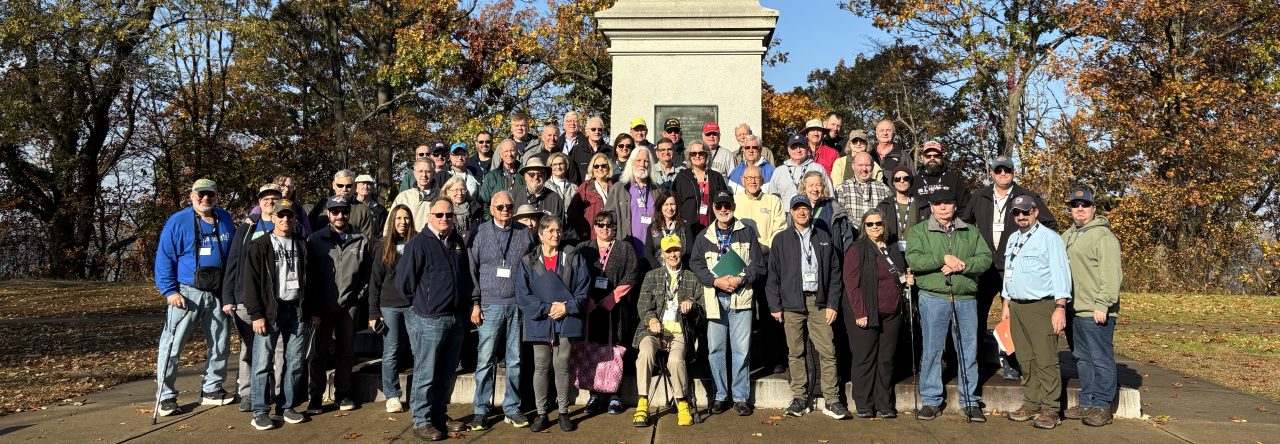
Emerging Revolutionary War welcomes back guest historian Larry Howard.
Introduction
From 1775 to 1777, Mohican Indians from Stockbridge, Massachusetts, formed a Patriot militia company that served in the American revolution, including the siege of Boston, the capture and siege of Fort Ticonderoga, the Battle of Saratoga, and the Battle of Monmouth. In the summer of 1789, while patrolling in the Kingsbridge, New York, area in what is now the Bronx, the Stockbridge company was attacked by British Lt. Col. John Simcoe’s Loyalist Queen’s Rangers in a battle alternately known as the Battle of Kingsbridge, the Battle of Cortland Ridge, or the Battle of Van Cortlandt’s Woods. It is also known as the Stockbridge Massacre, because the Queens’ Rangers killed an estimated forty Stockbridge Indians. The Rangers had one soldier killed and three wounded. This ended the Stockbridge Indian militia company’s service.
This article explores the background of the Mohican people in the Hudson River valley which includes what is now western Massachusetts, specifically the town of Stockbridge. It will explain why the Indians formed a militia company that was part of the Massachusetts militia, serving initially in the French and Indian War, and later in the American Revolution. After discussing the various campaigns the Stockbridge militia company participated in, ending with Kingsbridge and honors bestowed by General George Washington, the article concludes by highlighting the forced departure of the Mohicans from Stockbridge, ultimately settling in Wisconsin, where today they are known as the “Stockbridge-Munsee Community, Band of Mohican Indians.”
Who Were the Stockbridge Indians?
The indigenous peoples known as the Mohicans once occupied territory ranging along the entire Hudson River valley from Lake Champlain to Manhattan, New York, and included parts of Vermont, Massachusetts, Connecticut, Pennsylvania, and New Jersey.[i] According to oral tradition, the Mohican people migrated from other parts of the continent to the Hudson River valley, along the river they named Mahicannituck. They called themselves the Muh-he-con-neok, or the People of the Waters That are Never Still.[ii]
The Mohicans first encountered Europeans in 1609 with the arrival of Henry Hudson, a trader for the Dutch. This began lucrative fur trading and new technologies like iron kettles and guns to the Mohicans, but created new tensions with neighboring tribes like the Mohawk over control of the trade, as well as drawing them into the conflict between the Dutch, English, and French as those European powers wrestled for control of North America.[iii] The Europeans introduced not only new trade goods and new wars to the area, but also new diseases, such as smallpox, measles, and scarlet fever, which the Mohicans and other Indians had no immunity to, resulting in a drastic population decline.[iv]
By the early 1730s, the combination of cultural and economic pressures, including indebtedness and questionable land deals, pushed the Mohicans eastward into the Housatonic River Valley in western Massachusetts, where they encountered Christian missionaries in 1734.[v] Responding to a complex mix of spiritual curiosity and a pragmatic need for new strategies of survival, the Mohicans permitted Englishman John Sergeant to establish a mission in the village of Wnahktukuk in 1738, which the English called Stockbridge. The tribe was then commonly known as the “Stockbridge Indians.”[vi]
Military Campaigns
With the Stockbridge people’s history so closely connected with English colonists in the area, the Mohicans also became deeply intertwined with the major military conflicts of the 18th century, where they served as crucial allies to the English against the French and, later, serving with the Americans against the Crown. Stockbridge Mohicans enlisted in Massachusetts militia companies in both the French & Indian War and the American Revolution, along with other Wappinger and Munsee Indians from the area.[vii]
French & Indian War
The Seven Years’ War, beginning in 1754 and known in the colonies as the French and Indian war, saw armed conflict between England and France. Both nations recruited Native peoples into the struggle, and the Stockbridge Mohicans, allied with the British, participated in a series of campaigns against the French and their Native allies.[viii] In 1754, a committee of the Massachusetts government officially declared that the Stockbridges join the colony’s militia as “soldiers in the province service.”[ix]
Militia service was seen as a way for young Mohicans to reaffirm their heritage as warriors and restore a sense of balance in uncertain times.[x] Their experience as warriors and scouts – especially in the woodlands of North America, which differed greatly from the generally open terrain of European battlefields – made them highly valuable assets to the colonial forces and they frequently served as scouts in Rogers’ Rangers and like units. They conducted reconnaissance missions as far away as Niagara and the portage area between Lake Champlain and Lake George in New York.[xi]
In one action, Stockbridge scouts found hundreds of French soldiers on the western side of Lake George, providing English leaders with evidence that French forces were steadily moving closer to territory claimed by the British.[xii] About thirty Stockbridge warriors, serving in Roger’s Rangers under Lieutenant Naunauphtaunk were involved a skirmish near Fort Ticonderoga, a French base, and proved that French forces outnumbered British forces in the area.[xiii] Shortly after mission, Naunauphtaunk and his soldiers joined Roberts on a raid into Canada to destroy French livestock and harvests.[xiv]
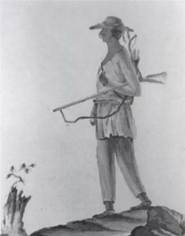
The Stockbridge Indian company continued to serve in the colonial militia through the remainder of the war, conducting reconnaissance and raids in support of British and colonial forces. True to their native heritage, the company remained distinctive in dress and arms. Not issued uniforms, they typically wore linen trousers and shirts, and deerskin shoes, carrying a musket, tomahawk, and a bow and 20 arrows.[xv]
American Revolution
When the colonies declared independence from Britain, the Stockbridge Mohicans, alongside the Oneida and Tuscarora nations, chose to support the Americans’ cause.[xvi] As early as the summer of 1774, New York’s royal governor William Tryon had attempted to bring the nations onto the British side, but it was actually Massachusetts that became the first state to have Indian militiamen when it formed the Stockbridge Indian company.[xvii] The Stockbridge company, made up of about 60 Indians as its soldiers, participated in campaigns that included the Siege of Boston, Bunker Hill, Valcour Island in Lake Champlain, Ticonderoga, Saratoga, and Monmouth Courthouse.[xviii] They also served as a vital buffer between frontier settlements and British forces and were instrumental as intelligence-gathering scouts.
By the authority of Congress, General George Washington officially added the Stockbridge company to the Continental Army, where they served to counter the British Army’s movement from Canada south along Lake Champlain. To distinguish the Stockbridges from other Indian nations fighting with the British, the Stockbridges were ordered to wear a blue and red cap so that the “officers and soldiers of [the American] army art to take particular notice, to the end that we may not, by mistake, kill our friends instead of our enemies.”[xix]
During the Battle of Valcour Island, the Stockbridges served as scouts to report on British activities, which may have helped Continental Army General Arnold’s maritime delay of the British attack.[xx] British scouts reported to British General Burgoyne that there were Indians “hiding in shame,” but it is more likely that the Stockbridges were hiding behind obstacles such as trees and rocks as they observed and reported on the British.[xxi] Captain Abraham Nimham reported in a Boston newspaper his account of Stockbridge scouts and their encounter with British troops near Skenesborough (now Whitehall, New York), south of Fort Ticonderoga:
…[T]here came along two Regulars driving a number of horses; we jumped up and seized them; [The] Regulars were so very much frighted, that they made no resistance, neither could they speak plain…. Our prisoners attempted to get away from us, we were therefore obliged to make them feel that our hatchets were heavy. I told them if you will behave like prisoners, we will use you well, but if you don’t we must kill you; after this, they behaved well, and did everything we bid them.[xxii]
Battle of Kingsbridge — the Stockbridge Massacre
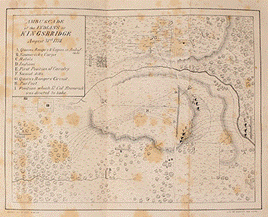
The Stockbridge Indian’s most significant sacrifice came in 1778 during the Battle of Kingsbridge, also referred to as the Battle of Van Cortlandt’s Woods, in what is now the Bronx, New York. In this engagement, a company of sixty Stockbridge soldiers was ambushed and nearly wiped out by British troops, a devastating loss from which their community would struggle to recover.[xxiii]
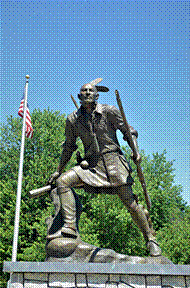
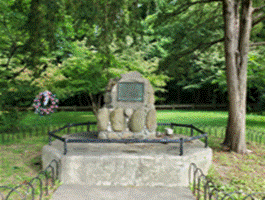
On August 31, 1778, Stockbridge militia soldiers were on a scouting mission looking for British army forces near the northern end of Manhattan – an area that is now Van Cortlandt Park in the Bronx, New York. Led by the Continental Army’s Captain Daniel Nimham, the last sachem of the Wappinger tribe from the Hudson Valley, the Stockbridge Company was ambushed by a 500-man British and Loyalist force comprising the Queen’s Rangers and Tarleton’s Dragoons, led by Lieutenant Colonel John Graves Simcoe. In the ensuring battle, about forty Mohicans were killed.[xxiv] Though they fought bravely, the militia force was outnumbered and surrounded. With a high casualty rate of about sixty-seven percent killed, the Stockbridge militia company effectively ceased to exist as an effective military unit. Simcoe recorded Captain Nimham’s final moments before he was killed, as he told his Mohican soldiers that “he was old and would stand and die there.”[xxv] Nimham’s father was also killed.
After the Revolution: Dispossession and Diaspora
As General-in-Chief of the Continental Army, George Washington praised the Stockbridge Indians, writing that they “remained firmly attached to us and have fought and bled by our side; [and] that we consider them as friends and brothers.”[xxvi] And in 1783, Washington sponsored an ox roast in Stockbridge to thank the Tribe for its service during the war.[xxvii] Yet despite their loyal service and sacrifice, the Mohican soldiers of Stockbridge returned from the war to find their lands systematically taken from them through debt, fraudulent sales, and the relentless pressure of land-hungry settlers. They were no longer welcome in their own village. As early as 1765, Daniel Nimham unsuccessfully petitioned the New York Common Council for resolution of a land grab of Indian land by colonists, subsequently travelling to England in 1766 to present the same case to King George III.[xxviii] In the mid-1780s, they accepted an invitation from the Oneida Nation, which had also fought for the colonists in the Revolution, and relocated to New York, establishing “New Stockbridge.” There, they once again cleared forests, built farms, and established a church and school.[xxix]
This respite was short-lived. Land companies and the state of New York soon pressured for the removal of all Indians. This began a series of forced migrations westward. In 1818, a group led by John Metoxen traveled to Indiana, only to find the land they had been promised had been sold.[xxx] The community then negotiated a treaty for land in modern-day Wisconsin, beginning another move in 1822. As a result of the 1832 Indian Removal Act, signed into law by President Andrew Jackson, the Stockbridge Mohicans and other Indian nations were forced to relocate west of the Mississippi River. During this period, the Mohicans were joined by a group of their relatives, the Munsee people, and the combined community eventually became known as the Stockbridge-Munsee.[xxxi] Additional treaties and federal removal policies continued to displace them until the Treaty of 1856 relocated them to Shawano County, Wisconsin, where descendents remain today.
Conclusion
The history of the Stockbridge Mohican people challenges the often-simplified story of America’s colonial period. The once expansive nation found itself pressured after Europeans moved west into traditional Mohican lands. Attempting to live in harmony with their new neighbors, many Mohicans embraced Christianity, adopted Anglo-American farming and governance, and fought and died for the American cause of freedom, yet they were systematically dispossessed of their lands and forced into a diaspora spanning hundreds of miles and multiple generations. Their story highlights the complex choices Native peoples faced in the 17th, 18th, and 19th centuries. Their story also demonstrates that acculturation and alliances were not guarantees of either acceptance or security. The Stockbridge Mohicans were active in their own history, making difficult decisions in a world that was rapidly and violently changing around them.
In the French & Indian War, the Mohicans of Stockbridge stood with American colonial militia forces as the British and Americans successfully prevented French hegemony in North America. Then in the American Revolution, the Mohicans fought side-by-side with Americans to prevent British tyranny and establish American liberty. The journey of the Stockbridge-Munsee people from the “waters that are never still” to the forests of Wisconsin stands as a powerful testament to the endurance, strength, and hope of a proud and determined people.
[i] Dorothy Davids, A Brief History of the Mohican Nation Stockbridge-Munsee Band (Bowler, WI: Stockbridge-Munsee Historical Committee, Arvid E. Miller Memorial Library Museum, 2017), 2. https://mohican-nsn.gov/wp-content/uploads/2025/07/2017breif-history-1.pdf.
[ii] Ibid., 1.
[iii] Ibid., 2.
[iv] Davids, 3; Brandon James Crawford, “The Stockbridge Indian Mission: A Historical Reappraisal,” Detroit Baptist Seminary Journal (30, 2025): 43, https://dbts.edu/wp-content/uploads/2025/06/The-Stockbridge-Indian-Mission-by-Brandon-James-Crawford.pdf.
[v] Patrick Frazier, The Mohicans of Stockbridge (Lincoln: University of Nebraska Press, 1992), 18.
[vi] Davids, 3; Fraizer, xi.
[vii] “The Stockbridge Militia and the Battle of Van Cortlandt’s Woods,” Martin Van Buren National Historic Site, National Park Service, https://www.nps.gov/mava/learn/historyculture/the-stockbridge-militia-and-the-battle-of-van-cortlandt-s-woods.htm.
[viii] Davids, 3; Laurence M. Hauptman, “The Road to Kingsbridge: Daniel Nimham and the Stockbridge Indian Company in the American Revolution,” American Indian Magazine (Vol 19, No 3, Fall 2017), https://www.americanindianmagazine.org/story/road-kingsbridge-daniel-nimham-and-stockbridge-indian-company-american-revolution.
[ix] Frazier, 111.
[x] Ibid., 111.
[xi] Anthony Phillip Blasi, Frontier Rangers of Colonial New England: From King Philip’s War to the American Revolution (Charleston, SC: History Press, 2025), 69; Frazier, 112, 115.
[xii] Fraizer, 117.
[xiii] Ibid., 119.
[xiv] Ibid., 119.
[xv] “Daniel Nimham,” American Battlefield Trust, https://www.battlefields.org/learn/biographies/daniel-nimham. This description came from Johann von Ewald, a Hession officer during the American Revolution, but is an accurate description of Stockbridge militia soldiers’ attire and equipment during the French & Indian war.
[xvi] Davids, 3.
[xvii] Frazier, 206.
[xviii] Victor J. DiSanto, “Daniel Nimham, the Wappingers, and the Daniel Nimham Monument,” Journal of the American Revolution (January 9, 2024), https://allthingsliberty.com/2024/01/daniel-nimham-the-wappingers-and-the-daniel-nimham-monument/.
[xix] Frazier, 209.
[xx] Ibid., 210.
[xxi] Ibid., 212.
[xxii] Ibid., 213. Nimham’s account was published in the Continental Journal and Weekly Advertiser (August 21, 1777), 3.
[xxiii] Davids, 3; DiSanto; Laurence M. Hauptman, “The Road to Kingsbridge: Daniel Nimham and the Stockbridge Indian Company in the American Revolution,” American Indian: Magazine of Smithsonian’s National Museum of the American Indian (Fall 2017, Vol. 18, No. 3), Smithsonian Institution, https://www.americanindianmagazine.org/story/road-kingsbridge-daniel-nimham-and-stockbridge-indian-company-american-revolution.
[xxiv] “The Stockbridge Militia and the Battle of Van Cortlandt’s Woods,” Martin Van Buren National Historic Site, National Park Service, https://www.nps.gov/mava/learn/historyculture/the-stockbridge-militia-and-the-battle-of-van-cortlandt-s-woods.htm; “Battle of Kingsbridge,” Visit the Empire State Plaza & New York State Capitol, https://empirestateplaza.ny.gov/battle-kingsbridge.
[xxv] Hauptman.
[xxvi] “Daniel Nimham,” American Battlefield Trust, https://www.battlefields.org/learn/biographies/daniel-nimham.
[xxvii] “Footprints of our Ancestors: Mohican History Walking Tour of Stockbridge,” Mohican Nation, Stockbridge-Munsee Band, https://www.nativeamericantrail.org/wp-content/uploads/2020/10/Mohican-Walking-Tour-Booklet.pdf.
[xxviii] “Daniel Nimham,” American Battlefield Trust; Davids, 3; DiSanto.
[xxix] Davids, 4.
[xxx] Ibid., 4.
[xxxi] Ibid., 4.

