Captain James Willing’s Mississippi Raid, Part 2

Bernardo_de_Gálvez (Wikimedia Commons(
Bernardo De Galvez, Governor of Louisiana (Wikimedia Commons)

Willing’s next target was the town of Manchack upon which he descended “so rapidly that they reached the Settlements without being discovered.”[1]  On the 23rd, Willing’s advance parties captured the 250-ton British sloop Rebecca, with sixteen 4-pounders and six swivels.[2]  It was a coup worthy of Navy SEALS.  Rebecca was normally a merchant vessel, but had been armed and sent upriver to contest the Rattletrap’s advance by protecting Manchack.  Instead, her presence had strengthened Willing’s force.  Captured while lying against the levy opposite the town, she only had fifteen men aboard when an equal or superior force of Americans struck about 7 am.[3]  With Manchack captured and the Rebecca renamed the Morris, Willing turned his attention to the end game at New Orleans, where he hoped to dispose of his booty and obtain supplies useful for the American war effort.

At New Orleans, the Congressional Agent, Oliver Pollock, was aware of Rattletrap’s advance and began making preparations to dispose of the property Willing and his raiders had taken, a growing portion of which constituted slaves.  He organized a small force under his nephew, Thomas Pollock, to go up river and help Willing bring his vessels and cargo into port.  Instead, Pollock and his men proceeded down the river, where they captured an English brig, the Neptune, eventually bringing her into New Orleans as a prize.[4]  (The British would argue strenuously that Neptune and a private boat were not in fact legal prizes.)

Continue reading “Captain James Willing’s Mississippi Raid, Part 2”

Captain James Willing’s Mississippi Raid, Part 1


Willing's Mississippi Raid
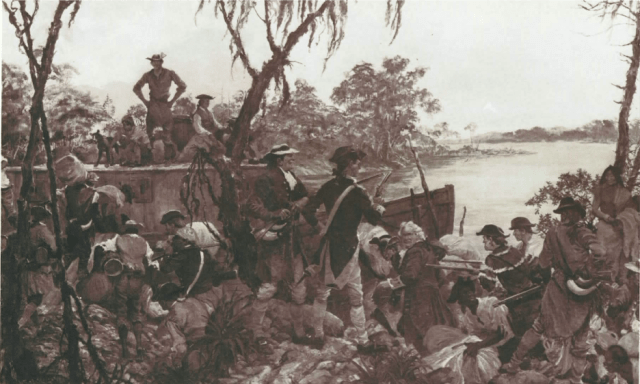
Willing’s Marine Expedition, The Marines in the Revolution: A Pictorial History, (Washington, DC: United States Marine Corps/Government Printing Office, 1975)

In 1778, Captain James Willing and his crew sailed and rowed the bateaux Rattletrap down the Ohio River to the Mississippi.   A “left” turn of sorts then took them down the Mississippi all the way to the Gulf of Mexico.  Willing’s purpose was straightforward: secure the neutrality of residents along the Mississippi, obtain supplies from New Orleans, and return them to the new United States.  It was as tall an order as the Ohio and Mississippi were dangerous.   British rangers and their Native American allies closely watched both shores and would readily attack vulnerable river traffic.  Willing’s only refuge lay in a string of forts the Americans had established on the Ohio, but they did not extend very far.  He would have to make due with his crew and the two swivel guns that armed Rattletrap. Continue reading “Captain James Willing’s Mississippi Raid, Part 1”

History after a Pandemic

The odds are good that you haven’t been able to visit some of your favorite Revolutionary War sites during the Covid-19 pandemic. Many of these locations rely on foot traffic for their annual income and may be struggling to stay afloat amidst various state lockdowns and a smaller number of visitors.  (We left out many national, state, and local parks, which sometimes have access to government funds.  But, they often have partnerships with non-profit foundations that provide vital support for their activities.)  So, we decided to start a list of museums and parks that you can help out now and visit as circumstances allow.  No doubt it will grow.  The list does not constitute a solicitation or endorsement, but many of our historians visited some of these museums in the past and found them really helpful to our own work.  (You may need to copy and paste some links.)  If you search our “weekender” posts, there are even more sites to support and visit when you can.

Continue reading “History after a Pandemic”

Review: John Adams Under Fire: The Founding Father’s Fight for Justice in the Boston Massacre Murder Trial by Dan Abrams and David Fisher

John Adams Under FireMost people with an interest in the American Revolutionary War have heard of the Boston Massacre, in which Captain Thomas Preston of the 29th Regiment of Foot, commanding a contingent of British soldiers, fired into a crowd, or a mob depending on one’s point of view, harassing/threatening a guard outside the Customs House.  Both sides in the growing dispute between Britain and its colonies rapidly turned the event, which occurred 250 years ago, to their political ends.  Several books have been written about the massacre and tried to sort fact from propaganda, at least in the context of revolutionary Boston.  In their latest book, John Adams Under Fire: The Founding Father’s Fight for Justice in the Boston Massacre Murder Trial, Dan Abrams and David Fisher tackle the trials of Captain Preston and his soldiers that followed. Continue reading “Review: John Adams Under Fire: The Founding Father’s Fight for Justice in the Boston Massacre Murder Trial by Dan Abrams and David Fisher”

The Journal of Nicholas Cresswell, Part 6


Vale of Edale (Photo by Atomviz, Wikimedia Commons)
Vale of Edale, Cresswell’s Home, the Beginning and End of His Adventures.  (Photo by Atomviz, Wikimedia Commons)

Skirmish in New Jersey

Cresswell found cheap lodging in New York and reunited with Joseph Brewer, who had fled Philadelphia himself, leaving his wife behind.  “The persecution against the friends of Gorvernment was too violent for a man of his warm temper to stay any longer amongst them with safety either of person or property.”[1]  While in New York, he watched the buildup of forces that Howe would later take on the Philadelphia campaign, but his focus remained on securing passage home.  It would take months, but Cresswell found ways to kill time, including watching a skirmish with the Americans he had so frequently cursed.

Continue reading “The Journal of Nicholas Cresswell, Part 6”

The Journal of Nicholas Cresswell, Part 5

Escape from America

Finally, in the spring of 1777, Cresswell again decided to try returning to England.  Thomson Mason, who had already intervened with two Committees of Safety to protect the Englishman, offered to help with Virginia authorities once more, provided that Cresswell swear not to join the British Army.  Cresswell did.  The best plan was to leave Leesburg, travel overland to Alexandria, then take a schooner down the Potomac and Chesapeake for Williamsburg and Hampton, where it might be possible go aboard a ship bound for British-occupied New York.  As he made his preparations, the local Committee of Safety arrived on April 16 to search his possessions for treasonable items.  They seized a shot pouch, powder horn, and bearskin he acquired from the Delaware Indians.  Cresswell decided not to contest the seizure lest it complicate his departure.

Continue reading “The Journal of Nicholas Cresswell, Part 5”

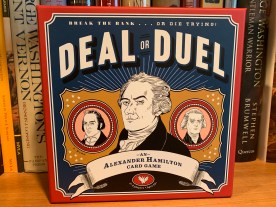
Gaming Away Social Distancing. Deal or Duel: An Alexander Hamilton Card Game

IMG_0611.jpeg
Game Box for Deal or Duel (Eric Sterner)

Among his many aphorisms, Ben Franklin reportedly said “games lubricate the body and the mind.”  Given the large number of quotes attributed to the sage, it is suspect.  But, his generation certainly understood games, both as a way of sharpening the mind and passing time in amicable company.  Franklin was fond of chess, but not above games of chance and gambling.  George and Martha Washington often played different card games with their guests.  George, of course, also made an occasional wager, particularly when traveling on business.  Even today, many parlors in restored colonial homes will contain a gaming table. Continue reading “Gaming Away Social Distancing. Deal or Duel: An Alexander Hamilton Card Game”

The Journal of Nicholas Cresswell, Part 4

A Loyalist under House Arrest

Having failed to reach the British Army in New York, Cresswell spent a miserable autumn and winter of 1776/1777 in northern Virginia, often arguing with his host, James Kirk, a Patriot and the only man who had ensured the Englishman could keep clothes on his back and a roof over his head.  Cresswell’s loyalist proclivities and extensive travels were widely known and on November 28, three men of the Committee of Safety in Alexandria “waited on me and informed me that the committee did not think it prudent to let me go out of the Country at this time and hoped that I would give  my word of honour not to depart this Colony for three months.  Otherwise they would confine me.  I was obliged to do the first as the lesser evil of the two.  They were polite enough not to search my chest.”[i]  Depressed as ever and suspecting Kirk of arranging the entire affair in order to keep him in Virginia, Cresswell did what he usually did when he was unhappy.  He got drunk.

Continue reading “The Journal of Nicholas Cresswell, Part 4”

The Journal of Nicholas Cresswell, Part 3

A Loyal Englishman in a Hostile Country

Part 2 click here.

When he arrived in Alexandria, Virginia in October 1775, Nicholas Cresswell, an Englishman visiting the colonies in search opportunity, found himself in dire straits.  The war had cut off his father’s money, while his loyalist principles strained his acquaintances and put him in an awkward position.  He summed it up: “if I enter into any sort of business I must be obliged to enter into the service of these rascals and fight against my Friends and Country if called upon.  On the other hand, I am not permitted to depart the Continent and have nothing if I am fortunate enough to escape the jail.  I will live as cheap as I can and hope for better times.”[i]

Continue reading “The Journal of Nicholas Cresswell, Part 3”

The Journal of Nicholas Cresswell, Part 2

An Englishman on the Frontier

Part 1 click here.

Nicholas Cresswell left Alexandria for the Illinois Country on March 16, 1775, his correspondence as yet unknown to the local Committee of Safety.  The Ohio River served as a highway to the west, so he headed for its origin at Pittsburgh.  Along the way, he stopped to visit the battlefield where French and Indian forces defeated Major General Edward Braddock in July, 1755.  Cresswell and his traveling companions found “great numbers of bones, both men and horses.  The trees are injured, I suppose by the Artillery…the greatest slaughter seems to have been made within 400 yards of the River…We could not find one whole skull, all of them broke to pieces in the upper part, some of them had holes broken in them about an inch diameter, suppose it to be done with a Pipe Tomahawk.”[i]

Monongaela Battle (Library of Congress)
Initial Dispositions of the Battle of the Monongahela.  Cresswell walked the battlefield on his way to Pittsburgh in 1775.  (Library of Congress)

Continue reading “The Journal of Nicholas Cresswell, Part 2”