Review: Rebels at Sea: Privateering in the American Revolution by Eric Jay Dolin, (New York: Liveright, 2022)

Compared to the rest of the literature on the American Revolution, the war at sea gets relatively little attention.  Eric Jay Dolin has joined a small cadre of writers and historians trying to rectify that shortfall.  In his latest book, Dolin takes on the privateering war, activities by privately financed vessels to wage war on British trade at the nominal behest of various states and the Continental Congress.  Granting letters of marque, essentially a license to take foreign ships as prizes on the high seas, gave states a way of quickly tapping private capital to create sea power and attack an enemy on the ocean.  It was an important innovation, one Britain and its colonies had used widely before the Revolution, and was often preferable to the expense of maintaining a large navy.  The rebelling colonies first issues such letters, followed by Congress itself.  

            The status of privateers was controversial.  Because the ships were privately financed, their owners and crews cashed in on prizes taken.  Entire fortunes could be made at the same time the war impoverished others.  For shipowners, the risks were manageable to secure such payoffs.   Officers and crewmen could also expect a healthy payday from a successful cruise.  Their risks, however, were substantial.  

Britain, of course, did not recognize its colonies as independent states, which invalidated any letters of marque and made the privateersmen crewing the ships pirates subject to summary hanging.  In practice, however, captured privateersmen were simply sent to prison, often the ship hulks floating in New York’s harbor.  It could be the same as a death sentence.  In America, some viewed them as a distraction from the main war effort created by greedy men lacking in public spirit.  

Dolin thoroughly reviews all of these issues and comes to the conclusion that, on the whole, privateers and their crews materially hindered the British war effort while preventing coastal economies from collapsing in the face of Britain’s superior fleet and control of the seas.  He backs the argument up by citing previous studies of economic losses.  For example, the first Secretary of Lloyd’s of London, and dominant insurer, concluded that 3,386 British vessels were captured during the war, of which 1,002 were either recaptured or “ransomed.” (That figure includes captures made by naval vessels and America’s allies.) Dolin estimates the value of captures made by American vessels at between $1.4 and $1.6 billion today.  In other words, the impact of privateering was substantial.

Dolin livens the story with narratives of ship encounters and individuals caught up in the war.  Much like the privateering war itself, they are too episodic to hang together as an integrated narrative.  But, he uses them effectively to underscore his broader points while helping the reader relate to the war at sea.  Dozens of illustrations enrich the read.  

            Eric Jay Dolin is an excellent writer, straightforward with a style that keeps the book moving while thoroughly engaging the reader.  Rebels at Sea is destined to become the starting place to understand the privateer war during the American Revolution. 

John Paul Jones Endangers Dutch Neutrality

John Paul Jones (Wikimedia Commons)

On the morning of September 25, 1779 from the deck of his new prize, the British frigate Serapis, John Paul Jones watched his former ship, Bonhomme Richard slide beneath the waves off Flamborough Head on Britain’s east coast.  It had been a brutal fight before the Americans prevailed over a well-handled, better-armed British vessel and became one of the most famous sea-duels in American history.  A floating wreck, Serapis’ condition made it unfit to continue with Jones’ original plan of taking the war to England by cruising for prizes.  Moreover, he was due in the Texel, a roadstead near Amsterdam where ships gathered for safer transit over waters regularly patrolled by the British fleet.   The French had a convoy gathering there and wanted an armed escort.  After spending days repairing Serapis, Jones, his small naval squadron (AlliancePallasVengeance), and his prizes (Serapis, Countess of Scarborough), reached Dutch shores on October 3.  

Continue reading “John Paul Jones Endangers Dutch Neutrality”

Down the Rabbit Hole with Three Captains Johnny

On the afternoon of June 4, 1782 in the grasslands of western Ohio, a Pennsylvania volunteer named Francis Dunlavy spent a portion of his time trying to shoot a Native American he later called “Big Captain Johnny.”  For his part, the Indian attempted with equal passion to kill Dunlavy.  At some point, they worked themselves into a position on opposite sides of a recently fallen tree at the edge of a wood that adorned a modest, but noticeable rise that could pass for a hill in the surrounding plain.  Even dropped on its side, the tree still held a full canopy of leaves, and the two combatants stalked each other around it.    Eventually, “Big Captain Johnny” saw his opening.  He was close enough to rise and hurl tomahawks at Dunlavy.   Fortunately, he missed and Dunlavy survived to relate the tale to his friends and family.  In 1872, more than 30 years after Dunlavy passed, his family related the tale to C.W. Butterfield, who wrote the first history of the Crawford Campaign.  Before telling the story again, I wanted to confirm it.  That meant searching for Francis Dunlavy and Captain Johnny anywhere, and everywhere, they might have left footprints in history. 

Continue reading “Down the Rabbit Hole with Three Captains Johnny”

Henry Clinton and “A Miracle on Sullivan’s Island”

By the Red Sea the Hebrew host detained

Through aid divine the distant shore soon gained;

The waters fled, the deep passage a grave;

But thus God wrought a chosen race to save.

Though Clinton’s troops have shared a different fate

‘Gainst them, poor men! Not chosed sure of heaven,

The miracle reversed is still as great—

From two feet deep the water rose to seven.[6]

–St. James Chronicle

While delegates to the Second Continental Congress debated the matter of Independence in 1776, the British brought the war to Charleston, South Carolina.  Defense of the city focused on Fort Sullivan, on Sullivan’s Island at the northern mouth of Charleston Harbor.  Major General Henry Clinton, commanding an Army expedition against the Americans, was determined to exploit the fort’s vulnerabilities.  He ultimately failed, but his effort, or lack thereof, prompted a British newspaper to craft a little ditty taunting the poor general.

Fort Sullivan
The Attack on Fort Sullivan, June 28, 1776 from Edward McCrady, The History of South Carolina in the Revolution, 1775-1780
Continue reading “Henry Clinton and “A Miracle on Sullivan’s Island””

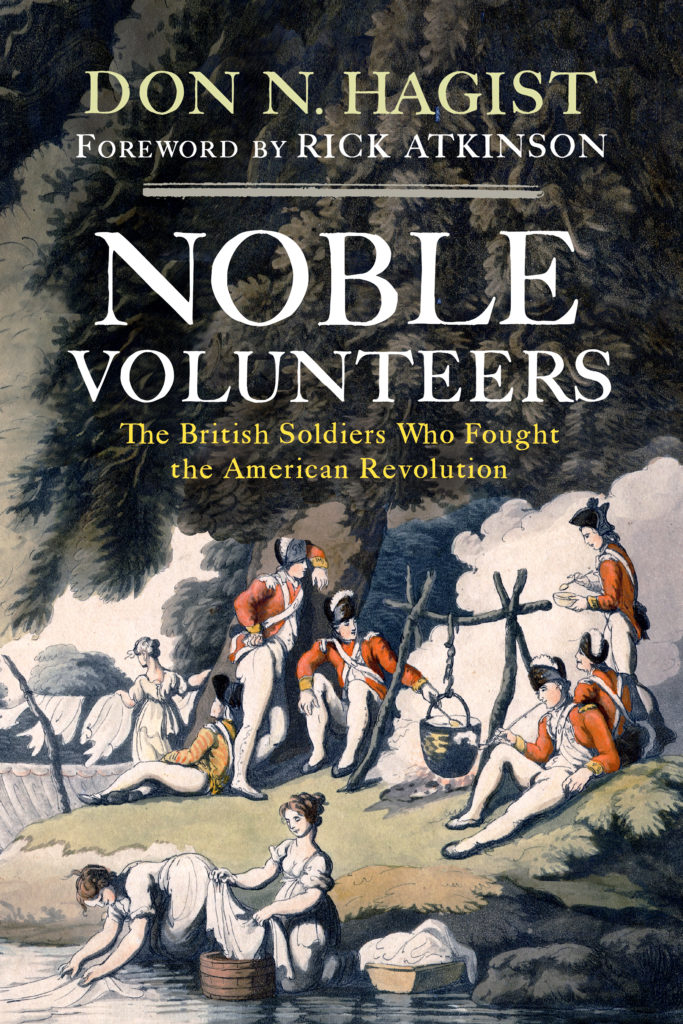
Review: Noble Volunteers: The British Soldiers Who Fought the American Revolution by Don Hagist

Don Hagist is one of our foremost American authorities on the common British soldier during the American Revolution. His latest book, Noble Volunteers: The British Soldiers Who Fought the American Revolution, is an institutional portrait of the British army that fought the American Revolution. Hagist has walked this ground before, most notably in British Soldiers, American War, which dedicated a chapter to a specific individual as a way of illustrating the experience of the common soldier. Noble Volunteers extrapolates on that, using soldier accounts, regimental paybooks, muster rolls, pension applications, and any other available material to give us an integrated picture of the entire army and how it functioned. It’s an extraordinarily valuable book.

Continue reading “Review: Noble Volunteers: The British Soldiers Who Fought the American Revolution by Don Hagist”

Bicentennial Minutes

Almost fifty years ago, the United States celebrated its Bicentennial, treating July 4, 1976 as the 200th anniversary of its founding. (The next “major” milestone will be the semi-quincentennial, which doesn’t quite roll of the tongue). For just over two years, from July 4, 1974 through October 1976, every night CBS Television broadcast a very short monologue by some public personality, ranging from actors and directors to writers and politicians. (Oddly, I don’t recall any historians, but one hopes with more than 750 episodes at least one made it on camera.) They were a minute long, give or take a few seconds, and served as miniature history lessons (or a long commercial), each timed to an anniversary of some specific event on that day. In some ways, they were “on-this-day-in-history” lessons. So, for example, on May 7, 1976 movie director Otto Preminger described Thomas Jefferson’s May 7, 1776 departure from Monticello to return to the Continental Congress. Similarly, on June 4, 1976 Senator Fritz Hollings very briefly described the first arrival of British ships near Charleston as a prelude to their attack on June 28, 1776. Each began with a musical flourish that told you what was coming and was integrated with some still images, a set, or a location that looked “historical” in the background. The series turned out to be relatively popular and was even nominated for two Emmys in 1975 and 1977.

Continue reading “Bicentennial Minutes”

Historians from the Past: C.W. Butterfield (1824-1899)

Butterfield from his book on George Rogers Clark

Early histories of the American Revolution in the west relied on oral tradition, local lore, legend, and even a bit of inventive myth-making as a young United States spread beyond the Appalachians and sought to develop its own, new identity.  Considerable effort, but not always the most rigorous methodology, often went into combining these sources into a narrative and telling an integrated story of how events in Boston, New York, Philadelphia, Charleston or London eventually affected communities “over the mountains.”   The first historians overlapped with the Revolutionary generation.   Often, the writers were children in the early 1800s and heard stories from veterans and settlers themselves (or their relations, descendants, and neighbors) in their old age.   

            A second generation came along in the mid-19th century.   The most notable was Lyman Draper.   He set out to write the definitive history of the war on the frontier, but ended up amassing the definitive archive.  While working on his never-published history, Draper crossed paths with Consul Wilshire Butterfield, who had moved to Madison, Wisconsin in part because of Draper’s success building libraries in the city and state.   Like many of his contemporaries, including Draper, Butterfield did not start as a professional historian.  Born in Oswego, NY, he moved with his family as a boy to Seneca County, Ohio in 1834, briefly attended school in Albany, and then took a brief tour of Europe in 1846.  The following year, he wrote a history of Seneca County, which was published in 1848, the same year he was elected the county’s Superintendent of Schools.  The job didn’t last long as he set out for California during the Gold Rush.  Rather than becoming a “Forty-Niner” he ran for Superintendent of State Schools, but narrowly lost.   Then it was back to Ohio, where he studied law, served briefly as Secretary of a Railway Company, and eventually opened a legal practice in Bucyrus, Ohio.   Along the way, Butterfield, who lacked much in the way of formal education but was clearly adept at learning, took the time to publish a book on punctuation.  Then, in 1873, the Cincinnati publisher Robert Clarke & Company issued Butterfield’s An Historical Account of the Expedition Against Sandusky Under Col. William Crawford, in 1872.   (The campaign’s climatic battle took place about 20 miles from Butterfield’s law practice.)  The book was a hit and the transplanted Ohio lawyer changed careers. 

Continue reading “Historians from the Past: C.W. Butterfield (1824-1899)”

Review: Tecumseh and the Prophet: The Shawnee Brothers Who Defied a Nation by Peter Cozzens

Life, liberty, and the pursuit of happiness made their way into the American revolutionary project most explicitly in the second paragraph of the Declaration of Independence.  So, I hope you’ll forgive my taking of liberties in reviewing a book that starts in the Revolutionary War Era and peaks during the Madison administration.  Peter Cozzens’ new book, Tecumseh and the Prophet (Alfred A. Knopf, 2020), is a dual biography of the legendary Shawnee leader and his younger brother, Tenskwatawa, aka “the Prophet,” whose mid-life inspiration reawakened nativist aspirations among the Native American nations living in Ohio, Indiana, Illinois, and Michigan.   Together, the two sought to build a pan-Indian movement to resist the growth of the young American nation into the Midwest in the country’s first decades.

Continue reading “Review: Tecumseh and the Prophet: The Shawnee Brothers Who Defied a Nation by Peter Cozzens”

Review: Russell Mahan, The Kentucky Kidnappings and Death March: The Revolutionary War at Ruddell’s Fort and Martin’s Station, Kindle ed. (West Haven, UT: Historical Enterprises, 2020).

In the summer of 1780, Captain Henry Bird crossed the Ohio River with some 800 Native Americans from various British-allied tribes and two companies of soldiers from Detroit (roughly 50 Canadians and Tories and a mixed group of regulars from the 8th and 47th regiments) to invade Kentucky.  More importantly, he brought two pieces of artillery, a three pounder and a six pounder.  It was one of the largest and most substantial attacks into Kentucky during the American Revolution.  

Bird’s goal was the Falls of the Ohio (today’s Louisville), which was critical to the American war effort on the frontier due to its critical position on the Ohio River.  Bird rendezvoused with the great bulk of the Native Americans at the confluence of the Great Miami and Ohio Rivers, (west of today’s Cincinnati) to discover that they had other plans.  Attacking fortified areas was less appealing than raiding small settlements and isolated farms, where the Indians might secure booty and terrorize the locals into abandoning Kentucky.  Constituting the vast majority of the army, the Native Americans won out. 

Continue reading “Review: Russell Mahan, The Kentucky Kidnappings and Death March: The Revolutionary War at Ruddell’s Fort and Martin’s Station, Kindle ed. (West Haven, UT: Historical Enterprises, 2020).”

Poet in a Patriot Prison

CONFINEMENT hail! in honour's justest cause.
True to our King, our Country, and our Laws;
Opposing anarchy, sedition, strife,
And every other bane of social life.
These Colonies of British freedom tir'd,
Are by the frenzy of distraction fir'd;
Rushing to arms, they madly urge their fate,
And levy war against their parent state.
Surrounding nations, in amazement, view
The strange infatuation they pursue.
Virtue, in tears, deplores their fate in vain; 
And Satan smiles to see disorder reign;
The days of Cromwell, puritanic rage,
Return'd to curse our more unhappy age.
We friends to freedom, government and laws; 
Are deem'd inimical unto their cause:
In vaults, with bard and iron doors confin'd,
They hold our persons, but can't rule the mind.
Act now we cannot, else we gladly wou'd;
Resign'd we suffer for the public good.
Success on earth sometimes to ill is given,
To brave misfortunes is the gift of Heaven.
What men could do we did, our cause to serve,
We can't command success, but we'll deserve. 

--- Dr. John Smyth

The American frontier west of the Appalachian mountains was a fluid place in 1775.  Settlers, officials, and Native Americans were all struggling to decide where their loyalties and interests lay, with the British government in London, colonial governments, or the rebelling Americans organizing themselves to determine their own fates.  Individuals often switched sides as the war unfolded

One man who was a constant in his loyalty to the crown was Dr. John Connolly of Pittsburgh.  Before the Revolution, he had led Virginia’s efforts as Lord Dunmore’s agent to seize control over the Forks of the Ohio and assert its claims westward, even receiving a promise of land in far-off Kentucky.  When the fighting started in Massachusetts, he developed a plan to mobilize Native Americans and Britain’s far-flung military forces on the frontier to attack Pittsburgh and then march on Virginia.  Dunmore and General Gage both approved.  So, Connolly and two loyalists, Allen Cameron of South Carolina and Dr. John Smyth of Maryland, plus Connolly’s enslaved servant travelled surreptitiously through Maryland, hoping to reach Detroit via Pittsburgh, the Ohio River, the Wabash River, and then anther overland trek.  Local patriots recognized them outside Hagerstown, Maryland and the trio was promptly arrested on the night of November 19.  A quick hearing by the local Committee of Safety decided to ship them off to Frederick, where a more thorough investigation revealed Connolly’s plan. Continue reading “Poet in a Patriot Prison”