Reverend John Gano and the battle for Forts Montgomery and Clinton

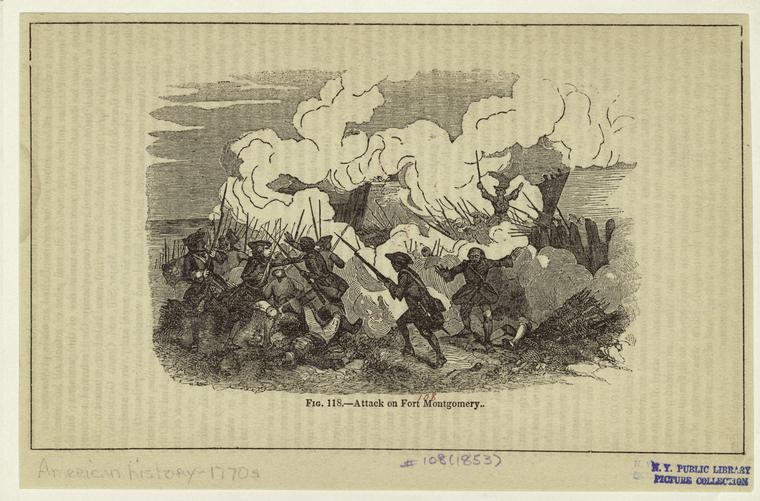
Attack on Fort Montgomery (NYPL)

Reverend John Gano served as a pastor of a Baptist Church in New York City before the Revolution.  When the British occupied the city, his congregation split and dispersed.  Although he resisted attempts to recruit him as a chaplain, the minister accepted an invitation to preach to a Continental regiment on Sundays until the Royal Navy cut him off from Manhattan.  Recalled Gano, “I was obliged therefore, to retire, precipitately, to our camp.”[1]   The preacher would become a chaplain after all.  Gano joined Colonel Charles Webb’s Connecticut Regiment and followed it.

                  Gano stayed with the army, was there during the battles in New York and mistakenly found himself in front of his regiment at White Plains.  He remained with the unit until enlistments expired at the beginning of 1777.  The minister pledged to rejoin if Webb and his officers raised a new regiment, but instead found himself at Fort Montgomery on the Hudson, eventually succumbing to arguments from General James Clinton and Colonel “Dubosque” to join the men stationed there as a chaplain.  (This was probably Colonel Lewis Dubois of the 5th New York.)  He remained there until Sir Henry Clinton launched his autumn attack into the Hudson Highlands to support General Burgoyne’s campaign to Albany.  Allowing for the uncertainties and errors of first-hand experiences and perspectives, the happenstance-chaplain provided an excellent first-hand account of the battles for Fort Montgomery and Fort Clinton on October 6, 1777.

“We had, both in Fort Montgomery, and Fort Clinton, but about seven hundred men.  We had been taught to believe, that we should be reinforced, in time of danger, from the neighbouring militia; but they were, at this time, very inactive.  We head of the approach of the enemy, and that they were about a mile and a half from Fort Clinton.  That fort sent out a small detachment, which was immediately driven back.  The British army surrounded both our forts, and commenced universal firing.  I was walking on the breastwork, viewing their approach, but was obliged to quit this station, as the musquet balls frequently passed me.  I observed the enemy, marching up a little hollow, that the might be secured from our firing, till they came within eighty yards of us.  Our breast-work, immediately before them, was not more than waist-band high, and we had but a few men.  The enemy, kept up a heavy firing, till our men gave them a well directed fire, which affected them very sensibly.   Just at this time, we had a reinforcement from a redoubt, next to us, which obliged the enemy to withdraw.  I walked to an eminence, where I had a good prospect, and saw the enemy advancing toward our gate.  This gate, faced Fort Clinton, and Captain Moody, who commanded a piece of artillery at that fort, seeing our desperate situation, gave the enemy a charge of grape-shot, which threw them into great confusion.  Moody repeated his charge, which entirely dispersed them for that time.

About sun-set, the enemy sent a couple of flags, into each of our forts, demanding an immediate surrender, or we should all be put to the sword.  General George Clinton, who commanded Fort Montgomery, returned for answer, that the latter was preferable to the former, and that he should not surrender the fort.  General Hames Clinton, who commanded in Fort Clinton, answered the demand in the same manner.  A few minutes after the flags had returned, the enemy commenced a very heavy firing, which was answered by our army.  The dusk of the evening, together with the smoke, and the rushing in of the enemy, made it impossible for us to distinguish friend, from foe.  This confusion, have us an opportunity of escaping, through the enemy, over the breastwork.  Many escaped to the water’s side and got on board a scow, and pushed off.”[2]

In his recent history of the Saratoga Campaign, Kevin Weddle cites General Clinton’s estimate of 350 American casualties: 70 killed, 40 wounded, and 240 captured, roughly half of the combined garrison of both forts.  (Weddle estimates the American garrison at 700, not the 800 Gano believed).  British losses amounted to forty killed and 150 wounded out of 2,150 in the assaulting forces.[3]

Gano spent the remainder of his service in the northeast, accompanying the men during General Sullivan’s campaign against the Iroquois, but otherwise spending the time in encampents.  He finally returned to New York and reoccupied his house after war: “My house needed some repairs, and wanted some new furniture; for the enemy plundered a great many articles.”[4]  After the war, the minister rebuilt his congregation in New York before relocating to Kentucky, where he died in 1804.


[1]                 Biographical Memoirs of the Late Rev. John Gano (New York: Printed by Southwick and Hardcastle for John Tiebout, 1806), 93.

[2]                 Ibid., 98-100.

[3]                 Kevin Weddle, The Compleat Victory: Saratoga and the American Revolution (New York: Oxford University Press, 2021), 300, 302.

[4]                 Biographical Memoirs of the Late Rev. John Gano, 116.

The Nassau Cannon

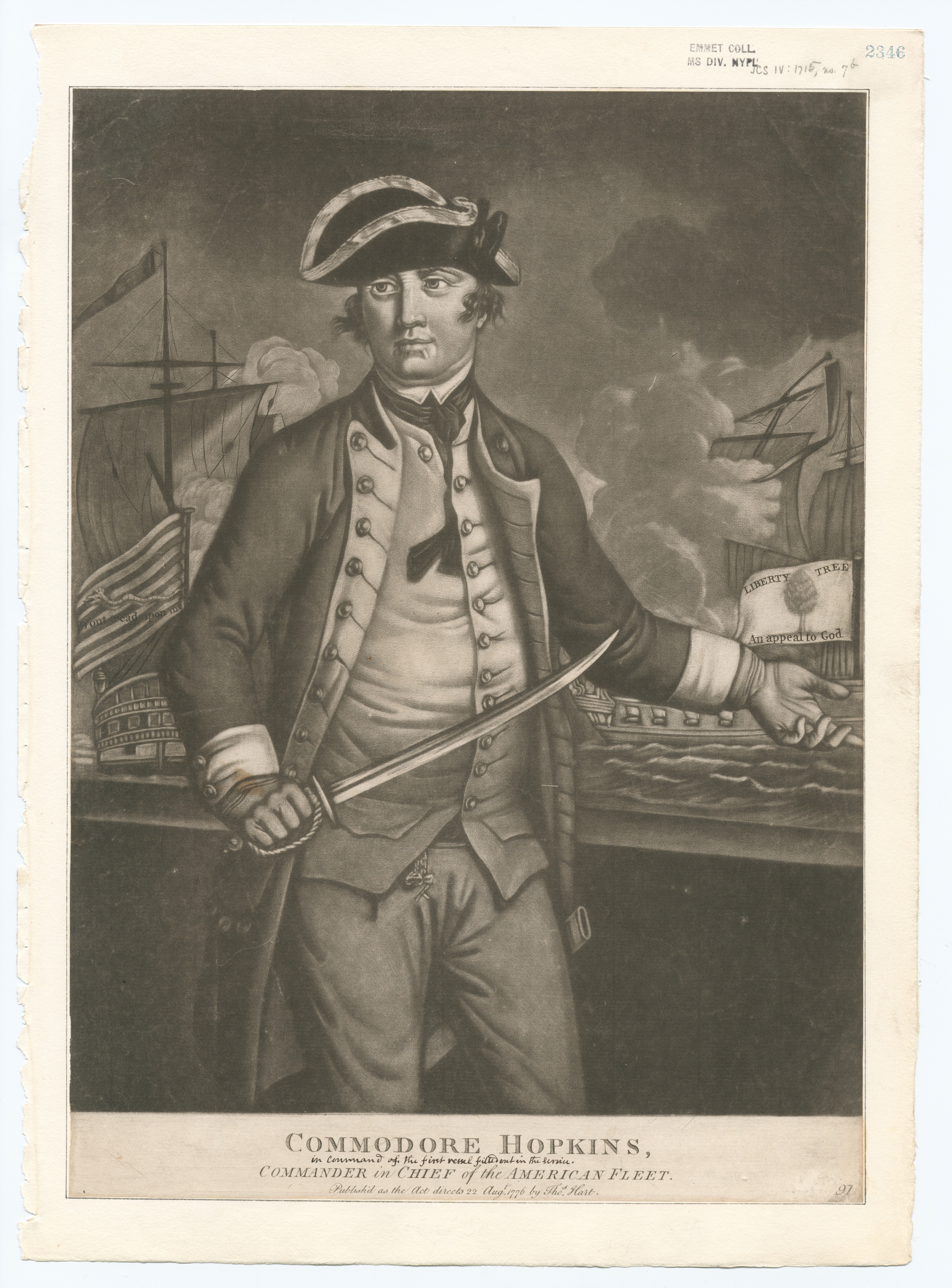
In March, 1776 Commodore Esek Hopkins led the bulk of the Continental Navy on a raid to the Bahamas, where it occupied the town of New Providence on Nassau Island for two weeks.  Hopkins and his captains were drawn by a report of gunpowder stored in the town, which the patriot cause desperately needed.[1]  Unfortunately for Hopkins, the colony’s governor had spirited away some 150 barrels the night before the American flotilla’s arrival.  Not all was lost as the Marines quickly demanded and received the surrender of two small forts defending the town and its harbor.  With those in hand, Hopkins and his men quickly got to work removing artillery, military stores, and other useful supplies.

            While the American Marines and sailors managed to recover just 24 casks of powder, their haul in sizeable artillery pieces and mortars was impressive: 88 cannon ranging from 9- to 36-pounders; 15 mortars from 4-11 inches; 5,458 shells; 11,071 roundshot; 165 chain & double shot, plus fuses, rams, sponges, carriage trucks, mortar beds, copper hoops, and various stores not required for artillery.[2]  It was a boon to be sure.  The curious part of Hopkins’ inventory of captured war material, however, is that he sent it to Connecticut Governor Jonathan Trumbull, not a representative of the Naval Committee that had issued his orders.  To John Hancock, president of the Continental Congress, he sent a report of his mission, but only mentioned “I have taken all the Stores onboard the fleet.”[3]  Indeed, his report of the armaments aboard the British schooner Hawke, which the fleet captured on its return to American waters, was more complete.  It took another day, until April 9, for Hopkins to forward the inventory of seized cannon.  Congress merely resolved that an extract of his letter should be published for delegates to peruse.[4] Perhaps inadvertently, Hopkins exacerbated regional political conflicts and undermined his own command.

Continue reading “The Nassau Cannon”

Book Review: The Whiskey Rebellion: A Distilled History of an American Crisis (Yardley, PA: Westholme Publishing, 2023)

During the second half of the 18th century, the Forks of the Ohio, where the Monongahela and Allegheny Rivers come together to form the Ohio River, were a vortex of conflict that dramatically influenced the course of events in North America and the unfolding of a young United States.  In his latest book, The Whiskey Rebellion: A Distilled History of an American Crisis, historian Brady J. Crytzer adds to his already substantial body of work exploring the critical role the region played in American history.  It is a must read.

            In 1791, Congress passed a whiskey tax to raise revenue and pay off war debts.  Treasury Secretary Alexander Hamilton, whose brainchild the whiskey tax was, designed the tax to help consolidate capital for investment in the country’s infrastructure.  Small farmers, who constituted the bulk of distillers on the frontier, rebelled.  Their resentment of the tax was not driven merely by its existence, but also by its structure, which they argued discriminated against small farmers.   They had a point.  Whiskey, not just as commodity, was a medium of exchange because hard currency was scarce on the frontier.   Thus, in some ways, the whiskey tax resembled the stamp tax; one had to pay it to engage in normal commerce.  The tax could be levied both on stills and the amount of whiskey each distiller produced.  Large enterprises who ran their stills year-round could pay the tax.  Small farmers, however, primarily ran their stills for brief periods in order to convert grain crops to more readily transportable whiskey.   Moreover, the tax had to be paid in cash, which was scarce on the frontier.  As a result, the tax was regressive and more difficult for smaller farmer to pay than for large the large distillers.  

            Rebellion was in some ways the predictable outcome.  By 1791, the frontier was populated by people with a tradition of resisting governments they believed were run for the benefit of others.  Whether those elites were in far-off London or distant Philadelphia was immaterial.  Pittsburgh might be a federalist outpost as a frontier center for exercising the authority of the newly-established United States government, but the more populous surrounding countryside was dominated by small farmers and small communities.  They responded much in the same way Americans had before the Revolution: community meetings and remonstrances, isolated attacks on officials, intimidation of those cooperating with distant governments, destruction of property, the creation of new political institutions, and the old stand-by: tarring and feathering.  Events culminated in a two-day battle for General John Neville’s home and a large muster of rebels at the site of British Major General Edward Braddock’s defeat on the Monongahela River.

Continue reading “Book Review: The Whiskey Rebellion: A Distilled History of an American Crisis (Yardley, PA: Westholme Publishing, 2023)”

Book Review: Steven P. Locke, War Along the Wabash: The Ohio Indian Confederacy’s Destruction of the U.S. Army, 1791 (Havertown, PA: Casemate Publishers, 2023).

The frontier is inextricably tied to the early development of the United States under its 1789 Constitution.  In The Treaty of Paris ending the Revolution, Britain legally ceded its territories north of the Ohio and east of the Mississippi Rivers up to the borders of Canada to the United States—the very same territory it had claimed from France at the end of the Seven Years War.  While European states might redraw borders, they did not consult the people actually living in the area.  Congress proclaimed the area the Northwest Territory and in the following years, native people, particularly the Native nations living in modern Ohio, Indiana, and Michigan fought a lengthy war with the new Unites States, inflicting one of its worst defeats on the United States Army and coming closer than any other Native American coalition to halting, or at least slowing, the spread of white society beyond the Appalachians.

            Steven P. Locke, in his new book, War Along the Wabash, chronicles the first major campaign of the United States Army in what has become known as the War of the Northwest Territory.  In 1791, frustrated by Indian attacks on frontier settlements that had not stopped after the American Revolution, Congress authorized the Washington Administration to raise an army and conduct a campaign against the Ohio Indians, the Miami, Seneca/Cayuga, Shawnee, Wyandot, Odawa, Ojibwe, Potawatomi, and Delaware.  Major General Arthur St. Clair, a veteran of the Revolutionary War, was Governor of the Northwest Territory and took personal command of the army created for the campaign.  His objective was simple enough, to launch his army from Fort Washington in modern Cincinnati to Kekionga, a cluster of Native American villages at the portage between the Maumee and Wabash Rivers in modern Fort Wayne.  Presumably, Americans ensconced in such a fort would be able to readily overawe the local tribes in their homes, force a Native American recognition of American “ownership” of the Ohio Country, and stop Indian raids along and across the Ohio River.  St. Clair received command on March 4, 1791 and was expected to march out of Fort Washington by July 10, hardly sufficient time to recruit, organize, train, and equip an army large enough for the task before him, particularly on the sparsely populated frontier.   Federal troops and supplies had to come all the way from the east coast by way of Pittsburgh and the Ohio River, while Kentucky provided militia and filled out some provisional levies. 

            Despite his intimate experience with the connection between military operations and logistical support, Secretary of War Henry Knox pressed St. Clair all summer to get his troops moving.  St. Clair, of course, could not.   The Americans had already launched mounted raids into Native American territory, which generally resulted in burned villages and despoiled crops.  According to Locke, the speed with which those raids proceeded highlights the cross-purposes under which St. Clair’s campaign would take place.  He could either move quickly with a largely mounted force over existing trails or take a more deliberate, plodding approach through the wilderness by building a road, which necessitated infantry and engineers.  St. Clair chose the latter, but the pressure from Knox and President Washington never ceased.  St. Clair responded by marching the army out of Fort Washington in September and slowly moving northward, building a road, camps, and forts as it moved a little over two miles a day, even before the army had fully assembled at Fort Washington. Indeed, in the first month, St. Clair was not usually with the army, consumed by logistical duties as he shuttled back and forth from Fort Washington or Kentucky gathering supplies and militia and then moving them forward over the newly built, yet still primitive, road. 

            By November 3, 1791, St. Clair had rejoined his army and reached the headwaters of the Wabash River with one regular infantry regiment, two levy regiments, and assorted militia, artillery, dragoons, teamsters, and camp followers.  Altogether, it was about 1,400 men.  Mistakenly believing he was closer to Kekionga than was the case and that the Indians would not attack, he did not build breastworks that night, but deployed his army in two lines with some militia thrown across a creek and various outposts scattered around his position.  He had detached his best federal regiment and sent it back down the trail to escort a supply train coming up to feed the army.  Thus, the United States Army was at its weakest point during the campaign when the Indians of the emerging Ohio Indian Confederacy struck early the next morning.  

            The Confederacy force of 1,100 warriors applied traditional tactics, quickly routing the forward militia and then moving along the flanks to the rear, essentially surrounding St. Clair and then pressing ever tighter.  Sniping from cover, the Indians seemed immune to American fire while inflicting heavy losses on the defenders.   St. Clair launched two bayonet charges to restore his lines.  As usual, the Native Americans gave way to the bayonet charges and then moved around the charging unit’s flanks as it separated from the main army, bringing each under a withering cross-fire.  In a sense, St. Clair carved up his own army and dished out pieces for the Confederacy to consume.  By the time St. Clair launched a third bayonet charge to clear his route of retreat, his army had collapsed.   He escaped with 500 men, leaving 900 dead, dying, or wounded on the battlefield, including dozens of women and children among his camp followers.  (Estimates of American losses vary widely among historians.)  The disaster was worse than General Braddock’s defeat on the Monongahela in 1755, or Custer’s in 1876.  War Along the Wabash is at its strongest when relating and analyzing the battle.  

            Locke tells the entire tale well, discusses the difficulties of raising an army from virtually nothing, includes small biographies of major “characters” as he introduces them, pays careful attention to logistics, which are often overlooked in campaign histories and were critical in the unfolding of St. Clair’s campaign, analyzes decisions and strategies, and discusses the fallout after St. Clair returned to Philadelphia to defend his decision-making.  While most of the story is from the American perspective, which is better documented, Locke makes a serious effort to address Native American perspectives and experiences as they assembled and fought the American army.  

All that said, he lapses into odd, avoidable errors from time to time.  In my Kindle edition, Locke writes on page 397 that there were approximately 400 commissioned officers in the army (nearly 1 in 3 of the total force) at the beginning of the battle, just 150 of whom remained at the end, meaning 250 commissioned officers were killed during the battle.  Yet, on page 429 he notes 69 out of 124 commissioned officers being killed or wounded during the three-hour battle.  Collectively—and there are more eyebrow-raising moments—such errors or inconsistencies distract from the book’s overall strengths, which are considerable.  

In 1793, during his campaign against the Ohio Indian Confederacy, Major General Anthony Wayne led his army up St. Clair’s trace and built a fort near the battlefield, identifiable by the large number of human remains and camp detritus, which he named Fort Recovery.  A town, still named Fort Recovery, grew up there, and the site of the battle largely lies under Wayne Street.   (Museums and parks around town commemorate both St. Clair’s defeat and Wayne’s subsequent campaign).  War Along the Wabash is an excellent starting point to understand St. Clair’s campaign and the defeat that often bears his name.  It will not be the last word, but it sets a high bar that future historians will have to work hard to surpass.  

Serendipity, Genealogy, and the 241st Anniversary of the Battle of Upper Sandusky

We interact with history at a personal level in many ways.  We enjoy careers in the field, read, tour locations, work as living historians (or interact with them), dig through archives, trace our roots, visit museums, or simply stumble across some connection in the course of living our daily lives.  But, a fortuitous bit of family history struck on a recent weekend, just shy of the 241st anniversary of a battle.  

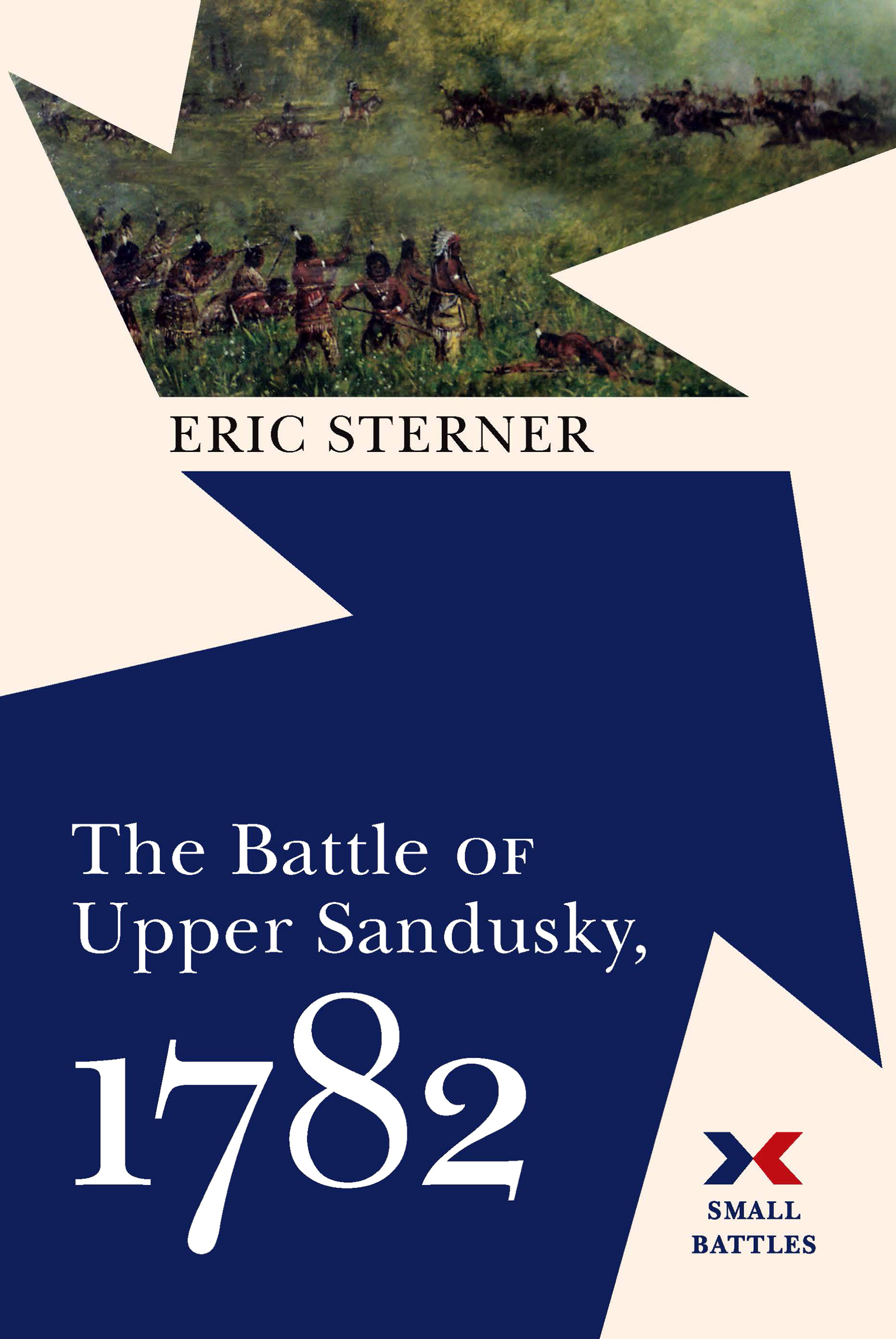
My wife and oldest daughter spent a Sunday morning with my in-laws to visit and record some family stories and memories.  They came back with a box of material.  The first document they perused was a 19thcentury application for membership in the Daughters of the American Revolution.  I was in a different room and suddenly heard yelling as my wife came to find me.  I assumed a snake had gotten into the house or we’d won the lottery without playing.  It turned out that the DAR applicant, a direct forebear of both my wife and daughter, was descended from Nicholas Dawson, who had fought in the Crawford Campaign, which happened to be the subject of my second book, The Battle of Upper Sandusky, 1782.  (Shameless bit of self-promotion: it just went on sale).  Talk about coincidence.

Many volunteer actions on the frontier during the American Revolution lacked troop rosters.  But, to stimulate volunteering for the Crawford campaign the county lieutenants for Pennsylvania’s Washington and Westmoreland counties offered to count the time on campaign against a volunteer’s legal militia obligations. So, they created rosters, some of which partially survived.  The Pennsylvania Archives published that material.  Sure enough, Nicholas Dawson shows up as a miscellaneous volunteer, meaning only that the roster didn’t include his company assignment.  The ever-helpful Fold3 database also holds pension debt certificates issued to Dawson on January 18 and 20, 1785.

Continue reading “Serendipity, Genealogy, and the 241st Anniversary of the Battle of Upper Sandusky”

Isaac Shelby State Historical Site

Entry to Traveler’s Rest. (Author Photo)

The American Revolution in the east has its share of founding fathers while war in the west has its share of legendary characters.  Few could claim to be both.  Isaac Shelby was born in western Maryland in 1750 and migrated with his family farther south and west in 1770, near Bristol Tennessee.  Shelby in Lord Dunmore’s War and became a surveyor for North Carolinian Richard Henderson’s Transylvania Company, created to secure land west of the Appalachians just before the American Revolution.  (Daniel Boone was the best known of Henderson’s surveyors).  

            When the Revolution broke out, Shelby served first with the Virginians and then accepted roles handling logistics for Virginians, Continentals, and North Carolinian units operating along the frontier. Organizational structures were fluid along the Appalachians, more often centered around communities and available manpower than formal state boundaries, and Shelby participated in a variety of actions against British and Loyalist forces in North and South Carolina.  The personal nature of the partisan conflict eventually led Shelby and others on the frontier, including John Sevier, to organize the so-called “Overmountain Men” in a pursuit of Loyalists led by British Major Patrick Ferguson.  The two sides eventually clashed in the Battle of King’s Mountain, a resounding victory for American forces in October 1780.

Continue reading “Isaac Shelby State Historical Site”

Old Fort Harrod State Park

In 1774, frontiersman James Harrod led a surveying party from western Pennsylvania to the region south of the Ohio River known as Kentucky.   The group laid out a small fort, started their first buildings, and staked out claims to larger farms beyond the town’s walls but left the area with the start of Dunmore’s War between Virginia and the Shawnee Native Americans living north of the Ohio. 

Old Fort Harrod Interior

            Harrod returned in the spring of 1775 with a group of settlers.  Greater numbers made a larger fort and town necessary.  Harrod’s return to the area coincided with the outbreak of the American Revolution, which quickly led renewal of intense fighting between Native Americans and whites living on the American frontier.  British support for the Native Americans, particularly after 1777, made Kentucky an extraordinarily dangerous place to live.  Together with Boonesborough and Logan’s Station, Harrodstown, also known as Harrodsburg, constituted the bulk of white settlement in Kentucky during the war’s early years. 

“[T]he poor Kentucky people, who have these twelve months past been confined to three forts, on which the Indians made several fruitless attempts.  They [the Indians] have left us almost without horses sufficient to supply the stations, as we are obliged to get all our provisions out of the woods.  Our corn the Indians have burned all they could find the past summer, as it was in cribs at different plantations some distance from the garrisons, & no horses to bring it in on.  At this time we have not more than two months bread,–near 200 women & children; not able to send them to the inhabitants; many of those families are left desolate, widows with small children destitute of necessary clothing.”

Despite continuing violence on the frontier, the prospect of land and escaping the war in the east led immigration into Kentucky to outpace population outflows while military success under George Rogers Clark ensured that the frontier settlements survived and increased. 

Harrodsburg became the capital of Kentucky County when Virginia asserted ownership of the area and is still the seat of Mercer County.  To commemorate Kentucky’s frontier history, the state established Old Fort Harrod State Park, which encompasses a recreated fortified town complete with period buildings, furnishings, and crops.  Living historians and artisans demonstrate the 18th century skills needed to survive and flourish far from the eastern seaboard.  Several exhibits help explain the frontier experience before, during, and after the American Revolution.   Additionally, the park incorporates several later buildings as a museum of local history and monuments to George Rogers Clark and Abraham Lincoln’s family.

Old Fort Harrod exterior curtain wall with blockhouse

Old Fort Harrod State Park

100 S. College Street

Harrodsburg, KY  40330

Jack Jouett, Jefferson’s Paul Revere, after the War

Jack Jouett House

Jack Jouett was Thomas Jefferson’s Paul Revere, most famous for riding pell mell through the night to warn Virginia’s governor in 1781 that Banastre Tarleton and his men were on their way to Charlottesville to capture the governor and Virginia’s General Assembly.  Given Tarleton’s reputation for speed, surprise, and route, Jouett had to ride down back roads and country lanes with low hanging-trees, cattle paths, and foot paths to get ahead of the British officer with enough time to warn Virginia’s government-in-exile.  https://emergingrevolutionarywar.org/2016/08/02/jack-jouett-midnight-rider-of-the-south/  Unlike Revere, whom the British famously captured, Jouett arrived in Charlottesville with enough time for Jefferson and most legislators to escape.

Read more: Jack Jouett, Jefferson’s Paul Revere, after the War
Jack Jouett House with earlier stone kitchen visible at the rear

            It’s a great story and Jouett makes it into standard biographies of Jefferson, histories of the war in Virginia, or campaign studies of Cornwallis and Tarleton.  But, Jouett’s story doesn’t end there.  Like many veterans—Jouett served in the Virginia militia—he headed west, over the Appalachians, in search of land and new opportunities.   The next year found Jouett in Kentucky County, Virginia.  Despite the bloodletting that went on in Kentucky during the Revolution, families continued to flock there.  Shortly after his arrival, he married, eventually fathering twelve children.  Given Kentucky’s exploding growth, the Virginia legislature divided Kentucky County into Lincoln, Jefferson, and Mercer counties and the people of Lincoln county elected Jouett as their representative in the Virginia General Assembly.  But, at heart, he remained a Virginia farmer, raising crops and livestock.  Sadly, he continued the practice of slavery, eventually owning twenty-five people.

Historical Marker at Jack Jouett House in Versailles, Kentucky

            In 1797, Jouett and his family bought a 530-acre farm in Woodford County and built one of Kentucky’s earliest brick homes, a step up from the log and stone buildings many settling the frontier built on their arrival.  Reflecting the period, it adopted design features from Virginia with a central hall and parlor and bedrooms in a half-floor attic.  The building included an earlier stone-walled kitchen built in the 1780s.  Jouett eventually moved away to Bath County in 1809 and died in 1822.  The house 1797 house, however, remains and was restored between 1972-1978 and opened for public tours in 1978.  Many of the interior contents are from the period and a small museum telling Jouett’s story in Virginia and Kentucky is in a separate building nearby.  It is not far from Lexington or some of Kentucky’s other Revolutionary War sites like Harrodsburg or Boonesborough.  It can be visited at:

Jack Jouett House Historic Site
255 Craig’s Creek Road
Versailles, Kentucky 40383
(859) 873-7902

It is best to visit the location’s website (http://jouetthouse.org) or call ahead for operating hours.

Tippecanoe Battlefield

During a recent trip following VA Militia Colonel George Rogers Clark and his Illinois Campaign, my brother and I stopped off at the Tippecanoe Battlefield Interpretive Center in the appropriately-named Battlefield, Indiana, not far from Lafayette.  The battlefield park encompasses the site of a clash between American soldiers and a multinational coalition of Native Americans led by Tecumseh and his brother Tenskwatawa, more widely known as “The Prophet.”  It is a gem of a battlefield from America’s founding era.  The Treaty of Paris ceded British “authority” over the Northwest Territory to the new United States.  Of course, it did so without consulting the Native Americans who actually lived there.  That imposition of a European concept naturally led to resistance and involved the United States in some of its earliest wars as a country, notably the War for the Northwest Territory during the Washington Administration and then Tecumseh’s resistance movement and the War of 1812, in which Native Americans in the area primarily sided with the British.  Like St. Clair’s Defeat (1791), the Battle of Fallen Timbers (1794), and the Battle on the Thames (1813), Tippecanoe (1811) became a milestone among those conflicts.  

Harrison Monument at Tippecanoe in Battlefield, IN. The hilltop stretches into the distance. Some of the trees visible were present during the battle, but are dying from the afflictions that affect aging trees.

Concerned by growing nativist sentiment and alliances among the Indians from several different tribes, Indiana Territorial Governor William Henry Harrison led nearly 1,000 infantry, militia, and cavalry north from Vincennes to a growing Indian Settlement known as Prophetstown established by the Shawnee leaders Tecumseh and the Prophet.  Expecting a parlay with Tenskwatawa on November 7, Harrison made camp on a hill near Tippecanoe creek the night of November 6, 1811.  Tecumseh, an experienced war captain and diplomat, was away from Prophetstown at the time, leaving his brother nominally in charge, although various war captains and chiefs from tribes interested in The Prophet’s message were at Prophetstown as well.  

Continue reading “Tippecanoe Battlefield”

Catherine the Great Takes Notice of the American Revolution

Catherine the Great By Ivan Argunov (Wikimedia Commons)

Catherine II, aka Catherine the Great, was one of the most dynamic and substantive monarchs of the eighteenth century.  A wealth of contradictions characterized her reign.   A reformer who corresponded regularly with the likes of Voltaire and Diderot, she was also a dedicated imperialist who divvyed up Poland in league with her neighbors and waged offensive wars to the south while colonizing as much of Siberia and Central Asia as she could.  She seized power in a de facto coup, watched her rivals conveniently die, and embraced a Russian tradition of banishing unreliable or undesirable subjects, defined as those did not serve her interests, to Siberia.  At the same time, she explicitly located the sovereignty of the nation among its people, sought to expand the number and classes of subjects with a role in administrative decision-making, and sincerely desired be seen as a what might be called a “democratic autocrat.”[1]  So, one might expect Catherine’s Russia to have a mixed view of the American Revolution.  As always, she was sure not to disappoint.

The years prior to Lexington and Concord were exhausting for Russia.  In 1772, it completed the first partition of Poland in cooperation with Prussia and Austria.   In 1774, it finally brought a six-year war with the Ottoman Empire to a successful resolution in the Treaty of Kuchuk-Kainarji, which expanded Russian territory in the south, giving it greater access to the Black Sea.[2]  Throughout the period, Catherine dealt with a number of internal rebellions and uprisings built around phony claimants to her throne.   By far the most dangerous was a Cossack uprising led by Emil Pugachev, who claimed to be Catherine’s deposed husband Peter III.  He was caught at the end of 1774 and executed in 1775.  When Britain’s North American colonies rebelled, it rated notice, but little attention in the Russian capital, St. Petersburg.  Before too long Britain came calling, requesting 20,000 troops to suppress the rebellion.   Catherine declined, but wrote a correspondent that she expected America to become independent in her lifetime.[3]  Then her government turned toward its latest round of internal reform meant to improve the administration of its vast and growing territory.  That might have been the end of it, but European politics intervened.

Continue reading “Catherine the Great Takes Notice of the American Revolution”