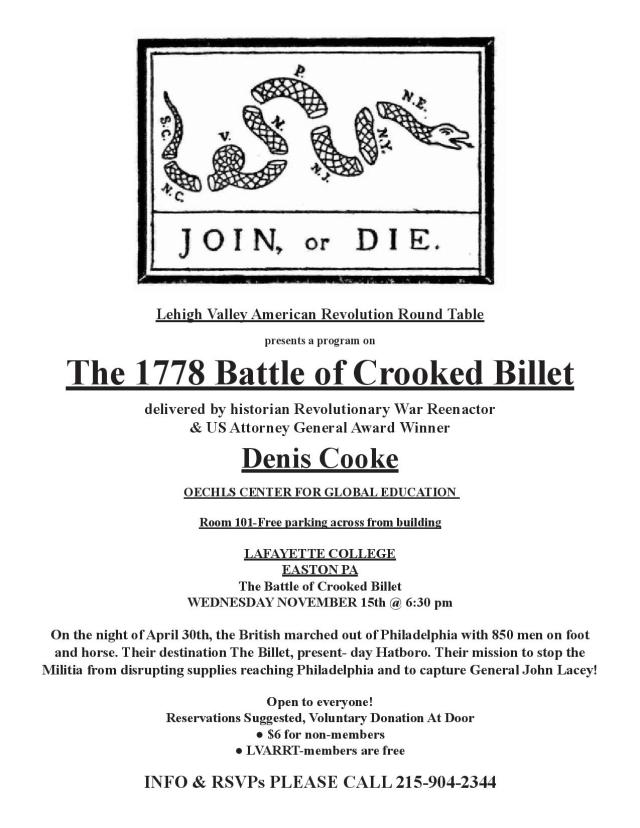
Join our friends at the Lehigh (PA) Valley American Revolution Round Table on Wednesday, November 15, 2017 at 6:30 p.m. at the Oechls Center for Global Education at Lafayette College in Eastern, Pennsylvania. The topic is the battle mentioned above.
Noted historian, reenactor, and U.S. Attorney General Denis Cooke will be the speaker. See flyer below for further details.
With autumn just around the corner, cooler weather on the horizon, and the holidays quickly approaching. Some stores in the local area have Halloween, Thanksgiving, and Christmas decorations all for sale currently, Emerging Revolutionary War wanted to bring your attention to a few different Revolutionary War Era happenings to mark on your calendars. Continue reading “Upcoming Lectures, Talks, and/or Events”→
If you follow Campaign 1776, the initiative by our friends at Civil War Trust, you are familiar with the saga over the Princeton Battlefield. Now you have a chance to help as well.
Battle of Princeton, Death of Mercer by Trumbull (courtesy of Yale University)
With the start of the work week, some folks loath logging onto the computer to check work email, news, and updates. If you are one of those folks, keep reading, as the news we are about to share is positive and exciting.
This past Thursday, July 27, 2017, Campaign 1776, the initiative of the Civil War Trust, announced the preservation of 184 acres at two sites in New York state. One tract of land was pivotal to the United States success in the Saratoga Campaign in 1777 and where a U.S. fleet was saved during the War of 1812.
The Battle of Fort Ann, fought on July 8, 1777 was a four-hour affair and was influential in the course of the larger Saratoga Campaign as it affected the British’s attempt to secure the strategically important Hudson River Valley. The delay around Fort Ann and every delay on the route of General John Burgoyne’s push south aided the Patriot cause tremendously.
Fast-forward to the War of 1812 and Sackets Harbor, New York provided as safe-haven for the United States fleet operating on the Great Lakes. Horse Island and the harbor that gained prominence during the May 29, 1813 offensive by the British, is where 24 acres were saved by Campaign 1776. The battlefield, which was one of 19 sites that benefited from $7.2 million in grants announced earlier in July and the first War of 1812 site anywhere in the country to be awarded money since the National Park Service expanded the grant opportunities in 2014.
Not just one success, but two for this Monday morning! For the full report, courtesy of our friends at Civil War Trust, click here.
Recently, a few emails have appeared in the Emerging Revolutionary War (ERW) email detailing lists of books to read on the American Revolutionary Era. During the summer months, when large segments of the population hit the road for vacations, ERW thought a post about what books to nab for that trip would be a helpful tidbit of information.
One of the emails was from our friends at The Museum of the American Revolution and was geared toward younger audiences. The books were geared toward different age groups, bracketed for 12 years and up, ages 7 to 12 years, and then ages 2 to 7. A final category was for graphic novels.
Reaching younger enthusiasts is the goal of many preservation and/or historic sites and this list is a great way to get them involved during the summer months. Check out the entire list here.
Lastly, if so inclined, the Museum sends out a “Read the Revolution” email list via their website to read reviews of applicable books.
The other email was our friends at the Journal of the American Revolution and was geared toward adults as it tabulated “The 100 Best American Revolution Books of All Time.” The list is broken down into different categories, including but limited to, “all-in-one” histories, people, politics, and conflict and war.
For the complete listing, click here. How many have you read? What has been your favorite?
A special thanks to Stacey Fraser at the Lexington Historical Society for the update on the new exhibit described below.
If one asked what a buzzword for 21st century communication would be today, what would be your answer?
Text? Tweet? Snap?
(courtesy of Lexington Historical Society)
What if the follow up question was that some of the same buzzwords of the 21st century could describe the 18th century? Thanks to the Lexington Historical Society at Buckman Tavern, you can see the similarities yourself.
Opening on April 8th, the interactive exhibit is part of the admission ticket to the tavern. Titled #Alarmed! 18th Century Social Media “explores how news went viral 250 years ago” in addition to letting “visitors imagine how colonials might have made use of modern media tools to kick start a revolution. Continue reading “#Alarmed”→
Looking for something to do midweek? Enjoy a Wednesday night at Shenandoah University and learn about an aspect of early American history.
“The Pox and the Covenant” by Tony Williams
If in the lower Shenandoah Valley or can make the trek, join Shenandoah University’s History Fellows in welcoming Tony Williams, senior fellow at the Bill of Rights Institute, for a guest lecture.
Author of five books on the Early American history and holds a Bachelor of Arts in history from Syracuse (NY) University and a Master of Arts in United States history from Ohio State University. After a successful 15-year teaching career at the middle and high-school level, he became the Program Director at the Washington, Jefferson, & Madison Institute in Charlottesville, Virginia in 2014.
The lecture will be held at Henkel Hall, Hester Auditorium and will begin at 7 p.m. Williams will have his books for sale after the talk, including the title that bears the lecture’s name.
For information and questions, please contact Jonathan Noyalas, Chair of the Shenandoah University’s History Fellows at (540)-665-4501 or jnoyalas01@su.edu.
If interested in other events at Shenandoah University of this nature, check out the link here.
Is it too early to make plans for March? Never, right?
Well, if you are looking forward to spring and want to mix in some Revolutionary War history, look no further than the America’ History LLC Conference the weekend of March 24 through 26, 2017 in Historic Williamsburg, Virginia.
For those arriving early, you can take advantage of a Yorktown Battlefield Tour led by Bill Walsh on Friday afternoon. That evening the conference adds a new element in 2017 with a welcoming reception with the speakers. A panel discussion with all the speakers will focus on “Lies and Legends of the American Revolution.” In regards to the speakers for the event, America’s History LLC. have compiled an all-star lineup.
Spearheaded by Edward Lengel and David Preston. These two gentlemen will be joined by historians James Kirby Martin, Mark Lender, John Grenier, Michael Gabriel, Dennis Conrad, Robert Smith, and Robert Selig.
The conference wraps up on Sunday. For more information and how to register for the conference, click here.
On February 1, 2017 at 7:00 p.m. join Emerging Revolutionary War’s Derek Maxfield for the launch of the “Historical Horizons Lecture Series” sponsored by the Genesee Community College History Club.
Two of the most important men in American History are John Adams and Thomas Jefferson. From the time they met in Philadelphia in 1775 until their deaths in 1826, these two men had a most fascinating relationship; much of the time it was one of admiration and love, but it was interrupted by a period of intense partisan strife that nearly ended the friendship. Come hear the intriguing story of how the friendship was restored.
The lecture is part of the Historical Horizons Lecture Series sponsored by the GCC History Club. Get the complete spring semester line-up here: https://gcchistoricalhorizons.wordpress.com/
All events are FREE and open to the public at the Genesee Community College Batavia campus, room T102 of the Conable Technology Building.
On this date, in 1781, the British army marched out of their entrenchments at Yorktown and surrendered to General George Washington and the combined Continental and French armies.
Modern view of the “Surrender at Yorktown” site (P. Greenwalt)
Although the victory did not conclusively end the war, the victory prompted British Prime Minister, Lord Frederick North, to exclaim,
“Oh, God, it is all over!”
Approximately two years later, with the signing of the Treaty of Paris on September 3, 1783, the American Revolutionary War was truly over.
What is not truly over is the efforts to preserve, interpret, and educate the current and future generations about the importance of Yorktown and the American Revolution. In the spring, the new American Revolution Museum of Yorktown will open its doors, updating the Victory Center at Yorktown Museum.
From the Jamestown-Yorktown Foundation website, the museum’s goals are to;
“Through comprehensive, immersive indoor exhibits and outdoor living history, the American Revolution Museum at Yorktown offers a truly national perspective, conveying a sense of the transformational nature and epic scale of the Revolution and the richness and complexity of the country’s Revolutionary heritage.”
For more information about the museum, what it entails, and the opening date, click here.



 This past Thursday, July 27, 2017, Campaign 1776, the initiative of the Civil War Trust, announced the preservation of 184 acres at two sites in New York state. One tract of land was pivotal to the United States success in the Saratoga Campaign in 1777 and where a U.S. fleet was saved during the War of 1812.
 One of the emails was from our friends at The Museum of the American Revolution and was geared toward younger audiences. The books were geared toward different age groups, bracketed for 12 years and up, ages 7 to 12 years, and then ages 2 to 7. A final category was for graphic novels.


 Emerging Revolutionary War Era