Revolutionary Era Connection in Orlando, Florida?

When one mentions the word “Orlando” what is the first thought to pop into your head?

Universal?

Or maybe two words; “Disney World or Walt Disney?”

In all likelihood, the name Francis Wayles Eppes, is not one of the people you would associate central Florida with. You may even be asking, who is Francis Wayles Eppes.

Eppes
Francis Wayles Eppes

Born on September 20, 1801, Francis was the only surviving child of Thomas Jefferson’s daughter Maria and her husband, John Wayles Eppes. When his mother died in 1804, his grandfather, the third president of the United States at the time, took young Francis under his care and the child resided at Monticello, Jefferson’s Virginia estate.

As young Francis grew, he spent time at Poplar Forest, Jefferson’s estate near Lynchburg, Virginia, which was bequeathed to him by his grandfather after the grandson married Mary Elizabeth Randolph in 1822. Francis, prior to marriage, studied law at both Georgetown College and South Carolina College.

With the death of his father and grandfather within three years of each other; 1823 and 1826 respectively, Francis and his wife joined the movement south, leaving Virginia for sunny Florida.

Initially settling outside Tallahassee and was instrumental in the formation of one of the first Episcopalian churches in the Florida territory, when he donated $500 to a construction of St. John’s Episcopal Church. He was a vestrymen, delegate to the Episcopalian convention in Florida, and also secretary of the local diocese for many years.

After a long public service record in Tallahassee, including serving as intendant or mayor of the capital for a few terms and being an early proponent of a school of higher learning–Jefferson-esque–which became the precursor to Florida State University, Eppes relocated to central Florida in 1869.

Even in his 60’s, Eppes stayed active, becoming a citrus farmer and was part of the group that founded the Cathedral Church of St. Luke in Orlando, the first Episcopal church in the growing town.

IMG_1446
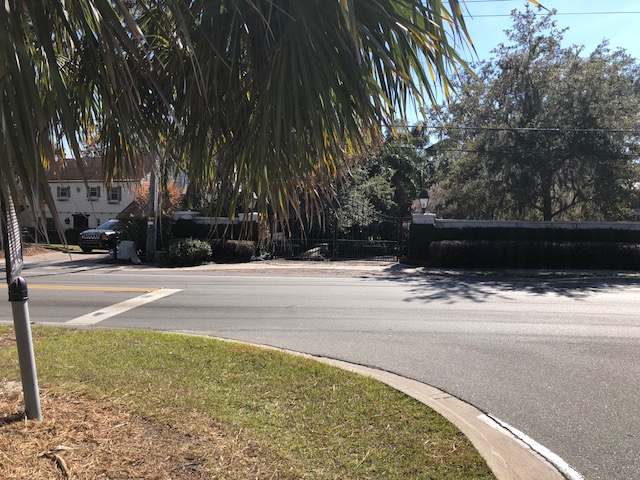
Eppes’s home in Orlando. Plaque on front porch reads; “Site and home of Francis Eppes Grandson of President Thomas Jefferson Original House Built in 1868 Marker Placed by Orlando Chapter NSDAR December 3, 1998”

A historian, writing about Eppes’s contributions of that era summarized the Virginian in the following words; “Through the 40’s, 50’s, and 60’s [1800s] there were few civic, religious, or educational affairs in which he did not have a prominent  part.”

On May 30, 1881, Francis Wayles Eppes passed away at his home and would be buried in Greenwood Cemetery. He was 79 years old.

Christmas 1776

In preparation for an upcoming publication by Emerging Revolutionary War’s historian Mark Maloy, I was doing some light reading about the Battles of Trenton and Princeton. That is when I came across the following quote by the late Albert Chestone;

“The great Christmas raid in 1776 would forever serve as a model of how a special
operation–or a conventional mission, for that matter–might be successfully
conducted. There are never any guarantees for success on the battlefield; but with a
little initiative and a handful of good Americans, the dynamics of war can be altered
in a single night.”

There is no doubt that the actions that followed the daring enterprise of crossing the Delaware was a turning point in the long road to independence of the American colonies. Yet, sometimes we overlook the entire operation as a fait accompli. Continue reading “Christmas 1776”

Lachlan McIntosh

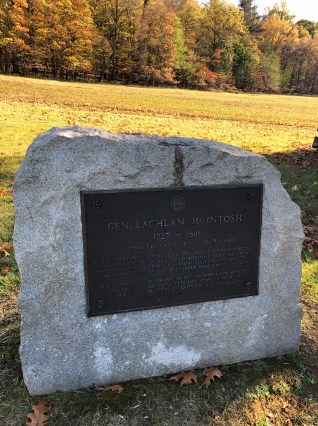
On a recent trip to Valley Forge National Historical Park I came across the monument to featured below, of a general that did not initially ring a bell in my memory. So I did a little investigating. The first name was intriguing. His story even more so. Especially how he came to spend the winter at Valley Forge.

Lachlan McIntosh
Lachlan McIntosh Monument, Valley Forge National Historical Park (author collection)

Born near Raits, Badenoch, Scotland on March 17, 1725 and at the age 11, Lachlan, along with his family and approximately 100 other Scottish immigrants, landed in Georgia where they founded the town of New Iverness. Out of all the cruelties that could visit a family eking out a future on the frontier, the calamity that claimed Lacklan’s younger brother would have been far down the list. While swimming in the Altamaha River in 1737, Lewis McIntosh was killed by an American alligator.  Continue reading “Lachlan McIntosh”

Three American Revolutionary War Luminaries

A few years ago I had the opportunity to visit Yorktown National Battlefield. This evening I was scrolling through my cache of American Revolution photos on an external hard drive, when I came across the picture below.

IMG_5993

A simple monument to three luminaries of the American Revolution. Three brilliant young men, one of which, John Laurens, would fall in one of the last small engagements of the war.

Could you imagine the conversation between the three that fateful October evening of 1781?

Review: The Ghost Ship of Brooklyn, An Untold Story of the American Revolution by Robert P. Watson

ERW Book Reviews (1)

Andersonville. Bataan. Auschwitz. All conjure up images of disillusion, devastation, and death.

All are infamously known as harsh prisoner-of-war camps. When those words are read, images flash through your mind and memory of hollow faces attached to gaunt bodies staring blankly in the direction of the cameraman.GhostShip_300x456

With Robert P. Watson’s new history, The Ghost Ship of Brookly, An Untold Story of the American Revolution, one can add another word to the lexicon of prison camp vernacular.

Jersey.

Or a few more words specifically, the HMS Jersey.  Continue reading “Review: The Ghost Ship of Brooklyn, An Untold Story of the American Revolution by Robert P. Watson”

“Old Ironsides” To Set Sail Again!

Happen to be around Boston this weekend? Or live within traveling distance? Check out the special event happening this weekend from Sunday, July 23rd through Monday, July 24th at the U.S.S. Constitution Museum and Charlestown Navy Yard.

The U.S.S. Constitution, the oldest commissioned naval vessel still afloat will set sail again. Launched in 1797 and named by President George Washington, the vessel is a wooden-hulled, three-masted heavy frigate. She has been dry-docked since May 18, 2015 but will return to the water on July 23rd.

Old Ironsides
“Old Ironsides” the U.S.S. Constitution, photo taken April 2016 (author collection)

The event, co-sponsored with the National Parks of Boston will have a full-plate of free, family-fun events starting at 4:00 p.m. on Sunday and continuing into the morning hours of Monday.

For a full-listing of these events, including information about the museum, and answers to a few frequently answered questions, click here.

For those that cannot make it live to the re-launch, the event will be live on Facebook video streams at 4:00 p.m. and 6:00 p.m. along with live video streams throughout the night of the major events. Check out the Facebook site for the museum by clicking here.

ERW Weekender: Cornwallis House

IMG_0461
Cornwallis House, Winnsboro, South Carolina

In the quaint South Carolina town of Winnsboro, a few miles off of current Interstate-77 sites a two-story stands one of the oldest dwellings in a town founded by Richard Winn of Virginia a few years before the start of the American Revolution.

Yet, it was during those hostilities that one of the more famous military leaders came to “Winnsborough” as it was sometimes listed on maps of the time. His name, Lord Charles Cornwallis, the overall commander of British forces in the Southern Colonies. He would use the house during the winter of 1780-1781.

The house itself is an enigma. The structure dates to pre-1776 obviously, but the builder and owner of the house is still not known. Yet, it is well document that the house did serve during the labeled “winter of discontent” for the British and Cornwallis.

Across the street resides the Mount Zion Institute which became quarters for British soldiers during that winter of 1780-1781.

After the conflict the property and house was deeded to Captain John Buchanan, a veteran of the American Revolution. Buchanan was part of the welcoming party for the Marquis de Lafayette when the Frenchman landed at Georgetown, South Carolina.

Although not open to the public, special requests will be entertained. Click here for the link below for more information on the house and also who to contact for those special arrangements.

Memorial Day

Memorial Day, the last Monday of May, commemorates the men and women who gave the ultimate sacrifice in defense of this country. I wanted to take the moment to remember all those who gave their life in service to this country. Thank you!

The picture below is of Chalmette National Cemetery, which is now preserved by the National Park Service, as part of Jean Lafitte National Historical Park and Preserve. In total, over 15,300 United States veterans are interred there, serving in armed conflicts from the War of 1812 through the Vietnam War.

IMG_8609
Chalmette National Cemetery (author collection)

In the theme of the Revolutionary War Era, in which this blog is dedicated, one of the most famous quotes to come out of any soldiers’ mouths about giving their life for the cause of American independence was from Nathan Hale.

Hale, about to be executed for espionage, uttered the now famous words;“I only regret that I have but one life to lose for my country.”

Or can you think of another one?


Review: Brandywine, A Military History of the Battle that Lost Philadelphia but Saved America, September 11, 1777 by Michael C. Harris

ERW Book Reviews (1)

In southeast Pennsylvania on September 11, 1777, the largest battle, by number of combatants, was fought between the British forces under Lord General William Howe and the Continental and militia forces under General George Washington. After the day long engagement, one of the bloodiest of the entire American Revolution, approximately 1,900 men were killed, wounded, or captured. Washington lost 8% of his entire force that day, Howe 4%.

61DmCqGVtrL._SX335_BO1,204,203,200_
Brandywine, A Military History of the Battle that Lost Philadelphia but Saved America, September 11, 1777

Yet, the Battle of Brandywine has been eclipsed by the history that followed shortly thereafter the bloody engagement. Fifteen days after the battle along Brandywine Creek, Howe’s British and Hessian forces will capture Philadelphia and Washington’s army will spend the pivotal 1777-1778 winter at Valley Forge. Although the battle has been the subject of a few histories and folded into larger campaign studies, Michael C. Harris’s book-length treatment is the first to take an analytical and discerning eye to the engagement and separate myth from fact. Published by Savas Beatie, LLC, in 2014 in hardcover, the book has now been released in paperback.  Continue reading “Review: Brandywine, A Military History of the Battle that Lost Philadelphia but Saved America, September 11, 1777 by Michael C. Harris”

ERW Weekender: Museum of the American Revolution

On April 19, 2017, symbolic in American Revolutionary War history, the Museum of the American Revolution opened in Philadelphia, Pennsylvania. The weekend before, I had the chance, to get a “sneak peak” of the new museum.

IMG_1670
Museum of the American Revolution

I left thoroughly impressed as the museum fills in a critical need for telling this utmost important era in our nation’s history. Yet, the development of exhibits along with the myriad of learning styles and technology underscores the need in this 21st century to be approachable and inclusive to reach various levels of interest that the visitor may have.

Greeting visitors as they approach are a few murals depicting well-known scenes of the American Revolution–including the symbolic “Crossing of the Delaware” and the “Signing of the Declaration of the Declaration.” Along with one of the most important sections of the Declaration of Independence.IMG_1651 (1)

After entering the museum the exhibit area is on the second floor, beginning with the build-up to the war and ending with a nod to the upholding of the revolutionary ideals. Broken up into four segments, the exhibits cover the period of the “Road to Independence” from 1760-1775, “The Darkest Hour” 1776-1778, “A Revolutionary War” 1778-1783, and ending with “A New Nation” 1783 to present-day. A must-see is the short 15-minute film that is centered on George Washington’s command tent, which is shown behind the screen at the conclusion of the film.

Yet, do not shirk the exhibits, which include the a portion of the last remaining “Liberty Tree” from Annapolis, Maryland that fell during a hurricane a few years back. Small movie theaters dot the exhibit area depicting different aspects of the war and history. The Oneida Native Americans, the first allies of the United States are also prominently–and rightfully–highlighted as to their contributions.

IMG_1661Another of the interesting components of the museum is the use of interpretive questions, including “Why were they called Hessians?” with an accompanying multi-dimensional map that shows the different German principalities that contributed troops to the British war effort. Another interesting panel discusses the first use of acronym “USA.”

The museum’s display collection of artifacts is also truly amazing. From a few of the first flags carried by units in the war, to the aforementioned “Liberty Tree”, to a portion of the famous North Bridge, in Concord, Massachusetts.

Combined with the interactive displays, the chance to walk onto a privateer ship, and the assortment of artifacts on display, the museum exhibit area caters to all levels of enthusiasts and can definitely absorb a few hours of your time.

IMG_1653
North Bridge segment

With the museum main attractions situated on the second floor, the first floor of the museum is free to house the orientation film, a cafe, and the gift shop. If you have never been to Philadelphia, the museum is another highlight to add to your bucket list itinerary. If you have ventured to the “City of Brotherly Love” before, the museum provides an excellent reason to journey back.

For information on the museum, including programs, exhibits, and the admission fee, click here.