On the morning of March 15, 1783, George Washington strode into the “New Building” or “Temple” as the structure was referred as, to address the assembled officers of the Continental Army. He asked General Horatio Gates if he could have the floor to say a few words and when he unfolded his pieces of paper on the podium, the words lost their importance.
This past July I had the pleasure to attend and present at the American Battlefield Trust Teacher Institute. One of the keynote speakers was David O. Steward, the author of Summer of 1787: The Men Who Invented the Constitution. During his talk, there were a few points that stuck out to me and I share them with you.
72 elected, 55 attended, and 35 delegates were probably there all summer.
Out of the 55 that attended, 39 affixed their signatures to the document
In reference to George Washington, Stewart candidly remarked he had “more influence by keeping his mouth shut” almost as if by his calm, quiet demeanor, he was displaying that “I trust in you and I’ll try and make it work” with whatever the delegates designed in that hot and stuffy room in Philadelphia. Continue reading “Summer Lecture on Summer of 1787”→
Part of an ongoing series about the Continental Army in Morristown, New Jersey. To read previous posts, click here.
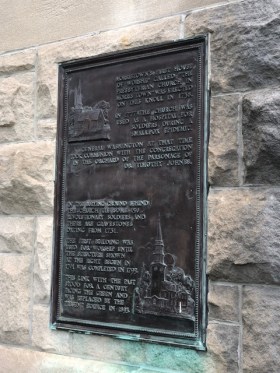
Plaque on wall of the Presbyterian Church
During the winter encampment, in 1777, at Morristown, George Washington ordered the inoculation for smallpox of the Continental Army. Although knowing the probability that some of his men would succumb to the disease when infected with even a small dosage of the puss, the commander-in-chief knew that the necessity of the process. By the end of the American Revolutionary War, more American soldiers would die of smallpox than British shot and shell.
With a population of 700 people and less than 70 dwellings, any public space of size was utilized to treat and quarantine the soldiers undergoing the smallpox inoculation. One of the religious establishments that was used was the Presbyterian Church across the street from Morristown Green, the center of town.
The Presbyterian Church already had a long history in Morristown, being the first congregation founded in the town, dating back to 1733 (the one you see today is actually the third to grace the same site).
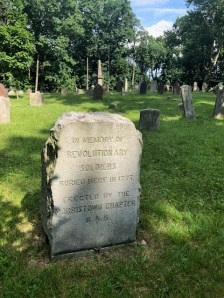
Behind the church is a graveyard referred to as “The Burying Ground” which holds the remains of over 1,700 individuals. Included in that number are the remains of numerous soldiers that succumbed to the smallpox inoculation during the winter encampment of 1777. From the burials that are known, 138 remains are those of soldiers from the American Revolution.
During the annual commemoration of Independence Day, the town of Morristown will offer guided programs of “The Burying Ground.” At other times throughout the year, the church itself will offer tours. You can find information about the church programs of the cemetery here.
Whether you visit on a guided tour or independently stroll the ground, the though to keep in mind is; the men who died whether on the field of battle, succumbed to smallpox, or lived a long life as a veteran, the all helped make Morristown the placed where “America Survived.”
In the introduction, Andrew Shankman narrows down the one word that has driven the history career of Dr. John M. Murrin; “Anglicization.” (page 1). This process happened in a period of approximately 60 years, as the colonists along the eastern seaboard of North America became “in virtually every measurable way…more not less British in their attitudes, outlooks, and actions…” (page 1).
With that thought in mind, the collection of essays from the pen of Dr. Murrin comprise this single volume, Rethinking America, From Empire to Republic published by Oxford University Press. Understanding the history and historiography of these decades and the military, political, social, and economic sub-themes of the time period define the work. Yet, this is not history from just the top down; from the perspective of the elites nor from the bottom-up, but a melding of the various tiers of society. Continue reading “Review: Rethinking America From Empire to Republic by John M. Murrin”→
Part of an ongoing series of about the Continental Army in Morristown, New Jersey. For the first post, click here.
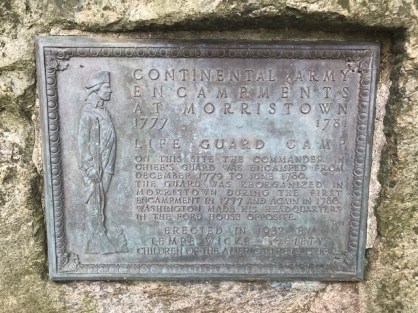
Across the street from the Ford Mansion, the elegant home of the Jacob Ford, Jr. and his family, and the headquarters for George Washington during the winter encampment of 1779-1780, sits a small boulder with a iron plaque plastered on the side.
Erected in 1932 by the Tempe Wicke Society Children of the American Revolution, the monument commemorates the Life Guards that served as Washington’s headquarters command during the American Revolution. Although the unit went by different names and reorganized at least twice, including once during the winter encampment at Morristown, the company, numbering approximately 150 men, would be around for the duration of the war. Continue reading “Uncovering the Continental Army in Morristown”→
Part of an ongoing series about the Continental Army in Morristown, New Jersey. To read previous posts, click here.
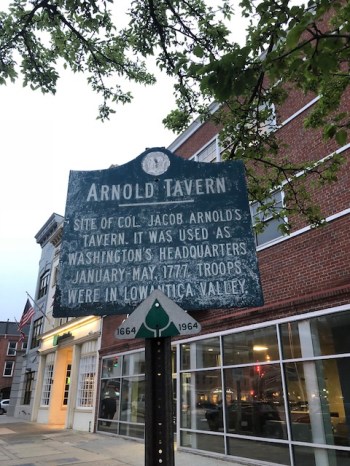
All that remains is a historical marker, on the side of North Park Place across the street from Morristown Green. For a few months, between January 1777 and May 1777, in this location, the headquarters of the Continental Army was located. Within that headquarters, obviously, was George Washington.
Although no specific date of construction exists, it is believed that Arnold’s Tavern was built by Samuel Arnold between 1735 and 1750. By the time of the American Revolution owned by the son, Colonel Jacob Arnold. The structure was three stories high, with a wide hallway that bisected the building, a front and back parlor, barroom, dining room, and kitchen. Continue reading “Uncovering the Continental Army in Morristown”→
Part of an ongoing series of about the Continental Army in Morristown, New Jersey. For the first post, click here.
“The smallpox has made such head in every quarter that I find it impossible to keep it from spreading thro’ the whole army the natural way.” General George Washington wrote in February 1777.
By the time the Continental Army was encamped in Morrristown, Washington had become a firm believer in the inoculations for smallpox for the entire army. The inoculation process would entail the following: Continue reading “Uncovering the Continental Army in Morristown”→
Approximately one month ago, I took a temporary detail assignment to Morristown National Historical Park. The national park preserves the winter cantonments of the Continental Army during the American Revolution; including the harshest winter, weather-wise, of the entire war, in 1779-1780.
For parts of multiple winters and even during the campaigning season, Washington’s forces would come to Morristown, situated behind the Watchung Mountains, which provided safety but also a perch to monitor the British in the New York City.
The town still bears witnesses to this rich legacy of housing soldiers, with historic buildings and signs dotted around the spiraling town. On a walk the other day, I came across the house below, with a small plaque situated on the front of the dwelling.
The home saw soldiers use it for their encampments throughout the majority of the war years. On his return to the United States the Marquis de Lafayette was welcomed with a reception in the building as well, which is in the photo below.
Morristown is filled with tidbits of history from the American Revolution and I as spend the next few months there as a park ranger, I will share what I come across. So, stay tuned as I uncover the history of the place that “Saved America” according to the park’s unofficial slogan.
When writing a book, one of the most important initial aspects is picking a title. The author needs one that is expressive, attracts attention, but has some overall tie-in that provides a fitting capture of the essence of the book.
One of the advantages of writing history is the use of quotes. Let the participants, combatants, or witnesses of the event provide the context for a title. When one resonates, go with it!
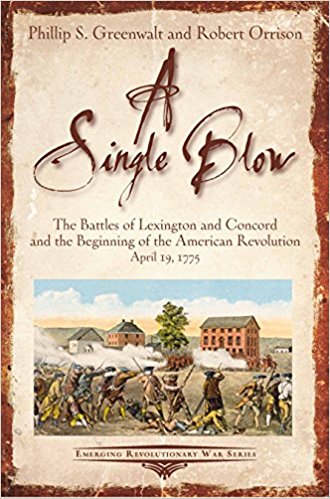
With the recent publication, the co-author, Robert Orrison and myself bounced various potential titles off each other. Then we had a list of our favorites included in the initial information sheet sent to Ted Savas, of Savas Beatie, LLC, the publisher. Yet, one continued to stand out, as it was written in a diary by a British junior officer slightly more than a month before the Battles of Lexington and Concord.
The entire inscription is below:
“It is certain both sides were ripe for it, and a single blow would have occasioned the commencement of hostilities.” —Lieutenant Frederick Mackenzie, Royal Welch Fusiliers, March 6, 1775.
Mackenzie’s uncanny foresight predicted the exact outcome of the fighting that erupted on April 19, 1775. With casualties suffered by both sides, the war of words and near-misses became a war of shot and shell.
Hostilities had commenced and we had a title. A Single Blow: The Battles of Lexington and Concord and the The Beginning of the American Revolution.
Love brought Dr. Samuel Prescott, a practicing physician, to the town of Lexington on the night of April 18, 1775. The young doctor was courting Ms. Lydia Mulliken, when the alarm of the British soldiers marching from Boston went out to the local militia. Lydia’s brother was one of those called to gather.
Love. That emotion also drew Dr. Prescott back toward his hometown of Concord—this time to alert friends, neighbors, and family members of the urgent news of the evening. En route, Dr. Prescott along with Paul Revere and William Dawes, alerted the countryside of the moving British troops. After being vetted and vouchsafed as a true friend of liberty, Dr. Prescott rode posthaste to his hometown, where his word carried greater weight.
A artist’s interpretation of Paul Revere’s (or maybe William Dawes or Dr. Samuel Prescott)’s ride to warn the Massachusetts countryside. (courtesy of VFW)







 Emerging Revolutionary War Era