While visiting home in New Jersey this past week I was able to travel to many different sites associated with the Monmouth Campaign of June 1778. One of those sites in particular was Coryell’s Ferry (or Landing), which straddled the Delaware River in present-day New Hope, Pennsylvania and Lambertville, New Jersey.
Ferry Landing Park in New Hope, PA. The site of Coryell’s Ferry.
France’s official entrance into the war on the Americans’ side in early 1778 forced the British to alter their overall military strategy. His Majesty’s Forces began withdrawing from the American interior and were consolidated along the coast between New York City and Newport, Rhode Island. From there, reinforcements were ordered to be dispatched to Florida and the Caribbean to counter France’s impending threat in that region. Philadelphia, which had been occupied since the previous September, was deemed unnecessary to hold any longer. By June 17, 1778, British Lt. Gen. Henry Clinton’s army of over 20,000 men had crossed the Delaware at Cooper’s Ferry (present-day Camden, New Jersey) and was marching northeast towards New York City.
Three days later the Continental Army was in full pursuit with Washington’s advanced column being led across the river by Maj. Gen. Charles Lee at Coryell’s Ferry (some thirty miles northeast of Philadelphia). By June 22, Washington and the last elements of his army were in New Jersey as well. What exactly was to happen next was not yet known. Clinton could either transport his army to New York City via South Amboy or from Sandy Hook. Until it could be discerned what the British general’s intentions were, Washington planned to “govern ourselves according to circumstances.” In six days the two armies would collide in desperate battle near the small village of Monmouth Court House.
Lambertville, NJ from the Pennsylvania side of the Delaware River. The Continental Army crossed here between June 20-22, 1778.
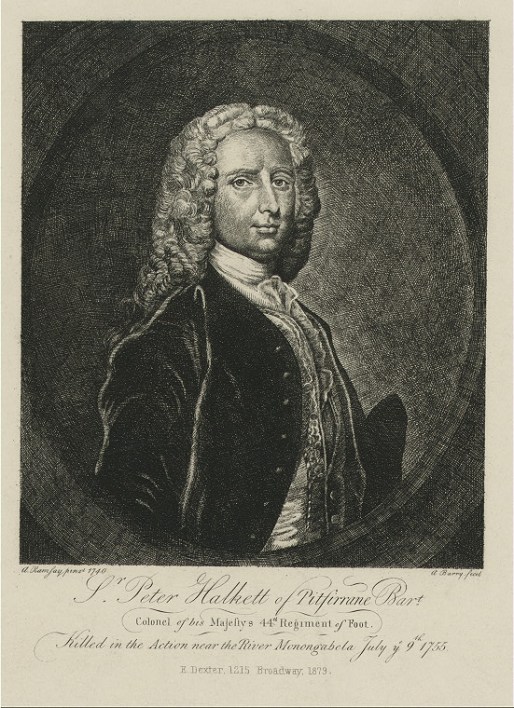
Two-hundred and sixty-three years ago, July 9, 1755, Britain suffered one of the country’s most humiliating military defeats along the banks of the Monongahela River in western Pennsylvania. Only miles away from its objective – Fort Duquesne – Maj. Gen. Edward Braddock’s army of some 1,400 men was attacked and cut to pieces by a detachment of Canadians and their Indian allies. In several hours of vicious fighting, Braddock’s force sustained over 900 casualties and was sent fleeing from the Ohio River Valley. Among the dead was the commanding officer of the 44th Regiment of Foot, Col. Peter Halkett.
Col. Peter Halkett, 44th Regiment of Foot. New York Public Library
Three years following Braddock’s Defeat, another British Army trudged its way west with its crosshairs set yet again on Fort Duquesne. Accompanying General John Forbes’ expeditionary force was an officer of the 42nd Regiment of Foot, Maj. Francis Halkett – Sir Peter’s son. He had attached himself to Forbes’ command with the desire to return to the battlefield of 1755 and locate the remains of his father and younger brother, James, who served as a subaltern and was also killed in action that day. Because of the army’s hasty retreat, the British dead and dying that could not be carried from the field were left behind. It would be a near impossible task to identify the remains if any could be found, but Halkett was determined to try. Continue reading ““It is my father!”: Francis Halkett’s Mission to the Monongahela Battlefield”→
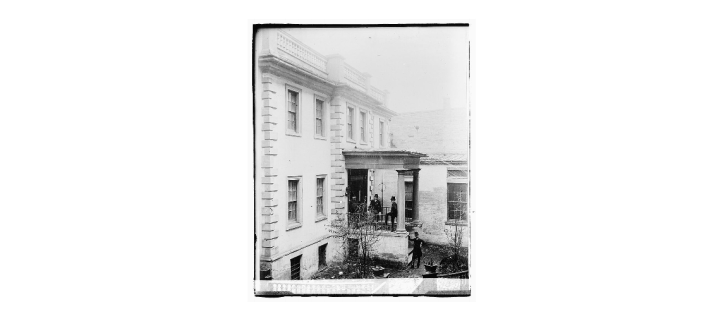
The campaigns of 1755 began when Britain’s ranking military leaders in North America met in Alexandria, Virginia with the colonial royal governors of Maryland, Massachusetts, New York, Pennsylvania, and Virginia, at the home of prominent Ohio Company member, John Carlyle. On April 14-15, 1755, in what became known as the “Carlyle House Congress,” the newly minted commander in chief of His Majesty’s Forces in North America, Major General Edward Braddock, presented London’s military objectives for that coming spring and summer. The Crown’s strategy, on paper, was simple: capture and hold key French fortifications within the boundaries of New York, Nova Scotia, and Pennsylvania before the enemy could concentrate his strength. This plan was intended to oust the French from His Majesty’s colonial possessions on the continent before a large-scale conflict could commence.
The John Carlyle House, c. 1918-1920, Library of Congress.
The task of subduing the French, Canadians, and their Native American auxiliaries in these regions fell upon a mixed contingent of British Regular soldiers, colonial provincial troops, and British-allied Native American warriors. How each group would be utilized depended upon how the respective expeditionary field commander chose to execute his orders by moving, supplying, and fighting his men. Continue reading “The Carlyle House Congress and Britain’s Military Objectives for 1755”→
Several weeks ago I was fortunate enough to take part in Fort Ticonderoga’s twenty-second annual War College of the Seven Years’ War as a guest author. This was my first experience attending the War College, and I can confidently say that I plan on going again. The three day symposium took place from Friday, May 19, to Sunday, May 21, and consisted of lectures, book signings, and even a tour of some of the fort’s awe-inspiring artillery collection on display throughout the complex by curator Matthew Keagle. If you have not visited Fort Ticonderoga before, their massive inventory of 17th and 18th century cannon is well worth the visit alone. In fact, this August the staff and outside historians and interpreters will be conducting a symposium entitled, “New Perspectives on the ‘Last Argument of Kings’: A Ticonderoga Seminar on 18th-Century Artillery.” You can access the schedule and more information here. I am saving up my pennies right now to go!
The War College’s Saturday and Sunday lecture lineups were superb. They included several lectures that focused on the colony of New France and France’s regular soldiers deployed in North America. I consider myself a French and Indian War historian, but I have never paid much attention to what transpired along the Mississippi River during the conflict. It is easy to forget sometimes that France’s claims on the continent included not just Canada, but south down the Mississippi River all the way to Louisiana. This region seems too far away from everything else to have served an important role during the war, but that simply was not the case. Thanks to Joseph Gagne (Laval University) and David MacDonald (Illinois State University, retired), I was introduced to events transpiring in the Illinois Country and Louisiana.
Other lectures were also given focusing on The Cherokee War (Jessica Wallace, Georgia College and State University) and even smallpox. David Kelton, University of Kansas, shared with us his work entitled, “Disease Diplomacy: How Rumors of Smallpox, Outbreaks, and Diabolical Schemes Shaped the Course of Empire in North America, 1755-1764.” His arguments targeted the myths of biological warfare conducted by the English against Native Americans. Another talk that I was excited for (it had a whole lot to do with my first book I authored) was a look at Ephraim Williams and the Bloody Morning Scout during the Battle of Lake George, presented by Gary Shattuck. Gary’s conclusions and judgements were in line with my own. He did not believe that Colonel Williams blundered his way into an ambush that left him and scores of men under him dead. It is always nice to see when historians reassess the decisions made and roles played by those who have been judged poorly by history. The photographs used in the presentation of the battlefield today were also very useful. Shattuck had a good eye for the terrain and gave me the best look at where the positions held by Baron de Dieskau’s French Regulars, Canadian militia, and Native Allies, in his opinion, most likely were (of course this is still up for debate).
Unfortunately, I needed to leave early and missed Sunday’s talks, which included Brady Crytzer discussing his new book on the Kittanning Raid of 1756, as well as a look at Cadwallader Colden, a colonial statesman from New York, and his experiences during the French and Indian War by John Dixon (College of Staten Island). Matthew Keagle also conducted a talk on the dress and traditions of light infantrymen. I missed a good day.
On my way out of Fort Ticonderoga I stopped off at one of my favorite battlefields. Just outside the fort complex down the exit road is the Carillon battlefield, where on July 8, 1758, a massive British and provincial force under the command of James Abercromby continuously assaulted a fortified line of earthworks and abatis held by a much smaller French army under the leadership of the Marquis de Montcalm. By day’s end the French had emerged victorious, inflicting over 2,000 casualties within Abercromby’s force. The 42nd Regiment of Foot (The Black Watch), alone, lost well over 600 men. It was the bloodiest military engagement fought in North America prior to the Civil War, yet it is widely forgotten.
Carillon Battlefield, Fort Ticonderoga, NY. Remnants of the French earthworks are visible in front of the treeline.
Today, the Carillon Battlefield is small, or at least the area that is easily accessible to the public is. Despite this, portions of Montcalm’s earthworks still remain (rebuilt by future armies making their way to the Heights of Carillon) and the spot is dotted with several monuments, including one for the Black Watch, as well as a reconstructed cross to mimic the one placed along the French lines by Montcalm to memorialize his victory and honor his men’s courage against such great odds. Other than this tiny open area, the rest of the battlefield is covered with a dense thicket making it difficult to explore. However, it is extremely peaceful and serene. If you look to the woods with your mind’s eye, you can almost see the waves of scarlet red moving relentlessly towards your position, and hear the shriek of the bagpipes, the crack of the drummer’s cadence, the rattling of musket fire, and the yells of men charging towards a probable death.
Monument to the 42nd Regiment of Foot, “The Black Watch,” dedicated in 1997.Fields just outside the exit of Carillon Battlefield and Fort Ticonderoga, where Abercromby’s men formed their ranks and repeatedly advanced against Montcalm’s fortified line.
Fort Ticonderoga and the Carillon Battlefield are a must-see for any history buff.
During the spring and summer of 1754, conflict over colonial possessions in North America erupted in western Pennsylvania. England’s military influence was ousted from the Ohio River Valley, and before the year was over the Captain-General of His Majesty’s Forces, the Duke of Cumberland, planned to dispatch regular troops to the colonies. Major General Edward Braddock, along with a thousand men of the 44th and 48th Regiments of Foot, was ordered to Virginia to organize a four-pronged summer offensive against the French at the Forks of the Ohio River, in Nova Scotia, the Great Lakes region, and along Lake Champlain. The two British regiments with Braddock had served primarily in Ireland, and possessed minimal experience in combat (Colonel Sir Peter Halkett’s 44th Regiment was lightly engaged at Culloden in 1746). Historian David Preston described the experience carried to North America by the senior and junior officers of Braddock’s expeditionary force:
While there was a growing sense of professionalism in the mid-eighteenth-century British Army, most younger officers had formed whatever expertise they possessed through studying manuals, guidebooks, and historical works by ancient and modern authors such as Thucydides, Caesar, Vegetius, and Humphrey Bland, whose Treatise of Military Discipline, first published in 1727, was the unofficial guide to basic drill and maneuver for young officers. The officers’ own lack of formal training, along with their mechanistic daily regimens, prevented them from achieving competency much beyond the level of basic training that they were expected to perfect in their soldiers. While some senior officers had tasted battle, the first test of combat leadership for many of the junior officers or subalterns came on the banks of the Monongahela.[1]
Despite the lack of battlefield experience, King George II, the Duke of Cumberland, and Braddock were confident that the “professionalism” of the regular troops would be enough to oust French forces (Troupes de la Marine, Canadian militia, and Native American auxiliaries from the Ohio River Valley and Great Lakes) from Fort Duquesne.
The first break from Vegetius’s influence and British army doctrine in the Age of Enlightenment occurred before the campaigns of 1755 even commenced. The 44th and 48th Regiments of Foot were understrength and carried with them to North America roughly 500 men each. To raise their numbers to full battalion strength – 700 men – the units were augmented with colonial levies from Maryland, Pennsylvania, and Virginia. Already lacking in experience, the addition of colonial militiamen (militias were the largest recruiting pools in the colonies) did nothing but delegitimize the “professionalism” of the two regiments. The levies, who previously only drilled once every few months or so with their respective militias, were expected to conduct themselves like British regular soldiers.
Along with the colonists augmented into the regiments of foot, the task of capturing the various French strongholds in Nova Scotia and along Lakes Champlain and Ontario that summer was given to non-regular troops. To subdue the French garrisons, small armies of colonial provincial soldiers were recruited in New England, New Jersey, and New York. Braddock’s army, too, was supplemented with provincials from Maryland, Pennsylvania, Virginia, and the Carolinas. The expeditionary force ordered to bag Fort Saint-Frédéric (Crown Point) along Lake Champlain was composed of 3,000 provincial troops with only one British regular, Captain William Eyre of the 44th Regiment of Foot, serving among them.[2] Again, these provincial regiments were entirely green (other than some veterans of various frontier services and the Louisbourg Expedition of 1745) and made up of levies and volunteers drawn predominantly from local militias. Also, attached to these armies were Native American auxiliaries, whose style of warfare was completely foreign to regular troops and far from professional. Service against and alongside these “savages” was the first exposure to irregular warfare in North America that His Majesty’s soldiers would receive. Vegetius believed that heavy reliance on auxiliaries, in this case Native Americans, colonial provincials, and colonial troops on the British military establishment, was detrimental to the performance and survival of professional units and overall cohesion.[3]
For the most part, the colonial provincials held their own on the battlefield against French forces, more so than the British regulars did early in the French and Indian War. They obtained victories in Nova Scotia, along the southern shore of Lake George in New York, and diligently defended the frontier against French and Indian raids. However, the colonists could never truly mesh with the regulars from Great Britain. British officers held them in contempt. “The Americans,” Brigadier General James Wolfe declared, “are in general the dirtiest most contemptible cowardly dogs that you can conceive. There is no depending on them in action. They fall down dead in their own dirt and desert by battalions, officers and all. Such rascals as those are rather an encumbrance than any real strength to an army.”[4]
Officers serving in North America and British authorities in London, like William Pitt, began to recognize the importance in 1758 of separating from the seemingly arrogant professionalism that the British Army had so dearly held on to. The conflict being fought in the colonies was not a conventional European war. Even as a world war was being waged elsewhere around the globe, it became evident that something needed to change if His Majesty King George II was to claim North America as his own. William Pitt, Leader of the House of Commons and Secretary of State for the Southern Department, put forth and instituted an agenda that shifted the sole focus on winning with professional soldiers in North America to building a substantial military force consisting of a majority of colonists. He ordered 20,000 colonists to be levied or recruited into provincial units. The crown would supply them the required arms, ammunition, tents, and provisions, and would reimburse the colonial assemblies for the costs of raising, clothing and paying the men. In response to this proposal, the colonies mustered over 23,000 troops for the upcoming 1758 campaigns.[5] These men complimented the 20,000 British regulars dispatched to the colonies that year. At close glance, the measure instituted by Pitt’s administration resembled France’s levée en masse in 1793 on a smaller scale.[6] This was an early example of the departure from Vegetius’s classical reliance on professional soldiers in favor of larger armies consisting of men serving shorter terms of enlistment. Discipline for these men was mild and their training was limited. “Men,” one of Vegetius’s general maxims read, “must be sufficiently tried before they are led against the enemy.”[7] Quality was displaced by quantity. This was not the only aspect of the British Army that was transforming in the wilderness of North America. The nature of the conflict was forcing a change in the way the war was being waged as well.
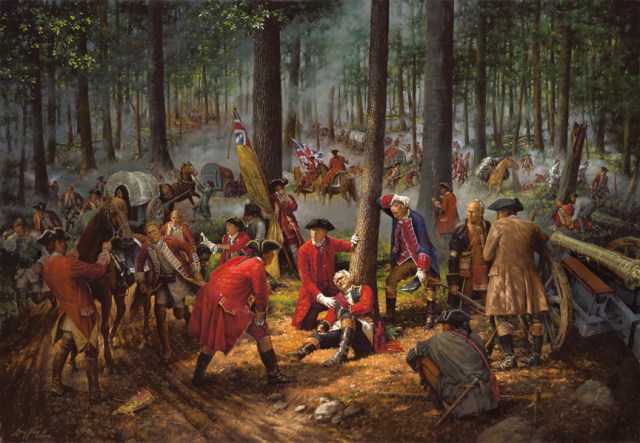
Edward Braddock’s expeditionary force of regulars and provincials crossed the Monongahela River on the morning of July 9, 1755 and precipitated a departure from Vegetius and Humphrey Bland’s strategic, operational, and tactical influence. Less than ten miles outside of Fort Duquesne, the 1,400-man column engaged and was easily defeated by a smaller force of Canadians and Indians fighting in an irregular manner. Braddock’s Defeat signaled an end to England’s classical style of linear warfare – it had officially met its match and was countered. Vegetius and Bland’s disciplined closed-rank formations had faltered. Vegetius wrote that, “The nature of the ground is often of more consequence than courage.”[8] However, this referred to terrain and its effect on the seven linear formations that Vegetius had presented. General engagements in Europe did not take place in thick vegetation. Maneuvering, let alone fighting, in closed-ranks was nearly impossible to accomplish smoothly in North America. As Braddock’s army had learned along the banks of the Monongahela, His Majesty’s Forces needed to adapt to the current conditions and nature of warfare in the colonies. To do so, officers needed to adjust tactically and borrow from the colonists and their Native American auxiliaries who were accustomed to loose formations and irregular warfare. Adapting meant completely altering preconceived tactical doctrine.
The Wounding of Edward Braddock at the Battle of the Monongahela, July 9, 1755
No other classical text had more of an influence on princes and young officers of the 18th century than Flavius Vegetius’s De Re Militari. For centuries, the ancient Roman manual on the art of war inspired men to professionalize the militaries of Europe. Standing armies were formed to fight for King and Country. Officers whipped their men into shape, drilling and disciplining by the book. As conflicts erupted throughout the world, the British armies took to the field waging war over royal successions. They emerged as a dominant force on the European continent. Vegetius continued to influence the conduct of His Majesty’s Forces and it appeared as if his principles were to become a mainstay in British military doctrine. Then, as the second half of the 18th century began, tension between England and France over colonial possessions in North America boiled over. By the spring of 1754, armed conflict had ignited an undeclared war in western Pennsylvania. Less than a year later two royal regiments (the 44th and 48th Regiments of Foot) had left Ireland and disembarked in the colony of Virginia.[1] In North America they were confronted by a different way of war – an unconventional one. Would Vegetius’s principles and the doctrine he influenced continue to remain true? Or could only a departure from his art and science of war prepare England’s forces to combat the new threat? War does not change, but warfare does, and Vegetius’s classical influence began to fall out of favor.
This two-part essay will demonstrate that Vegetius’s military influence on the British Army officially began to diminish during the French and Indian and American Revolutionary Wars (1754-1783). To do so, this essay will analyze Vegetius’s initial influence on England’s military thinkers and officers during the Age of Enlightenment. It will then examine why the departure from this classical military theory and science was necessary and how it transformed the way that the British Army approached war at the moral and physical levels. It will then summarize and conclude.
Flavius Vegetius Renatus was a high-ranking official in the Roman Empire during the 4th century. It is quite possible that he served in some sort of financial position for the court which would have given him insight into military matters.[2] He was not a soldier, and he approached the art of war as a historian. When compiling his most famous work on Roman military institutions he desired to write a treatise, “for public use, [regarding] the instructions and observations of our old historians of military affairs, or those who wrote expressly concerning them … to exhibit in some order the peculiar customs and usages of the ancients….”[3] Vegetius began writing in the late 4th century during a time of decline for the Roman military. He had hoped that the Emperor would accept his work as a set of mere suggestions, or precedents demonstrated by the “ancients.” While it had not been used widely by his contemporaries, his treatise, On Roman Military Matters (De Re Militari), became a crucial piece of military thought and theory in Europe centuries later.
Flavius Vegetius’s field manual, On Roman Military Matters, written around 386 A.D., offered its readers a glimpse into the discipline and organization, and weapons and tactics utilized by the Roman Legions.[4] Through the medieval period in Europe, Vegetius’s book on the art of war served as an essential part of any prince’s military education. According to Dr. Charles S. Oliviero of Norwich University, “Until Clausewitz’s Vom Kriege appeared in 1832 to guide those who would understand the nature of Napoleonic warfare, no single writer in the West was more influential than Roman historian and writer Flavius Vegetius Renatus.”[5]On Roman Military Matters laid the groundwork for maintaining a professional standing army through discipline, organization, training, and administration. It also provided 26 chapters on strategy, tactics, and the principles of war, which were widely read and implemented by rulers and officers. The various tactical movements listed greatly influenced linear formations and battlefield maneuvering, which evolved to accommodate new weapons technology as time went on. Following the Renaissance, his influence widely reemerged in the 18th century at the onset of the Age of Enlightenment in Europe.
The Age of Enlightenment brought on a period in Europe known as the Military Enlightenment as well. According to historian John Lynn, “The Military Enlightenment followed the program of the broader Enlightenment, which sought to pattern study and knowledge after the natural sciences. By doing so it hoped to provide simple but fundamental, almost Newtonian, empirical truths, even in the realms of human psychology and conduct. Science seemed basic to all understanding.”[6] Military thinkers and officers turned to classical texts for direction in organization and tactics. Operating in compact linear formations, the geometric nature of a 18th century battlefield was perceived to be scientific. The commanding officer was required to possess a certain type of genius, but nearly everything on a battlefield could be measured and predicted. Antoine-Henri Jomini carried this belief into the 19th century, but before his famous theories presented in The Art of War were published, European officers turned to earlier works in order to better understand the principles of war and warfare.
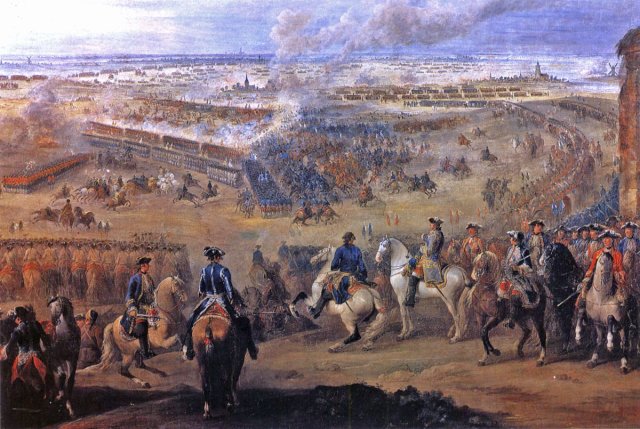
It was believed by many military reformers in Europe that Vegetius offered these tactical principles. “Vegetius,” John Lynn described, “… inspired such military advances as battalion organization, firing by countermarch, and marching in step. This process was a later phase of that earlier intellectual phenomenon, the Renaissance.”[7] Book III of On Roman Military Matters offered guidance in tactics for linear style formations (seven possible tactical formations to be exact). The closed ranks that the Roman Legions maneuvered in were meant to instill discipline by not allowing any room for men to turn and run or fall out of order. Again, these formations influenced a geometrical view of the battlefield. From afar a battlefield would resemble a series of thick and thin lines moving back and forth against each other. These lines could be turned at various angles and degrees to meet threats coming from any direction. It became easier for officers to control and command their men if they could remain in a tight-packed linear formation. This was not a simple task, but with properly educated men at the helm, and disciplined troops on the ground, it became more easily quantifiable and predictable. In the 18th century, war and warfare were viewed as a profession in their own right.
Battle of Fontenoy, 1745, a classic example of a linear engagement
When analyzing the key actions of a military engagement in order to pinpoint a decisive moment or turning point, one does not usually come across a retreat and/or rout that actually attributed to the success of an army. However, during the late morning of September 8, 1755, roughly three miles south of Lake George in New York’s Adirondack Mountains, a contingent of men from Connecticut and Massachusetts, and their Mohawk allies conducted quite possibly the first ever organized fighting retreat in American military history – one that would turn the tide of battle and save their army from potential destruction. It is easy for a maneuver like this to be overlooked, but without the crucial time bought for William Johnson’s provincial army at its encampment along the southern shore of the lake by Lt. Colonel Nathan Whiting’s courageous New Englanders, Baron de Dieskau’s French army may well have emerged victorious during the Battle of Lake George and subsequently pushed their way to Albany’s doorstep.
Around eight o’clock in the morning, September 8, 1755, a column of men 1,200 strong was marched out of William Johnson’s camp at the southern end of Lake George. The column’s destination was Fort Lyman, roughly fourteen miles to the south located beside the Hudson River (present-day Fort Edward, NY). There, intelligence gathered by Johnson’s army had placed the 1,500 strong French force led by Jean-Armand, Baron de Dieskau, which was believed to be preparing an assault against the 500 man garrison of New Hampshire and New York provincials.
The contingent of reinforcements dispatched from the English camp was under the overall command of Colonel Ephraim Williams, 3rd Massachusetts Provincial Regiment, and was comprised of his own regiment, 200 Mohawk Indians, and another 500 men of the 2nd Connecticut Provincial Regiment led by Lt. Colonel Nathan Whiting. The column marched south down the military road with the Mohawk at its head, followed by the Massachusetts men, and Whiting’s regiment taking up the rear.
Nathan Whiting, born in 1724 and a resident of Windham, was 31-years-old in 1755 and one of William Johnson’s youngest field officers. He was a graduate of Yale and a veteran of the Louisbourg expedition during King George’s War – service which earned him a lieutenant’s commission in His Majesty’s Forces. When hostilities between England and France erupted in 1754 he was commissioned as the 2nd Connecticut Provincial Regiment’s lieutenant colonel and was sent to Albany to serve as part of the Crown Point Expedition, an offensive designed to oust the French from the Lake Champlain-Lake George-Hudson River corridor. The regiment’s colonel, Elizur Goodrich, was ill and bedridden during the Battle of Lake George, so Whiting served as the unit’s field commander during his absence. Whiting was a loyal officer and earnestly dedicated to the cause in which he was fighting for. Before reaching the southern shore of the lake on August 28, he penned a heartfelt letter to his wife that epitomized his character: “… [P]ray make your Self as easy as possible[.] I know your D[aily] prayers are for my preservation[.] Let it be an article of them that it not be obtained by any unworthy means, but in the prosecution of the Duty I owe at this time to my Self, my Country & my God.”[1]
About two hours or so and three miles into the march to Fort Lyman, the forward ranks of Ephraim Williams’s column of reinforcements were ambushed by Dieskau’s native allies, Canadian militia, and regular grenadiers of the Regiments of Languedoc and La Reine. The French outside of Fort Lyman had earlier uncovered dispatches from a dead courier that was sent to inform the English outpost that reinforcements were going to be sent from the lake encampment to assist it in case of an attack. Using this intelligence, Dieskau marched his army up the military road towards Lake George and prepared an ambush to surprise the oncoming party of reinforcements. Although the ambuscade was initiated prematurely before the entire column could march into Dieskau’s hook-like formation, it still succeeded in throwing the English force into confusion and sent it scurrying back up the road to Lake George. Both Ephraim Williams and Chief Hendrick (commanding the Mohawk contingent) were killed during the confrontation and all order was lost, leaving Whiting, who was now the highest ranking officer on the field, to try to prevent a disaster.
The Bloody Morning Scout, 10:00 a.m. Map by Nicholas Chavez.
The 2nd Connecticut was spared from being involved in the ambush because of their distance to the rear of the column. However, they were met with the sights and sounds of the maelstrom unfolding ahead of them as panic-stricken men streamed through their ranks along the military road. Knowing that an all-out rout would spell disaster for Johnson and the rest of the army at the lake – which was surely Dieskau’s next target – Whiting ordered his Connecticut men to take to the woods surrounding the road and use every bit of cover possible to hold back the onrushing enemy. Rallying a handful of Bay Staters and Mohawks, they too rejoined the fighting. If Whiting could not stand and fight, he was going to run and fight in order to buy time for the rest of the army to prepare to meet the inevitable assault heading its way. With tremendous tenacity, the brave band of New Englanders and their native allies returned fire at every opportunity. They loaded, discharged their firelocks, and then ran to the next available form of concealment, repeating the process again and again. Their resistance forced Dieskau to slow his pursuit and even gave his Indians the chance to break ranks and leave the fight or return to the morning’s engagement site to plunder.
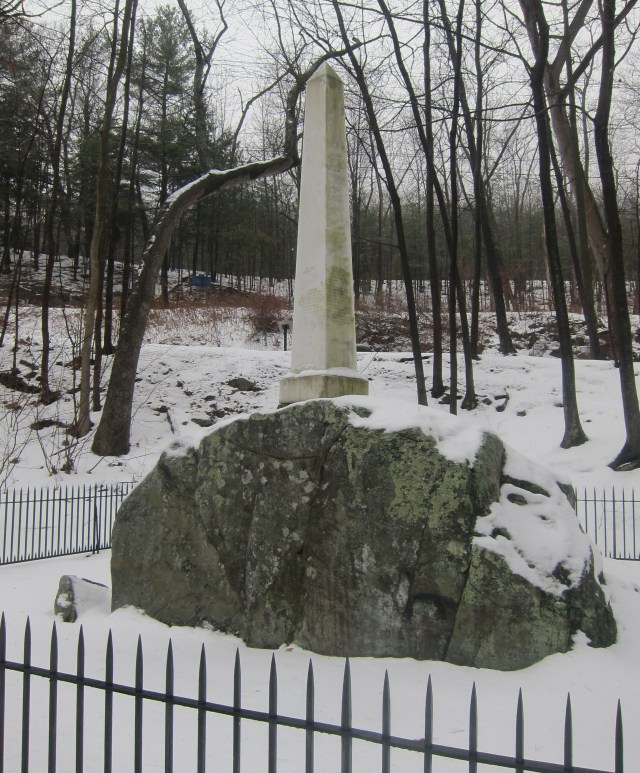
Obelisk dedicated to Col. Ephraim Williams near the spot of his death during the Bloody Morning Scout. Author’s photo.
Whiting’s fighting retreat was achieving its intended goals. Back at the Lake George encampment the fighting could clearly be heard inching closer and closer. Having the necessary time needed to prepare a defensive position, Johnson ordered his men to throw up a makeshift breastwork of logs and whatever else could be found. Artillery was planted aiming down the military road and a body of men from Lt. Colonel Edward Cole’s 1st Rhode Island Provincial Regiment was ordered forward to aid Whiting. The added strength brought Dieskau’s army to a near halt. For well over an hour the men of Whiting’s fighting retreat fought desperately against their relentless foe, refusing stubbornly to give up every inch of ground over the three miles from the ambush site to the lakeshore encampment. In the words of Lt. Colonel Seth Pomeroy of the 3rd Massachusetts, who was fortunate enough to have been ordered to remain behind in camp, Whiting’s men made a “very handsom retreet.” [2]
It was nearing noon when, in Pomeroy’s words, the rearguard, “Came within about ¾ of a mile of our Camp there was ye Last Fire our men gave our enemies which kill’d grate numbers of them [as they were] Sean to Drop as Pigons….”[3] Emerging from the wood line into the clearing made by Johnson’s camp, Whiting and his men caught the first glance of what their courageous actions had accomplished that morning. There in front of them the entire army waited to meet the oncoming enemy behind a long line of newly built breastworks.
For four hours Dieskau attempted to break the English lines, not once even coming close to reaching their defenses. By nightfall the French army was in full retreat (without its commander, who was left behind on the field wounded) back to Carillon to the north, and William Johnson and his army could finally declare the Battle of Lake George a victory for His Majesty King George II. The southern shore of the lake was still in British hands, and the road south to Albany was again secure. Plans were made to build a large permanent fortification at the site of Johnson’s encampment, and by the end of the month construction of what would come to be christened Fort William Henry began.
Despite the tremendous leadership and collective effort of many officers during the battle, Johnson took all the credit for himself – even though he was wounded early in the fighting and had missed most of it. His second-in-command, Major General Phineas Lyman of Connecticut, who had commanded the army during the fighting after Johnson’s wounding, was not mentioned in the general’s report to the royal governors the following day. Also omitted from this were Nathan Whiting and his men who desperately fought to buy time for the army to prepare the defenses that proved so crucial to deciding the outcome of the battle. It is impossible that Johnson simply did not know what had transpired in the forests south of Lake George that morning – he would have clearly heard the sound of musket fire slowly progressing towards his camp. He mentioned in his report hearing the, “… heavy firing, and all the Marks of a Warm Engagement….”[4] His failure to include the service of Lyman and Whiting in his recollections was nothing more than a want of glory and a personal vendetta that he seemed to hold against Connecticut’s officers. For his victory at the Battle of Lake George, Johnson was later knighted – an honor that would have been better bestowed upon others.
An already underappreciated event in America’s colonial history, the English victory at the Battle of Lake George halted Dieskau’s offensive into New York’s interior and quite possibly saved Albany and everything north of it from falling into the hands of France and being cut off from the rest of the colonies. In my opinion, had the battle been lost by the English its consequences would have been far greater than Braddock’s Defeat along the Monongahela. Not only was the Ohio River Valley already lost that summer, but if the British were also ousted from Lake George then the major water “highway” north into Canada would have been lost as well. This would have given France a direct route south into New York’s interior and even an avenue of approach towards New York City via the Hudson River. Many more would have been in danger following that summer than just the frontier settlers of Maryland, Pennsylvania, and Virginia. So if these observations are at least in some part accurate, then the significance of the English victory along the southern shore of Lake George cannot be understated. If this truly was one of the more strategically significant battles of the French and Indian War, then Nathan Whiting’s fighting retreat made the victory possible. It was the decisive action of the Battle of Lake George and quite possibly the first ever successfully organized fighting retreat in American Military History.
[1] Nathan Whiting, “The Letters of Colonel Nathan Whiting,” in The Papers of the New Haven Colony Historical Society, vol. 6 (New Haven, CT: New Haven Colony Historical Society, 1900), 137.
[2] Seth Pomeroy, The Journals and Papers of Seth Pomeroy: Sometime General in the Colonial Service (New York: Society of Colonial Wars in the State of New York, 1926), 114.
[4] Milton W. Hamilton, “Battle Report: General William Johnson’s Letter to the Governors, Lake George, September 9-10, 1755,” in Proceedings of the American Antiquarian Society, vol. 74 (Worcester, MA: Published by the Society, 1965), 22.
No military engagement fought in America prior to the Civil War was bloodier or more costly than the Battle of Carillon (Ticonderoga). For over four hours during the afternoon of July 8, 1758, British and French forces ruthlessly clashed in upstate New York atop the heights west of Fort Carillon, producing over 2,400 casualties – nearly 2,000 of them English. In a year of such memorable British triumphs this was truly an incredible and most tragic disaster. By nightfall, Major General James Abercromby’s army was in full retreat up Lake George, and the Marquis de Montcalm’s courageous Frenchmen remained behind their earthworks, celebrating one of the most miraculous victories ever won on the continent.[1]
It had been over four years since George Washington ordered his small detachment of Virginians and Mingo warriors to open fire on the French-Canadian party encamped within Jumonville Glen, and England’s military efforts against the French in North America were still abysmal. Seventeen fifty-eight was meant to turn the tide in favor of King George II. With William Pitt’s ascension to Secretary of State for the Southern Department, it became his duty to prosecute the war in earnest, sparing no expense. After the failed operation against Fortress Louisbourg and the capitulation of Fort William Henry the previous year, plans for a four-pronged offensive in North America began to formulate. These large-scale movements were directed against Forts Duquesne and Frontenac (located along the eastern shore of Lake Ontario), Louisbourg (yet again), and finally Fort Carillon atop the promontory between Lakes Champlain and George. The effort against the French at Carillon was to be led by the newly instated Commander-in-Chief of His Majesty’s Forces in North America, Major General James Abercromby.
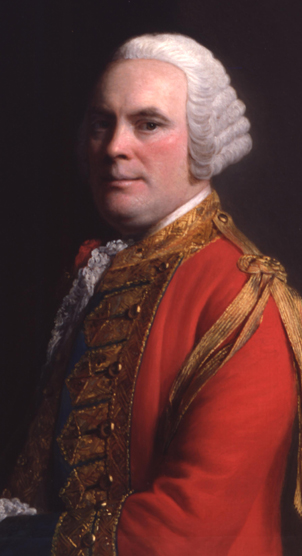
Major General James Abercromby
James Abercromby was born in 1706 in Glassaugh, Scotland and received his first commission as an ensign in 1717 with the 25th Regiment of Foot. He saw action and was wounded during the War of Austrian Succession, and by 1756 he held the rank of major general, serving under Lord Loudoun in North America. By December of the following year he was officially commissioned to replace Loudoun after his recall. To compliment Abercromby during his offensive against Fort Carillon, Brigadier General George, Viscount Howe (the older brother of Richard and William) was given the role of second-in-command for the expedition.[2]
During June 1758, Abercromby’s army of British Regulars and colonial provincials gathered along the southern shore of Lake George beside the still present ruins of Fort William Henry, which was burned by Montcalm following its capitulation the previous August. By July 5, when the army began its embarkation down Lake George, the British could count a total of 16,000 men amassed to assault Carillon – it was the largest military force ever assembled for a campaign on the North American continent. Nearly 10,000 provincials from New England, New Jersey, and New York had joined ranks with eight regiments of British Regulars. To oppose them over thirty-two miles to the north, Montcalm had roughly 3,500 men at his disposal with another 500 that would join him before the battle commenced.[3]
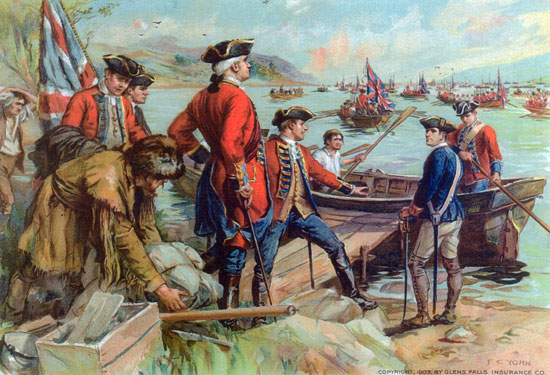
Embarkation of Abercromby’s Army, July 5, 1758
On July 5, nearly one-thousand small boats and other crafts departed from the shore of Lake George and headed north. The spectacle must have been amazing. Extending seven miles in four rows covering shoreline to shoreline, Abercromby’s army rowed towards its destiny, arriving at its debarkation point the following day around 10:00am. The landing party, consisting of Rogers’ Rangers, Thomas Gage’s 80th Light Infantry, and Phineas Lyman’s 1st Connecticut Regiment, staggered ashore with George Howe at the head of the advance. The men were immediately met with resistance and a running battle commenced that ran several miles to the north near Bernetz Brook. Leading on foot at the head of an advancing force is no place for the second-in-command of an army, but Howe was not your typical general and that is why his men adored him. At 4:00pm the fighting became the hottest it was all afternoon as the French continued their hasty withdraw back to Montcalm’s lines. During this contest, Howe lost his life. With their beloved leader now dead, confusion amassed and the British left the field and returned to the landing site. While the skirmishing yielded no true tactical significance, Montcalm was alerted of Abercromby’s landing and began to fortify the heights west of Fort Carillon, choosing to face the British in the field rather than defend against a siege with his army so outnumbered.[4]
The following day, Abercromby’s army marched to within a mile and a half or so of the French at Carillon and encamped for the evening. From this position near a saw mill the commander-in-chief added the finishing touches to his battle plan on the morning of July 8 – it was from here as well that he would observe the engagement, staying far behind the frontlines. With the loss of his trusted subordinate, Howe, and the information newly at hand that a large body of French reinforcements numbering 3,000 men was approaching Fort Carillon, Abercromby seemingly lost his wit. Rather than sending an experienced engineer such as Major William Eyre of the 44th Regiment of Foot to observe the French position, he instead ordered two of his personal aides, Captains James Abercrombie and Matthew Clerk to ride forward and report the situation. The two officers returned and suggested to the commanding general that the French earthworks were incomplete and that the position could easily be carried with a frontal assault. Abercromby accepted the report as gospel and began preparations for an attack.[5]
Truth be told, by the morning of July 8, the French had indeed completed their defensive works a half-mile to the northwest of the fort. The series of fallen logs – stacked some six to seven feet high with loopholes cut into them to fire out of from behind cover – extended from the lowland near the La Chute River to the south across the peninsula to Lake Champlain to the north. The area in front of the earthworks was cleared for about one-hundred yards, and a line of abatis was erected in front of the line to hinder the enemy’s advance. The earthworks were defended by seven regiments of French Regulars, each manning roughly a hundred yards of entrenchment. To the right of the line a company of Troupes de La Marine (Canadian Regulars) was positioned and a battery of six cannon was placed in a redoubt constructed on the left. Canadian militia defended the lowland near the La Chute River. This area was the weak point in Montcalm’s line, but Abercromby failed to exploit it. A battalion of the Regiment de Berry was left behind to man the fort and run ammunition to the front. While Montcalm had selected the best ground near the fort to make his stand, his position was nevertheless dangerous. His army was bottled up on a peninsula and if his defensive measure should fail his force would be trapped and surrounded by the overwhelming numbers of the British. Things could all begin tumbling down for Montcalm if his earthworks were blasted to splinters by the might of the English artillery before a frontal attack commenced. Lucky for him, however, Abercromby opted that an artillery barrage to precede the assault was unnecessary, and in fact, that no cannon would be needed at all to assist in carrying the French position.[6]
Louis-Joseph, Marquis de Montcalm
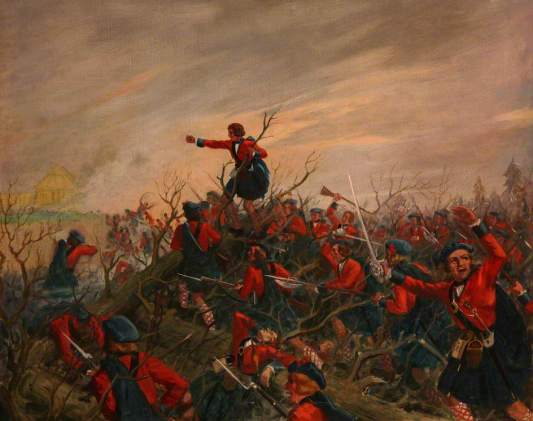
At half past noon, July 8, 1758, the 80th Light Infantry, Rogers’ Rangers, and a battalion of Massachusetts light infantrymen advanced forward to the abatis in a long skirmish line, driving the French pickets before them back to the earthworks. With the ground in front of the French position clear it was time to launch the grand European-style assault. Stepping out from the tree line at the base of the heights, over six-thousand men garbed in scarlet red moved forward in a line three ranks deep. The beating of drums and the shrill of the fifes pierced the air, and the wale of Scottish bagpipes reverberated from the musicians amongst the 42nd Regiment of Foot – the “Black Watch” – near the center of the line. Forward they went with undaunted courage only to be cut to pieces by French small arms fire upon reaching the abatis. There the dead and dying lay tangled amidst the branches as their comrades struggled to press forward. “The fire was prodigiously hot,” Captain Charles Lee (yes, that Charles Lee) of the 44th Regiment of Foot vividly remembered, “the slaughter of officers very great, almost all wounded, the men still furiously rushing forwards without any leaders.” Staring through the smoke up towards the French line, only the tops of the regimental standards were visible above the earthworks.[7]
The devastating effect of the French musketry forced the British lines to waiver. They could not obtain enough momentum to make their way into the enemy entrenchments, let alone even climb near them. Abercromby was no help during all of this. He remained behind at the sawmill camp delegating orders as his men were being sent into a meat grinder a mile and a half away. His decision to not order up his artillery to bombard the French or support his infantry’s attack was beginning to show how costly it truly was.
Again and again the regulars were ordered to advance, only to be met with the same result each attempt. Nearly four hours had passed since the initial line had stepped off and the situation was beginning to become desperate. In a last-ditch effort to pierce the French earthworks and turn the tide of the battle, the 42nd Regiment of Foot emerged from the abatis and with a terrible cry the “Ladies from Hell,” charged forward. As the “Black Watch” advanced up the heights, an officer of the 55th Regiment of Foot watched in admiration:
With a mixture of esteem, grief, and envy, I am penetrated by the great loss and immortal glory acquired by the Highlanders engaged in the late bloody affair. Impatient for the fray, they rushed forward to the entrenchments, which many of them actually mounted. Their intrepidity was rather animated and damped by witnessing their comrades fall on every side. They seemed more anxious to avenge the fate of their deceased friends than careful to avoid a like death….[8]
The “intrepidity” of the 42nd Regiment was not enough to carry the works. Their dedication and valor that day cost them tremendously. Of the 900 or so men that the regiment took into the field with them that bloody day, 647 were casualties – 314 of that number dead on the field. In any other battle of any other war fought in North America, only one other regiment, the 1st Maine Heavy Artillery at Petersburg on June 18, 1864, suffered a near greater loss of life in a single engagement. This is a sacrifice that needs to be better remembered.[9]
Assault of the 42nd Regiment of Foot “The Black Watch”
Around 5:00pm, Abercromby called off the attack and ordered his army to retire from the field. The men, battered and bruised, made their way back to the sawmill camp and later that night were led back down to the landing site from two days before. Rumors that Montcalm was following closely in pursuit to destroy the English army spread rapidly and the retreat became extremely hasty – if not an actual rout. The campaign was over.
Montcalm’s victory against the British at Carillon was nothing short of a miracle. His army was outnumbered four-to-one and had essentially trapped itself on the Ticonderoga peninsula in order to meet the English army in open combat to avoid a siege. Abercromby made zero use of his artillery to weaken or destroy the French defenses – which were somehow complete in less than two days and conveniently during the morning of the battle – and he failed to exploit any of the weak points on Montcalm’s flanks.
The British had failed to bag the French army at Fort Carillon and therefore left the enemy in possession of the crucial north-south waterway of Lake Champlain that offered direct access into the Richelieu River and henceforth Canada. The bloody defeat had cost Abercromby nearly 2,000 men with upwards of 800 of that number killed. Montcalm on the other hand incurred just fewer than 400 casualties – still roughly ten percent of his army present on the field that day. In the history of military conflict in America prior to the Civil War, only the Battles of Long Island and New Orleans come close to the 2,400 lost July 8, 1758.
The “Black Watch” Monument today on Carillon Battlefield (notice the position of the French earthworks in the rear of the photograph)
The Battle of Carillon was England’s most humiliating defeat of the French and Indian War. At no other battle during the conflict did a British/Provincial army outnumber its foe so greatly in both manpower and artillery, only to be beaten as terribly as Abercromby’s army was before the French entrenchments at Carillon. This defeat should not be put upon the shoulders of the brave men who fought with such rigor that July afternoon though. Their commanding general let them down. Abercromby’s failure to conduct proper reconnaissance and utilize his army’s artillery cost him the day. If George Howe had not been killed two days before, maybe things would have been different. But who knows? Lucky for Abercromby, the other three British offensives on the continent succeeded, so his defeat only cost him his job and not the war for his countrymen. He was replaced by Jeffrey Amherst two months later. The following year, another effort was made to take Fort Carillon with Sir Jeffrey at its head. The French ignited their powder supplies and abandoned the fort, blowing it up before a shot was fired in anger. France’s attention in North America had turned solely to defending Canada as James Wolfe’s army was threatening Quebec.
[1] William R. Nester, The Epic Battles of Ticonderoga, 1758 (Albany, NY: State University of New York Press, 2008), 156.
[3] Rene Chartrand, Ticonderoga 1758: Montcalm’s Victory against All Odds (New York: Osprey Publishing Ltd., 2000), 29.
[4] Fred Anderson, Crucible of War: The Seven Years’ War and the Fate of Empire in British North America, 154-1766 (New York: Vintage Books, 2000), 240-241; Nester, The Epic Battles of Ticonderoga, 1758, 126-131.
[6] Anderson, Crucible of War, 242; Nester, 139-140.
[7] Anderson, 243-244; Quoted in Stephen Brumwell, Redcoats: The British Soldier and War in the Americas, 1755-1763 (New York: Cambridge University Press, 2002), 28.
[8] Quoted in Archibald Forbes, The History of the Black Watch (N/A: Leonaur, 2010), 44.
By year’s end in 1755 the perils of war had blanketed the North American landscape as the battle for the continent raged between England and France. The opening years of conflict in what would come to be known as the French and Indian War were fought during a time of peace between the two mighty European powers in which no declaration of war would be announced until 1756. However, King George II and Louis XV had assembled the largest armies ever seen on the North American continent up to that time to defend and expand their respective colonial possessions. These measures were far from peaceful, and it was evident that after blood had been spilled in New York, Pennsylvania, and Nova Scotia, a declared war was inevitable.
The story of the campaigns of 1755 begins the previous year when tension in the Ohio River Valley boiled over, precipitating armed conflict. Colonial expansion (England moving west, France moving south) forced these two super powers on a collision course that culminated in May 1754 when a detachment of Virginians under the command of George Washington opened fire on a party of French colonial troops that were on a “diplomatic” mission to order all Englishmen out of the Ohio River Valley. These were the first shots fired in what eventually evolved into the French and Indian War. Although the only territory disputed over in 1754 was the land surrounding present day Pittsburgh, by the following year England’s eyes turned to French military strongholds in Nova Scotia, the Great Lakes region, and upstate New York.
The plan orchestrated by England’s Captain General, the Duke of Cumberland (George II’s son), for 1755 was to be carried out on four fronts in order to counter all of France’s military gains the previous year. Placed in command of the British regular troops being sent to the colonies, as well as the colonial provincial units then being raised for the coming campaigns, was Major General Edward Braddock. Meeting in Alexandria, Virginia in April with the royal governors of Maryland (Horatio Sharpe), Massachusetts (William Shirley), New York (James De Lancey), Pennsylvania (Robert Morris), and Virginia (Robert Dinwiddie), Braddock laid out Cumberland’s plans and what was to be expected of the colonies taking part in the various expeditions. Also present at the conference was William Johnson of New York, who was personally appointed by the general as Superintendent of Indian Affairs for the northern colonies.
Maj. Gen. Edward Braddock
William Johnson was given command of the provincial force that was to move north from Albany, NY and capture the French stronghold at Crown Point astride Lake Champlain. Using his close ties with the Iroquois, it fell upon his shoulders to muster Native American support and recruit warriors for his expedition as well as William Shirley’s thrust against Fort Niagara at the southwestern end of Lake Ontario. A clash of personality and interests between the two men would eventually lead to Shirley being denied of Indian support for his offensive and Johnson obtaining all that was offered from the Mohawks.
William Johnson
Along with these two armies moving through New York, efforts to secure the Chignecto Isthmus in Nova Scotia by capturing Fort Beauséjour, as well as a major push to take Fort Duquesne at the Forks of the Ohio River were also formulated. Robert Monckton was given overall command of the force that would advance from New England and capture Beausejour, and Edward Braddock himself would lead a large 2,400 man army of regulars and provincials that would oust the French from the Ohio River Valley. Upon capturing Duquesne, Braddock was then set to move north and link up with Shirley to assist in the capture of Fort Niagara. On paper the plan appeared clear and simple, and the men believed all the objectives could be taken with ease. By winter 1755, North America should belong to George II.
More times than none, plans that appear perfect on paper are hardly ever executed properly. This was the case for England’s grand scheme to capture the continent in 1755 before a large scale conflict with France could be forced upon them. On July 9, Braddock’s force made it to within several miles of the French at Fort Duquesne before it was attacked and defeated, suffering nearly 900 casualties, including the general who suffered a mortal wound. He later died during his army’s retreat to Fort Cumberland, Maryland four days later. By the end of the month, Colonel Thomas Dunbar, Braddock’s successor, had his men marching eastward towards Philadelphia where they would enter winter quarters in the middle of summer.
Battle of the Monongahela
With Edward Braddock’s demise, William Shirley was elevated to the position of Commander-in-Chief. Mourning the loss of his son, who served as a secretary to Braddock and was killed during the fighting along the Monongahela River, he was given the task of trying to avoid another disaster. Good news arrived from Nova Scotia later that summer as Monckton reported that his expedition had been a success. Fort Beauséjour and Gaspereau had fallen and the Chignecto Isthmus was secure. This British victory then in part led to the first ever ethnic cleansing to occur in the modern world. Thousands of French Acadians were deported out of the country to prevent any possible uprisings that might hinder British colonial expansion and military efforts against New France.
Lt. Col. Robert Monckton
The victory in Nova Scotia was the only successfully executed expedition of the four-pronged movement against the French in North America. Although Shirley and Johnson would not meet any sort of battlefield defeat in their efforts, Monckton’s campaign was the only one that captured its main objective.
Arriving at Fort Oswego at the southeastern corner of Lake Ontario, William Shirley was determined to repair and strengthen the old fortification before advancing any further. His time spent there went by wasted as he just simply could not get his army properly supplied or moving to capture Fort Niagara. He returned east to New York City and left his army at Oswego hoping to resume the offensive the following summer. As William Shirley failed to capture Fort Niagara, so too did William Johnson fail to capture Crown Point. However, Johnson’s army was able to secure the southern end of Lake George and defend New York from a French advance into the colony’s interior.
William Shirley
Among the dead and dying of Braddock’s command along the Monongahela River in July 1755, wagons filled with the general’s personal and official military correspondence were captured by the French-Canadians and their Native allies. Within these papers were the plans for the British offensives against New France. Freshly arrived from France and now having the knowledge of his enemy’s intentions, Jean Armand, Baron de Dieskau, the newly appointed General-in-Chief of regular troops in the colonies, sought to move against Johnson’s force south of Lake George from Crown Point, and then move west to deal with Shirley. On September 8, 1755, roughly three thousand British and French troops clashed south of and at the base of Lake George. When the day finally came to an end, Dieskau’s army had been repulsed and was sent retreating north towards Ticonderoga. With the southern shore of the lake now securely in British hands, Johnson’s army began construction of what would become Fort William Henry. Had Dieskau succeeded in dislodging Johnson’s men from the lake, it is quite possible that he could then have overrun Fort Lyman (Edward) fourteen miles to the south, and then marched his victorious army against Albany where he could have captured a major supply base and cut New England off from the rest of the colonies.
Battle of Lake George, September 8, 1755
Even though Johnson failed to capture his objective, he still claimed the only battlefield victory over France for England in a year of military disasters. Braddock was dead and his army mauled by the French outside Duquesne; Shirley was bogged down at Oswego and refused to go any further; Johnson was recovering from a wound received at Lake George while his army erected defenses; and Monckton’s men were deporting Acadians following their successful siege. Britain had failed to expel the French from North America before a full-scale war could be declared. As tension grew in Europe over alliances and territorial possessions, the world went to war in May 1756. Ultimate control of North America would be determined by how much attention could be placed on defending the British colonies and New France without risking defeat elsewhere throughout the world’s battlefronts.












 Emerging Revolutionary War Era