For good reason, much has been done, discussed, developed, and disseminated regarding the voluminous correspondence between Abigail and John Adams. Yet, her spouse was not the only recipient of the wisdom and insight that Abigail possessed. She also became friends with and communicated with Catherine Sawbridge Macaulay Graham in England.
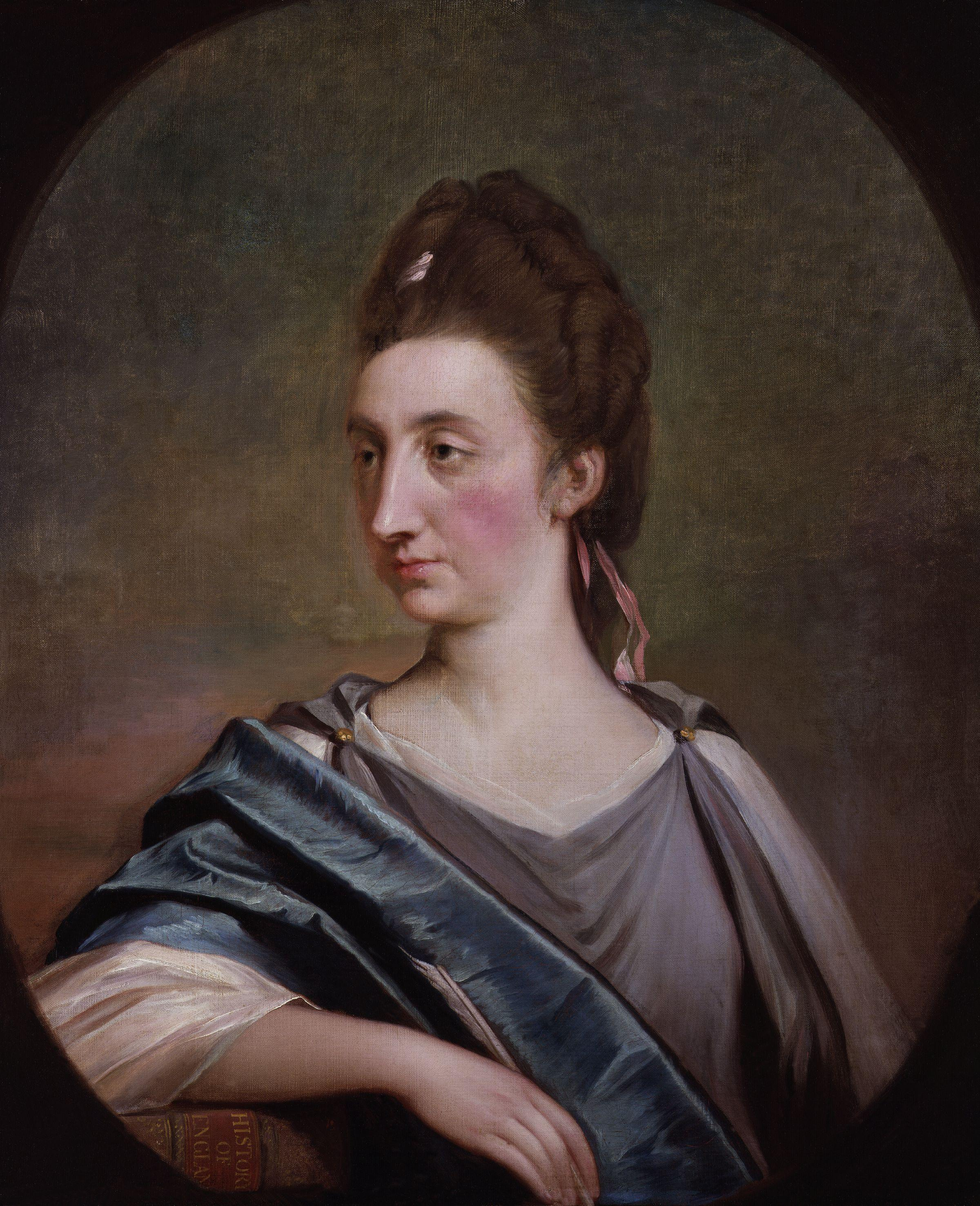
Catharine Sawbridge Macaulay Graham
Graham was a prominent English historian and writer, “at the forefront of radical transatlantic politics in the eighteenth century.” She was a prolific pamphleteer and considered one of England’s first major historians. She was a supporter of and wrote extensively on the American and French Revolutions. Through the cause of the former, she struck up a correspondence with Abigail Adams. Below is a letter from Abigail to Catherine in 1774 that highlights the current events in Massachusetts and also how close the two ladies on either side of the Atlantic Ocean had become in their letter writing. It is truly a remarkable letter that provides emotion and description of a friendship and life in Massachusetts on the cusp of revolution.
Madam
In the last Letter which Mr. Adams had the honour to receive from you, you express a Desire to become acquainted with our American Ladies.1 To them Mrs. Macaulay is sufficiently distinguished by her superior abilities, and altho she who is now ventureing to address her cannot lay claim to eaquil accomplishments with the Lady before introduced,2 yet she flatters herself she is no ways deficient in her esteem for a Lady who so warmly interests herself in the cause of America—a Cause madam which is now become so serious to every American that we consider it as a struggle from which we shall obtain a release from our present bondage by an ample redress of our Grieveances—or a redress by the Sword. The only alternative which every american thinks of is Liberty or Death.
“Tender plants must bend, but when a Goverment is grown to strength like some old oak rough with its armed bark it yealds not to the tug, but only nods and turns to sullen state.”
Should I attempt to discribe to you the complicated misiries and distresses brought upon us by the late inhumane acts of the British parliment my pen would faill me. Suffice it to say, that we are invaded with fleets and Armies, our commerce not only obstructed, but totally ruined, the courts of Justice shut, many driven out from the Metropolis, thousands reduced to want, or dependant upon the charity of their neighbours for a daily supply of food, all the Horrours of a civil war threatning us on one hand, and the chains of Slavery ready forged for us on the other. We Blush when we recollect from whence these woes arise, and must forever execrate the infamous memory of those Men whether they are Americans or Brittons, whose contagious Ambition first opened the pandoraen Box, and wantonly and cruelly scatterd the fatal ingrediants—first taught us filled with grief and anxiety to inquire
Are these thy deeds o Britton? this the praise
That points the growing Lusture of thy Name
These glorious works that in thy [better?] Days
fild the bright period of thine early fame
To rise in ravage and with arm prophane
From freedoms shrine each sacred Gift to rend
and mark the closing annals of thy reign
With every foe subdued, and every Friend.
You will think Madam perhaps from the account I have given you, that we are in great confusion and disorder—but it is far otherways. Tho there are but few who are unfealing or insensible to the general calimity, by far the greater part support it with that firmness, that fortitude, that undaunted resolution which ever attends those who are conscious that they are the injured not the injurer, and that they are engaged in a righteous cause in which they fear not to “bare their bold Breasts and pour their generous Blood.” Altho by the obstruction of publick justice, each individual is left at a loose, to do that which is right in his own Eyes, yet each one strives to shew his neighbour that the restraints of Honour and of conscience are more powerful motives, than the judiciary proceedings of the Law. Notwithstanding the inveterate Malice of our Enimies who are continually representing us, as in a state of anarchy and confusion, torn up with intestine broils, and guilty of continual riots and outrage, yet this people never saw a time of greater peace and harmony among themselves, every one uniting in the common cause, and strengthning each other with inconceivable constancy and sumpathetick ardor.
I mean always to Except those whose venal Souls barter freedom for Gold, and would sell their Country, nay gladly see an innocent land deluged with Blood, if they could riot upon its Spoils, which heaven Avert!—Tis with anxious Hearts and eager expectations that we are now waiting for the result of the united Supplications of America. Yet having so often experienced their Enefficacy we have little reason to hope. We think we have more to expect from the firm and religious observance of the association which accompanied them3—for tho it was formerly the pride and ambition of American[s] to indulge in the fashions and Manufactures of Great Brittain now she threatens us with her chains we will scorn to wear her livery, and shall think ourselves more decently attired in the coarse and plain vestures of our own Manufactury than in all the gaudy trapings that adorn the slave.—Yet connected as we are by Blood, by commerce, by one common language, by one common religion as protestants, and as good and loyal subjects of the same king, we earnestly wish that the three fold cord of Duty, interest and filial affection may not be snapped assunder. Tis like the Gordean knot. It never can be untied, but the sword may cut it, and America if she falls to use the words of the revered and ever honourd Mr. Pitt, will fall like a strong Man, will embrace the pillars of State and pull down the constitution along with her.
I must intreet your pardon Madam for Detaining you so long from the important Services in which you are engaged, but having taken up my pen I could not refrain giving utterance to some of those Emotions which have agitated my Bosom and are the cause of many anxious hours to her who begs leave to subscribe herself Dear Madam your great admirer & humble Servant,
Emerging Revolutionary War welcomes back guest historian Michael Aubrecht
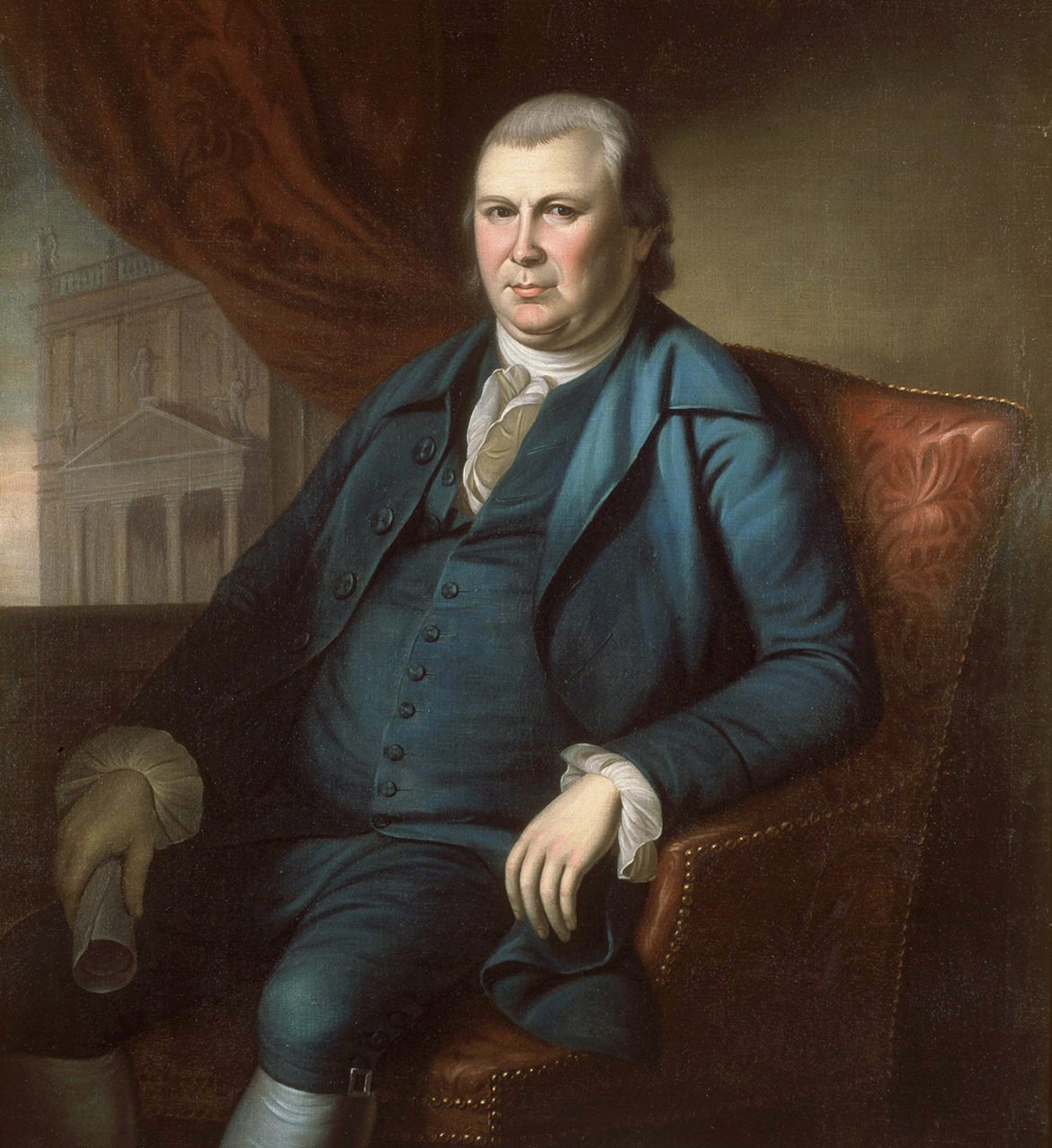
To call Robert Morris “a political renaissance man” would be an understatement. He was vice president of the Pennsylvania Committee of Safety (1775–76) and was a member of the Continental Congress (1775–78) as well as a member of the Pennsylvania legislature (1778–79, 1780–81, 1785–86). Morris practically controlled the financial operations of the Revolutionary War from 1776 to 1783. He was a delegate to the Constitutional Convention (1787) and served in the U.S. Senate (1789–95). Perhaps most impressive is the fact that he signed the Declaration of Independence and the Articles of Confederation and later signed the U.S. Constitution.
At the start of the war Robert Morris was one of the wealthiest men in the colonies, but he would go on to claim bankruptcy after some catastrophic decisions. To fully appreciate the contributions of Robert Morris we must go back and examine him from the beginning.
Robert Morris
Robert Morris was born on January 31, 1734, in Liverpool, England, the son of Robert Morris, Sr., and Elizabeth Murphet Morris. His mother died when he was only two and he was raised by his grandmother. Morris’ father immigrated to the colonies in 1700, settled in Maryland and in 1738 he began a successful career working for Foster, Cunliffe and Sons of Liverpool. His job was to purchase and ship tobacco back to England. Morris Sr. was known for his ingenuity, and he was the creator of the tobacco inspection law. He was also regarded as an inventive merchant and was the first to keep his accounts in money rather than in gallons, pounds, or yards.
In 1750 tragedy would once again strike the Morris family. In July Morris Sr. hosted a dinner party aboard one of the company’s ships. As he prepared to depart a farewell salute was fired from the ship’s cannon and wadding from the shot burst through the side of the boat and severely injured him. He died a few days later of blood poisoning on July 12, 1750. The tragedy had a terrible effect on Morris who became an orphan at the age of 16. Looking for a change he left Maryland for Philadelphia in 1748. He was taken under the wing of his father’s friend, Mr. Greenway, who filled the gap left by the death of Morris’ father. Raised with a tremendous work ethic Morris flourished as a clerk at the merchant firm of Charles Willing & Co.
Following in his father’s footsteps Morris was also gifted with successful ingenuity. In his twenties he took his earnings and joined a few friends in establishing the London Coffee House. (Today the Philadelphia Stock Exchange claims the coffee house as its origin.) Morris was sent as a ship’s captain on a trading mission to Jamaica during the Seven Years War (1756-1763). He was captured by a group of French Privateers but managed to escape to Cuba where he remained until an American ship arrived in Havana. Only then was he able to secure safe passage back to Philadelphia.
Shortly after Morris’ return to the colonies Willing retired and handed the firm over to his son Thomas who offered him a partnership. This resulted in the formation of Willing, Morris & Co. The firm boasted three ships that were dispatched to the West Indies and England importing British cargo and exporting American goods. This relationship lasted for over 40 years and was immensely successful. At one point, Morris was ranked by the Encyclopedia of American Wealth, along with Charles Carroll of Carrollton, as the two wealthiest signers of the Declaration of Independence.
As influential merchants, Morris and Willing disagreed with the changes in tax policy. In 1765, the Stamp Act was passed and was met with massive resistance. Morris was at the forefront and led protests in the streets. His fervor was so striking that he convinced the stamp collector to suspend his post and return the stamps back to their origin. The tax collector stated that if he had not complied, he feared his house would have been torn down “brick by brick.” In 1769, the partners organized the first non-importation agreement, which forever ended the slave trade in the Philadelphia region.
Morris married Mary White on March 2, 1769, and they had seven children. In 1770, he bought an eighty-acre farm on the eastern bank of the Schuylkill River where he built a home he named “The Hills.” Due to his growing reputation Morris was asked to be a warden of the port of Philadelphia. Showing his tenacity, he convinced the captain of a tea ship to return to England in 1775.
Later on, Morris was appointed to the Model Treaty Committee following Richard Henry Lee’s resolution for independence on June 7, 1776. The resulting treaty projected international relations based on free trade and not political alliance. The treaty was eventually taken to Paris by Benjamin Franklin who transformed it into the Treaty of Alliance which was made possible by the Continental Army’s victory at Yorktown in 1781.
Scholars disagree as to whether Morris was present on July 4 when the Declaration of Independence was approved. But when it came time to sign the Declaration on August 2 he did so. Morris boldly stated that it was “the duty of every individual to act his part in whatever station his country may call him to in hours of difficulty, danger and distress.” Until peace was achieved in 1783, Morris performed services in support of the war. His efforts earned him the moniker of “Financier of the Revolution.”
Michael is the author of “The Letters of Robert Morris: Founding Father and Revolutionary Financier.“
Emerging Revolutionary War welcomes guest historian Kenneth Bancroft
“Nothing but War is talked of…This cannot be redressing grievances, it is open rebellion…”1
250 years ago on October 20, 1775 a 25 year old Englishman wrote these words in Alexandria, Virginia, noting that “everything is in confusion…soon they will declare Independence.”2.Nicholas Cresswell had arrived in America a year and a half prior to that entry in a journal that he kept to chronicle his venture to “shape his course in the world” and set up a new life inVirginia, “as I like the situation of that Colony the best.”3 He was aware of grumblings from colonials, but his focus was on land and his adventure had him traveling and trading with the Native Americans in the Ohio country and experiencing the slave culture in the colonies, especially the horrific sugar plantations in Barbados.
But what his journal is most known for is his observations and critique of the revolutionary world from Virginia to New York in 1774 through 1777. Cresswell’s misfortune, among others, was that he arrived in America seeking opportunity just as the Imperial Crisis over the Intolerable Acts had began. News of, and reaction to the closure of the port of Boston frequently disrupted his schemes and social life. As an Englishman still loyal to the Crown, his Revolutionary War journal offers a unique outsider look at the costs of the conflict in the country and towns as opposed to the more common tomes of soldier life.
“No prospect of getting home this winter, as I am suspected of being a Spy.”4 Cresswell’s tenure in America was tenuous. Unsuccessful in trying to establish himself with land and basically broke, he blamed his misfortune on the “Liberty Mad”5 political climate that considered him a ‘Tory’ who would not commit to the cause. His penchant for getting into drunken political arguments did not help and kept getting him in trouble with local Committees of Safety.
“Am determined to make my escape the first opportunity.”6By that point Cresswell knew it was time to forgo his quest and return to England, but the question was how, especially with non- importation measures and the war closing ports. What followed next for Cresswell was an amazing account of encounters with revolutionary notables and locations such as Thomas Jefferson, Patrick Henry, and British General Howe in Philadelphia, Williamsburg, and New York respectively. Ultimately, Cresswell was able to secure passage back to England where he reluctantly picked up where he left off by order of his father to “shear or bind corn.”7
1 Nicholas Cresswell, The Journals of Nicholas Cresswell, 1774-1777, (North Charleston, South Carolina: reprinted 2024), 97.
The Journals of Nicholas Cresswell was first published in 1924 and offers a candid account of the American Revolution from a viewpoint not typically explored. Its accounts of mustering militia, salt shortages, political pulpits, and anti-Tory riots and fights add color to our revolutionary origins. Add to that Cresswell’s experiences with the Native Americans in the Ohio country and the plantations in Barbados which further inform our understanding of our colonial past. Join Cresswell’s journey! To read more about Cresswell’s journey click here. The blog is an online platform and resource to follow his daily posts as they occurred 250 years ago. Keyword search features and research links are featured as well. Follow along on Facebook, too, at Nicholas Cresswell Journals.
We are excited to announce that ERW historians Rob Orrison and Mark Maloy will be leading a four day tour of Boston and sites associated with the opening of the American Revolution. Part of BGES’ Field University Program, this tour is part of a series of tours that BGES is hosting focusing on the American Revolution.
From the BGES website: “Long considered the “Cradle of the Revolution,” Boston, Massachusetts, was home to many of the era’s leading figures—Dr. Joseph Warren, Samuel Adams, Paul Revere, John Adams, and many more. Its streets and wharves fostered the revolutionary spirit that would ignite a continent. In December 1773, tensions escalated dramatically when dozens of Bostonians and others boarded three ships at Griffin’s Wharf and dumped East India Company tea into the harbor in defiance of the Tea Act. Parliament soon responded with the punitive “Intolerable Acts,” placing Massachusetts under military control.
The powder keg exploded on April 19, 1775, when British Regulars and American colonists clashed on Lexington Green, spilling the first blood of the American Revolution. That day, a running battle raged from Concord to Cambridge—an opening salvo immortalized as the “shot heard ‘round the world.”
Join us during this 250th anniversary year for a multi-exploration of Boston and the nearby villages of Lexington and Concord. We’ll visit the pivotal sites and relive the moments that launched the Revolution, concluding with the dramatic engagements along the now-famous Battle Road.”
To purchase tickets, visit: https://blueandgrayeducation.org/tours/cradle-of-the-revolution-boston-to-lexington-and-concord/ Blue and Gray Education Society is a 501c3 created in 1994 to promote understanding of battlefields and other historic sites through the conduct of field study tours and seminars. BGES has sponsored many education and interpretive focused projects across the country.
We are excited to welcome historian and author J.L. Bell. Few know more about the events around Boston in 1775 than Bell. His blog, Boston 1775 (https://boston1775.blogspot.com/ ) is the most detailed and researched source on everything Boston 1775 (and before and after 1775). As we approach the 250th anniversary of Lexington and Concord, we will continue our on going discussion about the events leading up to the first shots at Lexington. Topics will include the military build up in Massachusetts including cannon (especially four stolen cannon), creation of minute companies and Gage’s military response. Leslie’s expedition to Salem in February as well as the newly created Provincial Congress and Dartmouth’s orders for Gage.
We have a lot to cover, so grab a drink and join us LIVE on our Facebook page on Sunday, February 2nd at 7pm. This will not be one you want to miss!
Everyone has heard of the “shot heard round the world” at the North Bridge, or the first shots of the war on the early morning of April 19, 1775 at the Lexington Green. But few people know about events that transpired in New Hampshire four months before Lexington and Concord. The events at Fort William and Mary on December 13 and 14 1774 were just as critical to the step toward war as the September Powder Alarm or the later Salem Alarm in February 1775.
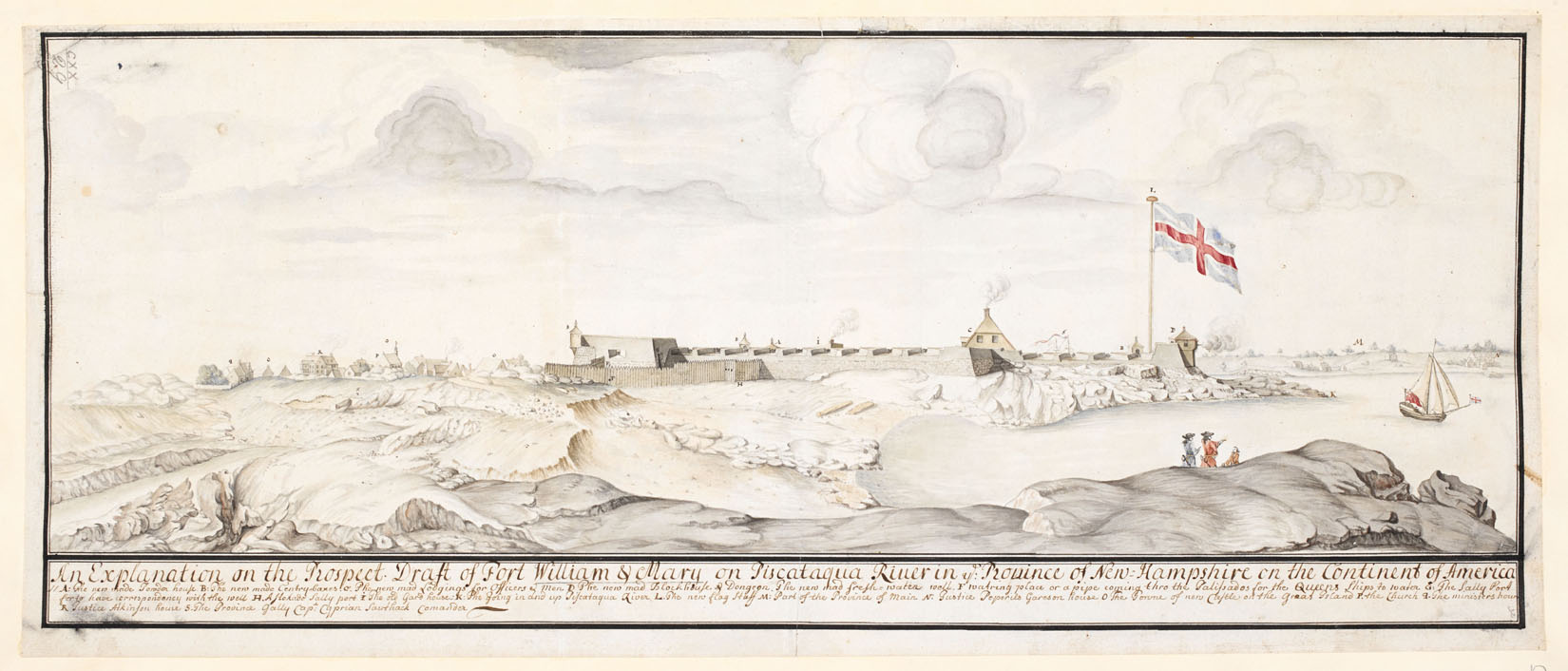
Fort William and Mary, ca. 1705 by Wolfgang William Romer
In response to the Massachusetts Powder Alarm in September 1774, colonial Whig leaders in nearby colonies began to make plans to “capture” local and colonial powder supplies. The crux was the issue of who really owned the gunpowder. Whig leaders believe they owned the power, the colonial militias. Royal leaders, Gen. Gage specifically, believe the powder was the “King’s Powder.” So any attempt to take the powder, was theft and treason. On December 3, 1774 the Rhode Island Assembly ordered the removal of cannons and powder from Fort George in Newport. On December 9, local militia carried out the order without any incident. Gage began to look at larger powder supplies that he believe were vulnerable. One large such supply was located at Fort William and Mary, located near Portsmouth, New Hampshire. This fort was isolated on the island of New Castle, at the mouth of the Piscataqua River. Located here was a small garrison of six men, guarding the fort and its supply of gunpowder.
Paul Revere and his other Patriot leaders in Boston became expert spies and soon received word that Gage was to send a contingent of British marines to Fort William and Mary. On December 13, Revere set out from Boston to Portsmouth to warn them of the coming expedition. Though the British navy was active in the area off of Portsmouth, Gage ironically made no plans to send an expedition to the fort. That would matter little in what happened next.
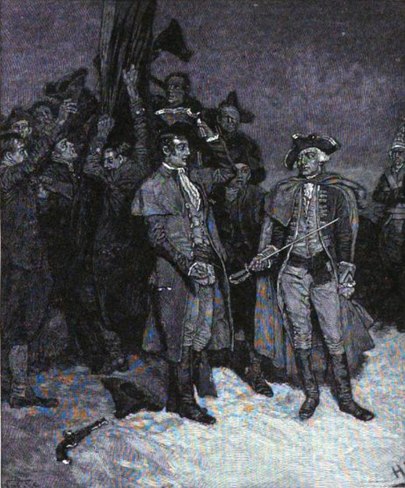
Surrender of Fort William and Mary by Howard Pyle
As Revere arrived in Portsmouth that afternoon, he gave the news of the supposed British expedition to the local Committee of Correspondence. Soon the local militia organized and, on the next day, nearly 400 militiamen assaulted the fort. The six-man British contingent inside the fort refused to surrender. They even fired three of their cannon at the attacking militiamen. For the first time, colonists were in open combat against British troops. The contingent eventually surrendered, having suffered a few injuries but no fatalities. That afternoon, the militia hauled away nearly 100 barrels of gunpowder. The next day nearly a thousand militiamen led by John Sullivan, arrived in Portsmouth due to the rider notification system. With no British to fight, these men assisted in going back to the fort to carry away muskets and cannon. Gage got word of Revere’s presence in Portsmouth and soon sent a small force from Boston to Portsmouth via the British navy. This force arrived the next week and at that point, there was nothing left of substance in Fort William and Mary.
The events at Portsmouth led Gage to be more aggressive in establishing a more coordinated spy network. As the new year began, Gage’s communications with England forced British officials to realize that this opposition was not like those in years past. The Patriots were arming themselves and establishing their own government in an affront to British authority. Former Prime Minister William Pitt, now sitting as a member of the House of Lords, knew the colonies well. He was well liked by the colonists, and he sought a compromise. He predicted the colonials would not back down and soon war would erupt between Great Britain and its colonies. Pitt proposed to remove British troops from Boston to lessen the tensions and to repeal the Coercive Acts. Both ideas were rejected overwhelmingly by Parliament.
In response to the news that the Continental Congress convened, Parliament on February 9, 1775, declared: “We find, that a part of your Majesty’s subjects in the province of the Massachusetts Bay have proceeded so far to resist the authority of the supreme legislature, that a rebellion at this time actually exists within the said province.” Now there was no doubt how the “Patriots” were viewed by Parliament and the King; they were rebels.
The events at Fort William and Mary were part of a succession of tense encounters between British authorities and local Whig leaders. Each one built on the tension from the previous. It is amazing that the “attack” by the New Hampshire militia on the fort, attacking the King’s troops, did not lead directly to war then. It would take four more months before another armed conflict sparked a revolutionary war.
To read more about the events leading up to Lexington and Concord, visit the Savas Beatie website to purchase “A Single Blow: The Battles of Lexington and Concord and the Beginning of the American Revolution” by Phillip S. Greenwalt and Rob Orrison
Many have heard of Paul Revere’s ride to Lexington and the shot heard round the world at Concord (and Lexington) but few know about the December 1774 raid and skirmish at Fort William and Mary in New Castle, New Hampshire. Here, inspired by news from Paul Revere, local militia attacked and captured a small British garrison at Fort William and Mary. Join us as we welcome Dr. Dr. Cynthia Hatch to discuss this much over looked action leading up the American Revolution.
Dr. Hatch is an Oklahoma State University Institute of Technology instructor specializing in Revolutionary War history. With a PhD in History, she explores the intricate political, social, and cultural dynamics of the 18th century, with a particular focus on the colonial legal system and the pivotal role of local narratives in shaping historical interpretations during the Revolutionary Era.
Join us as we discuss the events leading up and during the raid of Fort William and Mary and learn, were these the FIRST shots of the American Revolution? This Rev War Revelry will be pre-recorded and posted to our Facebook page at 7pm on Sunday, December 8th.
Emerging Revolutionary War welcomes back guest historian Evan Portman
Two future presidents walk into a Catholic church.
No, that’s not the beginning of a bad historical joke. It’s what happened on October 9, 1774, when George Washington and John Adams wandered into Old St. Mary’s Catholic Church while serving as delegates to the First Continental Congress in Philadelphia.
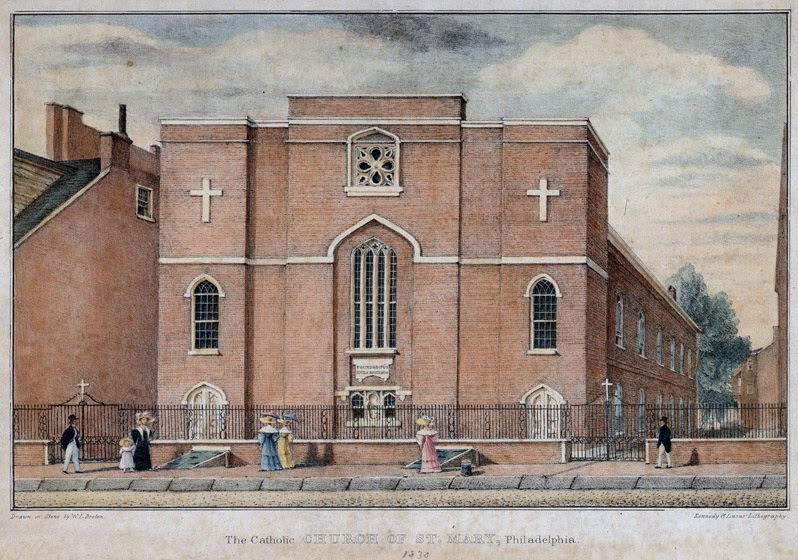
In September 1774, delegates from twelve of the thirteen colonies convened in Philadelphia for the purpose of discussing a response to Parliament’s recent Intolerable Acts. But after a month of debating (and bickering), Adams wrote that “the Business of the Congress is tedious, beyond Expression.”[1] Seeking a break from the monotony, Adams and Washington ventured to one of the oldest Catholic churches in the colonies. Established in 1763 by parishioners of Old St. Joseph’s, St. Mary’s Church grew from the need for a Catholic cemetery.
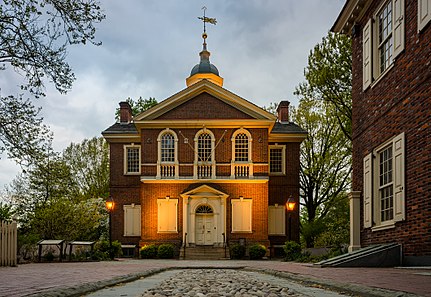
“[L]ed by Curiosity and good Company I strolled away to Mother Church or rather Grandmother Church, I mean the Romish Chappell,” Adams wrote to his wife Abigail that day.[2] The church stood just a few blocks south of the Congress’s meeting place at Carpenters’ Hall and starkly contrast anything the Protestant Adams had seen before. A descendant of some of America’s early Puritans, Adams was raised in the Congregational church of Braintree, Massachusetts, where “unfettered daylight through clear window glass allowed for no dark or shadowed corners, no suggestion of mystery.”[3] Old St. Mary’s could not have been more different. Light poured through several stained-glass windows before a large, ornate altar, behind which hung a dramatic depiction of Christ’s passion while burning candles and incense lit the nave.
Adams’s puritanical upbringing taught him to abhor such pageantry in the house of the Lord. He looked with pity upon “the poor Wretches, fingering their Beads, chanting Latin, not a Word of which they understood, their Pater Nosters and Ave Maria’s.” Even “their holy Water—their Crossing themselves perpetually—their Bowing to the Name of Jesus, wherever they hear it” appalled the young lawyer from Boston.[4]
Despite his disdain, some elements of the mass impressed and even moved, Adams. He described the priest’s homily as a “good, short, moral Essay upon the Duty of Parents to their Children, founded in Justice and Charity, to take care of their Interests temporal and spiritual.” Its brevity stood in stark contrast to the long-winded sermons of the Great Awakening, with which Adams would likely have been familiar. Even the priest’s flashy garments were noteworthy to the future president. “The Dress of the Priest was rich with Lace—his Pulpit was Velvet and Gold,” Adams noted.[5]
But most noteworthy of all was the “Picture of our Saviour in a Frame of Marble over the Altar at full Length upon the Cross, in the Agonies, and the Blood dropping and streaming from his Wounds.” That combined with the organ music, which Adams described as “most sweetly and exquisitely” was enough to move him. “This Afternoons Entertainment was to me, most awfull and affecting,” he confessed. But in the eighteenth century, the word “awful” did not mean what it does today. Adams quite literally meant that he was “full of awe” in observing the mass. He was so moved, in fact, that he wondered how “Luther ever broke the spell” of Catholicism.[6]
Perhaps Adams’s experience that day, 250 years ago, is indicative of the Revolution at large, as it brought together men from disparate backgrounds and regions. As a young man in Braintree, Adams likely never imagined he could be moved by a “papist ceremony,” nor could he probably have imagined signing his name on a document securing independence from his former country. In this way, the American Revolution made fantasy a reality, and the impossible, possible.
[1]“John Adams to Abigail Adams, 9 October 1774,” Founders Online, National Archives, https://founders.archives.gov/documents/Adams/04-01-02-0111. [Original source: The Adams Papers, Adams Family Correspondence, vol. 1, December 1761– May 1776, ed. Lyman H. Butterfield. Cambridge, MA: Harvard University Press, 1963, pp. 166–167.]
[3] David McCullough, John Adams, (New York: Simon & Schuster, 2001), 84.
[4] “John Adams to Abigail Adams, 9 October 1774,” Founders Online, National Archives, https://founders.archives.gov/documents/Adams/04-01-02-0111. [Original source: The Adams Papers, Adams Family Correspondence, vol. 1, December 1761– May 1776, ed. Lyman H. Butterfield. Cambridge, MA: Harvard University Press, 1963, pp. 166–167.]
The ground fog was thick off the Ohio; the air was chilly on that early October morning. Two groups of hunters moved north along the river in the pre-dawn darkness, hoping to shoot a deer for their breakfast. Instead, they stumbled across something unexpected: Shawnee warriors! The battle of Point Pleasant was on.
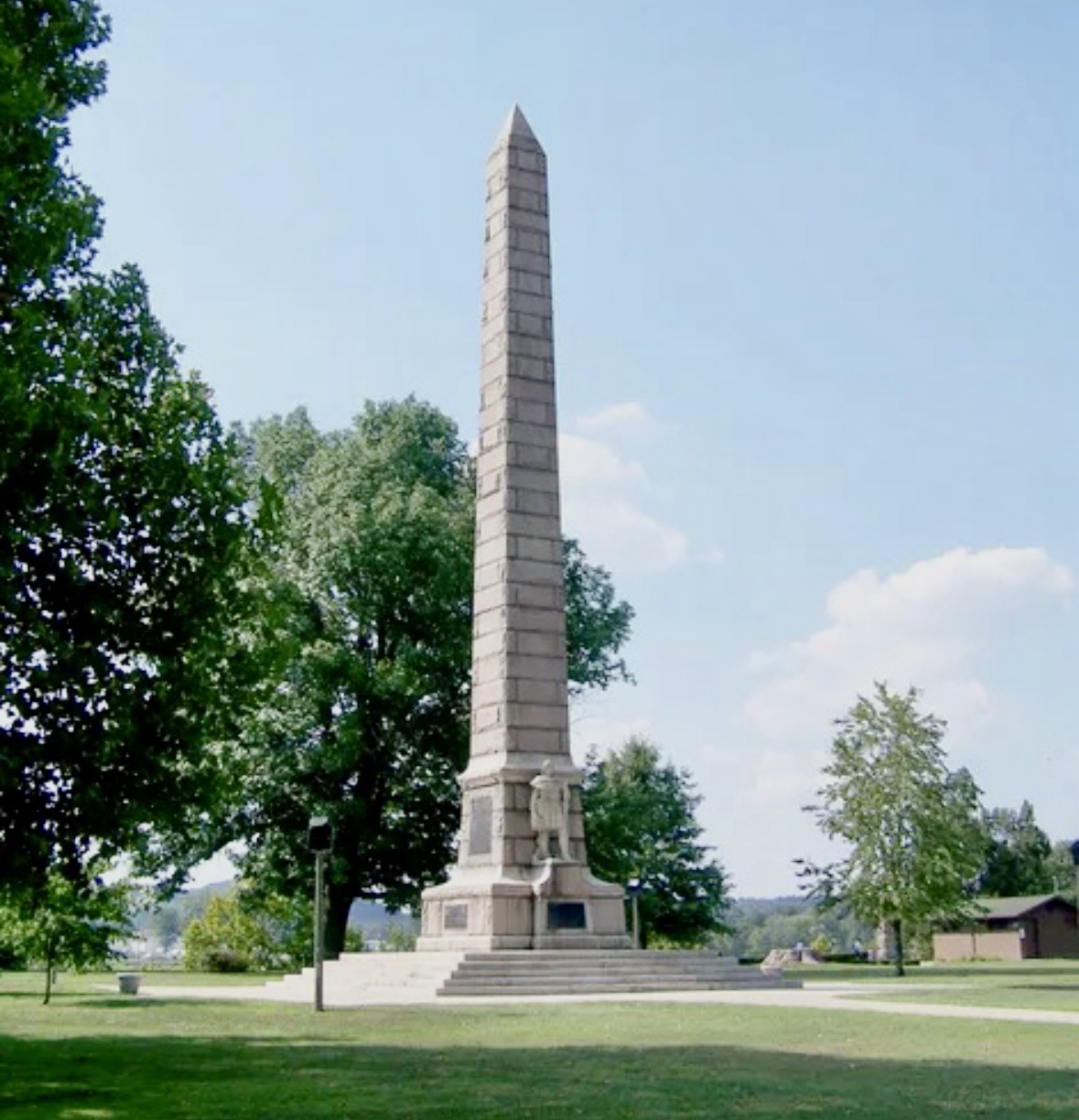
Point Pleasant Monument
In the summer of 1774, exactly 250 years ago and on the very eve of the American Revolution, the Virginia Colony went to war, but not with the British. In fact, the colonists at this stage still considered themselves to be British. Virginia went to war that summer against the Shawnee, Mingo, Wyandot, and other Native American tribal nations west of the Appalachian Mountains. As wars go, this wasn’t much of one, lasting barely six months and with only one decisive battle.
It stemmed from what one side called emigration and what the other considered encroachment. Bodies of English settlers, in ever increasing numbers, were crossing the mountains in hopes of settling land in the Ohio River Valley. This was territory that had been claimed by the French and transferred over to the British at the end of the Seven Year’s War. To the tribal nations in the Ohio Valley, like the powerful Shawnee, it was an affront. The settlers were looked upon as invaders, encroaching upon ancestral hunting grounds. Inevitably, the stage was set for violent and bloody clashes between these two peoples.
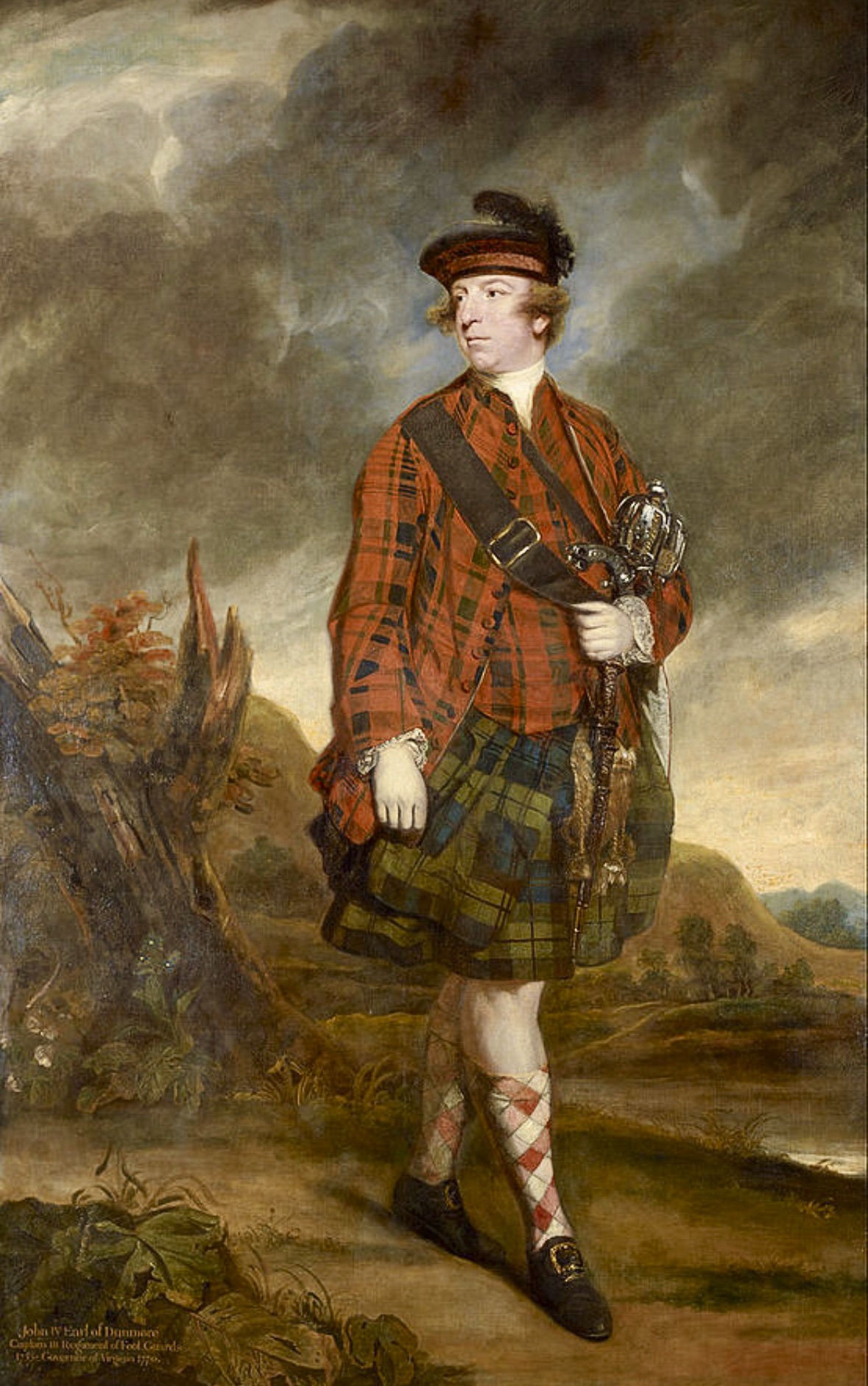
Hoping to pacify the frontier and establish once and for all Virginia’s jurisdiction over the Ohio Valley, the colony’s royal governor, John Murray, 4th Earl of Dunmore, asked the House of Burgesses to declare war and he called out the Virginia militia. In the years to come, many of the men serving in these militia companies would go on to distinguish themselves as officers and soldiers in the Continental army during the Revolution. For them, the fighting on Virginia’s frontier, in what came to be called Dunmore’s War, would serve as a dress rehearsal. This would be the last time in our nation’s history that a colonial American militia would march to war under the banner of the British crown.
John Murray, 4th Earl of Dunmore
At the Treaty of Fort Stanwix in 1768, the Iroquois peoples of the powerful Six Nations sold lands south of the Ohio River to the British, from Fort Pitt (modern-day Pittsburgh) down to the Louisa River (now the Kentucky River). This was territory the Iroquois believed to be part of their domain. For money and gifts totaling around £10,000, the Six Nations ceded to the Crown lands making up the modern states of Kentucky and West Virginia. The Shawnee and other western tribes in the Ohio Valley were outraged as white hunters, surveyors, land agents and settlers began to pour over the mountains. A trade-off of terror began, with both sides viciously attacking the other.
In the late summer of 1773, the first planned emigration into the new territory of Kentucky was undertaken. A prominent leader of this enterprise was Captain William Russell, a substantial landowner in southwestern Virginia and a magistrate of the newly created Fincastle County. Another organizer and the man who would act as guide for this first emigration attempt, made up of his and several other families from the Yadkin River Valley in North Carolina, was an obscure hunter named Daniel Boone. Boone led a party of 50 men, women and children through Powell’s Valley in southwestern Virginia, hoping to pass through Cumberland Gap into Kentucky. On October 10, just three miles behind Boone’s main party, his 17-year-old son James, 17-year-old Henry Russell, and a small group of young men, bringing up cattle and other supplies, were attacked by 19 Shawnee, Cherokee, and Delaware warriors. Both Boone and Russell were shot and hideously tortured to death. Word of the attack spread, causing the elder Boone’s party to turn back, abandoning all hopes of settling in Kentucky.
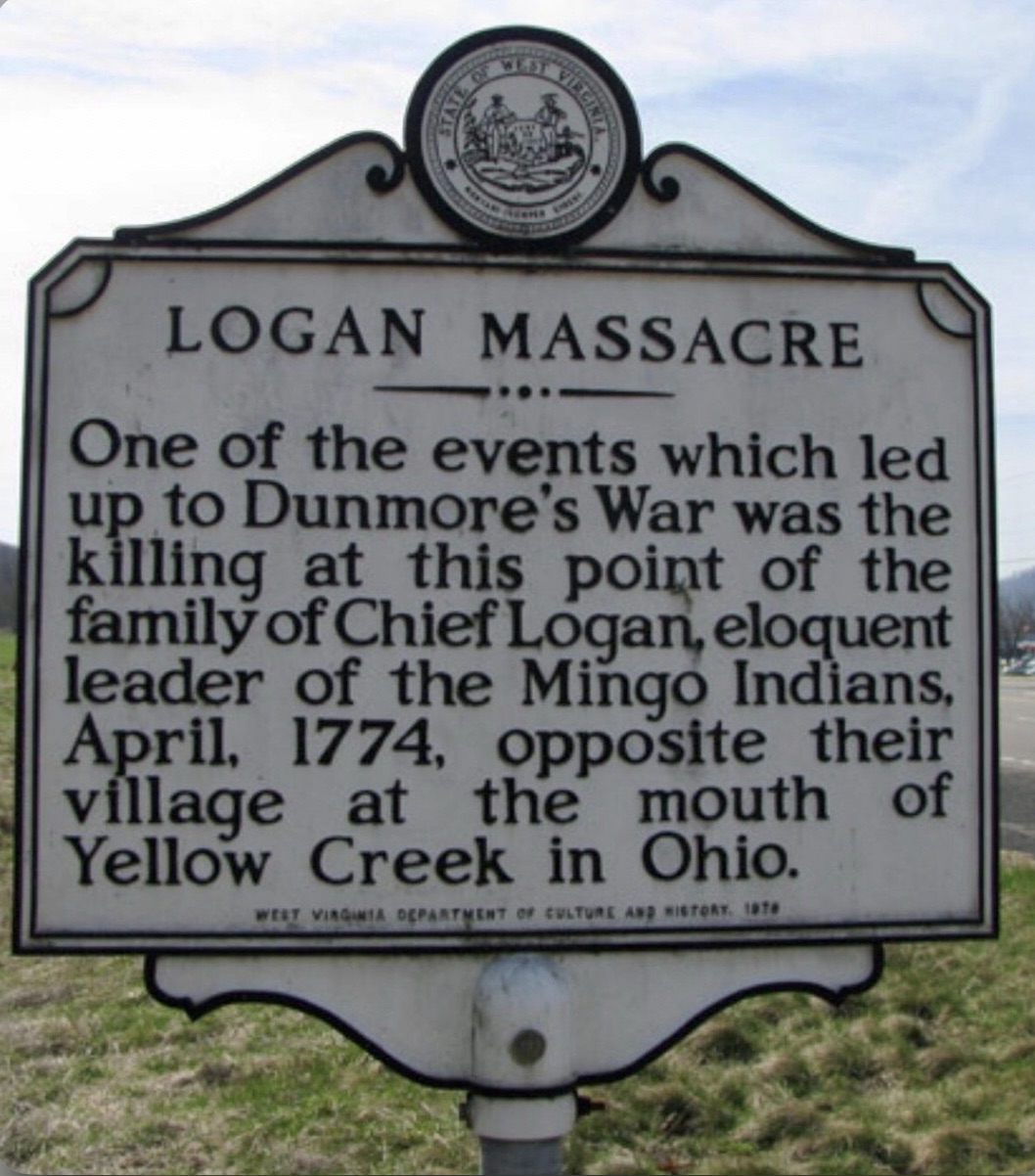
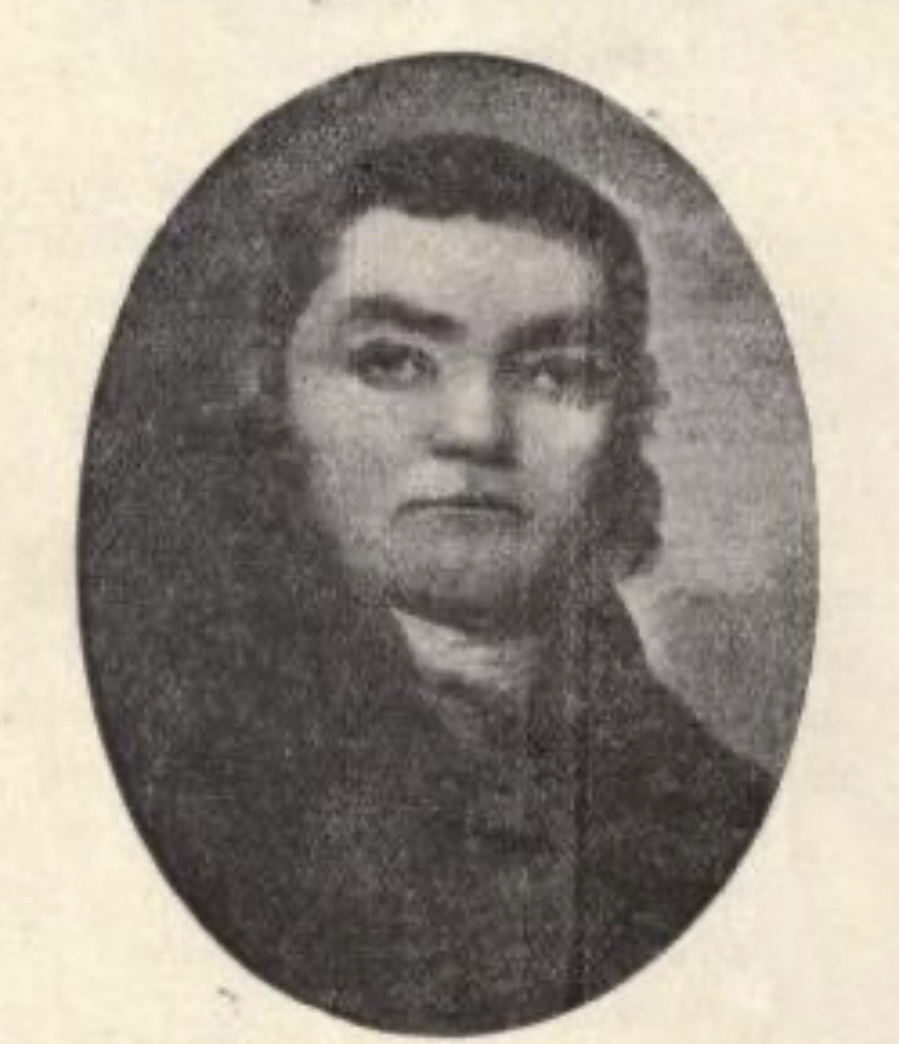
In late April of 1774, at a white trading post on the south bank of the Ohio River called Baker’s Bottom, several peaceful men and women of the Mingo tribe were murdered and scalped by white settlers believed to be under the leadership of a man named Daniel Greathouse. Among the victims were family members of a Mingo leader named Talgayeeta; he was known to the English as John Logan. As a result of the attack, the once peaceful Logan swore vengeance and, accepting help from the Shawnee, began indiscriminately attacking isolated white farmsteads along the Monongahela River throughout the summer.
With word of the atrocities reaching Williamsburg, Governor Dunmore sent out a circular letter to all county lieutenants to be on the alert, build small forts and blockhouses for more security and to send out rangers to watch the trails. He was growing frustrated with the Virginia House of Burgesses for not creating regular, provincial military units to defend the frontier. The burgesses were preoccupied with the political unrest in the east, mainly due to parliamentary taxation. They passed a resolution to observe a day of humiliation, fasting, and prayer in response to the Boston Port Bill, which had resulted from the Boston Tea Party in December 1773. On May 26, Lord Dunmore dissolved the House of Burgesses and under his authority as royal governor, mobilized the Virginia Militia.
In late July came the first action of the militia. An expedition against an important Shawnee village on the Muskingum River, Wakatomika, was led by Major Angus McDonald. At Fort Fincastle, near modern-day Wheeling, WVA, McDonald’s battalion of 400 men pushed off in canoes and small boats on the Ohio River. Among his company commanders were two future Patriot leaders of the Revolutionary War, George Rogers Clark and Daniel Morgan. Combat with the Shawnee was minimal, although McDonald’s force did suffer some casualties. Wakatomika was plundered and burned, along with several other villages before the militiamen returned to Fort Fincastle. On the whole, the expedition had accomplished very little and, instead of curbing the Native American attacks on settlers, actually caused the attacks to increase. Lord Dunmore now knew that overwhelming force would be needed.
In the late summer of 1774, Dunmore authorized the creation of two divisions of his militia, north and south. At Winchester, he mustered around 700 men from Virginia’s eastern counties. The Governor was disappointed, however, to learn that his invitation to join the division, made to a retired British army officer living in Berkeley County, was turned down. He was Horatio Gates, future major general in the Continental army, victor at the battle of Saratoga in 1777, and the man who suffered a devastating loss to the British at Camden in August 1780.
To the south, at Staunton, VA, militia Colonel Andrew Lewis, a future brigadier general during the Revolution, mustered ultimately around 1,100 men from the western counties of Augusta, Botetourt, Fincastle, Bedford, and Culpepper. With negotiations failing, by late August, Lord Dunmore put the Northern and Southern Divisions into motion. Their plan was to rendezvous on the Ohio River and march on the upper Shawnee villages on the Scioto River, in modern-day Ohio. Dunmore’s Northern Division marched west from Winchester to Fort Pitt, then down the Ohio to Fort Fincastle. There, 500 more men joined the division. Many of Dunmore’s troops had no weapons so he sent back to Williamsburg for 300 stands of arms. Dunmore’s second-in-command was Colonel Adam Stephen, another future major general in Washington’s Continental army. On October 2, the division moved farther south down the Ohio, to Fort Gower on Hockhocking Creek.
Colonel Andrew Lewis
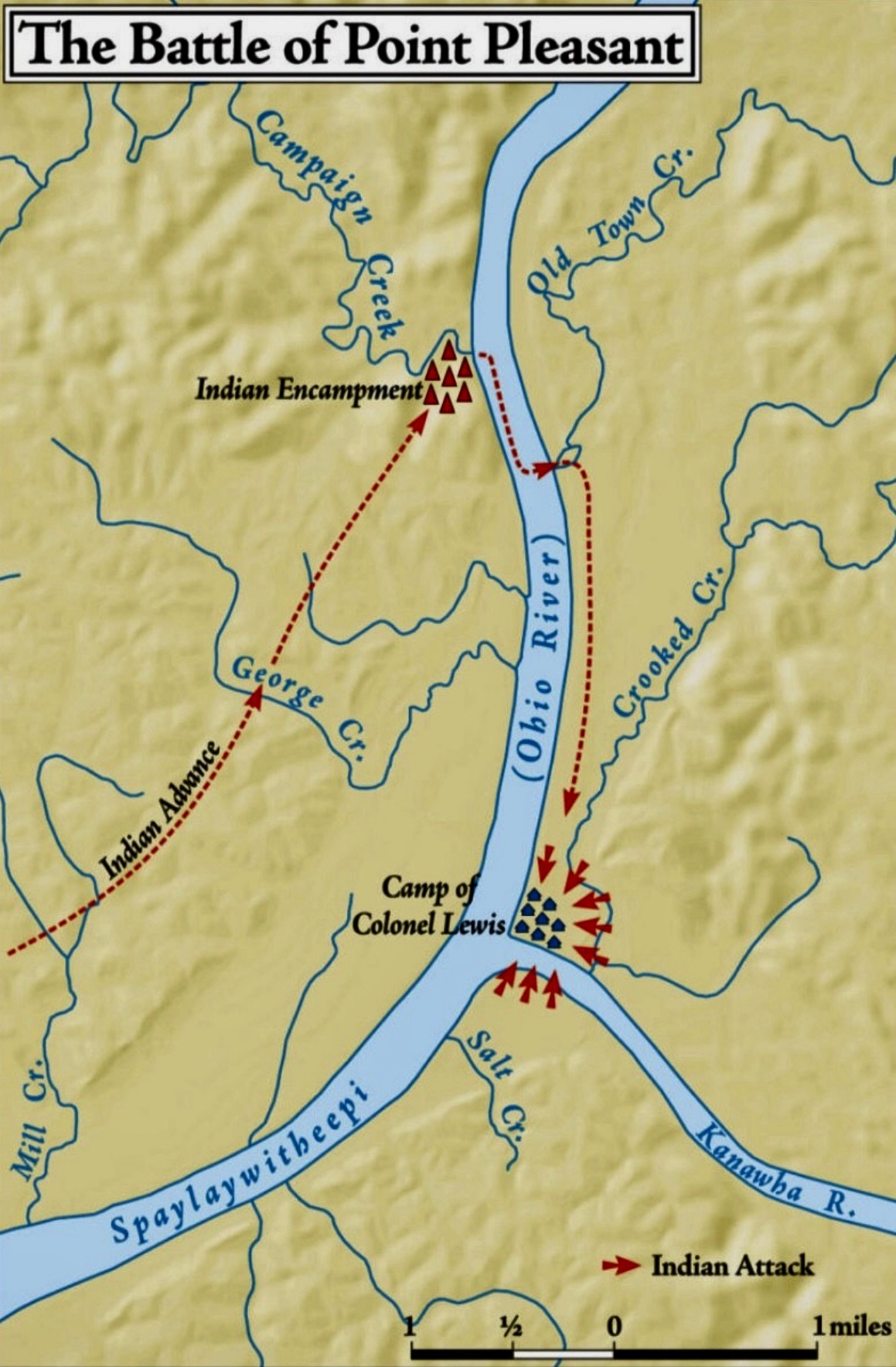
From Staunton, Andrew Lewis marched his Southern Division west to a place called Great Levels, on the Greenbriar River. He named it Camp Union, on the site of modern-day Lewisburg, WVA. He then headed south, hitting the Kanawha River and following it west to where it empties into the Ohio at a place called Point Pleasant. Lewis’ lead elements arrived there on October 6 and began building barricades from the Ohio River on their left around to the Kanawha, which was at their backs. They also built pens and corrals for the livestock that would feed Lewis’ companies.
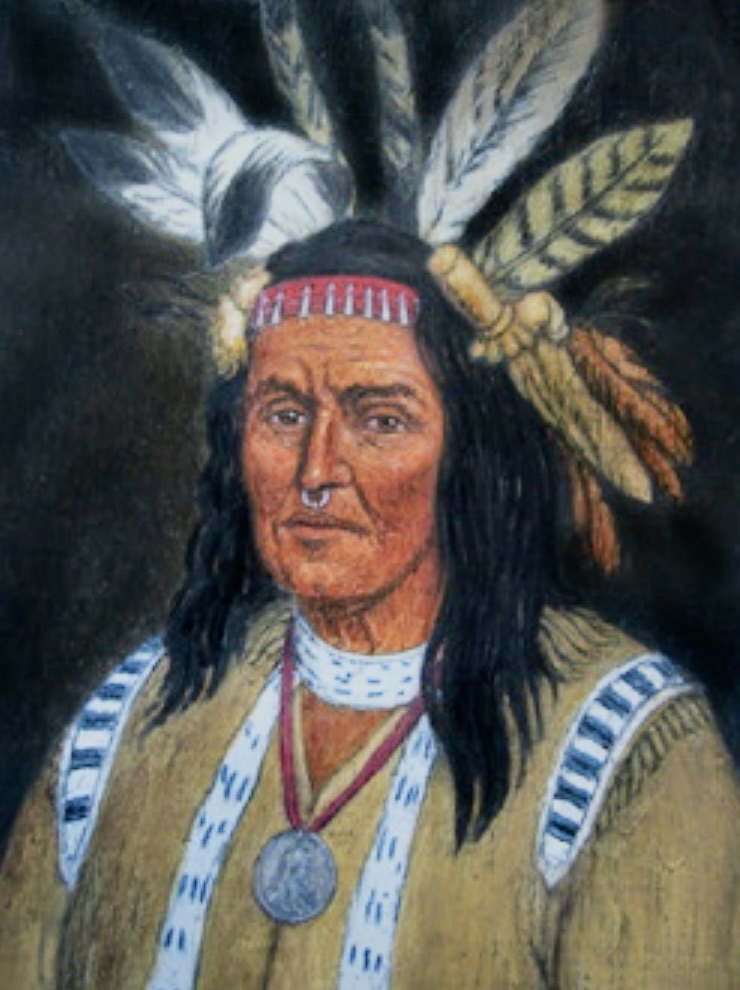
Leading the Shawnee and several other allied tribes as head war chief was a man named Hokoleskwa, also called Cornstalk. He commanded a force of around 1,000 warriors, which possibly included the future Shawnee war chief, Blue Jacket. Though his army was equal in size to both of the Virginia militia divisions individually, Cornstalk would be greatly outnumbered were those divisions to rendezvous, as planned. He decided, then, to attack each division separately and destroy them in detail. Being closer to the Southern Division, he chose to attack it first. On the night of October 9, Cornstalk rafted his army across the Ohio River at Old Town Creek, about five miles above Col. Lewis’ encampment. They then marched south to within two miles of the militia.
Shawnee Chief Cornstalk
In camp, Lewis issued a rather unpopular order. Feeding his troops from the livestock he had brought along from Camp Union, Lewis ordered the oldest and poorest quality beeves butchered first. Not having a taste for stringy beef, two separate, two-man hunting parties set out before dawn on the foggy morning of October 10, moving north along different paths, looking for deer. After walking nearly two miles, both hunting parties stumbled upon Cornstalk’s warriors. Shots were fired and one of the hunters, Pvt. Joseph Hughey of Fincastle, was killed. The other three made their escape and brought news of the enemy presence back to Col. Lewis.
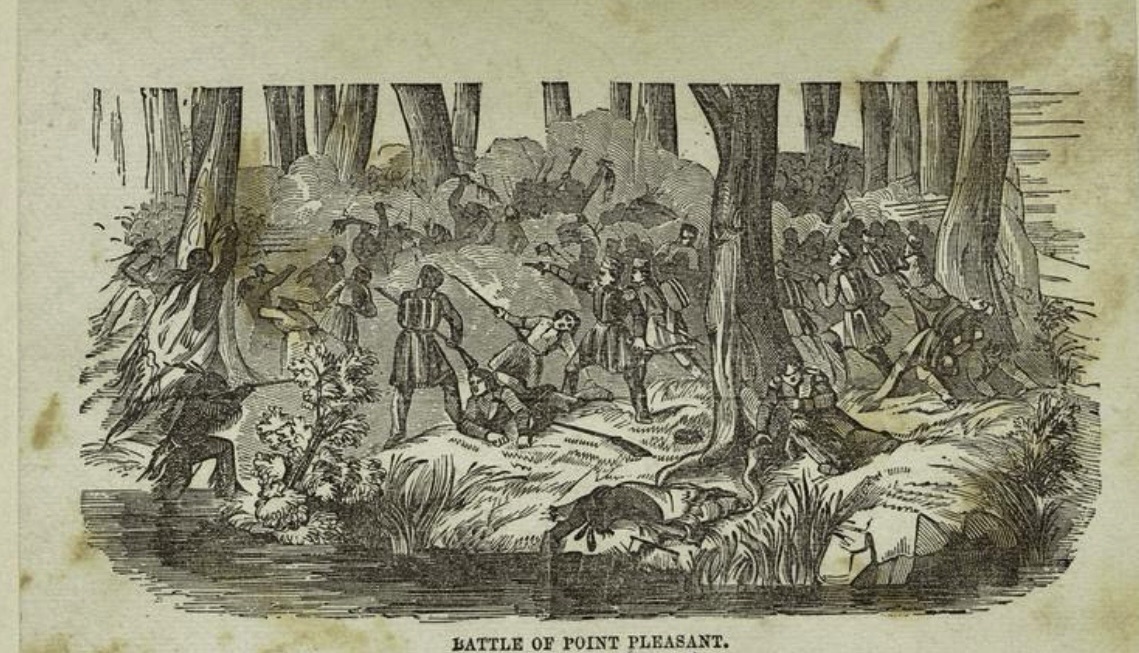
Thinking this was possibly a large scouting party, Lewis ordered two detachments of 150 men each to move up and reconnoiter. On the left, close to the Ohio River, were men from Botetourt County, commanded by Col. William Fleming. On the right, farther inland, were Augusta County militiamen commanded by Lewis’ own brother, Col. Charles Lewis. Around sunrise, Cornstalk’s warriors attacked, opening a brisk fire on the Virginians. Charles Lewis was hit almost immediately, in the abdomen. While being helped back to the encampment, he called to his men: “I am wounded, but go on and be brave.” Fleming’s Botetourt men also came under fire. The militiamen were outnumbered and the Shawnee attack was so fierce that both Virginia detachments faltered and were forced to fall back, ultimately around 200 yards. William Fleming was likewise hit, with wounds to the head and left arm. He continued to direct his men, though, until weakening from his wounds. Under his own power, he walked back to the encampment. A gap in the line separated the militia detachments. Warriors began rushing forward to exploit that breach. Directing the battle from the encampment, Andrew Lewis ordered Col. John Field of Culpepper forward with 200 men to assume command on the right, with orders to extend his left flank to link up with the Botetourt contingent. Lewis sent another 200 troops to join the Botetourt men, with orders for Captain Evan Shelby to assume command on the left. With more Virginia troops becoming engaged, Cornstalk’s initial superiority in manpower was starting to fade. The tide was turning.
Battle Map – Point Pleasant
Under sustained fire, the militia detachments were finally able to link up. With their flanks no longer in the air, the battle line now stretched from the Ohio River over to Crooked Creek, making a flanking maneuver by the warriors next to impossible. John Field was killed; Evan Shelby took command of the entire line of battle. The fight had turned hand-to-hand. For several hours the bloody contest continued. Those Virginians who understood the Shawnee dialect afterwards claimed they had heard the sound of Cornstalk’s voice over the din of battle encouraging his warriors to “Fight and be strong”. Hand-to-hand combat, by its very nature, can be brutal and bloody. Both sides were suffering severe losses as the contest continued but Cornstalk made the decision to stay in the fight at Point Pleasant in order to inflict more damage to Lewis’ men. Withdrawing from the battle in order to fight another day put Cornstalk’s forces under a decided disadvantage. It would allow the wings of the Virginia militia to combine, closer to the Shawnee villages. He had to continue to fight as long as possible. But after so many hours, the allied warriors were beginning to falter, falling back under the pressure from the militia. The long rifles of the Virginians were now taking a heavy toll.
Battle of Point Pleasant, October 10, 1774
Col. Lewis sent orders to Capt. Shelby to advance his troops. With this surge, Cornstalk’s braves began to give more ground. Lewis earlier had ordered three companies of Augusta militia to move to the right, along the heights above Crooked Creek in order to flank the enemy. Now they opened fire, surprising the warriors on Cornstalk’s left. With knowledge that more militiamen were coming up from Camp Union, Cornstalk had no choice but to disengage at this point. Close to sunset, after hours of bloody combat, Cornstalk’s army began to withdraw, hoping to get back across the Ohio. They largely carried off their dead, throwing some of the bodies into the river to hide their losses. They were successful, however, and made the north bank of the river but Chief Cornstalk’s attempt to destroy the Southern Division had failed.
The Virginia militia had won the field, but at a terrible cost. Andrew Lewis lost around 75 men killed in the engagement with 140 more wounded. It’s believed that Cornstalk’s casualties were similar. Just before the battle, Lord Dunmore had moved his division inland, closer to the Shawnee villages, and established Camp Charlotte at Pickaway Plains. With his allied warriors not willing to engage further, Cornstalk had no choice but to initiate peace talks. His decision did, however, save the upper Shawnee towns from destruction.
With the subsequent Treaty of Camp Charlotte, Lord Dunmore’s War came to an end, but peace on the frontier would be fleeting. Within six months, shots were fired at Lexington and Concord, plunging America into war with Great Britain. More settlements were established in Kentucky and Shawnee raids would continue throughout the next twenty years.
With the coming of the American Revolution, Lord Dunmore himself would eventually be forced out of Virginia, pursued by some of the same militia officers he had commanded in the war that took his name.
For more about Point Pleasant and Dunmore’s War, check out our Rev War Revelry with Dr. Glenn Williams on our Facebook page or You Tube Channel.
This weekend, September 7-8, ERW travels to Philadelphia for the kick off of the 250th anniversary of the First Continental Congress. We will be coming to you live via our Facebook page from historic sites across Philadelphia and especially Carpenters Hall, the meeting place for the First Continental Congress. We will welcome special guests and share with you the great history surrounding the First Continental Congress and some places that you can visit the next time you are in the City of Brotherly Love.
Stay tuned to our Facebook page this weekend for numerous live videos throughout Saturday and Sunday!


 Emerging Revolutionary War Era