Lafayette at Brandywine

Marquis de Lafayette was a French aristocrat serving in the French army, and recently married, when the Revolution broke out in America.  He followed events with interst, and was motivated to come and fight with the Americans.

He arrived in March, 1777, nineteen years old and eager.  He immediately formed a friendship with Washington, and was an aide on his staff.  In the meantime British forces had invaded Pennsylvania, intent on capturing Philadelphia.  Washington’s army took a position behind Brandywine Creek, and the British attacked on September 11, 1777.  British troops had flanked the Americans, and reinforcements were rushed to the threatened sector, making a stand on Birmingham Hill.

Eager to get to the fighting, Lafayette and a group of French officers rode to the unfolding battle at Birmingham Hill, arriving as the action was at its hottest.  Approaching from the south, they rode up the Birmingham Road, and turned to the left, coming in behind the brown-coated troops of General Thomas Conway’s Pennsylvania brigade.

Continue reading “Lafayette at Brandywine”
Benjamin Henry Latrobe: Architect of the Republic

Emerging Revolutionary War welcomes guest historian Darien Ashley. A short bio follows this post.

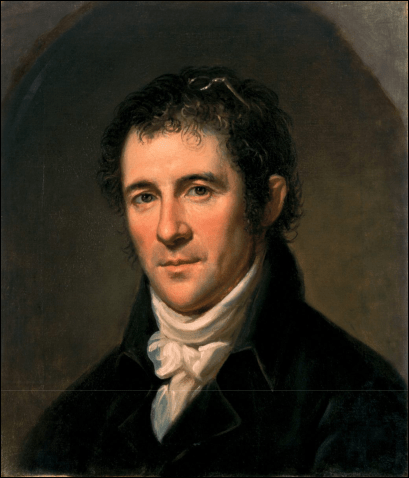
The best architecture is that which reflects clearly the ideals and activities of the people which inhabit it. This is true for both private dwellings and public buildings. The objects of architecture serve as a lasting testament to identity. These objects, once created, continue to shape minds long after the architect is gone. A nation’s capital city is a site where man can establish glorious structures which convey a sense of who the people are, where they came from, and where they intend to go. The United States Capitol building is a prime example of a structure that continues to inform American identity long after its architects have passed. This article serves as an investigation of the life of one of the most important architects of not only the Capitol, but of the nation itself, Benjamin Henry Latrobe.

Guests to the United States Capitol building often get a shock from the fact that one of its primary architects, Benjamin Henry Latrobe, was an Englishman. Indeed, the man who designed the hallowed, old halls of Congress hailed from a Moravian religious settlement located on the outskirts of Leeds, England. However, Latrobe himself would have objected to the label “Englishman”. Indeed, throughout his life, Latrobe referred to the United States as “his” country and was quick to point out that his mother, Anna Margaretta Antes, was born and raised in Pennsylvania. Latrobe’s father, Benjamin Henry Latrobe Sr., met Anna after she had been sent to London to finish her education. Both of Latrobe’s parents held prominent positions within the Moravian ministry and raised their children to follow in their example.

Continue reading “Benjamin Henry Latrobe: Architect of the Republic”

The 245th Anniversary of "Give Me Liberty or Give Me Death"

On this date, in 1775, Virginian Patrick Henry, a delegate to the Second Virginia Convention from Hanover County, Virginia sat in on the ongoing debate at St. John’s Episcopal Church in Richmond, Virginia.

Patrick Henry

The 28-year old then stood to give his defense of his proposed amendments to the petition then being debated. Below is the last few lines of his now famous statement, with the last sentence being the one most remembered;

If we were base enough to desire it, it is now too late to retire from the contest. There is no retreat but in submission and slavery! Our chains are forged! Their clanking may be heard on the plains of Boston! The war is inevitable and let it come! I repeat it, sir, let it come.

Continue reading “The 245th Anniversary of "Give Me Liberty or Give Me Death"”

ERW Weekender: Ninety Six, The Site That Has It All

Emerging Revolutionary War welcomes historian Vanessa Smiley to the blog.

The thing about Ninety Six National Historic Site is that it’s unassuming exterior hides a wealth of history. It’s also nowhere near a major highway, meaning you have to want to get there if you’re thinking of visiting. And when you do get there, you will realize that there’s more history per acre than its demur entrance lets on. Located in the back country of South Carolina, Ninety Six has a history that speaks to the stories of Native Americans, the American frontier of the 18th century, and the American Revolution.

Entrance to the park
(courtesy of Ninety Six NHS, NPS)

The site at Ninety Six holds a treasure trove of study on these subjects. Native American, mostly Cherokee, activity was heavy in the area long before European settlers arrived. One of the earliest backcountry trading posts, established by Robert Gouedy in 1759, made Ninety Six a hotbed of trading activity thanks to its location at the crossroads of twelve different roads and paths, linking the area to nearly all parts of the colonies.

Continue reading “ERW Weekender: Ninety Six, The Site That Has It All”

ERW Weekender: Boston Massacre: 250 Years and 1-Day Later

Crispus Attucks. Every American school child learned that name in a social studies or history class in grade school. On the night of March 5, 1770, Attucks, an African-American was one of the six Bostonians that was killed by British soldiers.

Known in American history as the “Boston Massacre” the tragic event was used as fodder by the Sons of Liberty and pro-revolutionary minded individuals to propel the colonies toward rupture with Great Britain.

Continue reading “ERW Weekender: Boston Massacre: 250 Years and 1-Day Later”

“The First Blood Spilt to Freedom”: Dangerfield Newby, the Boston Massacre, and Crispus Attucks 250 Years Later

Emerging Revolutionary War welcomes back guest historian Kevin Pawlak

Every quest for liberty has its first martyr. Two-hundred and fifty years ago this evening, the cause of American liberty gained its first five when British soldiers fired on a crowd of Bostonians in an event immortalized as the Boston Massacre.

Boston Massacre depiction

The first to fall at the end of the British muskets was Crispus Attucks, a mariner of mixed African and Native American heritage. Bostonians paraded Attucks’ remains alongside the four other victims to a common grave but Attucks’ popularity did not grow until the next century when abolitionists used him as a symbol of patriotism. Abolitionists emphasized and stretched Attucks’ role. To supporters of abolition, Attucks was a household name.

Continue reading ““The First Blood Spilt to Freedom”: Dangerfield Newby, the Boston Massacre, and Crispus Attucks 250 Years Later”

ERW Weekender: Wheeling

Emerging Revolutionary War welcomes guest historian Jon-Erik Gilot. A short bio is attached at the bottom of this post.

Though perhaps more widely known as the birthplace of West Virginia during the Civil War, Wheeling and its environs retains several significant sites associated with the Revolutionary War. The name itself is translated from the Delaware language meaning “place of the skull,” legend having that the severed head of a white settler was placed on a pole by local Native Americans as a warning to others to stay away.

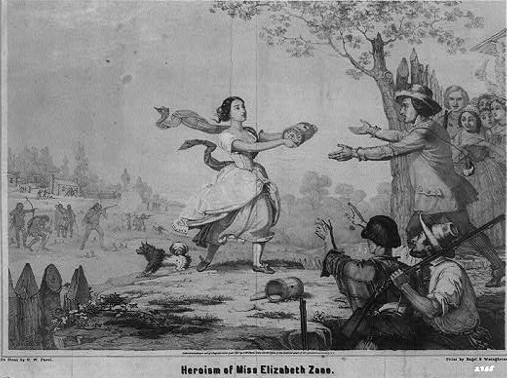
Betty Zane’s Run for Gunpowder during Second Battle of Fort Henry–1782
(image courtesy of Library of Congress)

Wheeling was founded in 1769 by Colonel Ebenezer Zane and his brothers Jonathan and Silas. Five years later in 1774 Fort Henry (originally called Fort Fincastle) was built overlooking the Ohio River to protect the growing numbers of settlers from attack. The fort was twice attacked during the Revolutionary War, first in 1777 and again on September 11 – 13, 1782, when a force of British loyalists (Butler’s Rangers) and Native Americans (under the command of outlaw Simon Girty) attacked the fort’s 47 defenders. The fort was besieged over two days, culminating in Betty Zane’s heroic run for gunpowder in a nearby cabin. The British and natives broke off the battle with the arrival of Virginia militia reinforcements. Fort Henry is acknowledged as one of the final battles of the Revolutionary War.

Continue reading “ERW Weekender: Wheeling”

George Washington’s Birthday Celebration

During George Washington’s lifetime and maybe because he was such a great man, he had two birthdays beginning in the 1750’s. Born under the Julian calendar, George was born on February 11, 1731/32. When the English Parliament decreed in 1750 that two years hence England would switch calendars and adopt the Gregorian, used by the majority of countries/states in Europe, there was a discrepancy. So, 11-days was added (some believe that the old calendar was off by a year and a eleven days thus the slash in “1731/32” above).

Regardless, Washington’s birthday was moved to what we, in the United States, are taught now, that it fell on February 22, 1732. Just don’t tell his mother, who believed to her dying day that he was born on the aforementioned date. And who argues with mothers?

What we cannot argue with is that certain birthdays were celebrated at Gadsby’s Tavern, in Alexandria (a city a young George surveyed and helped lay out), Virginia. On October 6, 1796, John Gadsby leased the City Hotel from John Wise and quickly became the epicenter of social and political discourse in Alexandria.

Today the Gadsby Tavern and Museum is open to the public and run by Historic Alexandria a department within the City of Alexandria. For more information and to plan your visit, a bite to eat, or celebrate a birth night ball like George click here.

The balcony where musicians would sit and play at Gadsby’s Tavern (author’s collection)
The hall at Gadsby’s Tavern, which can still be rented out today for celebrations and ceremonies. (author’s collection)

62nd Foot at Freeman’s Farm

Emerging Revolutionary War welcomes guest historian Kevin Pawlak. A short bio follows the post below.

On May 25, 1775, the 62nd Regiment of Foot stood for review. The line of men, clad in their redcoats with buff facings, did not impress the reviewing officer. He called the regiment “very much drafted” and “very indifferent.” Despite the disparaging grade, in just over two years, the 62nd Foot commendably fought in one of the fiercest actions of the War for Independence.

John Anstruther
courtesy of 62ndregiment.org

Scottish military man Lt. Col. John Anstruther led the 62nd Foot in the campaign of 1777. Anstruther faced no easy task; the 62nd was the junior British regiment in John Burgoyne’s army and most of its men were inexperienced in campaigning and battle. To make the situation even worse, roughly one-quarter of the 62nd Foot’s soldiers were German. Language barriers likely prevented complete cohesion within the unit. However, with a war on, nothing could be done to rectify the regiment’s defects as it marched south into New York.

Anstruther’s regiment was present for the operations around Fort Ticonderoga in early July 1777. After American forces abandoned the fort, the conglomerate and inexperienced 62nd remained behind to man Mount Independence overlooking Lake Champlain. As the rest of Burgoyne’s army continued campaigning, the men of the 62nd Foot spent time guarding themselves against rattlesnakes rather than the enemy. Their time came to rejoin the main army before the Battle of Saratoga commenced.

Continue reading “62nd Foot at Freeman’s Farm”

Following Washington

Emerging Revolutionary War welcomes guest historian Terry Rensel.

I despise driving the Pennsylvania Turnpike, so for my drive from Fredericksburg, Virginia to Erie, Pennsylvania to visit family for Thanksgiving I decide to go cross-country to Cumberland, Maryland and then play it by ear from there. As I realized that I was going to be close to Fort Necessity, I decided to make that a stop since I’ve never been there, then see what the day held.

Although a child of NW Pennsylvania, and getting plenty of young George Washington in school, Fort Necessity was a place that I have never been before. It appealed to both my interest in, and desire to visit as many, National Park Service sites as possible. I also have an interest in travelling historic roads, so the fact that US 40, the National Road, was included made it a bit of a two-for for me.

I knew that Fort Necessity itself was a small fortification, I had no idea just how small until I saw it with my own eyes. I can’t believe that this unassuming stockade was the place was a place where the opening acts of the French and Indian War occurred.

Fort Necessity from treeline

The National Park Service has signage, and recently planted trees, where the historic 1754 tree line was. There wasn’t much room for maneuver. The Visitor Center isn’t a very large building, but their exhibits were fantastic. Along with battle related items, there is also a series of items and interpretation for the National Road.

Continue reading “Following Washington”