Spring has not get touched the tree-covered hills to the east of Elmira, New York, but the Chemung River sparkles in quiet anticipation as it flows between them. The Newtown Battlefield State Park won’t open for another few days or so—it operates seasonally May through October—but I have stopped nonetheless to see what might be here.
“I am very apprehensive our Expedition will not appear in History,” wrote Lt. Obadiah Gore, Jr., of the Continental Army.
And indeed Gore’s worries seem to have played out just that way. I know almost nothing about this Revolutionary War battle, although I have driven by the battlefield for decades. In fact, for two full years not so long ago, as I was doing my Ph.D. at Binghamton University, I drove through the battlefield four times a week on my way from and to Saint Bonaventure University, where I work. I really need to stop sometime, I kept telling myself.
For years, the old State Route 17 passed through the battlefield with little more than a sign telling motorists they were passing through and an arrow pointing up a road that could have been someone’s driveway. The expansion of Route 17 into Interstate 86 now gives motorists the chance to whisk right on by even faster, giving even less notice, despite signs that still say I am passing through.
On this date, 241 years ago, the first salvo of what would become the American Revolutionary War, was fired on Lexington Green and North Bridge in Concord.
Historian John Galvin once wrote about the Battles of Lexington and Concord that they were the “least known of all American battles.” I never really understood what Galvin meant, as I had read extensively about April 19, 1775 and thought I understood the details of that day in history.
Yet, until this past weekend, when I spent the better part of four days touring the sites and walking the trails, talking to the historians around the towns, I did not realize how much more there is to what actually happened on that April day.
For starters, did you realize that Paul Revere did not go town-to-town calling out, “The British are Coming” to homesteads and roadside taverns? Instead, he was the catalyst that started a chain reaction of messengers and runners to different towns throughout the countryside that cast the alarm in a wide net.
He also would have told farmsteads and meetinghouses along the way that the “Regulars are Coming,” since the colonists still thought of themselves as British.
Or that the unofficial birth of the United States Army is attributed to the militia that followed Colonel James Barrett and Colonel John Buttrick down the hill toward the British at the North Bridge?
The field where the militia under Colonel James Barrett and Colonel John Buttrick began their advance from toward the North Bridge. The militia would be coming toward us to descend toward the span.
That was the first time that men, formed in regiments with officers, made an advance against what they perceived as an enemy force, and did so in a “very military manner.”
What prompted the various militia companies, which came from other towns than just Concord, to sally forth from the hill toward the now infamous North Bridge? The main reason was what was happening in Concord was the mistaken reason behind the smoke emanating from the town?
In the town, the British were burning military supplies and the wooden gun carriages found in the hamlet. Sparks landed one of the nearby dwellings and British soldiers actually put down their muskets to form a bucket brigade, with civilians, to help put out the flames. The smoke that billowed from the doused fires is what prompted the militia and minutemen response.
With water being dumped on the flames, smoke billowed up, which prompted milita Adjutant Joseph Hosmer to ask the officers; “Will you let them burn the town down?” That prompted the forward movement of the militia down the hill and against the British.
Or did you realize that some of the militia, from the nearby town of Acton, suffered some of the first casualties at North Bridge, including their militia captain, Isaac Davis, who was one of the first killed in the engagement?
View of the Old Manse, built in 1770 for Reverend William Emerson. View from the Concord River/North Bridge direction.
Somewhere in the midst of the action in Concord was Reverend William Emerson, the grandfather of Ralph Waldo Emerson who would later write that the action on April 19, would be known as the “shot heard round the world” years later.
These are just a few of the interesting tidbits that I picked up this past weekend. Altogether, they reinforce the historic events that I knew unfolded on this day in American History. However, along with reflecting on what transpired in my visit to Massachusetts, these new tidbits of valuable information underscore the important stories and accounts that shape this spring day that are beckoning to be told.
There is so much to be gained by walking the grounds, talking to the historians and historical enthusiasts of the area, and just taking time to appreciate what this day, April 19th, meant to the future of the United States and the era it was leaving behind as part of the British Empire.
For the last nineteen years, the Civil War Trust has done their own sort of “spring cleaning.” On the first weekend of April, the Trust has promoted clean-up at various battlefields and historic sites across the nation. Officially called “Park Day” this year’s date is April 2nd.
This year, the Civil War Trust is expanding their park clean up day to include American Revolution and War of 1812 battlefields, as part of their “Campaign 1776” initiative. Hallowed ground such as Guilford Court House and River Raisin Battlefield are just two of the battlefields on the list.
Volunteer activities include everything from picking up trash to building trails to painting. All ages are welcome and even groups, such as Boys Scout packs, Lions Club members, and like-minded groups are encouraged to seek out the opportunities close to their home.
In return for volunteering, a free t-shirt commemorating your work in Park Day along with the chance to hear local historians describe the history that unfolded on that sacred ground.
For more information on participating in this “annual hands-on preservation event” and to find a historic site and/or battlefield near you, click the link below.
The night was chilly, snow laid on the streets and walks of Boston, and the cold air kept people bundled up around the port town of Massachusetts colony.
Yet, the cold air could not dampen was the seething resentment a growing number of Bostonians were feeling toward the occupying British military. Minor brawls and exchanges had taken place in the various taverns and around the bustling harbor; common places where alcohol and/or hard work created short tempers.
However, on this night, March 5, 1770, outside the Custom House on King Street a British redcoat infantrymen, the sentry, kept his post. Private Hugh White, whose shift it was to stand guard, would have noticed the approach of Edward Garrick, who had come calling for a British officer who owed Garrick’s boss money for his wig services. Unbeknownst to Garrick, the apprentice, the debt had been paid, so no response from the field officer was forthcoming.
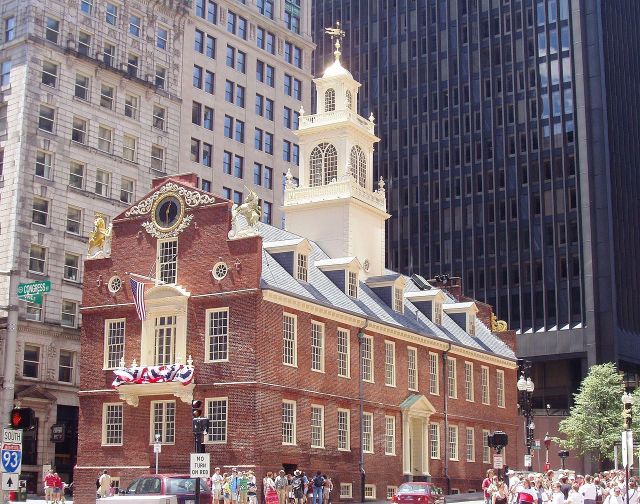
Old State House (Custom House) scene of the Boston Massacre on March 5, 1770
A response from White was forthcoming, who admonished the young man to have a more respectful tone when speaking to an officer in His Majesty, the King’s service. Garrick did not take too kindly to this tone and responded with an insult of his own toward White.
This prompted White to leave his post and literally knock some sense into Garrick by way of a musket strike to the side of the head. Garrick yelped in agony and a companion took up the verbal barrage toward the British soldier.
The cacophony created by the yelling of insults and as the colonial version of a game of telephone spread the message about what was transpiring at the Customs House. Church bells were rung, a telltale sign that something was afoot, led to the crowd surging past 50 in number by the evening.
White, prudently, had left his post and retreated up onto the steps of the Customs House summoned a runner (messenger) to race to the local barracks for extra manpower.As was custom, there was an officer of the watch, in this case, Captain Thomas Preston and seven soldiers responded.
En route, Henry Know, destined to become chief of artillery for the Continental Army in the American Revolution urged Preston, “For God’s sake, take care of your men, if they fire, you must die.”
Against this sage advice, shouts of “Fire” were emanating from the crowd, which had also resorted to throwing snowballs and spitting in the direction of the red-coated soldiers. Other derogatory names for British soldiers, like “lobsterbacks” which took into account the red uniforms adorned by the British infantry were also heard being shouted.
The British soldiers, with loaded muskets, and Captain Preston reached White’s station, the British officer ordered the large crowd to disperse. Preston had taken a position in front of his soldiers and had told a member of the crowd that his soldiers would not fire unless ordered.
No order was ever given.
Shortly after Preston spoke those words to a Bostonian, a foreign object hurtled toward Private Hugh Montgomery and knocked the infantryman off his feet. His musket clattered onto the steps. Standing up, Montgomery reportedly yelled “Damn you, fire!” and pulled the trigger of his musket. The accompanying “bang” reverberated in the square.
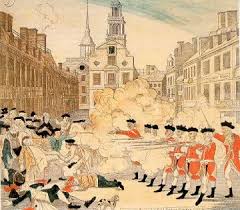
Copy of the lithograph by Paul Revere on the Boston Massacre
And then there was a pause of an uncertain length.
This silence was broken by the staccato of other muskets being fired. A few rounds belched forth from the British soldiers. Screams and shouts along with deafening echo of the discharge of black-powder muskets in an enclosed city square mixed with the sickening thud of lead impacting bone and body.
All told, eleven colonists were hit from the volley fire. Three were killed outright; Samuel Gray, James Caldwell, and Crispus Attucks. One more, Samuel Maverick, who was struck by a ricocheting round would die later that same evening. One more, a recent immigrant from Ireland, Patrick Carr, would succumb to his wounds a fortnight later.
In the immediate aftermath, Preston would call the majority of his unit, the 29th Regiment of Foot to the scene. With the mob spilling out of the Customs House Square, Governor Thomas Hutchinson, the acting governor, was able to temporarily restore a semblance of tranquility with the promise that a fair trial of what transpired that March 5th evening would happen.
The trial would be a major event for the city of Boston, but, that was in the near future. With the shots fired and the citizens struck, the burgeoning independence movement had a rallying point. Lives were lost that night, but, the events that followed would, to the proponents of American independence, make them martyrs for the cause.
Russellborough doesn’t look like much now, but once upon a time, these ruins were one of the nicest homes along the North Carolina coast. Now, its spaciousness comes from the cavernous pavilion that protects the houses’ remains.
By the outline of stone and brick on the excavated ground, though, the house must have once been quite impressive. The stump of a stone fireplaces rise from the edge of the far foundation. A round brick cylinder marks the location of an indoor well. The house apparently had a secret passage that allowed residents to escape trouble, too. Continue reading “The Ruins of Russellborough”→
Emerging Revolutionary War welcomes guest historian Robert “Bert” Dunkerly to the blog as the author of this post.
It is well known that German troops (commonly called Hessians) fought alongside the British during the war. One of the more intriguing questions of the Revolution remains; how did they communicate? At any given time, German units could comprise from one third to one half of the larger British armies. They were also present in equal numbers in smaller detachments.
French was a common language that many European officers would have known, and there is evidence that German and English officers communicated in French during campaigns. The language barrier also impacted daily army operations. For example, Georg Pausch of the Hesse-Hanau Artillery requested an English officer who spoke German for a court martial. Yet most of that procedure was conducted in French.
Written orders from General Phillips in Montreal in 1777 to Hessian Artillery units were given in French, suggesting that this was commonly done in these calm, routine situations.
It wasn’t a perfect system but it worked well enough. Adjutant General Major Bauermister of Hesse-Cassel, for example, notes that the English spoke poor French, when communicating with them. Yet what about among small units like companies or battalions?
Re-enactors portraying the Hesse Kassel Jaeger KorpsWould mediocre command of a language suffice for communication in combat situations? Often small groups of British and German troops operated together on patrols or raids. Marching to Freeman’s Farm (Saratoga) in 1777 was a column that included Germans on the left, English on the right, and English troops as flankers. Such situations required close coordination.
Other times they were side by side on battlefields, such as at the Battle of Guilford Courthouse in 1781, where the German Von Bose Regiment was aligned next to the British 71st Highland Regiment. Close coordination in these cases was essential.
Still another example is from Brandywine, where Captain Johann Ewald wrote that in the army’s advance, were 60 jaegers on foot, fifteen mounted jaegers, a company of Highlanders, and a company of British light infantry. All these troops worked in tandem to protect the army from ambush and clear the way for the advance. Yet Ewald was silent on how they did so.
Captain Ewald, also wrote of his experiences in Virginia, where, in the advance on Richmond, small numbers of troops were interspersed. They marched into the town in this order: Jaegers, British dragoons, more jaegers, and British Light Infantry. There are dozens of other examples.
Despite the many instances of German and British units mingling, there is precious little documentary evidence of how officers, or the common soldiers, communicated. Perhaps they used a combination of French, translators who spoke either English or German, and hand signals or other agreed- upon methods.
Timing and clarity are key in close quarters combat, there is no chance to second guess in an ambush or a raid. There were likely instances of misunderstanding that may have led to mistakes and even led to friendly fire incidents.
Of the many accounts this author has researched, only a few mention how they communicated. Perhaps it was something so mundane, or so well understood, that they saw no need to comment on it in their writings. It is hoped that further research will shed light on this question.
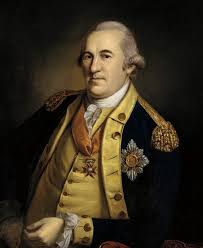
On February 23, 1778, Baron Friedrich Wilhelm von Steuben arrived at the Continental Army encampment at Valley Forge. He quickly ingratiated himself with George Washington and the commanding general’s cadre of staff officers. John Laurens would write a fortnight later;
Baron von Steuben
“The Baron Steuben has had the fortune to please uncommonly….All the genl officers who have seen him, are prepossessed in his favor, and conceive highly of his abilities… The General [Washington] seems to have a very good opinion of him, and thinks he might be usefully employed in the office of inspector general…”
Steuben would assume the “acting” inspector general position three days after John Laurens penned the above letter, on March 12, 1778. Five days later, Steuben’s plan to train the Continental Army was approved by Washington. The transformation could begin.
Who was this “acting” soon-to-be permanent inspector general of the Continental Army? Steuben was born on September 17, 1730 in the Duchy of Magdeburg, in what is now eastern Germany. He journeyed with his father at age 14 on his first military campaign and joined the military at the young age of 17.
The last thirteen years before coming to America he had served in an administrative capacity for the Furst Josef Friedrich Wilhelm of Hohenzollern-Hechingen and was made a baron in 1771.
The baron arrived on American soil on December 1, 1777 and two months later arrived in York, Pennsylvania where he met with the Continental Congress on February 5, 1778. He found his way quickly to Washington’s encampment at Valley Forge.
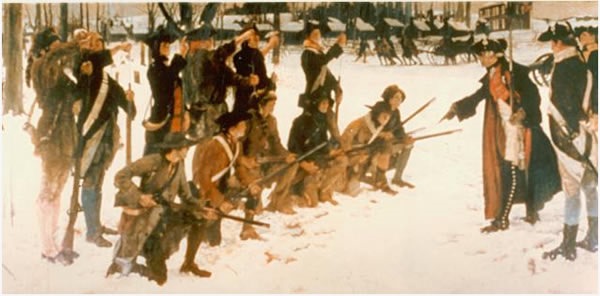
On March 19, 1778, the first squad of men from the Continental Army undertook their first lesson with the baron. After learning the English words needed, von Steuben tasked each soldier of the 100 man squad to mirror him. The selected squad would follow the different maneuvers while listening to the baron “singing out the cadence.” While the squad went through their drills, another selected squad of onlookers studied the movements and then carried the drills to others.
Edwin Austin Abbey painting of von Steuben and the drilling of American soldiers at Valley Forge
The baron’s unique training regimens showed almost instant results, as von Steuben attested within a fortnight of the start of training. The soldiers “were perfect in their manual exercise; had acquired a military air; and knew how to march, to form column, to deploy, and to execute some little maneuvers with admirable precision.”
By the end of March, with Washington’s blessing, the entire army went under the drill regimen as instructed by von Steuben. The Prussian “acting” inspector general put his mark on all aspects of camp life as evidenced by the routine the soldiers adhered to while becoming acquainted with the manual of arms. “At nine a.m….new commands explained to each regiment at parade, then practice. By late afternoon, regiments were practicing by brigades.”
When a soldier fumbled a maneuver or the squad was not crisply moving through the drills, the baron’s temper would get the best of him and he would unleash a slew of epithets that was a unique blend of French and German with a few words of English sprinkled in for good measure.
The silver lining in these outbursts occurred when the baron would politely and calmy ask one of his assistant to translate into English the curse word of the moment. A light-hearted moment came when von Stueben asked his translator one time to, “come and swear for me in English, these fellows won’t do what I bid them.”
However, von Steuben won the trust of his trainees, as he instilled a sense of pride, of soldierly bearing, and when he did have his outbursts, those moments just underscored his similarities to the men he was training. As one biographer accurately summed up these occasions, the outbursts “humanized him” in the eyes of the rank-and-file.
There was one little secret that only the baron and his small staff were privy too; von Steuben was making up the drill and routine practices employed each day as he went along!
After the drilling of that day was completed and the baron snatched a quick bite to eat, von Steuben was off to his quarters where he scribbled out the lessons to be taught the following day.
Along with drill, camp life even improved, as von Steuben mandated changes that improved camp sanitation, which in turn, reduced sickness among the rank and file. By the end of the encampment, von Steuben controlled, according to historian Herman O. Benninghoff II, “the Valley Forge soldier’s introduction to command and control.”
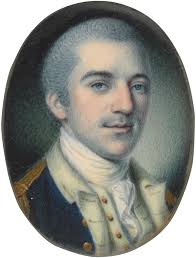
On April 1, 1778, John Laurens wrote to his father and president of the Continental Congress, Henry Laurens about the major impact of von Steuben.
John Laurens, aide to George Washington during the Valley Forge encampment
“Baron Steuben is making sensible progress with our soldiers. The officers seem to have a high opinion of him…It would enchant you to see the enlivened scene [of camp at Valley Forge]…If Mr. [Sir William] Howe opens the campaign with his usual deliberation, we shall be infinitely better prepared to meet him than we have ever.”
By May 1778 a Board of War member, a committee formed by the Continental Congress the previous year, wrote to a fellow board member the following lines, “America will be under lasting Obligations to the Baron Steuben as the Father of it. He is much respected by the Officers and beloved by the Soldiers themselves…I am astonished at the Progress he has made with the Troops.”
A fitting compliment came from the pen of George Washington who wrote to von Steuben near the end of the encampment at Valley Forge that “the army has derived every advantage from the institution under you, that could be expected in so short a time.”
Before von Steuben could finish the drilling of the soldiery that winter, the British stirred from their perch in Philadelphia and the lessons on the snowy plains of Valley Forge would be put to the test.
A fisherman by trade before the war, the savior of the American Continental Army during the war on two occasions, and returned to civilian life with personal, physical, and economic hardships because of the war.
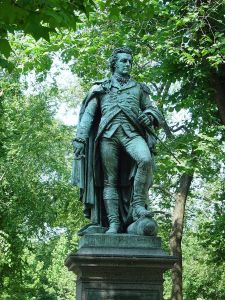
John Glover
That one line could simply sum up John Glover of Marblehead, Massachusetts. Unfortunately, Glover has received scant attention; a few lines here, a page in this publication, or a reference in passing when talking about the engagements around New York or the Crossing of the Delaware.
Daniel Glover is more than well deserving of the epithet, “one of the greatest leaders of the American Revolution you have never heard of.”
Born on November 5, 1732 in what is now Danvers, Massachusetts, where he lived until the death of his father when he was just four years old. His mother Tabitha Bacon Glover moved young Daniel to Marblehead, on the coast of Massachusetts where he would apprentice, when he came of age, as a shoemaker. He eventually looked toward the sea and made a living as a merchant.
Daniel became well-entrenched in Marblehead society, he joined the local militia in 1759 and entered politics, aligning himself with the Whig party in 1760. By the time of the first shots on the Green of Lexington and the North Bridge at Concord, Glover was a colonel of militia in the Marblehead Regiment.
Although his regiment made the march to Boston and took part in the siege, Glover was away on detached duty when the Battle of Bunker (Breed’s Hill) was fought. When George Washington rode into Cambridge, Massachusetts and assumed command of the American forces, Glover lost his headquarters. A product of Glover’s fine taste, the Marblehead sailor had picked the home of a loyalist as his own command post. Washington chose the mansion, which now is a national historic site, as his own. Yet, a company of Glover’s Marblehead soldiers was also chosen to be the guard of Washington’s new headquarters.
Showing his importance and marshaling his background in shipping, Glover donated one of his own ships, the Hannah, named after his spouse, to build a hodgepodge navy for use by the Americans. One of the ships that made this volunteer navy actually captured a British ship, the brig HMS Nancy in which held as its cargo, 2,000 muskets, 30,000 rounds of artillery ammunition, and one brass mortar amongst other crucial military supplies much in need by Washington’s army.
After the siege of Boston was lifted with the evacuation of the British, Glover, with the rest of the Continental Army, headed south to New York City where another campaign and another chance to show his worth to the cause awaited.
On the night of August 29 and into the early morning hours of August 30, Colonel Glover and his able Marblehead regiment sailed the majority of Washington’s forces from Brooklyn across the East River to safety. Altogether, approximately 9,000 soldiers, plus artillery and supplies escaped from under British General Sir William Howe’s command. With Marylanders under Lord William Stirling launching ferocious rear-guard suicidal charges, Glover’s men saved Washington’s army that late August night.
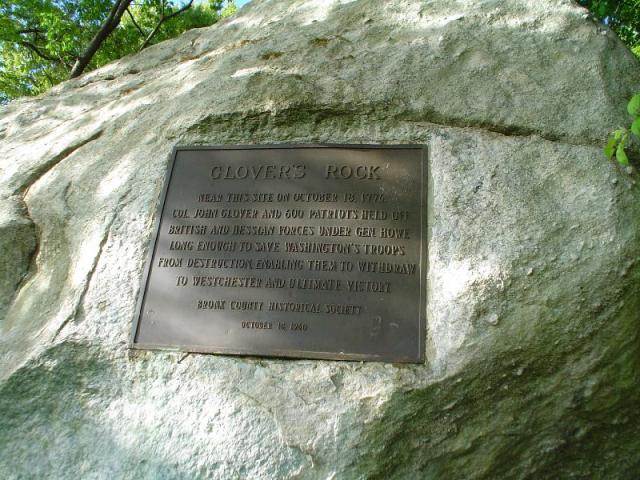
A month and a half later, on October 18th, Glover’s Brigade of Massachusetts soldiers held off a large contingent of British and Hessian mercenaries as Washington’s army retreated to safety. With approximately 750 men at his disposal, Glover’s rearguard action held over 4,000 enemy soldiers from threatening the retreat of the American forces.
Glover’s Rock, commemorating the action at Pell’s Point
Showing his humility, Glover would write about seeing the enemy come ashore before the engagement at Pell’s Point, that his first inkling was to give “a thousand worlds to have General [Charles] Lee or some other experienced officer present.” Luckily for the Americans, Glover did not get his wish and led admirably.
Glover’s command stuck with Washington’s forces during their retreat across New Jersey and into Pennsylvania and eventually to the banks of the Delaware River. In the prelude to the pivotal “Crossing of the Delaware” the former Marblehead sailors and their 43-year old commander would prove crucial.
To complete the surprise, Washington had to get his men across the ice-clogged Delaware River and to Trenton, New Jersey. Washington laid his eyes on Glover and outlined his thoughts and the big issue at hand; how to ferry his men across?
The response to his commander in chief was simple; to “not be troubled about that, as his boys could manage it.” Another primary account said that Glover and his command showed “perseverance…accomplished what at first seemed impossible.”
With Washington’s daring plan and Glover’s practicality, the “impossible” happened and the Americans scored a cause rallying victory at Trenton on December 26, 1776 and another equally important victory at Princeton, New Jersey on January 3, 1777.
After these winter battles, Glover went home to care for his gravely ill wife, Hannah, but there was nothing he could do. After a year long struggle, Hannah died on November 13, 1778 leaving John with eight children, including the oldest John who was a captain in his father’s Marblehead regiment.
While at home, George Washington petitioned the Continental Congress to promote Glover to brigadier general. Congress agreed and on February 21, 1777 the former Marblehead merchant became a general in the Continental Army.
When Glover returned to active duty, he was given the task of escorting the British and Hessian prisoners captured at the Battle of Saratoga and also took part in the unsuccessful attempt to expel the British from Newport, Rhode Island in 1778.
The end of the war saw him still in service in the Hudson Highlands where most notably he was on the board of officers that sentenced British spy Major John Andre to death. At the very end of the war, on September 30, 1783, Glover received a brevet to major general.
John Glover Statue Commonwealth Avenue, Boston
With the war over, Glover and his second wife, Francis Fosdick resided in Marblehead. However, Glover’s health and family were devastated by the war. Glover’s health was impaired by years of hard campaigning, including struggling with malaria in 1777. He lost his first wife Hannah during the war and his oldest son, John, disappeared as a prisoner-of-war while being transported over the Atlantic Ocean. Even his pre-war career, as a merchant, was greatly impacted by the seven-year conflict.
Glover rebounded as best he could and did serve in a few political positions, including in the Massachusetts State Legislature and as a Selectman for Marblehead. One highlight of the post-war years was when President George Washington stopped over in Marblehead and was entertained by his former subordinate.
On January 30, 1797, Glover passed away from hepatitis at the age of 64 and became one of the greatest leaders of the American Revolution you have never heard of.
In the lowest depths of one of the coldest winters in the American Revolution, the Continental Army uncovered the dedication that the core of the military movement had.
Suffering was beyond comparison.
The cause was supply, the crux of many an army before and after the Revolutionary War. The issue started from the top, the quartermaster general position.
“The lack of a competent, effective quartermaster general for the period from October 10, 1777 to May 2, 1778 threatened the Continental Army’s existence more than the enemy” wrote author and historian Herman O. Benninghoff, II.
His bold proclamation is chillingly on-point.
That time frame coincided with the approximately same length of time George Washington’s forces were at Valley Forge.
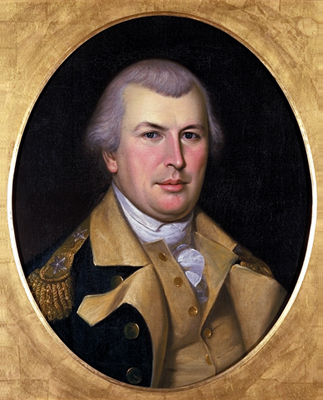
Nathanael Greene would become Quartermaster General in March 1778 during the encampment at Valley Forge
On January 5, 1778, Nathanael Greene, who would soon be tapped as quartermaster general of the Continental Army, wrote to fellow officer General Alexander McDougall;
“The troops are worn out with fatigue, badly fed, and almost naked. There are and have been thousands of the Army without shoes for months past. It is difficult to get sufficient supplies to cloath the Army at large.”
Moving directly to Valley Forge from active campaigning, the soldiers arrived with their supplies in a deplorable condition. Shoes had been torn to shreds with the long marches and many of the men had nothing but rags to wrap feet in. Shortly after arriving, the army numbered approximately 12,000 men under arms, yet 4,000 of these men, 1/3rd of Washington’s entire force, was deemed “unfit for duty” because a lack of supplies.
Another 1,100 would desert because of the horrid conditions of the winter encampment; no food, no pay, and barely clothes to keep warm.
Another 2,000 died of disease, including typhus, pneumonia, and other “camp fevers” which categorized a whole assortment of various ailments. Medicine was almost non-existent and lack of proper sanitation played a major role as well.
A delegate to the Confederation Congress was informed by an informant in Valley Forge that “a great portion of the soldiers are in a very suffering condition for want of necessary clothing, and totally unfit for duty.”
The suffering of the soldiers for a want of simple, basic clothing, becomes even more painful with the following realization by John Marshall, serving as an officer at Valley Forge, and the same Marshall who would become the Supreme Court Justice.
“In a desert which supplies not the means of subsistence, or in a garrison where food is unattainable, courage, patriotism, and habits of discipline, enable the soldier…..but to perish in a country abounding with provisions, requires something more than fortitude.”
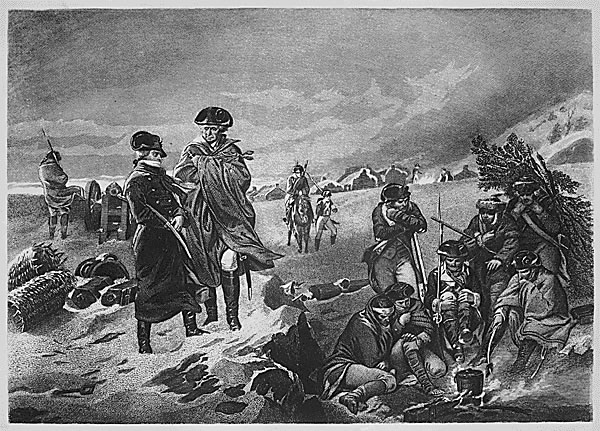
One artist’s depiction of what the encampment at Valley Forge looked like
That is what is most astonishing, that there were surpluses to be attained, but Continental currency had depreciated to the point that by late 1777 and early 1778 it was at an exchange rate of four Continental dollars to one dollar of hard specie. By 1779 that ratio would be 30 to 1.
To further complicate matters, the Continental Army did not even have the wagons to gather the materials. In mid-February, a report from camp to Henry Laurens, president of the Confederate Congress, deplored of the “want of Waggons & the like.”
Out of the depths of this despair, where cries of “No Meat, No Meat” rent the air as soldiers voice their frustration, came a self-proclaimed baron.
This man would leave a lasting impression on the make-up of the army, second only to George Washington.
His assessment of the army upon his arrival amazed him, the “fortitude of the common soldiers and that no army in Europe would hold together and endure under such deprivations of food and clothing and shelter.”
That prognosis shows the depth of commitment that boiled in the hearts of the dedicated survivors of the cold, hunger, and privations of Valley Forge.
The army was ready to be molded and with his arrival, Baron Friedrich Wilhelm von Steuben would turn out to be the right guy at the right juncture in time. The Continental Army, held together by George Washington, would be transformed by this new inspector general.
Valley Forge would be the elixir of change for the army and the revolution.
Part One, of a series on the importance of Valley Forge in the American Revolution
On December 19, 1777, the Continental Army, under the command of General George Washington, marched into Valley Forge, Pennsylvania. Located approximately 20 miles from Philadelphia, which had fallen to the British that autumn, Washington’s army would spend the next five-plus months in this soon-to-be iconic place in the quest for American independence.
Yet, the accounts of how desperate the condition of the American forces were emanates throughout the centuries and strikes awe and amazement at the level of perseverance that the soldiers committed to. The winter of Valley Forge was just one of many cold, bleak, and destitute winters that the Continental Army faced during the seven-year conflict.
Artist depiction of the encampment at Valley Forge. George Washington and the Marquis de Lafayette are the two horsemen depicted prominently
However, that does not take away from the conditions of that winter. Especially when written from the ink and quill or pencil of the common soldier. Especially with what that winter cantonment did in the transformation of that Continental Army.
One of the best remembrances of that cold winter comes from Joseph Plumb Martin, whose Memoir of a Revolutionary Soldier, is still in print today.
Upon arrival at Valley Forge, Martin would write:
“We were now in a truly forlorn condition,–no clothing, no provisions, and as disheartened as need be. We arrived, however, at our destination a few days before christmas. Our prospect was indeed dreary.”
Just a short time after his arrival, Martin continued the plight of himself (and most likely many a soldier in that encampment) when he wrote;
“I lay here two nights and one day, and had not a morsel of any thing to eat all the time, save half a pumpkin, which I cooked by placing it upon a rock, the skin side uppermost, and making a fire upon it; by the time it was heat through I devoured it with as keen an appetite as I should a pie made of it at some other time.”
Martin’s account is supported by General James Varnum, who reported on December 20, 1777, “that his division had eaten no meat during 48 hours and had been three days without bread.”
Suffering at Valley Forge
Yet, during that winter, the experience of Valley Forge, according to another veteran of that harsh winter, “added iron to their souls.”
More than “iron souls” would be needed to defeat the British in the American Revolution. Winter, 1777, would see to that as well.


 Spring has not get touched the tree-covered hills to the east of Elmira, New York, but the Chemung River sparkles in quiet anticipation as it flows between them. The Newtown Battlefield State Park won’t open for another few days or so—it operates seasonally May through October—but I have stopped nonetheless to see what might be here.

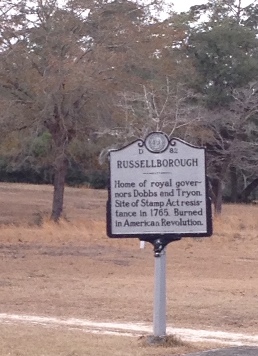 Russellborough doesn’t look like much now, but once upon a time, these ruins were one of the nicest homes along the North Carolina coast. Now, its spaciousness comes from the cavernous pavilion that protects the houses’ remains.
![030_30[1]](https://emergingrevolutionarywar.org/wp-content/uploads/2016/02/030_301.jpg?w=640)



 Emerging Revolutionary War Era