James Monroe at the Battle of Trenton

Washington Crossing the Delaware, by Emanuel Gottlieb Leutze The Metropolitan Museum of Art, http://www.metmuseum.org
Washington Crossing the Delaware, by Emanuel Gottlieb Leutze
The Metropolitan Museum of Art, http://www.metmuseum.org

One of the iconic images of the Revolutionary War is Emanuel Gottlieb Leutze’s 1851 painting, Washington Crossing the Delaware.  It is the night of December 25, 1776.  The Continental Army is being transported across the Delaware River to attack a Hessian garrison at Trenton, New Jersey, some nine miles to the south.  In the foreground, anonymous men (and possibly one woman) of varying nationalities and races row an overloaded boat across the river, pushing great slabs of ice out of the way.  Two of the boat’s occupants are not anonymous: General George Washington, standing resolutely near the bow, and young Lieutenant James Monroe, holding the stars and stripes.

Leutze’s painting is glorious–and wrong in almost every detail.  The river resembles the Rhine more than the Delaware; the boat is too small and of inaccurate design; there is too much light for what was a night crossing; Washington did not cross standing up; the stars and stripes had not yet been adopted by the Continental Congress; and James Monroe was not holding the flag, not in the boat, and not even present with the army.

He was already across the river, and he was busy.

Washington’s plan for a surprise attack on Trenton was a risky attempt to reverse the sagging fortunes of the Patriot cause. During the summer of 1776 British forces, including Hessian mercenaries, had driven the Continental Army from New York across New Jersey and into Buck’s County, Pennsylvania.  Expired enlistments and outright desertion had thinned the American ranks, and many of those who remained were despondent.  Washington gambled that a successful attack against an isolated British outpost would boost the army’s morale and stiffen the resolve of Congress and the people.

Three Hessian regiments, comprising about 1,400 men, were stationed at Trenton under the command of Colonel Johann Rall (also spelled Rahl).  Washington planned to bring 2,400 Continental soldiers across the river overnight at McKonkey’s Ferry, march to Trenton, and attack before dawn.  Two other elements of the army were part of the plan.  A 1,900-man force under Colonel John Cadwalader would make a diversionary attack against British troops at Bordentown, New Jersey.  General James Ewing would lead 700 men across the Delaware at Trenton Ferry, control the bridge over Assunpink Creek, and intercept any Hessian troops retreating from Trenton.  Bad weather prevented both of these deployments, meaning that everything would depend on the main body’s effort.  The army’s password for the evening was “Victory or Death.”

Washington’s plan included sending a small detachment of troops over the Delaware first to secure the army’s route of march.  James Monroe was with this contingent.  In his autobiography (written in the third person late in life and not completed before his death), Monroe described the mission:

The command of the vanguard, consisting of 50 men, was given to Captain William Washington, of the Third Virginia Regiment . . . Lieutenant Monroe promptly offered his services to act as a subaltern under him, which was promptly accepted.  On the 25th of December, 1776, they passed the Delaware in front of the army, in the dusk of the evening, at [McKonkey’s] ferry, 10 miles above Trenton, and hastened to a point, about one and one-half miles from it, at which the road by which they descended intersected that which led from Trenton to Princeton, for the purpose, in obedience of orders, of cutting off all communication between them and from the country to Trenton.

Monroe noted that the night was “tempestuous,” and that snow was falling.  While manning their post, the detachment was accosted by a local resident who thought the Continentals were British troops.  Describing the incident many years later at a White House dinner during his presidency, Monroe recalled that the man, whose name was John Riker, was “determined in his manner and very profane.”  Upon learning that the soldiers were Americans, he brought food from his house and said to Monroe, “I know something is to be done, and I am going with you.  I am a doctor, and I may help some poor fellow.”  Dr. Riker proved remarkably prescient.

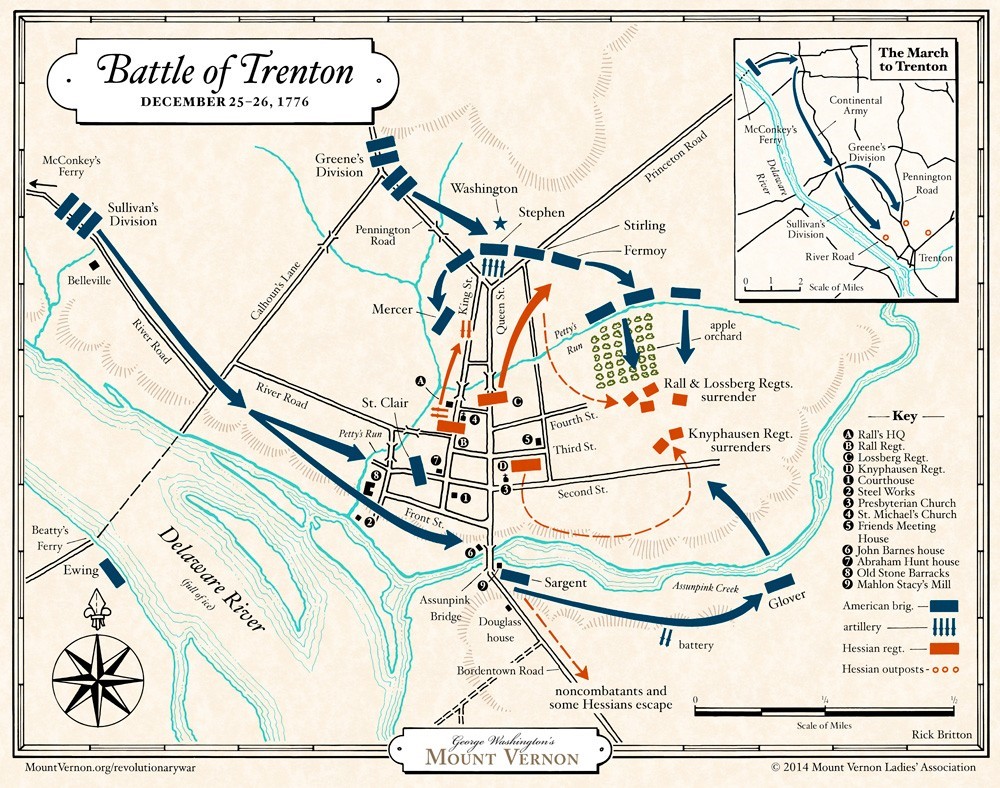
Battle of Trenton map courtesy George Washington’s Mount Vernon

The main army’s river crossing and march to Trenton took longer than planned, meaning that the attack would occur well after sunup.  Outside the town Washington divided his force, sending a division commanded by Major General Nathaniel Greene to attack from the north while the other, led by Major General John Sullivan, attacked from the south.  At 8:00 AM the assault began, and here we return to Monroe’s account from his autobiography:

Captain Washington then moved forward with the vanguard in front, attacked the enemy’s picket, shot down the commanding officer, and drove it before him.  A general alarm then took place among the troops in town.  The drums were beat to arms, and two cannon were placed in the main street to bear on the head of our column as it entered.  Captain Washington rushed forward, attacked, and put the troops around the cannon to flight, and took possession of them. Moving on afterwards, he received a severe wound and was taken from the field. The command then devolved upon Lieutenant Monroe, who attacked in like manner at the head of the corps, and was shot down by a musket ball which passed through his breast and shoulder. He was also carried from the field.

The Capture of the Hessians at Trenton December 26 1776, by John Trumbull (Yale University Art Gallery) (James Monroe lies wounded on the ground at left center)
The Capture of the Hessians at Trenton December 26 1776, by John Trumbull (Yale University Art Gallery)
(James Monroe lies wounded on the ground at left center)

Monroe was brought to the same room where William Washington lay, and their wounds were dressed by the army’s surgeon general and Dr. John Riker.  Riker’s prediction of helping “some poor fellow” came true as he repaired a damaged artery in Monroe’s shoulder. What neither man realized at the time was that the intrepid physician had saved the life of a future president.

George Washington’s gamble in initiating the Battle of Trenton paid off.  The victory was complete, and came at a surprisingly small cost in terms of American casualties.  Two enlisted men froze to death during the nighttime march, and two were wounded in combat.  The only losses among officers were the nonfatal wounds sustained by William Washington and James Monroe.  Washington followed up his success at Trenton with another at Princeton on January 3, 1777, where the Continental Army proved that it could prevail over regular British troops.

The best commentary upon James Monroe’s performance at Trenton, and his Revolutionary War service generally, comes from no less an authority than George Washington.  Writing to an acquaintance in 1779, Washington noted Monroe’s “zeal he discovered by entering the service at an early period, the character he supported in his regiment, and the manner in which he distinguished himself at Trenton, where he received a wound.”  The general concluded that James Monroe had “in every instance maintained the reputation of a brave, active, and sensible officer.”

Scott H. Harris is the Executive Directors of the James Monroe Museum in Fredericksburg, Virginia. Harris became director of the James Monroe Museum and Memorial Library in July 2011, following ten years as director of the New Market Battlefield State Historical Park (administered by Virginia Military Institute).  From 1988 to 2001, Scott was the first curator of the Manassas Museum and later director of historic resources for the City of Manassas, Virginia.  Prior to his work in Manassas, he was a consulting historian with the Association for the Preservation of Virginia Antiquities in Richmond and an historical interpreter with the Colonial Williamsburg Foundation.  He has been a board member of the New Market Area Chamber of Commerce, Prince William County/Manassas Convention and Visitors Bureau, Shenandoah Valley Travel Association, and Virginia Civil War Trails, Inc.  He is a past president of the Virginia Association of Museums and serves as a peer reviewer for the Museum Assessment and Accreditation programs of the American Association of Museums.

Scott received his BA with honors in History and Historic Preservation from the University of Mary Washington in 1983.  In 1988, he received an MA in History and Museum Administration from the College of William and Mary. Scott is also a graduate of the Seminar for Historical Administration, the nation’s oldest advanced museum professional development program.

Emerging Revolutionary War in Civil War Trust’s Hallowed Ground

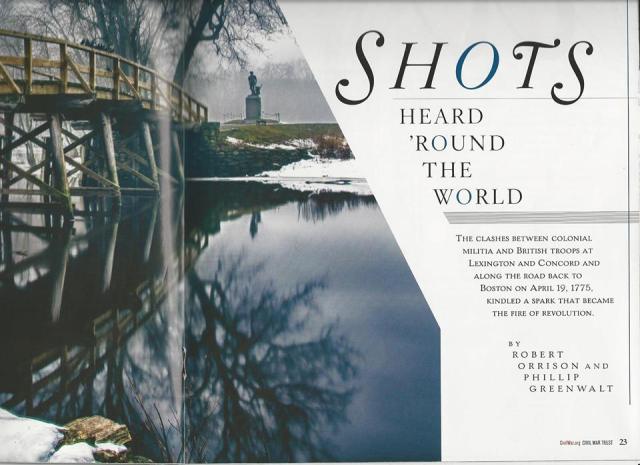
Recently Emerging Revolutionary War Era authors Phillip Greenwalt and Rob Orrison were featured in Hallowed Ground, the Civil War Trust’s quarterly magazine. Their article “Shots Heard Around the World” focuses on the events surrounding Lexington and Concord in 1775. As CWT President Lighthizer writes “the journey towards the stillness at Appomattox began with a shot heard ’round the world at Concord.”

As many of you know, the Civil War Trust has launched a new initiative called “Campaign 1776”, to preserve American battlefields that relate to the American Revolution and the War of 1812. Part of that initiative is funding the archaeology and preservation of land around the area known as “Parker’s Revenge.”  Here, on the afternoon of April 19, 1775, Minutemen met the returning British column on its way from Concord to Boston.  The Minutemen under Capt. John Parker, severely bloodied the British, in a “revenge” from their earlier meeting on the Lexington Green.

Also in the same issue of Hallowed Ground, ERW contributors Drew and Kate Gruber write about the how the American Revolution was on the minds of those who fought in the Civil War. Their article “So Doth History Repeat Itself” covers the “ancestral connection” that both sides had to the patriots of the revolution.

Be sure to check out Hallowed Ground and if you are not already a member of the Civil War Trust, be sure to join today.  Their work in preserving American battlefields is unparalleled.  We thank the staff of Hallowed Ground for including us in their latest issue.  Look for more exciting ventures from Emerging Revolutionary War Era soon!

12345463_949159305165119_407761998932429738_n

“The Old Wagoner”

Part One

The last battle of the Revolutionary War was fought in 1951 in Winchester, Virginia. Daniel Morgan, the “Old Wagoner” or ‘Old Morgan” as he was known to his soldiers, was front and center of the maelstrom once again just as he was on many a battle field from Quebec to South Carolina during the War for Independence.

Daniel Morgan Statute in Winchester, Virginia (courtesy of Winchester Star)
Daniel Morgan Statute in Winchester, Virginia
(courtesy of Winchester Star)

Residents of Cowpens, South Carolina, a small town near Spartanburg named for Morgan’s dramatic and strategically critical victory of 1781, arrived in Winchester, Virginia to claim the earthly remains of their revered hero. Morgan’s grave was overgrown and in decrepit condition. In Winchester, only one out of forty people queried by the Carolinians knew who Morgan was. Armed with shovels, a mortician, and a letter of authorization from Morgan’s great-great granddaughter, the Carolinians showed up at Mount Hebron Cemetery to dig up the general, take him “home” and reinter him at the site of his greatest victory. There he could rest among a populace that revered his name and cherished his significant contributions toward American independence. However, word of the Carolinians’ attempted exhumation of Morgan quickly spread through town and a contingent of devoted local admirers quickly headed to Mt. Hebron to stop the Carolinians initiative. In the end, a court ruled that the “Old Wagoner” would remain interred at Mt. Hebron in Winchester. Not only did he stay, but this episode kindled a reverence for the General’s legacy and place in history among Winchester’s populace.

Seventeen year-old Daniel Morgan moved into the Shenandoah Valley in 1753, with nothing but sheer determination to carve out a life for himself in the rugged frontier of western Virginia. His early years are shrouded in mystery that Morgan himself kept secret from even his closest associates throughout his life. He was born of Welsh parentage in 1836 in Bucks County Pennsylvania or Hunterdon County, New Jersey, the fifth of seven children. It was a hard life of work on the family farmstead with no opportunity for even a rudimentary education. His time was spent chopping wood, hoeing fields and other taxing physical labor. His mother died when he was young, and his father remarried. A dispute with his father prompted the fiery Morgan to head west on the Great Wagon Road to Carlisle, Pennsylvania where he worked briefly during the winter of 1752-53, before continuing south to the Shenandoah.

Although Morgan lacked an education, the work on the family farm had hardened his six-foot, two-hundred pound frame into a powerful and muscular young man who was well suited for the physicality of life on the frontier. The blue-eyed youth initially obtained employment as a farm laborer in eastern Frederick County in what is now Clarke County. He worked hard and soon earned an offer of better employment. In spite of his youth, Morgan eared employment as the overseer of a saw mill where he learned to manage older and more experienced men, developing his leadership ability. Morgan’s energy and work ethic impressed Robert Burwell who offered Morgan a position as a teamster hauling valley produce across the Blue Ridge to Fredericksburg and other towns in the Virginia Piedmont and carrying badly needed supplies back to the frontier that was the Shenandoah Valley of the 1750’s.

Morgan enjoyed the freedom of the open road and in less than two years had earned enough money to buy his own team and Conestoga wagon. During this time, Morgan had become close friends with fellow teamster John “Captain Jack” Ashby, grandfather of the Virginia Civil War cavalryman. Ashby was noted for his “horsemanship, marksmanship and daring exploits.” Ashby taught Morgan to shoot, hunt, ride and live in the wilderness along the Blue Ridge.  The two men were kindred spirits and became good friends.

In 1755, the French and Indian War came to the Shenandoah Valley when British Maj. Gen. Edward Braddock’s column passed through the Winchester area on its way to wrest Fort Duquesne from the French at the “Forks of the Ohio,” now the site of Pittsburgh. Morgan signed on the haul supplies to Fort Cumberland in western Maryland and soon found himself as a teamster with the army, rolling into western Pennsylvania. When the French and Indians routed Braddock at the battle of the Monongahela in July, the teamsters emptied their wagons of supplies and carried wounded soldiers back to Fort Cumberland. At some point in this campaign, Morgan’s actions or words angered a British officer who violently chastised the young teamster and struck him with the flat of his sword. Morgan’s temper exploded, and the young wagoner knocked the officer out with one strong punch. A court martial sentenced Morgan to 500 lashes, a punishment that often killed its recipients. The stout Morgan endured the suffering and noted that the drummer miscounted and he had only received 499 lashes. He would proudly wear the scars suffered at the hands of the British for the rest of his life.

Depiction of Daniel Morgan on the frontier (courtesy of Fort Edwards)
Depiction of Daniel Morgan on the frontier
(courtesy of Fort Edwards)

With Braddock’s devastating defeat, the French and Indians went on the offensive raiding into western Virginia. Morgan enlisted in a Ranger Company commanded by his friend, “Captain Jack” Ashby. Morgan spent much of his time patrolling the wilds of the Allegheny Mountain posts of Hampshire County and building stockades to defend against the marauding French and Indians. On one occasion while carrying messages to one of the forts along with two other men, Indians waylaid his party at Hanging Rock on the Cacapon River, killing his comrades. They shot Morgan in the neck, but he raced away on his horse, narrowly escaping the tomahawk of a pursuing Indian. Morgan lost consciousness from blood loss, but luckily the horse had the path to fort ingrained in her memory and carried him back to safety. Morgan remained in the Ranger Company until Col. George Washington disbanded it in October. Morgan began a period of multiple pursuits. He sojourned himself in the wilds for several months trying his hand as a hunter. He likely spent time as a militiaman in Frederick County. By 1758, however, he almost instinctively returned to the open road, hauling wheat, tobacco and hemp across the Blue Ridge to eastern Virginia commercial centers such as Alexandria, Dumfries or Fredericksburg. In driving the wagons, Morgan had found his calling. The harsh life of the teamster suited his rough and tumble personality. He quickly gained a reputation as on the leading pugilists of the Shenandoah Valley. He could often be found at Berry’s Tavern in what is now Berryville but at the time was known as Battletown because of the constant brawling that occurred at the tavern. These were brutal affairs that included wrestling, punching, choking and gouging of eyes, but Morgan reigned as the champion. Although not always victorious, the stout teamster made sure there was a rematch which he usually won. In spite of his reputation for drinking and fighting, Morgan prospered as a successful teamster, even if his brawling occasionally landed him on the docket of the Frederick County Circuit Court. In 1762, he found love with Abigail Curry who became his common-law wife, introduced him to the Presbyterian religion and bore him two girls. At her request, he cut back on drinking and brawling. He also rented a tract of land began farming marketable crops. Morgan had finally found the good life he sought in the Valley of Virginia.

With talk of independence in the air in 1774, Morgan participated in Lord Dunmore’s War. He was part of a column that operated in the Wheeling, Virginia area. They attacked Indians along the Muskingum River in the Ohio Country and drove them off, but he did not participate in that war’s decisive action at Point Pleasant. As the war drew to a close, word of the troubles in Boston circulated among the men, and Morgan was among those who committed to solidarity with the Massachusetts patriots.

Part Two will cover Morgan in the opening years of the American Revolution, so check back next week.

A life-long student of military history, Scott C. Patchan is a graduate of James Madison University in the Shenandoah Valley. He is the author of many articles and books, includingThe Forgotten Fury: The Battle of Piedmont (1996),Shenandoah Summer: The 1864 Valley Campaign (2007), andSecond Manassas: Longstreet’s Attack and the Struggle for Chinn Ridge (2011).

Patchan serves as a Director on the board of the Kernstown Battlefield Association in Winchester, Virginia, and is a member of the Shenandoah Valley Battlefield Foundation’s Resource Protection Committee.

Mercer’s Grenadier Militia

RevWarWednesdays-headerThis is part two in the series by guest historian Drew Gruber. For part one, click here.

On the morning of October 3, 1781, British Colonels Tarleton and Thomas Dundas led another expedition north towards Gloucester Courthouse and away from the protection of their fortifications at Gloucester Point. Their command that day included some of the most renowned fighting men then in service. Cavalry and mounted infantry from Tarleton’s own British Legion, combined with a detachment of Colonel Simcoe’s Queen’s Rangers, elements of the 17th Dragoons, men from the 23rd Regiment (Royal Welch Fusiliers), German Jaegers and part of the 80th Regiment of Foot provided an impressive host for their American and French adversaries. Captain Johann Ewald, commander of the Jaegers commented after the war that he was sent out with “one hundred horse of Simcoe’s and the remainder of the jagers and rangers, which amounted to only sixty man in order to take a position between Seawell’s planatation and Seawall’s Ordinary. I was to form a chain there to protect a foraging of Indian corn.”[1]

Continue reading “Mercer’s Grenadier Militia”

Mercer’s Grenadier Militia

RevWarWednesdays-header


Emerging Revolutionary War and Revolutionary War Wednesday is pleased to welcome back guest historian Drew Gruber.

Part 1

When we think about American militia during the Revolutionary War, the image of an untrained rifle-toting citizen turned soldier comes to mind. This stereotype of the American soldier, popularized by movies like The Patriot is not completely false but such generalizations should give us pause and inspire us to investigate the roll of American militia, independent companies, and ‘irregular’ troops a bit closer. For example, how was it that on October 3, 1781 a group of Virginia militiamen defeated an elite British force? The story of Lieutenant Colonel John Mercer’s Grenadier Militia during the battle at Seawell’s Ordinary has been told and retold since 1781, however the formation of this illustrious group is often ignored and deserves a closer look. Continue reading “Mercer’s Grenadier Militia”

The Shot Heard Round the World

RevWarWednesdays-header

Today, we are pleased to welcome back guest author Kate Gruber.

Ralph Waldo Emerson. Courtesy of the Library of Congress.

When American colonists reached for their newspapers on the morning of April 20, 1775—the day after the first shots fired at Lexington and Concord—they did not see the words “The Shot Heard Round The World!” emblazoned across the front page. Today, we use this phrase to describe the legendary first gunshot fired on Lexington Green, the gunshot that began the 8-year war for American independence from Britain. The words “the shot heard round the world” are as omnipresent in our collective memories as “one if by land, two if by sea,” and even “I have not yet begun to fight!” But did you know that this phrase did not exist during the American Revolution? In fact, the words “the shot heard round the world” were not penned until sixty years after the event, and were written not by an eyewitness to the action at Lexington and Concord, but by famed American poet (and Civil War contemporary) Ralph Waldo Emerson.

Continue reading “The Shot Heard Round the World”

Cowpens: Defense in Depth

RevWarWednesdays-header


On a cold January morning 234 years ago, one of the most stunning events in American military history took place in a cattle pasture.   Cowpens, South Carolina, was an overwhelming American victory, at a time when one was desperately needed.

What went so well?  General Daniel Morgan understood the limitations and strengths of his troops, as well as those of his opponents.  He used that to his advantage, along with a keen eye for terrain and a good understanding of the strategic satiation.

Continue reading “Cowpens: Defense in Depth”

Looking Back to Cowpens: William J. Hardee and the Battle of Averasboro

Lieutenant General William J. Hardee.

After abandoning Fayetteville, North Carolina to Maj. Gen. William T. Sherman’s army group, Lieutenant General William J. Hardee withdrew his corps north of the city. Hardee had ordered the Clarendon Bridge over the Cape Fear River destroyed, removing the possibility of a vigorous pursuit by the Federals. The situation for the Confederates, however, remained dire. Hardee’s immediate superior, Gen. Joseph Johnston, was in the process of assembling a makeshift army to delay Sherman’s advance. By the middle of March, the forces that Johnston hoped to consolidate were still scattered throughout the state. More time would be needed for the Confederates to rendezvous. Since Hardee’s corps was naturally positioned to contest the enemy as they left Fayetteville, it would fall to him to engage Sherman once he resumed his march. The veteran officer would prove to be more than equal to the task.

Continue reading “Looking Back to Cowpens: William J. Hardee and the Battle of Averasboro”

Lexington Part II – “Our troops advanced towards them, without any intention of injuring them.” Who Fired First at Lexington?

RevWarWednesdays-header


Battle of Lexington, Engraved 1874

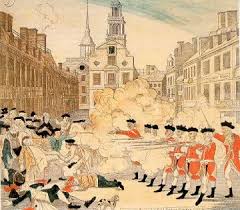
The above words were written by Lt. Col. Francis Smith in his official report to General Thomas Gage. Smith, in command of the British expedition to Concord recently returned from what would be the opening salvo of rebellion. Smith wanted to be clear that he never intended to start bloodshed. In the days afterwards, the Massachusetts militia made it clear that they intended to lay the blame at the “regulars.” As soon as the British returned to Boston, the war of words began on who fired the first shot to begin a worldwide war. The British column that was led by Smith was sent from Boston to capture supplies reportedly stored at nearby Concord.  To get to Concord, the British would have to march through Lexington.  Due to a complex warning system, the local militia in Lexington were mustered and called to arms.  Captain John  Parker and his minutemen were lined up on the Lexington green in two rows, facing the road to Cambridge and the Lexington meetinghouse. The road south of the green headed to Concord, and Parker had his mean assembled on the northern portion of the green, away from the Concord road.

Continue reading “Lexington Part II – “Our troops advanced towards them, without any intention of injuring them.” Who Fired First at Lexington?”

George Washington Remembers

RevWarWednesdays-header

Today, we are pleased to welcome guest author Bert Dunkerly.

WashingtonGeneral George Washington looks back at us from marble statues or stiff paintings with a grim-faced and determined look. Known for his dignity, resolve, and sound leadership, he seems cold and reserved. Yet he was also quite sentimental. In the midst of a campaign, with a massive British invasion force set to descend on him at New York City in July, 1776, Washington paused to pen these words: “I did not let the Anniversary of the 3rd or 9th of this Inst pas[s] of[f] without a grateful remembrance of the escape we had at the Meadows and on the Banks of the Monogahela. [T]he same Providence that protected us upon those occasions will, I hope, continue his Mercies, and make us happy instruments in restoring Peace & liberty to this once favour’d, but now distressed Country”.

Continue reading “George Washington Remembers”