Often the study of history can ground us and make us feel less “unique.” This allows us to hopefully put our own experiences into perspective and be able to hopefully learn from lessons of the past. Many today complain about how print and social media can distort facts to support a particular agenda. This is not a modern phenomenon. Many in the Sons of Liberty (such as Paul Revere) used print media to their advantage to promote resistance to and then independence from Great Britain.
Many pro-Patriot newspapers printed nothing less than propaganda pieces after the battles of April 19, 1775. Here is part of what was printed by the Massachusetts Spy on May 3, 1775.
“Americans! forever bear in mind the BATTLE of LEXINGTON! where British Troops, unmolested and unprovoked wantonly, and in a most inhuman manner fired upon and killed a number of our countrymen, then robbed them of their provisions, ransacked, plundered and burnt their houses! nor could the tears of defenseless women, some of whom were in the pains of childbirth, the cries of helpless, babes, nor the prayers of old age, confined to beds of sickness, appease their thirst for blood! – or divert them from the DESIGN of MURDER and ROBBERY!”
Obviously a historic study of the events on April 19, 1775 disputes much of what is claimed by the Massachusetts Spy. But when you have a point to make, an agenda to promote and a local population to rally to a cause…why should truth get in the way?! We have come a long way since 1775, but in many ways not much has changed.
The prints by Amos Doolittle of the events on April 19, 1775 did a lot to promote the Patriots cause in their “media war” war against the British.
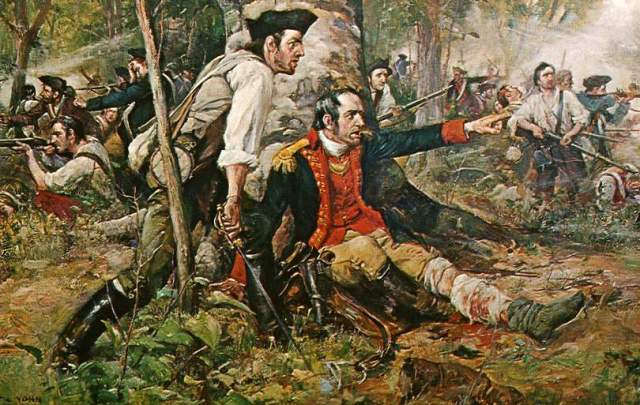
Sitting under a tree in north-central New York, suffering from a painful and mortal leg wound, yet still managing a successful defense after a powerful ambush, is a characteristic of a great military leader. All the while nonchalantly smoking his pipe!
General Nicholas Herkimer (courtesy of the NPS/Fort Stanwix and Oneida County (NY) Historical Society)
Nicholas Herkimer was the epitome of a successful militia commander. The Battle of Oriskany was a turning point. Herkimer, sitting on a once innocuous hillside, was a major reason why.
Even George Washington recognized the importance of Herkimer and made mention of his decision to not seek a commission in anything more than the militia of his home state. Not only that simple fact of service recognized by the commander-in-chief, but also his pivotal role in the Northern campaign of 1777.
“It was Herkimer who first reversed the gloomy scene of the Northern campaign. The hero of the Mohawk Valley served from love of Country, not for reward. He did not want a Continental command or money.”
Herkimer would succumb to the mortal leg wound ten days after the battle, but his role in what was described as “one of the bloodiest battles of the war” solidified his place in the category of “greatest leaders of the American Revolution you have never heard of.”
Born in the Mohawk Valley of New York to Palatinate immigrants, Nicholas was described as a slender built, dark complexioned, dark haired individual. When he was finished growing, he stood near six feet tall, a rather tall height in 18th century Colonial America. He could also boast of being multilingual, fluently speaking English, German, and Iroquois.
He saw action in the French and Indian War, helping to repel the French and Native American attack on German Flatts, New York on November 12, 1757. Although a disastrous day for the German community, as many were taken prisoner by the French and Native Americans, Herkimer’s role led to his promotion to captain in the militia within two months of the fighting on January 5, 1758. Thirty-years after his promotion to captain the town would be renamed “Herkimer” for the actions of this New Yorker during the subsequent war.
In April of 1758, Herkimer was present and assisted in the successful repulse of the French and Indian force.
With peace established in 1763, Herkimer looked toward personal matters, building a house on the south side of the Mohawk River in 1764. He married two ladies, both named Maria. One died and the other would remarry and move north of the border to Canada, after Herkimer’s death in 1777.
With tensions increasing in the 1770s between Great Britain and the colonies, Herkimer led the Tryon County, New York Committee of Safety and was elected colonel of the local militia. The Provincial Congress on September 5, 1776 promoted him to brigadier general of the militia. One of his first roles was to meet with Joseph Brant, a Mohawk military and political leader in an effort to try and keep the Native Americans neutral in the conflict between the colonies and Great Britain. He was unsuccessful.
During the Northern Campaign of 1777, with the thrust southward by British General John Burgoyne being the main column on its way to its destiny at Saratoga, a secondary column entered the Mohawk Valley under British General Barrimore”Barry” St. Leger. The combined British, German, Loyalist, and Native American force laid siege to Fort Stanwix, in present-day Rome, New York.
Herkimer heard about this and marched his militia to help raise the siege. His force was ambushed on August 6, as they were nearing Fort Stanwix. After the initial surprise, in which Herkimer received his wound, the militia responded well and a drawn out battle ensued.
Part of the reason that the majority of the militia recovered from the shock and endured the ensuing bloody carnage was directly related to the inspired leadership of Colonel Samuel Campbell who led one of the militia regiments in the force and Herkimer himself.
Herkimer, after having his horse shot and receiving his mortal wound in the opening shots of the engagement asked to be propped under a tree on the hillside his forces had utilized for their defensive stand He then calmly lit a pipe and with a continued cool demeanor directed the rest of the engagement.
Famous painting depicting the mortally wounded General Nicholas Herkimer directing his militia from his position seated under a tree, during the Battle of Oriskany on August 6, 1777. (Painting by Frederick C. Yohn)
After the day-long battle, Herkimer ensured he was the last to leave the field, after all the wounded that could be collected had been removed.
Although his wound was dressed on the field, the injury became infected and amputation was the only course of action. In the woods of western New York, the surgeon doing the operation was inexperienced and the wound bled tremendously. Herkimer would succumb to the wound on August 16, at the age of 49. He was buried near Little Falls, where he had built his home in the 1760s. The cemetery today is known as the “Herkimer Home Burial Ground.”
*Nicholas Herkimer’s role in the war and the Battle of Oriskany and the St. Leger campaign is described wonderfully by Michael O. Logusz in Volume 2 of “With Musket and Tomahawk” published by Savas Beatie LLC in March 2012.*
On this date, 241 years ago, the first salvo of what would become the American Revolutionary War, was fired on Lexington Green and North Bridge in Concord.
Historian John Galvin once wrote about the Battles of Lexington and Concord that they were the “least known of all American battles.” I never really understood what Galvin meant, as I had read extensively about April 19, 1775 and thought I understood the details of that day in history.
Yet, until this past weekend, when I spent the better part of four days touring the sites and walking the trails, talking to the historians around the towns, I did not realize how much more there is to what actually happened on that April day.
For starters, did you realize that Paul Revere did not go town-to-town calling out, “The British are Coming” to homesteads and roadside taverns? Instead, he was the catalyst that started a chain reaction of messengers and runners to different towns throughout the countryside that cast the alarm in a wide net.
He also would have told farmsteads and meetinghouses along the way that the “Regulars are Coming,” since the colonists still thought of themselves as British.
Or that the unofficial birth of the United States Army is attributed to the militia that followed Colonel James Barrett and Colonel John Buttrick down the hill toward the British at the North Bridge?
The field where the militia under Colonel James Barrett and Colonel John Buttrick began their advance from toward the North Bridge. The militia would be coming toward us to descend toward the span.
That was the first time that men, formed in regiments with officers, made an advance against what they perceived as an enemy force, and did so in a “very military manner.”
What prompted the various militia companies, which came from other towns than just Concord, to sally forth from the hill toward the now infamous North Bridge? The main reason was what was happening in Concord was the mistaken reason behind the smoke emanating from the town?
In the town, the British were burning military supplies and the wooden gun carriages found in the hamlet. Sparks landed one of the nearby dwellings and British soldiers actually put down their muskets to form a bucket brigade, with civilians, to help put out the flames. The smoke that billowed from the doused fires is what prompted the militia and minutemen response.
With water being dumped on the flames, smoke billowed up, which prompted milita Adjutant Joseph Hosmer to ask the officers; “Will you let them burn the town down?” That prompted the forward movement of the militia down the hill and against the British.
Or did you realize that some of the militia, from the nearby town of Acton, suffered some of the first casualties at North Bridge, including their militia captain, Isaac Davis, who was one of the first killed in the engagement?
View of the Old Manse, built in 1770 for Reverend William Emerson. View from the Concord River/North Bridge direction.
Somewhere in the midst of the action in Concord was Reverend William Emerson, the grandfather of Ralph Waldo Emerson who would later write that the action on April 19, would be known as the “shot heard round the world” years later.
These are just a few of the interesting tidbits that I picked up this past weekend. Altogether, they reinforce the historic events that I knew unfolded on this day in American History. However, along with reflecting on what transpired in my visit to Massachusetts, these new tidbits of valuable information underscore the important stories and accounts that shape this spring day that are beckoning to be told.
There is so much to be gained by walking the grounds, talking to the historians and historical enthusiasts of the area, and just taking time to appreciate what this day, April 19th, meant to the future of the United States and the era it was leaving behind as part of the British Empire.
When a historian, author, or student of the American Revolutionary War mentions the following three words, “Green Mountain Boys” there is usually one name that comes to the forefront.
Seth Warner is usually not that name. Yet, he is one of the two names that should be forever linked with the great history of the “Green Mountain Boys.”
For those that are drawing a blank, the other name usually associated with this famous unit is Ethan Allen.
Warner, born in hilly Woodbury, Connecticut on May 17, 1743, the fourth of ten children to Dr. Benjamin Warner and Silence Hurd Warner. The young Seth was a product of the western frontier, growing up on the fringes of the English world, and thus learning from an early age to live and survive in the woods, rivers, and hills of Connecticut and what would become Vermont.
He did attend what limited schooling was available and from his father, rudimentary medical practice. In an 18th century biography, Warner was remembered to have vast information on the nature and uses of indigenous plants.
During the French and Indian War, Warner served two summers fighting in the cause of the British and would serve as a captain in the “Green Mountain Boys” following the French and Indian War. One biography states that Warner was part of the famous ranger outfit known as Major Roger’s Rangers, yet there is no primary evidence that supports this biographical claim.
With war on the horizon following the action at Lexington and Concord, Warner was elected third in command, with Ethan Allen being elected in top command, on May 8, 1775 for the task of capturing Fort Ticonderoga in western New York.
Born where Native American still threatened the westward-minded colonists, with the training during two summers in the last major war on the American Continent, Warner would now play a major role in the upcoming American Revolution.
With that, Seth Warner and the “Green Mountain Boys” marched off to help make the dream of American independence a reality. Following Ethan Allen, Warner found himself embroiled in the first campaign outside the environs of Boston when on May 10, 1775 he took part in the American capture of Fort Ticonderoga in western New York. Following up the next day, Warner, serving as second-in-command, attacked and captured the British garrison at Crown Point, approximately 13 miles away from Fort Ticonderoga. When news broke of the exploit, the “Green Mountain Boys” and subsequently Warner quickly became a household name for the patriot cause.
With the turn of the season to summer, Allen and Warner appeared in Philadelphia to appeal directly to the Continental Congress. Their aim was to achieve recognition as a regiment for the “Green Mountain Boys.” On June 23, 1775, the day the two men appeared in front of the governing body of the American cause, the Congress agreed and sent the endorsement to the state of New York. After some debate in provincial Congress of the Empire State, the endorsement was finally agreed upon.
With the ensuing vote of officers, surprisingly, Allen was not elected as commander, but Warner survived in an officer capacity, garnering 41 of 46 votes for lieutenant colonel. No reason or notes from this convention, held on July 6, 1775 has ever surfaced.
Before 1775 was out, Warner, who would lead the command, found themselves on the way to Canada. Initially stationed along the St. Lawrence River on the way to Montreal and near the end of October, Warner’s men repulsed an amphibious landing and attack by Sir Guy Carleton, the British Governor-General of Canada. With the repulse, at the Battle of Longeuill led to the surrender of Fort St. John on November 3, 1775.
Ten days later Montreal fell to the American forces and Warner and his “Green Mountain Boys” entered the fallen city later that same day. The American commander, General Richard Montgomery wanted this crack unit to continue with him by canoe to Quebec but because of the lack of winter clothing, the command was forced to head south, for supplies.
Not to stay in a support role for long, Warner’s men marched north shortly after the turn of the year in January 1776 to reinforce the Americans laying siege to Quebec. While there Warner showed the depth of his concern for the welfare of his men. With the smallpox epidemic ravaging the American ranks–in fact more American soldiers would die of that disease than any single other cause–Warner allowed his men to be inoculated, which was not not akin to what inoculations are like today.
Click this link, courtesy of Mount Vernon, on what smallpox inoculation was like in Colonial America.
After the return from Canada, on July 5, 1776, Warner was elevated to the rank of colonel and tasked with raising another regiment from the New Hampshire Grants (the area now comprising Vermont). Yet, it was one year and one day later that Warner showed how valuable his role as a general officer was.
During the Battle of Hubbardton, Warner oversaw the rearguard of General Arthur St. Clair’s retreating American forces. Outside this frontier settlement, Warner’s men suffered more casualties and eventually yielded the field to the British, but the toll extracted from the British (over 200 killed, wounded, and captured) was high enough to cause the British to stop their pursuit of the retreating American army.
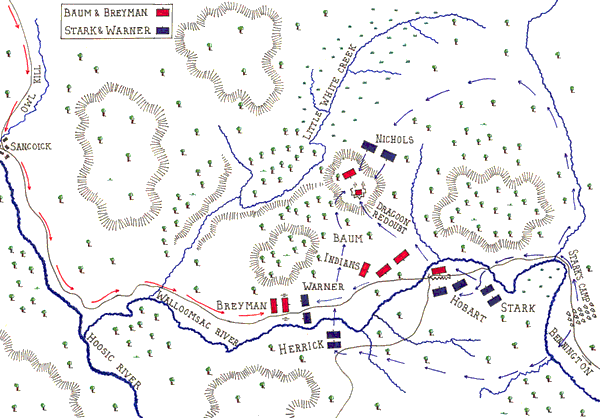
A month later, on August 16, 1777, Warner played another critical role in the American victory at Bennington. Under the overall command of General John Stark–another of the fiery, yet competent, and overlooked American general officers–Warner provided invaluable assistance because of his familiarity with the region. His home was a scant few miles from where the engagement would unfold.
Warner would oversee the left wing of the American assault and have as his goal the “Tory Redoubt” that fell on the east side of the Walloomsac River, which would be a dominant feature in the ensuing battle.
Battle of Bennington (courtesy of British Battles)
The Americans routed the German, British, and Loyalist forces, even halting a 600-man reinforcement column under German Lieutenant Colonel Heinrich Breymann who arrived on the field in the latter stages.
Stark reported to Congress that Warner showed “superior skill in the action.”
Unbeknownst to Warner at the time, the campaign that culminated with British General John Burgoyne’s surrender at Saratoga, was the defining moment in Warner’s American Revolutionary War career. Warner would stay in the service, reaching the rank of brigadier general, bestowed upon him in 1778 by the new state of Vermont courtesy of the state legislature. That made him the only brigadier general in the newly formed state. On September 6, 1780 Warner received his only wound of the war, in an ambush by Native Americans outside Fort George in New York.
Unfortunately for the old “Green Mountain Boys” commander, the years after his retirement in 1780 were not kind. He fell out of favor with his former commander, Ethan Allen which led Warner to confront him in 1781 about contact with the British when Allen was a prisoner-of-war. This was all in conjunction with some contact Vermont had with British Canada about possible negotiations in reunifying Vermont with the British Empire. The extent of the negotiations and the seriousness of the idea has been in question by historians ever since.
Regardless, Warner, in failing health in 1784, returned to Woodbury, where he died on December 26, 1784, at the age of 41. Warner’s remains lay in Roxbury, Connecticut.
*For more information on the campaigns of New York in which Warner played a role in, consult Michael O. Logusz’s two-volume “With Musket and Tomahawk” series published by Savas Beatie LLC. at http://www.savasbeatie.com*
The night was chilly, snow laid on the streets and walks of Boston, and the cold air kept people bundled up around the port town of Massachusetts colony.
Yet, the cold air could not dampen was the seething resentment a growing number of Bostonians were feeling toward the occupying British military. Minor brawls and exchanges had taken place in the various taverns and around the bustling harbor; common places where alcohol and/or hard work created short tempers.
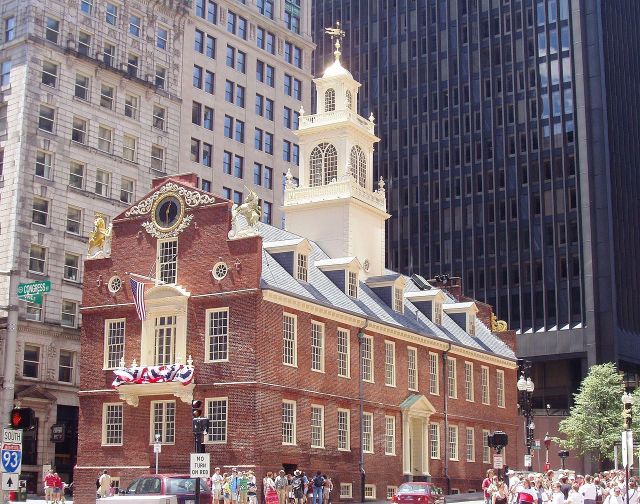
However, on this night, March 5, 1770, outside the Custom House on King Street a British redcoat infantrymen, the sentry, kept his post. Private Hugh White, whose shift it was to stand guard, would have noticed the approach of Edward Garrick, who had come calling for a British officer who owed Garrick’s boss money for his wig services. Unbeknownst to Garrick, the apprentice, the debt had been paid, so no response from the field officer was forthcoming.
Old State House (Custom House) scene of the Boston Massacre on March 5, 1770
A response from White was forthcoming, who admonished the young man to have a more respectful tone when speaking to an officer in His Majesty, the King’s service. Garrick did not take too kindly to this tone and responded with an insult of his own toward White.
This prompted White to leave his post and literally knock some sense into Garrick by way of a musket strike to the side of the head. Garrick yelped in agony and a companion took up the verbal barrage toward the British soldier.
The cacophony created by the yelling of insults and as the colonial version of a game of telephone spread the message about what was transpiring at the Customs House. Church bells were rung, a telltale sign that something was afoot, led to the crowd surging past 50 in number by the evening.
White, prudently, had left his post and retreated up onto the steps of the Customs House summoned a runner (messenger) to race to the local barracks for extra manpower.As was custom, there was an officer of the watch, in this case, Captain Thomas Preston and seven soldiers responded.
En route, Henry Know, destined to become chief of artillery for the Continental Army in the American Revolution urged Preston, “For God’s sake, take care of your men, if they fire, you must die.”
Against this sage advice, shouts of “Fire” were emanating from the crowd, which had also resorted to throwing snowballs and spitting in the direction of the red-coated soldiers. Other derogatory names for British soldiers, like “lobsterbacks” which took into account the red uniforms adorned by the British infantry were also heard being shouted.
The British soldiers, with loaded muskets, and Captain Preston reached White’s station, the British officer ordered the large crowd to disperse. Preston had taken a position in front of his soldiers and had told a member of the crowd that his soldiers would not fire unless ordered.
No order was ever given.
Shortly after Preston spoke those words to a Bostonian, a foreign object hurtled toward Private Hugh Montgomery and knocked the infantryman off his feet. His musket clattered onto the steps. Standing up, Montgomery reportedly yelled “Damn you, fire!” and pulled the trigger of his musket. The accompanying “bang” reverberated in the square.
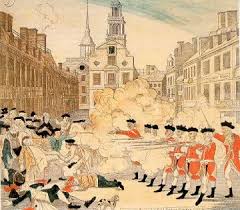
Copy of the lithograph by Paul Revere on the Boston Massacre
And then there was a pause of an uncertain length.
This silence was broken by the staccato of other muskets being fired. A few rounds belched forth from the British soldiers. Screams and shouts along with deafening echo of the discharge of black-powder muskets in an enclosed city square mixed with the sickening thud of lead impacting bone and body.
All told, eleven colonists were hit from the volley fire. Three were killed outright; Samuel Gray, James Caldwell, and Crispus Attucks. One more, Samuel Maverick, who was struck by a ricocheting round would die later that same evening. One more, a recent immigrant from Ireland, Patrick Carr, would succumb to his wounds a fortnight later.
In the immediate aftermath, Preston would call the majority of his unit, the 29th Regiment of Foot to the scene. With the mob spilling out of the Customs House Square, Governor Thomas Hutchinson, the acting governor, was able to temporarily restore a semblance of tranquility with the promise that a fair trial of what transpired that March 5th evening would happen.
The trial would be a major event for the city of Boston, but, that was in the near future. With the shots fired and the citizens struck, the burgeoning independence movement had a rallying point. Lives were lost that night, but, the events that followed would, to the proponents of American independence, make them martyrs for the cause.
A good friend, knowing my interest in military history brought me a very unique artifact, which led me to discover more about where this piece of history originated from. Here is what I discovered.
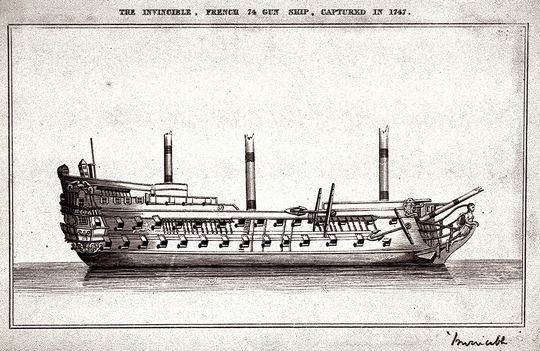
Launched in 1741 by the French as L’Invincible, this 74-gun French ship of line was captured by the British during the First Battle of Cape Finisterre on May 14, 1747.
The engagement during the War of the Austrian Sucession, was a five-hour engagement in the Atlantic Ocean, off the coast of northwest Spain. The British admiral, George Anson struck the 30-ship convoy of the French, which was under the command of Admiral de la Jonquiere and captured four ships of the line. One of those ships of the line was the L’Invincible.
The L’Invincible sacrificed itself to allow some of the convoy to escape and tried in vain to fend off six British warships.
A depiction of L’Invincible after being captured by the British in 1747
Given its more Anglicized name; HMS Invincible, the ship’s design was larger than the usual 74-gun vessels of the time. Her greater draft and lower center of gravity allowed her to carry much more sail. This allowed the ship to gain more speed.
Altogether her design helped revolutionize British warship making as she was the first 74-gun ship in the British Navy. By the time of the crucial Battle of Trafalgar in 1805, over three-fourths of the entire British Navy were line ships toting 74-guns.
In February 1758 while part of a large sailing of warships and transports, the HMS Invincible that left from St. Helens Roads near the Isle of Wight in England. The ship struck Horse Tail Sandbank and got stuck. Yet with the rising tide she was able to free herself.
Unfortunately, fate had it in for the ship, as the wind suddenly changed direction and increased in intensity and she dragged her anchor on the sandbank. A failed attempt to lighten her cargo and load of armament and putting her under full sail did not work either. She was marooned on the sandbar and began to take on water.
For the next three days, the majority of her cannons and stores were removed and on February 22, 1758 she rolled onto her side and was lost.
HMS Invincible laid wrecked, covered, and largely forgotten until the 20th century, when in May 1979 a local fisherman snagged his nets on the timbers. Local divers found more of the ship and has been investigated and parts recovered ever since.
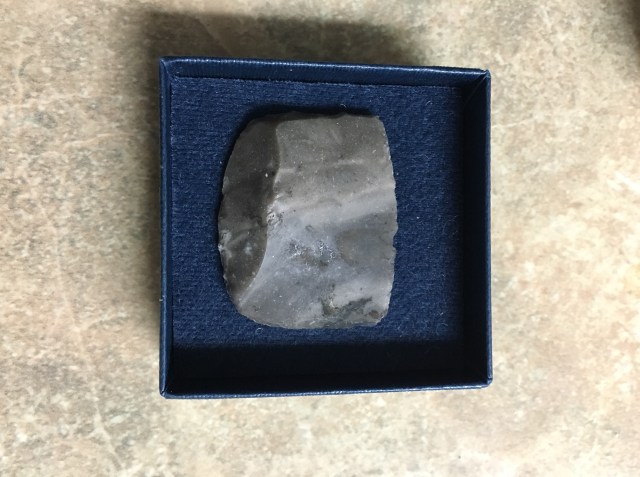
One of the interesting finds was the experimental flintlocks of the cannons of the HMS Invincible. Rather large, the nicely knapped flints were believed to be used in the canon locks. Canon locks and subsequent flints among the gunnery stores were considered a “unique find.”
A “Large Wedge Type Gun Flint” from the HMS Invincible (author collection)
Fore more information about the ship, the wreck, and the discovery, check out Brian Lavery’s The Royal Navy’s First Invincible. Link to the book via Amazon is here.
Emerging Revolutionary War welcomes guest historian Robert “Bert” Dunkerly to the blog as the author of this post.
It is well known that German troops (commonly called Hessians) fought alongside the British during the war. One of the more intriguing questions of the Revolution remains; how did they communicate? At any given time, German units could comprise from one third to one half of the larger British armies. They were also present in equal numbers in smaller detachments.
French was a common language that many European officers would have known, and there is evidence that German and English officers communicated in French during campaigns. The language barrier also impacted daily army operations. For example, Georg Pausch of the Hesse-Hanau Artillery requested an English officer who spoke German for a court martial. Yet most of that procedure was conducted in French.
Written orders from General Phillips in Montreal in 1777 to Hessian Artillery units were given in French, suggesting that this was commonly done in these calm, routine situations.
It wasn’t a perfect system but it worked well enough. Adjutant General Major Bauermister of Hesse-Cassel, for example, notes that the English spoke poor French, when communicating with them. Yet what about among small units like companies or battalions?
Re-enactors portraying the Hesse Kassel Jaeger KorpsWould mediocre command of a language suffice for communication in combat situations? Often small groups of British and German troops operated together on patrols or raids. Marching to Freeman’s Farm (Saratoga) in 1777 was a column that included Germans on the left, English on the right, and English troops as flankers. Such situations required close coordination.
Other times they were side by side on battlefields, such as at the Battle of Guilford Courthouse in 1781, where the German Von Bose Regiment was aligned next to the British 71st Highland Regiment. Close coordination in these cases was essential.
Still another example is from Brandywine, where Captain Johann Ewald wrote that in the army’s advance, were 60 jaegers on foot, fifteen mounted jaegers, a company of Highlanders, and a company of British light infantry. All these troops worked in tandem to protect the army from ambush and clear the way for the advance. Yet Ewald was silent on how they did so.
Captain Ewald, also wrote of his experiences in Virginia, where, in the advance on Richmond, small numbers of troops were interspersed. They marched into the town in this order: Jaegers, British dragoons, more jaegers, and British Light Infantry. There are dozens of other examples.
Despite the many instances of German and British units mingling, there is precious little documentary evidence of how officers, or the common soldiers, communicated. Perhaps they used a combination of French, translators who spoke either English or German, and hand signals or other agreed- upon methods.
Timing and clarity are key in close quarters combat, there is no chance to second guess in an ambush or a raid. There were likely instances of misunderstanding that may have led to mistakes and even led to friendly fire incidents.
Of the many accounts this author has researched, only a few mention how they communicated. Perhaps it was something so mundane, or so well understood, that they saw no need to comment on it in their writings. It is hoped that further research will shed light on this question.
Washington Crossing the Delaware, by Emanuel Gottlieb Leutze The Metropolitan Museum of Art, http://www.metmuseum.org
One of the iconic images of the Revolutionary War is Emanuel Gottlieb Leutze’s 1851 painting, Washington Crossing the Delaware. It is the night of December 25, 1776. The Continental Army is being transported across the Delaware River to attack a Hessian garrison at Trenton, New Jersey, some nine miles to the south. In the foreground, anonymous men (and possibly one woman) of varying nationalities and races row an overloaded boat across the river, pushing great slabs of ice out of the way. Two of the boat’s occupants are not anonymous: General George Washington, standing resolutely near the bow, and young Lieutenant James Monroe, holding the stars and stripes.
Leutze’s painting is glorious–and wrong in almost every detail. The river resembles the Rhine more than the Delaware; the boat is too small and of inaccurate design; there is too much light for what was a night crossing; Washington did not cross standing up; the stars and stripes had not yet been adopted by the Continental Congress; and James Monroe was not holding the flag, not in the boat, and not even present with the army.
He was already across the river, and he was busy.
Washington’s plan for a surprise attack on Trenton was a risky attempt to reverse the sagging fortunes of the Patriot cause. During the summer of 1776 British forces, including Hessian mercenaries, had driven the Continental Army from New York across New Jersey and into Buck’s County, Pennsylvania. Expired enlistments and outright desertion had thinned the American ranks, and many of those who remained were despondent. Washington gambled that a successful attack against an isolated British outpost would boost the army’s morale and stiffen the resolve of Congress and the people.
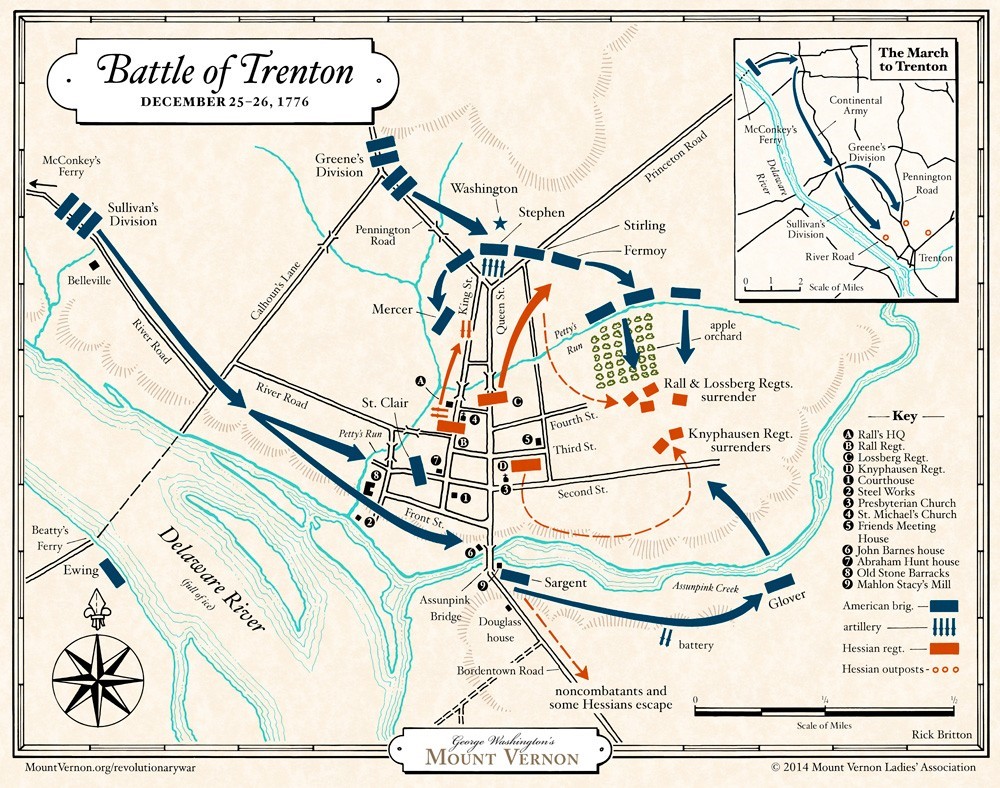
Three Hessian regiments, comprising about 1,400 men, were stationed at Trenton under the command of Colonel Johann Rall (also spelled Rahl). Washington planned to bring 2,400 Continental soldiers across the river overnight at McKonkey’s Ferry, march to Trenton, and attack before dawn. Two other elements of the army were part of the plan. A 1,900-man force under Colonel John Cadwalader would make a diversionary attack against British troops at Bordentown, New Jersey. General James Ewing would lead 700 men across the Delaware at Trenton Ferry, control the bridge over Assunpink Creek, and intercept any Hessian troops retreating from Trenton. Bad weather prevented both of these deployments, meaning that everything would depend on the main body’s effort. The army’s password for the evening was “Victory or Death.”
Washington’s plan included sending a small detachment of troops over the Delaware first to secure the army’s route of march. James Monroe was with this contingent. In his autobiography (written in the third person late in life and not completed before his death), Monroe described the mission:
The command of the vanguard, consisting of 50 men, was given to Captain William Washington, of the Third Virginia Regiment . . . Lieutenant Monroe promptly offered his services to act as a subaltern under him, which was promptly accepted. On the 25th of December, 1776, they passed the Delaware in front of the army, in the dusk of the evening, at [McKonkey’s] ferry, 10 miles above Trenton, and hastened to a point, about one and one-half miles from it, at which the road by which they descended intersected that which led from Trenton to Princeton, for the purpose, in obedience of orders, of cutting off all communication between them and from the country to Trenton.
Monroe noted that the night was “tempestuous,” and that snow was falling. While manning their post, the detachment was accosted by a local resident who thought the Continentals were British troops. Describing the incident many years later at a White House dinner during his presidency, Monroe recalled that the man, whose name was John Riker, was “determined in his manner and very profane.” Upon learning that the soldiers were Americans, he brought food from his house and said to Monroe, “I know something is to be done, and I am going with you. I am a doctor, and I may help some poor fellow.” Dr. Riker proved remarkably prescient.
Battle of Trenton map courtesy George Washington’s Mount Vernon
The main army’s river crossing and march to Trenton took longer than planned, meaning that the attack would occur well after sunup. Outside the town Washington divided his force, sending a division commanded by Major General Nathaniel Greene to attack from the north while the other, led by Major General John Sullivan, attacked from the south. At 8:00 AM the assault began, and here we return to Monroe’s account from his autobiography:
Captain Washington then moved forward with the vanguard in front, attacked the enemy’s picket, shot down the commanding officer, and drove it before him. A general alarm then took place among the troops in town. The drums were beat to arms, and two cannon were placed in the main street to bear on the head of our column as it entered. Captain Washington rushed forward, attacked, and put the troops around the cannon to flight, and took possession of them. Moving on afterwards, he received a severe wound and was taken from the field. The command then devolved upon Lieutenant Monroe, who attacked in like manner at the head of the corps, and was shot down by a musket ball which passed through his breast and shoulder. He was also carried from the field.
The Capture of the Hessians at Trenton December 26 1776, by John Trumbull (Yale University Art Gallery) (James Monroe lies wounded on the ground at left center)
Monroe was brought to the same room where William Washington lay, and their wounds were dressed by the army’s surgeon general and Dr. John Riker. Riker’s prediction of helping “some poor fellow” came true as he repaired a damaged artery in Monroe’s shoulder. What neither man realized at the time was that the intrepid physician had saved the life of a future president.
George Washington’s gamble in initiating the Battle of Trenton paid off. The victory was complete, and came at a surprisingly small cost in terms of American casualties. Two enlisted men froze to death during the nighttime march, and two were wounded in combat. The only losses among officers were the nonfatal wounds sustained by William Washington and James Monroe. Washington followed up his success at Trenton with another at Princeton on January 3, 1777, where the Continental Army proved that it could prevail over regular British troops.
The best commentary upon James Monroe’s performance at Trenton, and his Revolutionary War service generally, comes from no less an authority than George Washington. Writing to an acquaintance in 1779, Washington noted Monroe’s “zeal he discovered by entering the service at an early period, the character he supported in his regiment, and the manner in which he distinguished himself at Trenton, where he received a wound.” The general concluded that James Monroe had “in every instance maintained the reputation of a brave, active, and sensible officer.”
Scott H. Harris is the Executive Directors of the James Monroe Museum in Fredericksburg, Virginia. Harris became director of the James Monroe Museum and Memorial Library in July 2011, following ten years as director of the New Market Battlefield State Historical Park (administered by Virginia Military Institute). From 1988 to 2001, Scott was the first curator of the Manassas Museum and later director of historic resources for the City of Manassas, Virginia. Prior to his work in Manassas, he was a consulting historian with the Association for the Preservation of Virginia Antiquities in Richmond and an historical interpreter with the Colonial Williamsburg Foundation. He has been a board member of the New Market Area Chamber of Commerce, Prince William County/Manassas Convention and Visitors Bureau, Shenandoah Valley Travel Association, and Virginia Civil War Trails, Inc. He is a past president of the Virginia Association of Museums and serves as a peer reviewer for the Museum Assessment and Accreditation programs of the American Association of Museums.
Scott received his BA with honors in History and Historic Preservation from the University of Mary Washington in 1983. In 1988, he received an MA in History and Museum Administration from the College of William and Mary. Scott is also a graduate of the Seminar for Historical Administration, the nation’s oldest advanced museum professional development program.
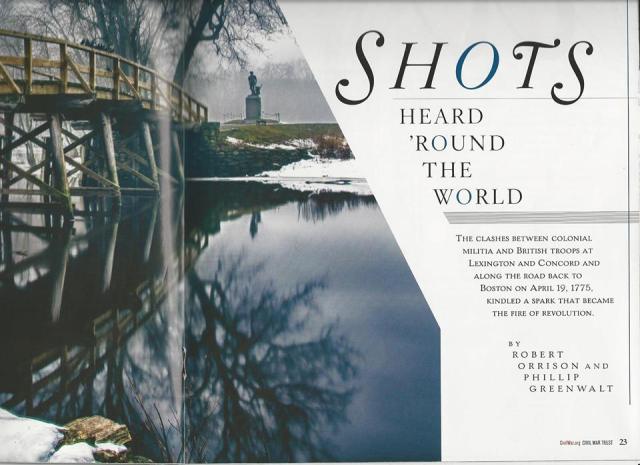
Recently Emerging Revolutionary War Era authors Phillip Greenwalt and Rob Orrison were featured in Hallowed Ground, the Civil War Trust’s quarterly magazine. Their article “Shots Heard Around the World” focuses on the events surrounding Lexington and Concord in 1775. As CWT President Lighthizer writes “the journey towards the stillness at Appomattox began with a shot heard ’round the world at Concord.”
As many of you know, the Civil War Trust has launched a new initiative called “Campaign 1776”, to preserve American battlefields that relate to the American Revolution and the War of 1812. Part of that initiative is funding the archaeology and preservation of land around the area known as “Parker’s Revenge.” Here, on the afternoon of April 19, 1775, Minutemen met the returning British column on its way from Concord to Boston. The Minutemen under Capt. John Parker, severely bloodied the British, in a “revenge” from their earlier meeting on the Lexington Green.
Also in the same issue of Hallowed Ground, ERW contributors Drew and Kate Gruber write about the how the American Revolution was on the minds of those who fought in the Civil War. Their article “So Doth History Repeat Itself” covers the “ancestral connection” that both sides had to the patriots of the revolution.
Be sure to check out Hallowed Ground and if you are not already a member of the Civil War Trust, be sure to join today. Their work in preserving American battlefields is unparalleled. We thank the staff of Hallowed Ground for including us in their latest issue. Look for more exciting ventures from Emerging Revolutionary War Era soon!
The last battle of the Revolutionary War was fought in 1951 in Winchester, Virginia. Daniel Morgan, the “Old Wagoner” or ‘Old Morgan” as he was known to his soldiers, was front and center of the maelstrom once again just as he was on many a battle field from Quebec to South Carolina during the War for Independence.
Daniel Morgan Statute in Winchester, Virginia (courtesy of Winchester Star)
Residents of Cowpens, South Carolina, a small town near Spartanburg named for Morgan’s dramatic and strategically critical victory of 1781, arrived in Winchester, Virginia to claim the earthly remains of their revered hero. Morgan’s grave was overgrown and in decrepit condition. In Winchester, only one out of forty people queried by the Carolinians knew who Morgan was. Armed with shovels, a mortician, and a letter of authorization from Morgan’s great-great granddaughter, the Carolinians showed up at Mount Hebron Cemetery to dig up the general, take him “home” and reinter him at the site of his greatest victory. There he could rest among a populace that revered his name and cherished his significant contributions toward American independence. However, word of the Carolinians’ attempted exhumation of Morgan quickly spread through town and a contingent of devoted local admirers quickly headed to Mt. Hebron to stop the Carolinians initiative. In the end, a court ruled that the “Old Wagoner” would remain interred at Mt. Hebron in Winchester. Not only did he stay, but this episode kindled a reverence for the General’s legacy and place in history among Winchester’s populace.
Seventeen year-old Daniel Morgan moved into the Shenandoah Valley in 1753, with nothing but sheer determination to carve out a life for himself in the rugged frontier of western Virginia. His early years are shrouded in mystery that Morgan himself kept secret from even his closest associates throughout his life. He was born of Welsh parentage in 1836 in Bucks County Pennsylvania or Hunterdon County, New Jersey, the fifth of seven children. It was a hard life of work on the family farmstead with no opportunity for even a rudimentary education. His time was spent chopping wood, hoeing fields and other taxing physical labor. His mother died when he was young, and his father remarried. A dispute with his father prompted the fiery Morgan to head west on the Great Wagon Road to Carlisle, Pennsylvania where he worked briefly during the winter of 1752-53, before continuing south to the Shenandoah.
Although Morgan lacked an education, the work on the family farm had hardened his six-foot, two-hundred pound frame into a powerful and muscular young man who was well suited for the physicality of life on the frontier. The blue-eyed youth initially obtained employment as a farm laborer in eastern Frederick County in what is now Clarke County. He worked hard and soon earned an offer of better employment. In spite of his youth, Morgan eared employment as the overseer of a saw mill where he learned to manage older and more experienced men, developing his leadership ability. Morgan’s energy and work ethic impressed Robert Burwell who offered Morgan a position as a teamster hauling valley produce across the Blue Ridge to Fredericksburg and other towns in the Virginia Piedmont and carrying badly needed supplies back to the frontier that was the Shenandoah Valley of the 1750’s.
Morgan enjoyed the freedom of the open road and in less than two years had earned enough money to buy his own team and Conestoga wagon. During this time, Morgan had become close friends with fellow teamster John “Captain Jack” Ashby, grandfather of the Virginia Civil War cavalryman. Ashby was noted for his “horsemanship, marksmanship and daring exploits.” Ashby taught Morgan to shoot, hunt, ride and live in the wilderness along the Blue Ridge. The two men were kindred spirits and became good friends.
In 1755, the French and Indian War came to the Shenandoah Valley when British Maj. Gen. Edward Braddock’s column passed through the Winchester area on its way to wrest Fort Duquesne from the French at the “Forks of the Ohio,” now the site of Pittsburgh. Morgan signed on the haul supplies to Fort Cumberland in western Maryland and soon found himself as a teamster with the army, rolling into western Pennsylvania. When the French and Indians routed Braddock at the battle of the Monongahela in July, the teamsters emptied their wagons of supplies and carried wounded soldiers back to Fort Cumberland. At some point in this campaign, Morgan’s actions or words angered a British officer who violently chastised the young teamster and struck him with the flat of his sword. Morgan’s temper exploded, and the young wagoner knocked the officer out with one strong punch. A court martial sentenced Morgan to 500 lashes, a punishment that often killed its recipients. The stout Morgan endured the suffering and noted that the drummer miscounted and he had only received 499 lashes. He would proudly wear the scars suffered at the hands of the British for the rest of his life.
Depiction of Daniel Morgan on the frontier (courtesy of Fort Edwards)
With Braddock’s devastating defeat, the French and Indians went on the offensive raiding into western Virginia. Morgan enlisted in a Ranger Company commanded by his friend, “Captain Jack” Ashby. Morgan spent much of his time patrolling the wilds of the Allegheny Mountain posts of Hampshire County and building stockades to defend against the marauding French and Indians. On one occasion while carrying messages to one of the forts along with two other men, Indians waylaid his party at Hanging Rock on the Cacapon River, killing his comrades. They shot Morgan in the neck, but he raced away on his horse, narrowly escaping the tomahawk of a pursuing Indian. Morgan lost consciousness from blood loss, but luckily the horse had the path to fort ingrained in her memory and carried him back to safety. Morgan remained in the Ranger Company until Col. George Washington disbanded it in October. Morgan began a period of multiple pursuits. He sojourned himself in the wilds for several months trying his hand as a hunter. He likely spent time as a militiaman in Frederick County. By 1758, however, he almost instinctively returned to the open road, hauling wheat, tobacco and hemp across the Blue Ridge to eastern Virginia commercial centers such as Alexandria, Dumfries or Fredericksburg. In driving the wagons, Morgan had found his calling. The harsh life of the teamster suited his rough and tumble personality. He quickly gained a reputation as on the leading pugilists of the Shenandoah Valley. He could often be found at Berry’s Tavern in what is now Berryville but at the time was known as Battletown because of the constant brawling that occurred at the tavern. These were brutal affairs that included wrestling, punching, choking and gouging of eyes, but Morgan reigned as the champion. Although not always victorious, the stout teamster made sure there was a rematch which he usually won. In spite of his reputation for drinking and fighting, Morgan prospered as a successful teamster, even if his brawling occasionally landed him on the docket of the Frederick County Circuit Court. In 1762, he found love with Abigail Curry who became his common-law wife, introduced him to the Presbyterian religion and bore him two girls. At her request, he cut back on drinking and brawling. He also rented a tract of land began farming marketable crops. Morgan had finally found the good life he sought in the Valley of Virginia.
With talk of independence in the air in 1774, Morgan participated in Lord Dunmore’s War. He was part of a column that operated in the Wheeling, Virginia area. They attacked Indians along the Muskingum River in the Ohio Country and drove them off, but he did not participate in that war’s decisive action at Point Pleasant. As the war drew to a close, word of the troubles in Boston circulated among the men, and Morgan was among those who committed to solidarity with the Massachusetts patriots.
Part Two will cover Morgan in the opening years of the American Revolution, so check back next week.
A life-long student of military history, Scott C. Patchan is a graduate of James Madison University in the Shenandoah Valley. He is the author of many articles and books, includingThe Forgotten Fury: The Battle of Piedmont (1996),Shenandoah Summer: The 1864 Valley Campaign (2007), andSecond Manassas: Longstreet’s Attack and the Struggle for Chinn Ridge (2011).
Patchan serves as a Director on the board of the Kernstown Battlefield Association in Winchester, Virginia, and is a member of the Shenandoah Valley Battlefield Foundation’s Resource Protection Committee.


 Often the study of history can ground us and make us feel less “unique.” This allows us to hopefully put our own experiences into perspective and be able to hopefully learn from lessons of the past. Many today complain about how print and social media can distort facts to support a particular agenda. This is not a modern phenomenon. Many in the Sons of Liberty (such as Paul Revere) used print media to their advantage to promote resistance to and then independence from Great Britain.



![030_30[1]](https://emergingrevolutionarywar.org/wp-content/uploads/2016/02/030_301.jpg?w=640)





 Emerging Revolutionary War Era