Emerging Revolutionary War welcomes guest historian Michael Aubrecht. A biography of Mr. Aubrecht is attached below.
In 2011 an exhibit titled “Slavery at Jefferson’s Monticello: Paradox of Liberty” started running at the Smithsonian’s American History Museum from January 27, 2012 – October 14, 2012. This somewhat controversial exhibition explored slavery and enslaved people in America through the lens of Jefferson’s plantation and was a collaborative effort between the Thomas Jefferson Foundation at Monticello and the African American History and Culture Museum in Washington DC. It helped to instigate public discussion about the dichotomy between the Founders and freedom. The paradox of course is that Thomas Jefferson drafted the Declaration of Independence and called slavery an “abominable crime,” yet he was a lifelong slaveholder. The exhibition provides a glimpse into the lives of 6 slave families living at Monticello and reveals how the paradox of slavery in Jefferson’s world is relevant for generations beyond Jefferson’s lifetime.
A version of this post appeared in the Emerging Civil War blog on August 17, 2018.
John S. Mosby, photographed here as a Federal civil servant
Those who know me know of my “interest” in famous Confederate partisan, John S. Mosby. Ok, some would say “love affair,” but either way, I grew up reading about Mosby and his exploits during the Civil War. It was not until later in my life that I started to read about the most interesting part of Mosby’s life—not his time in the war, but his time AFTER the war.
Mosby had a deep interest and passion in American history and you can see that on a trip that Mosby took north in April 1906 to one of the sacred sites of America’s founding: Boston, Massachusetts. In a 1906 letter to his friend Sam Chapman (a former member of Mosby’s Rangers), Mosby describes his visit and the many ironies (as a southerner) he experienced. Continue reading ““I hope my visit to Boston will do good…” Confederate Colonel John S. Mosby and American Revolution”→
Leading up to the anniversary of April 19, 1775, we will be sharing some short remembrances from a few people who are from Lexington and Concord.This installment is by Rich Gillespie, a native of Lexington, Massachusetts.
If you live in Lexington, Massachusetts, the beginning of the American Revolution is an essential piece of life. The Minuteman statue dominates the center of town, the village green where the Alarm List stood to face the Regulars is much as it once was, the Town Seal seen on your friendly snowplow quotes Sam Adams’ comment to John Hancock upon hearing the firing—“Oh, What a glorious morning for America!”, and the high school’s team is predictably the Minutemen. The British marched to and from Concord within 150 yards of my 4th grade classroom, and the spring field trip was to the key sites of Lexington and Concord. My first job (as was my sister’s) was guiding visitors on Lexington Green.
Hip-hip Huzzah-Haughty British troops leave Lexington (author collection)
Looking for something to do midweek? Enjoy a Wednesday night at Shenandoah University and learn about an aspect of early American history.
“The Pox and the Covenant” by Tony Williams
If in the lower Shenandoah Valley or can make the trek, join Shenandoah University’s History Fellows in welcoming Tony Williams, senior fellow at the Bill of Rights Institute, for a guest lecture.
Author of five books on the Early American history and holds a Bachelor of Arts in history from Syracuse (NY) University and a Master of Arts in United States history from Ohio State University. After a successful 15-year teaching career at the middle and high-school level, he became the Program Director at the Washington, Jefferson, & Madison Institute in Charlottesville, Virginia in 2014.
The lecture will be held at Henkel Hall, Hester Auditorium and will begin at 7 p.m. Williams will have his books for sale after the talk, including the title that bears the lecture’s name.
For information and questions, please contact Jonathan Noyalas, Chair of the Shenandoah University’s History Fellows at (540)-665-4501 or jnoyalas01@su.edu.
If interested in other events at Shenandoah University of this nature, check out the link here.
Emerging Revolutionary War welcomes back guest historian Katie Turner Getty
“Fire! Fire! You dare not fire!” “Cowardly rascals!” “Lobsters!”
Shouts pierced the icy stillness of the night as a raucous crowd gathered in Boston’s King Street on the night of March 5, 1770. With their voices carrying through the wintry air all the way to Long Wharf, the crowd hurled insults at eight British soldiers and their captain. The soldiers’ muskets rattled as snowballs, oyster shells, and chunks of ice lobbed by the unruly crowd rained down upon them.
Fifth Victim is the sketch of the coffin of Patrick Carr, published in the Boston-Gazette and Country Journal on19 March 1770.
The soldiers shot eleven townspeople that night. Three died in the snow where they stood. Two more would later die from their wounds. The remaining six would survive. All of the victims were male.
Documentary evidence shows that the crowd in King Street on the night of the Boston Massacre was overwhelmingly male. The crowd was variously described as “mostly boys and youngsters”, “near 200 boys and men”, “a parcel of Rude boys”, and “chiefly consisting of boys and lads”.[1]Continue reading “Women Speaking Softly: Female Voices of the Boston Massacre”→
The town meeting held on the night of December 16, 1773 at the Old South Meeting House was no ordinary meeting. Boston was well known for its public meetings, but this one was different. Frequently city leaders called town meetings to discuss important political, economic and social decisions facing the city or colony. The town meeting was a foundation of the political process for Massachusetts and much of the New England colonies. Royal authorities had watched these meetings more closely since the 1760s during the opposition to the Stamp Act. Colonial Whigs (anti Royal leaders) had used these meetings to protest British policies that they saw as threats to their liberties.
This town meeting was a follow up assembly to previous meetings held in November originally called for Faneuil Hall. The large turnout, however, required the crowd to move to the more spacious Old South Meeting House. Nearly 5,000 people attended the meeting to discuss the city and colony’s response to a new tax on tea and more directly, the ships in the harbor that held tea from the East India Company. The colonial Whigs did not want the cargo unloaded but the captain of the ships could not leave the harbor with the tea unless they had approval from the Governor. Governor Thomas Hutchinson did not believe he had the authority to allow the ships to leave without unloading the tea. Adding to that decision, Hutchinson was more than frustrated with those who had rejected Royal authority over the years. Thus, a legal and theoretical standoff ensued. That night, the people of Boston took the matter into their own hands.
On the surface, the Tea Act of 1773 was rooted in helping pay off the debt of the British Empire, caused in part by fighting the Seven Year War (French and Indian War) with France. Also, the revenue raised would pay British officials in the colonies, thus making them more loyal to Parliament and the British Crown. The Tea Act was one of many Parliamentary laws or “Acts” passed to raise revenue in the colonies. More importantly, the underlying purpose was for Parliament to display their authority to pass laws that were binding on the British colonies. Due to colonial opposition and resistance, many of these acts were repealed. However, the Tea Act, passed in 1773, sparked an immediate response throughout the colonies.
The Tea Act was also seen as a mode for saving a British held company, the British East India Company. Before 1773, the company had to sell its tea in London and was subject to duties. The company had collected large quantities of tea in warehouses in London and was looking for a way to disperse the tea at a bargain. The Tea Act allowed the company to sell directly to American ports without paying the duties. This also forced American buyers to only purchase their tea from the East India Company, which was subject to a tax. The good news was the price of tea was reduced because the Company no longer had to pay the duties in London. Colonists resisted the notion that Parliament could force them to buy tea from the East Indian Company (many made a good living off of smuggled tea sales) and that they were required to pay a tax on the tea.
The popular notion, “taxation without representation,” had been around since the 1750’s and became well-known in 1764 in response to the highly unpopular Sugar Act and Stamp Act. Colonial Whigs believed they had no representation in Parliament because they did not elect representatives to Parliament. British political theory and law believed in the model of “virtual representation” which meant the colonists did not vote for individual members of Parliament though that body, as a whole acted in the best interest for all British subjects. Colonial leaders, who for decades were allowed to vote for their representative bodies in their respective colony, did not accept this theory. The opposing views on representation began to open opposition to British authority over colonial matters.
Though passed in May 1773, the Tea Act did not impact the people in the colonies until fall. Seven ships of tea were sent to four American ports, Boston, New York, Philadelphia and Charleston. Meanwhile, colonial Whig leaders began to organize a resistance to the East India Tea that was en route. In fact, in every other city but Boston the tea was refused and forced to either be returned to England or confiscated by local officials. It was in Boston that a determined governor and history of Royal opposition led to a signal event in American history.
On November28th, the ship Dartmouth arrived loaded with tea. British law gave ships with imports twenty days to pay the duties or the local custom officials could confiscate the cargo. Hutchinson, when petitioned, would not allow the ship to leave the port without paying the duty. His sons, who acted as the Tea Consignees (authorized to receive the tea and see to its distribution) for Boston, also refused to back down and resign their positions, which happened in other American ports. Soon two more ships arrived in the harbor with the unwanted tea. Unable to return the tea to England and without being able to unload the tea due to the threats of local groups such as the Sons of Liberty, the captains of the ships were in a tight and dangerous spot.
On the night of December 17th, one of the largest public meetings in Boston convened at the Old South Meeting House. Speeches by Sam Adams, John Hancock, Joseph Warren and other Boston Whig leaders called for the return of the tea to England. Later in the evening, word came that a last minute plea to Governor Hutchinson to let the ships return was refused. Sam Adams announced publicly, “This meeting can do nothing further to save the country.”
The events that happened next have been debated since 1773, soon men arrived outside the Meeting House disguised as Mohawk Indians. Whether or not these men were signaled to move towards the ships with tea is unknown. As the “Mohawks” marched down Milk Street towards Griffin’s Wharf where the three ships of tea were docked, the thousands gathered inside the Old South Meetinghouse began to pour out of the building. Chants of “Boston a Teapot Tonight” and “Hurrah for Griffin’s Wharf” were reportedly heard. Some people followed the “Mohawks”, others continued to protest in the streets, while still others headed home believing that a confrontation was about to take place.
Many details remain unknown about who exactly the “Mohawks” were that marched on Griffin’s Wharf that night. The men used lamp soot and red ochre to disguise their faces and carried a wide assortment of weapons. As they made their way to the wharf, they yelled and “whooped” as Indians in a war party. If they had coordinated the timing with leaders in the Old South Meetinghouse, it is still unknown. The identities of most of these men either were never recorded or are lost to history; that is how tight their veil of secrecy was coupled with their sophisticated organization. As they made their way to the ships, the Whig leaders inside the Old South Meetinghouse stayed behind and were never directly part of what happened next.
The men, with a crowd behind them, approached the wharf. There they divided into three different groups, one for each of the ships, Dartmouth, Beaver and Eleanor. Being a port city, most of the men knew where to find the cargo they were looking for and how to operate on a ship. Respectively, most of the other cargo and private property on the ships were not touched. They were only after the tea. Hauling the chests to the deck, they were broken open and dumped into Boston Harbor. Some of the men watched to make sure no one was trying to steal any of the tea that they were dumping. The group of approximately 150 men worked quickly as the crowd of spectators grew.
The American Revolution did not just “happen.” It was the culmination of various events and acts that individually did not guarantee separation. As a collective, one can retroactively see how the accumulation of these events led to the inevitable. The Boston Tea Party was one of these events. This time it was different; this time Great Britain would respond in a way it never had before. The Tea Party gave the tinder box of revolution in America more fuel and many believed a small incident would cause a spark leading to open war between colonies and mother country. The spark would come on April 19, 1775 in the Massachusetts countryside.
Emerging Revolutionary War is honored to welcome guest historian Katie Turner Getty. A short biography is at the bottom of the post.
In terms of historical significance, few American cities rival Boston, where shades and shadows of the Revolution can be found around every corner. By walking the city’s famous Freedom Trail, one can follow in the literal footsteps of the inhabitants who left such an indelible mark on the city. Indeed, many heroes of revolutionary Boston—Revere, Adams, Otis—lie in their eternal repose in burying grounds mere steps from busy thoroughfares.
The presence of those revolutionaries still looms large in Boston and many of their old stomping grounds still stand. Several buildings located on the Freedom Trail played unforgettable parts in the revolution. From the fiery speeches at Old South Meeting House on the eve of the tea party to the blood shed by those massacred outside the Old State House*, these sites are popular and are frequently visited.
But there is one site not located on the Freedom Trail that is yet imbued with great historical import. Indeed, it is the site of the 1768 arrival of British warships in Boston Harbor and the troops who first took those fateful steps into Boston for the purposes of occupying the city.
East-facing view of Long Wharf and John Hancock’s office and counting house, built in 1763, and now the Chart House restaurant.
The name of this site, so often overlooked, is Long Wharf.
Long Wharf has stretched into the Atlantic from Boston for 300 years, serving as the world’s great doorway to the city. It was the longest wharf in Boston, extending 1,586 feet into the deep water of the harbor allowing up to 50 ships to dock at one time[1]. It would have been a place of great bustle—the loading and unloading of cargo by longshoremen, transporting of such cargo to the busy warehouses and shops that lined the wharf, and then the purchase of such goods by local people.
West-facing view toward Boston, from the end of Long Wharf. The Town House (now known as the Old State House), built in 1713, is in the distance.
On Friday, September 30, the Beaver, the Senegal, the Martin, the Glasgow, the Mermaid, the Romney**, the Launceston, and the Bonetta anchored in the harbor. On board the ships were “the 14th and 29th Regiments, a detachment from the 59th regiment, and an artillery train”.[2] The next day, Bostonians warily watched as “the war ships maneuvered closer to the town and ranged themselves as if for a siege.”[3] Then, carried off the warships by small boats, British troops stepped onto Long Wharf and into American history.
These ships and troops had arrived in the port of Boston as a response to colonial opposition to the Townshend Acts which were enacted by Parliament in 1767 in an effort to enforce their sovereignty over the colonies and raise revenue. The Townshend Acts imposed a tax on imports such as tea, glass, paper, and paints, as well as instituted a Customs board to help enforce British trade regulations and deter smuggling activity. Many Bostonians were opposed to the Townshend Acts and protested by gathering in mobs and harassing officials.
View of the Atlantic Ocean from the very end of Long Wharf.
Paul Revere immortalized the landing of the troops in an engraving entitled “A View Of Part of the Town of Boston In New England And Brittish [sic] Ships of War Landing Their Troops! 1768”. The image depicts the eight British ships of war arrived in the harbor, with smaller boats carrying red-coated soldiers to Long Wharf. Some troops are already amassed on the wharf, gathering into formation.
“A View of Part of the Town of Boston In New England And Brittish [sic] Ships of War Landing Their Troops! 1768” (courtesy of American Antiquarian Society http://www.americanantiquarian.org/Inventories/Revere/b2.htm )Revere’s engraving also shows many buildings running along the north side of Long Wharf in an uninterrupted line toward the town. They were warehouses, counting houses, shops, and dwellings. One of these buildings was John Hancock’s Counting House, which still stands on Long Wharf today. Currently incarnated as a restaurant called the Chart House, it is the oldest extant building on Long Wharf, built in 1763. John Hancock’s original wall safe is actually still set in the red brick wall of the second floor dining room. The safe is not off-limits; visitors may freely open and close the safe’s inner and outer doors or even run a hand over the smooth metal.
John Hancock’s original safe, still fixed in the wall of his Counting House.
When standing at the wall safe, take a few steps to the right and look out the front windows of the building. Look down to the ground level to see the path of the troops as they passed right by Hancock’s Counting House, “with insolent parade, drums beating, fifes playing, and colours flying, up King Street” as they headed down the wharf and into the town. The soldiers were marching to the Town House, at the base of King Street. And beyond that, to Boston Common.
View out a second floor window of Hancock’s Counting House, a few steps from the wall safe. The viewer is looking down at Long Wharf where the British troops marched past on October 1, 1768.
Long Wharf at the time (as it is today) was really just an extension of King Street, which ran all the way from the Town House (later to become the site of the Boston Massacre), down to the shoreline, then continued along in the form of a wharf, out into the harbor. After the Revolution, King Street was (perhaps appropriately) renamed State Street and is known by that decidedly more American moniker today.
The soldiers’ route may be traced today by any perambulating history enthusiast. Walk out past Hancock’s Counting House, to the terminus of Long Wharf and stand where the British soldiers disembarked. As you gaze out across the cold gray Atlantic, feel the stiff sea breeze rolling in off the water just as they did. Then turn your gaze away from the Atlantic and look back toward the city. The view is the same as in 1768—the Town House will be in your direct line of sight. As the soldiers marched down the wharf in a straight line, they too would have seen the Town House quite clearly.
A pamphlet published by the Boston Redevelopment Authority in the 1980s reveals that although the wooden timbers of Long Wharf are experiencing decay, the 17th and 18th century granite bulkheads beneath the wharf are still intact.[4] It is a thrill for any revolutionary history enthusiast to walk out to the end of Long Wharf, knowing that deep beneath his or her feet are the very same granite blocks, impervious to time and history, that bore silent witness to the arrival of the British soldiers who stepped onto Long Wharf and into history when they came to occupy Boston.
*The building known today as the Old State House was known in the 1770s as the Town House.
**The Romney actually arrived in Boston Harbor in May 1768 to help enforce customs and discourage the flouting of trade regulations, attempting to seize John Hancock’s ship, Liberty.
*Katie Turner Getty is a lawyer, history enthusiast, and lifelong resident of Boston. She holds an A.A. from Bunker Hill Community College in Charlestown, Massachusetts, a B.A. in History from Wellesley College, and a J.D. from New England Law Boston. She can often be found exploring historic sites both on and off the Freedom Trail.
[2] Paul Revere, A View of Part of the Town of Boston in New England and Brittish [sic] Ships Landing Their Troops! 1768, circa 1770, engraving, 26 x 40.5 cm, American Antiquarian Society, Worcester, Massachusetts http://www.americanantiquarian.org/Inventories/Revere/b2f1.jpg
[3] Richard Archer, As If An Enemy’s Country (Oxford: Oxford University Press 2010), xiv.
The financial direction of the gunnery was put into the hands of Fielding Lewis. Born into a wealthy family at Warner Hall in Gloucester County, Virginia in 1725, Fielding was the third son of John and Frances Lewis. Following his father’s footsteps, Fielding was a prosperous industrialist, running a fleet of ships to England and English ports, exporting tobacco and grain. In addition, he operated a store and served on numerous committees and local government associations that laid the groundwork for governing what would eventually become the United States of America. Fielding was addressed as Colonel Lewis, more often than not, reflecting his participation as a provider of provisions and raising the local Spotsylvania militia during the French and Indian War. Feats he was to repeat and go beyond during the Revolutionary War.
Colonel Fielding Lewis (Courtesy of The George Washington Foundation)
Often using his vast personal wealth, Lewis purchased schooners and sloops, outfitting them with artillery to patrol the Rappahannock River in an effort to protect civilian lives and property, and to stop British troops from seizing colonial weaponry.
In February 1776, Lewis purchased the schooner, Liberty, outfitting it with armory. Later, renamed Hornet, it sailed under the command of Richard Taylor of Caroline County. It carried a crew of twenty-one men. Lewis, then purchased a sloop named Defiance and placed it under the command of Captain Eliezer Callender. In April, Lewis purchased the pilot boat, Adventure, appointing Captain William Saunders at the helm.
Lewis commissioned ships to be built as well. The row galley was the most popular vessel used for defense of the river and harbor at the time. Although equipped with sails, the primary source of power was the oar. Larger row galleys measuring seventy feet long could carry a crew of fifty men. These galleys often-times carried two large eighteen pound cannons. Lewis commissioned another ship named Dragon and launched it in 1777; it was used primarily to patrol the Chesapeake Bay.
Free and enslaved blacks were often members of the crew. Around one-hundred and forty black men served with the Virginia fleet; one to ten on each of the seventy vessels. About ten served on the Dragon. Some of these men may well have been slaves belonging to Lewis or Dick. Only ten percent of black men who served in the navy were free, most were escaped slaves posing as free men, like Crispus Attucks, the first casualty of the Revolutionary War. To fulfill enlistment quotas, slaves served as substitutes for their masters. Unlike white men who served for a specific time, blacks were in it for the long haul; for only then could their service earn them the promise of freedom.
The first ship to engage in warfare was the Hornet, capturing four enemy merchantmen in the Rappahannock. Their ship, Speedwell, was taken into custody by the Virginia Navy and sent to the West Indies to bring back gunpowder. Fielding imported guns and ammunition for use in the colonies by the Rappahannock and the Patsey.
Lewis’s commitment to freeing the colonies from British rule was unrelenting. A wealthy man, he sacrificed nearly everything he possessed to see his dream of American independence from Britain rule become a reality. He sat on one local government committee after another. He bought ships and turned them into naval ships. He managed the financial direction of the gunnery, as well as procuring military materials. Col. Lewis appointed ship captains and he raised regiments, adding manpower to the Continental Army. During this time, Lewis didn’t neglect the on-going responsibilities he administered before the war. He presided over legal cases as the Justice of the Peace, provided religious leadership, administrative duties and support for the poor as a vestry member of St. George’s Anglican Church, and ran his plantation and mercantile business.
The Fifth Convention met in May of 1776 and authorized the Virginia Committee to reimburse Lewis 1,059 pounds to pay privateers who imported provisions. He was also reimbursed an additional 1,800 pounds in July. However by the end of the war Lewis was virtually bankrupt. He was owed a considerable amount of money but he never recouped all of the money he invested. By 1780, Lewis’ health had deteriorated to the extent that he was no longer able to manage the gunnery and the full responsibility fell on the shoulders of Charles Dick, who had used his personal credit to finance various tasks related to the success of the gunnery. The Convention was delinquent in its payments to Lewis, Dick and the sixty employees at the gunnery. Dick closed the factory for a time due to his inability to meet payroll. He wrote to Governor Thomas Jefferson his frustrations about the lack of funds:
“I will do all in my Power to carry on the Work; but impossibiltys I cannot do … There must be proper stores laid in, Provisions, Walnut Plank for Gun-stocks, Iron, Steel are the principal articles, and these require even a good deal of Real money – And without which little or nothing can be done; I cannot speak plainer.”
The gunnery closed in 1783, the same year that the Treaty of Paris was signed establishing the independence of the United States of America. The manufacturing plant continued to operate, repairing muskets badly damaged after the war. Subsequently, once the gunnery ceased operations, the property and land was sold to trustees of the Fredericksburg Academy, whose president was James Mercer. The academy opened in 1786.
The last major battle of the Revolutionary War occurred at Yorktown. Major General Charles Cornwallis surrendered to General George Washington in October of 1781. By December, Fielding Lewis, at the age of fifty-six, had succumbed to his battle with (consumption) tuberculosis. Charles Dick died a few years later in 1783. True patriots, Fielding Lewis and Charles Dick sacrificed their fortunes and health to free colonial America from British rule and were eye-witnesses to the birth of a new nation.
Today, at Historic Kenmore, in Fredericksburg, Virginia, stands the 18th-century plantation home built by Fielding Lewis and Betty Washington Lewis. The home, the pre-Revolutionary colonial kitchen and the Crownsinshield Gallery are open to the public for tours. Besides the antique collection of furniture and decorative arts, a musket produced by the Fredericksburg Gun Manufactory hangs in a display case in the gallery.
In the pages of American history, Col. Lewis and Charles Dick stand out as men whose faithful and persistent dedication to the cause of liberty lives on as an example of true patriotism.
“Fielding Lewis and Charles Dick may not have served on the battlefield during the Revolution, but they fought their own battles on the homefront, sacrificing all they had to keep the Gunnery running, naval ships operating and the militia supplied. Their sacrifices should remind us all to ask ourselves if we would be willing to do the same if ever called upon.” – Meghan Budinger, Aldrich Director of Curatorial Operations, The George Washington Foundation.
(Courtesy of The George Washington Foundation)
*Endnotes “Protecting the New Nation: The Fredericksburg Gun Manufactory
Photo Credit Information
Meghan Budinger, curator, sent me a list of questions that I had to answer in order to get permission to use the photographs from their collection.
State Marker: N-7,Fredericksburg Gun Manufactory
Courtesy of the George Washington Foundation (The Papers of George Washington Revolutionary War Series, Fielding’s letter to George Washington)
Courtesy of the George Washington Foundation (The Papers of George Washington Revolutionary War Series, Military Manual)
Courtesy of the George Washington Foundation (Musket: Fredericksburg Gunnery, Gift of Thomas Mellon II, 1936.)
Courtesy of the George Washington Foundation (Colonel Fielding Lewis, portrait by John Wollaston, Courtesy of the George Washington Foundation, circa 1755-1757.)
Courtesy of the George Washington Foundation Memorial stone from The Sons of the American Revolution
Emerging Revolutionary War is honored to welcome back historian Malanna Henderson.
Part One
N-7 Fredericksburg Gun Manufactory State Marker
Located at 200 Gunnery Road between Dunmore and Ferdinand Streets is the Old Walker-Grant public school. The three-acre campus is home to the Fredericksburg Regional Head Start educational program. Built in 1938, Walker-Grant was the first publically financed high school for black youth in Fredericksburg. The institution was named for Joseph Walker and Jason Grant.
Walker, born into slavery in Spotsylvania County in 1854, was freed after the Civil War and moved to Fredericksburg. Employed in a paper mill, Walker was self-taught and had a keen interest in expanding educational opportunities for black youth. He served as the sexton at St. George’s Episcopal Church for more than 50 years. Jason Grant was born free in Chatham, Ontario, Canada, in 1861 to a middle-class family. He attended Wilberforce Educational Institute in Ohio. He met an inspiring educator from Fredericksburg and decided to move there and teach. Grant taught at the county and city schools and also served as principal. His career spanned 42 years. Both Walker and Grant worked diligently to establish a learning institution for black children whose educational opportunities were marginalized by the social order of the day: segregation and racial discrimination.
Over two-hundred years ago, this location was once the site of the Fredericksburg Gunnery plant; the first government ran factory of its kind in the nation. Established in 1776, its existence was paramount to the victory of the Continental forces in winning the Revolutionary War.
By then, the colonists had interpreted an array of British economic policies as threatening their rights as Englishmen. When a slew of taxes were demanded of the colonists who were accustomed to governing themselves, their rebellious cry became, “no taxation without representation.” Until then, the planter-statesmen and other notables still felt they could reconcile with the mother country, despite the occurrences of the Boston Massacre in 1770 and the Boston Tea Party in 1773. However, in Virginia an odious act by the royal governor put the colonists on notice that the British were willing to spill more blood in an effort to vanquish the rebellion.
In the dead of night, on April 21, 1775, a mixed military unit of His Majesty’s Navy and Marines confiscated gun powder and armaments from the Williamsburg Magazine. This vital repository of weapons was stockpiled for the defense against Indian raids, slave revolts and riots. The action of the British soldiers left Virginia virtually defenseless.
John Murray, Fourth Earl of Dunmore and the last royal governor of Virginia ordered the raid. Many colonists saw this as the last straw. Dunmore had repeatedly rebuked the colonial statesmen’s demands, dissolving the House of Burgess and other political committees. An aristocrat, accustomed to having his word obeyed without question, Dunmore saw the burgeoning independence of the statesmen as an affront to his authority and responded by acts of retribution instead of compromise.
Blood had already been spilt at the Battles of Lexington and Concord a few days prior. Thus, disarming the colonists seemed a logical strategy to weaken their resolve. The shot heard around the world occurred in the north and in the south; the stealth act of a midnight raid struck a wedge between Britain and the American colonies that was irreparable.
The colonists had to arm themselves if they were going to war with England, whose military might seemed Herculean to the limited martial skills of the local colonial militias. There was no standing army. Each of the thirteen colonies had their own reservists, comprised of farmers, merchants and tradesmen who were needed sporadically for lawless incidents.
On July 17, 1775, the Third Virginia Convention convened in Richmond to create a working government structure. Delegates were elected to serve on the Committee of Safety, which replaced the Committee of Correspondence. Its powers were comparable to the defunct House of Burgess. The most important resolutions that sprung from those meetings were to raise two regiments, a total of sixteen companies of sixty-eight men each to serve one year tours. In addition, sixteen districts of Minutemen were planned. In all of the county militias, the remaining free white males between the ages of fifteen to fifty were to muster, eleven times a year. Below is a page from Colonel Lewis’s manual on military exercises and drills, dated 1777.
(Courtesy of The George Washington Foundation)
The last meeting of the convention took place on the 26th of August. An ordinance to build a gun manufacturing plant was enacted. One prominent Virginian intellectual described it as, a first step “in open defiance of British parliamentary law.”
The five commissioners appointed to operate the gun factory were Mann Page; William Fitzhugh; Samuel Selden; Charles Dick and Fielding Lewis, George Washington’s brother-in-law, husband to his sister Betty Washington. Lewis was elected chairman of the Committee. As it turned out, the only men who stayed the course was Charles Dick and Fielding Lewis.
Initially, the convention issued to Lewis 2,000 pounds to construct the gun manufacturing plant. Early in November, Lewis purchased a ten-acre tract of land located south of town. He also leased a nearby mill on four town lots.
Knowing how desperate the Continental Army was for arms, Lewis penned a letter, on February 4, 1776, to George Washington in haste. Now the Commander-in-chief of the Continental Army, George received this letter from Fielding describing the developments of the factory and the formation of the army regiments they were establishing. Of note, in August of 1775, Patrick Henry was named Colonel of the 1st Regiment, and the 2nd Regiment was commanded by William Woodford with Alexander Spotswood serving as major. In January of 1777, Hugh Mercer was named Colonel of the 3rd Regiment.
(Courtesy of The George Washington Foundation)
“…our Gunn Manufactory is now beginning & expect by New Years day to have near fifty Men imploy’d who will make about Twelve Gunns compleat a Day…”
The gunnery was close to the Hunter Iron Works, an important supplier. James Hunter, the owner, added the manufacturing of muskets to his production output, independent of government funding. He also supplied regiments with axes, spades, shovels and mattocks.
The items produced at the Fredericksburg Gunnery were muskets, bayonets, flint locks, ramrods and more. The plant encompassed a main manufactory, a stone powder magazine, cartridge works, repair shops and a vegetable garden, for the benefit of the employees.
Charles Dick ran the day to day operations, hiring a master workman and artisans. Although, the very capable Mr. Dick never discussed his origins or even his birthdate; the self-made man wasn’t a member of the established gentry. However, he easily found his place amongst Fredericksburg’s leading citizens. Dick was a successful merchant, land owner, Mason and a well-respected member of the community. He served on several important civic organizations; the Committee of Correspondence and later the Committee of Safety. A business partner and personal friend of Fielding Lewis, Dick was godfather to Lewis’ first son.
On September 22, 1775 an advertisement for locksmiths was published, most likely in the Virginia Gazette. Dick needed gunsmiths, artisans and a variety of other laborers to make the gunnery productive. It was evident, early on, that there was a deficiency of expert gunsmiths ready for hire. The House of Delegates passed an apprentice act so Dick could train a class of artisans from the white youth in the area. The young men would be housed, fed and clothed; all paid for by the government. Dick forbade the drinking of beer and rum at the establishment, a drastic change from Eighteenth Century practices. Three black men were engaged to cook, bake and do an assortment of odd jobs. Whether they were slave or free is unknown.
In an emergency the aristocrats of the town, women, too, worked at the factory stuffing cartridges, etc., for the more than one hundred guns hastily readied for the Fredericksburg and Spotsylvania militia. The most commonly used weapon at the time was the British Brown Bess, a muzzle-loading smoothbore musket. It fired a single shot ball or a cluster shot which fired multiple projectiles like a shotgun. About four shots per minute was the typical output from most soldiers. By May of 1777, the factory produced similar muskets to the British Brown Bess by the rate of twenty per week.




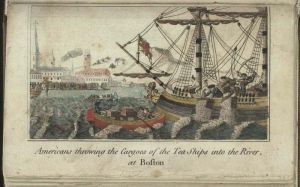 The town meeting held on the night of December 16, 1773 at the Old South Meeting House was no ordinary meeting. Boston was well known for its public meetings, but this one was different. Frequently city leaders called town meetings to discuss important political, economic and social decisions facing the city or colony. The town meeting was a foundation of the political process for Massachusetts and much of the New England colonies. Royal authorities had watched these meetings more closely since the 1760s during the opposition to the Stamp Act. Colonial Whigs (anti Royal leaders) had used these meetings to protest British policies that they saw as threats to their liberties.
 India Company. Before 1773, the company had to sell its tea in London and was subject to duties. The company had collected large quantities of tea in warehouses in London and was looking for a way to disperse the tea at a bargain. The Tea Act allowed the company to sell directly to American ports without paying the duties. This also forced American buyers to only purchase their tea from the East India Company, which was subject to a tax. The good news was the price of tea was reduced because the Company no longer had to pay the duties in London. Colonists resisted the notion that Parliament could force them to buy tea from the East Indian Company (many made a good living off of smuggled tea sales) and that they were required to pay a tax on the tea.
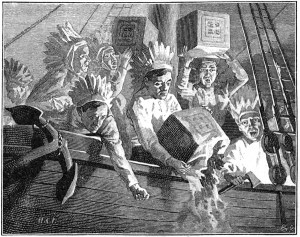 Many details remain unknown about who exactly the “Mohawks” were that marched on Griffin’s Wharf that night. The men used lamp soot and red ochre to disguise their faces and carried a wide assortment of weapons. As they made their way to the wharf, they yelled and “whooped” as Indians in a war party. If they had coordinated the timing with leaders in the Old South Meetinghouse, it is still unknown. The identities of most of these men either were never recorded or are lost to history; that is how tight their veil of secrecy was coupled with their sophisticated organization. As they made their way to the ships, the Whig leaders inside the Old South Meetinghouse stayed behind and were never directly part of what happened next.



 Emerging Revolutionary War Era
