Shortly after 11 p.m. on the night of June 16, Colonel (although the monument calls him general) William Prescott led approximately 1,200 Massachusetts soldiers toward the Charlestown Peninsula from Cambridge Common. These men would spend the night fortifying Breed’s Hill before spending the majority of the next day defending the earthen redoubt from successive British attacks. Although forced to evacuate due to low ammunition and the British breaching the redoubt, the defeat had a positive impact on the morale of the “Grand Army” as the New England militia soon-to-be-Continental Army.
Category: Revolutionary War
“Rev War Revelry” The Battle of Bunker Hill
On Tuesday, the 250th anniversary of the Battle of Bunker Hill, fought on Breed’s Hill on Charlestown Peninsula, will be remembered. On June 17, 1775, the last major engagement before George Washington arrived in Massachusetts to take command was fought between militia under Colonel William Prescott and British forces under General William Howe. Although a defeat for the patriots, resulting in the death of Dr. Joseph Warren, the victory was a pyrrhic one for the British.

Join Emerging Revolutionary War historians as they discuss the engagement, the personas, and the ramifications of the Battle of Bunker Hill. Also, stay tuned until the end for an announcement as well.
So, two days before the 250th, grab your favorite beverage and tune into our Facebook page at 7 p.m. EDT and have your questions ready. If you are unable to attend the live on Sunday evening, don’t fret, the video will be posted to YouTube by the anniversary and to our podcast channel as soon as possible
Review: Matthew E. Reardon, The Traitor’s Homecoming: Benedict Arnold’s Raid on New London, Connecticut, September 4-13, 1781.
Emerging Revolutionary War welcomes guest historian Riley Sullivan, Professor of History at San Jacinto College in Houston, Texas.
While many might be familiar with famed engagements at places like Bunker Hill, Saratoga, and Yorktown during the Revolutionary War, few are familiar with the actions that took place near New London, Connecticut in September of 1781. However, for the people of Connecticut, the battles that took place near Groton Heights and New London have been immortalized as a campaign highlighted by treachery and massacre. Largely, this interpretation has been adopted due to the commander of the British forces who engaged in this raid, Benedict Arnold.
Perhaps no other name in American History brings about more scorn than that of Benedict Arnold. Having defected to the British cause late in the Revolutionary War, for Americans at the time–and even today–he is viewed as a modern day Judas. However, with such infamy ultimately comes much misinterpretation of this historical figure and the events he was involved in. In Matthew E. Reardon’s recent study The Traitor’s Homecoming, he attempts to undo much of this misinterpretation. Drawing on previously unused primary sources, Reardon constructs an engaging argument that challenges the traditional view of Arnold’s conduct in the New London raid.
To construct this narrative of the New London raid, Reardon attempts to place into context the setting of the New London raid. By this stage in the war, the conflict in New York had been a state of stalemate for the previous few years. However, with Generals Washington and Rochambeu’s combined Franco-American forces on the move, the British commander in the region, Henry Clinton—informed by faulty intelligence as Reardon demonstrated—was convinced that an attack on New York was imminent. As a result, to divert Washington’s attention away from a possible attack on New York, Clinton authorized Arnold to lead a contingent of British troops to attack the vulnerable Connecticut coastline.
New London made the ideal target for a British raid as it had been a hotbed for commerce and privateering for the Patriot cause. To conduct such a raid, Clinton turned to Arnold as he was both a native of Connecticut and familiar with the New London area. Largely only being contested by militia behind a number of forts that guarded approaches to both the town and the Thames River, Arnold’s combined force of Loyalists, Hessian Jaegers, and British regulars made quick work of the Patriot militia throughout the campaign. Even with New London in their hands, outside events–notably Clinton’s realization that Washington was moving on Cornwallis at Yorktown–led to Arnold having to relinquish his gains. However, with the high casualties suffered by both sides during the raid, coupled with the burning of much of the town, the events “cemented Benedict Arnold’s reputation for villainy.” (x)
When considering the traditional interpretation of Arnold’s raid on New London, Reardon makes it clear throughout his work that a “distorted interpretation” of the events had emerged (ix). From veterans to the Groton Battle Monument at Fort Griswold Battlefield State Park, the events that took place in Connecticut in 1781 have been enshrined as a massacre of Connecticut militia at the hands of Arnold. However, when looking at contemporary letters, diaries, and later pension records, Reardon demonstrates that there are some noticeable gaps within the traditional account of this campaign. In particular, when examining the death of Colonel William Ledyard–who was alleged to have been killed while attempting to surrender–Reardon concluded that through these sources, the traditional accounts accepted proved to be inconsistent with contemporary accounts of the campaign.
But, even with these inconsistencies, this is not to say that the fighting at Fort Griswold and the subsequent burning of New London was less than brutal. Reardon wrote that “the immediate reaction of the community was shock” and that “for many it was beyond comprehension.” (339) To no surprise, this sheer shock of the fighting coupled with Arnold’s involvement led to this distorted narrative of the campaign.
Through the examination of contemporary letters, diaries, and later pension applications, Reardon is able to reconstruct in great detail the events of Arnold’s New London raid and offer an unbiased narrative. By providing these fresh sources in The Traitor’s Homecoming, Reardon effectively builds on the existing literature of the subject and demonstrates how public perception can lead to the misinterpretation of historical events like that of the New London raid.
Details:
Matthew E. Reardon, The Traitor’s Homecoming: Benedict Arnold’s Raid on New London, Connecticut, September 4-13, 1781. Published by: Savas Beatie LLC. Summer 2024. 448 Pages.
*Check out Emerging Revolutionary War’s YouTube page as well for a “Rev War Revelry” interview with author Matthew E. Reardon.*
“Rev War Revelry” Bullet Strikes from the First Day of the American Revolution
Much has been written about the “shot heard around the world,” as the poet Ralph Waldo Emerson eloquently wrote in the 19th century. Yet, what about those actual shots? The musket balls fired on April 19, 1775? What was the damage, and how does this material culture history add to our overall understanding of the events that unfolded on that fateful day? Thanks to historian Joel Bohy, who is part of a duo of historians, along with Doug Scott, we now have insight into that answer.
Using forensic techniques, seemingly straight out of CSI, the authors have done painstaking research into the bullet holes and artifacts struck by bullets to shed even more light on the events that unfolded along Battle Road, Lexington, and Concord on the first day of the American Revolution.
Join Emerging Revolutionary War for this pre-recorded “Rev War Revelry” this Sunday evening at 7 p.m. EDT with author Joel Bohy as he explains the history and research behind this book. A much-needed addition to any Revolutionary War enthusiast’s bookshelf!
Major John Van Dyk and the Bones of Major John André. Part I
Emerging Revolutionary War welcomes historian and educator Jeffrey Collin Wilford to the blog. A brief biog is at the bottom of this post. A list of sources will be at the bottom of the concluding Part III.
Major John André and John Van Dyk: Continental Artillery Soldier
Much has been written about the betrayal of America by Benedict Arnold. However, one small but candidly morbid fact buried in the story has not. It relates to the disposition of British Major John André’s remains as they lay in a wooden ossuary on a British mail ship on the banks of the Hudson River while awaiting their return to England in 1821. The only recorded recollection of this event was in a letter written by a 67-year-old former Revolutionary War soldier and published in a Virginia newspaper in 1825. This man also happened to be one of the four officers who escorted André to the gallows in Tappan, New York, on October 2, 1780.
John Van Dyk lived a storied life, serving America as a militiaman, Continental Artillery soldier, customs officer, New York City assessor, and assistant alderman. He came from an old Dutch family that had settled in the original New Amsterdam colony, which would eventually become Manhattan. There is ample evidence that, in 1775, he was actively involved in significant acts of disobedience against British rule with other “Liberty Boys,” as the New York Sons of Liberty preferred to call themselves.
One of these acts was stealing muskets and cannons from the Royal Armory and Fort George. Under the encouragement of Isaac Sears and Marinus Willett, he was one of a crowd of colonists who broke into the Royal Arsenal at City Hall on April 23, 1775, stealing 550 muskets, bayonets, and related munitions. The angry mob had been spurred to act by the attacks on their fellow countrymen the week previous at Lexington and Concord in Massachusetts. Every person who took a musket was required to sign for it, signaling a promise to return it if it was needed to fight against British occupation. That call came on July 4, 1775, when the New York Provincial Congress ordered them recalled to outfit newly commissioned Colonel Alexander McDougall’s 1st New York Regiment. It was relayed that anyone who refused would be deemed an enemy of the state. In all, 434 muskets were returned.
Exactly four months later, Captain John Van Dyk was one of sixty or so men who, under Liberty Boys Colonel John Lasher and Colonel John Lamb, executed the orders of the New York Provincial Congress to remove the cannon from Fort George at the southern tip of Manhattan and drag them back to the area of City Hall. With tensions high in the city, the state leaders feared they would be turned against the colonists if they were left in the hands of the British. One of the militia members assisting in the removal effort was 19-year-old King’s College student Alexander Hamilton of the Hearts of Oak independent militia. By this time, civil unrest had relegated the British colonial government to operating from naval ships anchored in New York Harbor, which made keeping the cannon secure from a more agitated population nearly impossible.
Just before midnight on August 23, 1775, a skirmish ensued between Lasher and Lamb’s men removing the cannon, and a British barge near the shore. It had been sent to monitor the rebels’ activity by Captain George Vandeput from the HMS Asia, a 64-gun British warship anchored near shore. Musket shots rang out, presumably started by the British, which resulted in the killing of a King’s soldier on the barge. As a result, the Asia turned broadside and opened fire with their cannons in a barrage on the city that lasted for three hours. A city whose population had already been diminished by the fear of a coming conflict, shrunk even further due to the terror experienced that night.
John Van Dyk spent most of the next eight years as an officer in General Henry Knox’s artillery while under the command of Colonel John Lamb. During the war, he saw action at Brooklyn, Harlem Heights, White Plains, Trenton, Brandywine, Germantown, Crosswicks Creek, Monmouth, and Short Hills. He was also at both Morristown winter encampments and Valley Forge. In 1780 he was captured by the British off the coast of New Jersey and confined on the prison ship HMS Jersey in Brooklyn before being released that summer.
Van Dyk had spent months out of commission in late 1779 and early 1780 with what, according to his symptoms, was probably malaria or yellow fever. He petitioned General Knox, who, in turn, appealed to General Washington for leave to recuperate. Making his way to West Point to meet with General Washington he was instructed by the Commander-in-Chief’s aide-de-camp to be evaluated by Dr. John Cochran, physician and surgeon general of the army of the Middle Department. On Cochran’s recommendation, General Washington wrote to President Samuel Huntington asking that the Continental Congress grant Van Dyk’s petition for an 8-month Furlow to sea to convalesce, which was common at the time as it was believed the fresh sea air was helpful to healing. Approved, it would take six months before he boarded the brig General Reed with a crew of 120 and 16 guns, a privateer out of Philadelphia commanded by Samuel Davidson. Once aboard ship he was temporarily made a Lieutenant of Marines.
Only two days into the voyage, on April 21, 1780, things took an immediate turn for the worse when they were intercepted and captured by the 28-gun HMS Iris and the 16-gun sloop HMS Vulture. The Iris was the former American warship USS Hancock, captured in July of 1777 and renamed by the British. Van Dyk was brought to Brooklyn and placed on the prison ship Jersey in Wallabout Bay, one of the most notorious and deadly places for holding American prisoners of war. Conditions were so poor that, while approximately 6,800 American soldiers died in battle during the Revolution, over 11,000 prisoners died on the Jersey alone! Fortunately for John Van Dyk, American officers were often traded off the Jersey for British officers who were in the custody of American forces. Within two months he was released and traveled to his temporary home of Elizabethtown, New Jersey to finish recuperating before rejoining Lamb’s artillery in Tappan, New York.
John Van Dyk had experienced many horrors of war in the years and months leading up to the morning of September 21, 1780, when British Major John André, an Adjutant General to British General Sir Henry Clinton, left New York City and sailed up the Hudson River. This pivotal incident would brand one of Washington’s closest generals a traitor and lead to the death of the esteemed and well-liked André. Ironically, Major André traveled on the very same sloop that had assisted in the capture of Captain Van Dyk just six months earlier.
Bio:
Jeffrey Wilford has been an educator in Maine for over 30 years where he holds certifications in history and science. He received a bachelor’s degree in communications with an emphasis in journalism from California State University – Fullerton and a master’s degree in education, teaching and learning, from the University of Maine. In addition to his career teaching, he has worked as a general assignment newspaper reporter and an assistant to the press secretary of former Maine Governor and US Congressman Joseph Brennen. He lives in Maine with his wife Nicolette Rolde Wilford.
Francis Channing Barlow: Chief Marshal of Concord’s Centennial
Emerging Revolutionary War welcomes guest historian Andrea Quinn.
In April 1875, Concord, Massachusetts, commemorated the centennial of the American Revolution’s beginning with a celebration that merged historical remembrance with contemporary national healing. At the heart of this tribute stood Major General Francis Channing Barlow, chosen as Chief Marshal for the event. His presence and leadership embodied the spirit of both Concord’s revolutionary origins and the sacrifices of the recent Civil War. Though his life included many achievements—from battlefield valor to public service—it was in this role as Chief Marshal that Barlow served as a living link between generations of American struggle and aspiration.
Barlow’s appointment was no mere formality. A Civil War general known for integrity, courage, and commitment to reform, Barlow had deep ties to Concord. As a youth, he was shaped by the town’s intellectual and moral environment, attending lectures by Ralph Waldo Emerson and immersing himself in the ideals of Transcendentalism. This upbringing instilled in him a strong sense of civic duty, justice, and personal responsibility—qualities that defined his wartime leadership and post-war public service.
The Concord Centennial was intended as more than a local remembrance—it was a national event. The town’s planning committee sought a figure who could represent both the revolutionary past and the post-Civil War Union. Barlow, whose own life had traced the arc of American idealism—from Brook Farm to the battlefields of Gettysburg and Spotsylvania—was their clear choice.
Continue reading “Francis Channing Barlow: Chief Marshal of Concord’s Centennial”250th Anniversary: Benedict Arnold’s War Begins, April 22, 1775
On Friday, April 21, 1775, word arrived in New Haven, Connecticut, regarding the fighting at Lexington and Concord. The Revolutionary War had begun, and thousands of militiamen from Massachusetts and the surrounding colonies in New England were converging around Boston to lay siege to the British army bottled up in the city. The next day, New Haven’s militia unit, the Governor’s Second Company of Guards, or Second Company, Governor’s Foot Guards, prepared to march to Cambridge.
Garbed in “A scarlet coat of common length, the lapels, cuffs and collars of buff and trimmed with plain silver wash buttons, white linen vest, breeches and stockings, black half leggins and small, fashionable and narrow ruffled shirt,” the Foot Guards made for quite the appearance. At the head of the 65-man-strong company was Captain Benedict Arnold, a leading member in revolutionary New Haven.
Arnold, 34-years-old at the outbreak of the war, had not stood pat during the decade leading up to April 1775. He was a member of the Sons of Liberty, and on multiple occasions, led mobs against the pro-monarchy members of the community. His leadership and zeal were recognized in March 1775 when he was elected captain of the militia. Like so many other patriots throughout the colonies, the shots fired at Lexington and Concord on April 19 would catapult Arnold onto a path to glory, and unfortunately for the country, later treason.
When the news arrived in town the evening of April 21, fifty-eight members of the Foot Guards voted to march to the assistance of their New England brethren. The next morning, Captain Arnold assembled the men on the New Haven Green, where the powder house was located. The doors were locked, and the keys to the stores in possession of New Haven’s Selectmen. Just off the green, at the intersection of College and Chapel Streets, stood Beers Tavern, where the Selectmen were gathered and discussing the town’s response to the recently received news.
The Foot Guards positioned themselves outside the building, while Arnold banged on the door demanding the keys to the powder house. The Selectmen refused to turn them over until official orders arrived. “None but the Almighty God shall prevent my marching,” Arnold passionately assured them. His forceful persuasion worked. The storehouse was opened, and the militia retrieved the necessary ammunition, flints, and powder. Once equipped, Arnold led his men out of New Haven and began a three-day march to Cambridge to join the fight.
Idleness was not in Benedict Arnold’s nature, and upon arriving within the army’s camp, he approached the Massachusetts Committee of Safety with a proposal to lead an expedition against the British-held Ford Ticonderoga situated between Lake George and Lake Champlain in New York. The fort helped defend the crucial waterway system running north-south from Canada and housed cannon that could be vital to the patriot cause. The committee’s chairman, Dr. Joseph Warren, backed the plan and it was approved. On May 3, Arnold was promoted to colonel in the service of Massachusetts (not Connecticut) and was ordered to raise a force in western New England to accomplish the mission. The future hero of Saratoga and traitor to American liberty spurred his horse out of Cambridge and set his sights on taking “America’s Gibraltar.”
Review: “The Ride: Paul Revere and the Night That Saved America” by Kostya Kennedy
“LISTEN, my children, and you shall hear
Of the midnight ride of Paul Revere,
On the eighteenth of April, in Seventy-five”
Henry Wadsworth Longfellow penned the poem, “Paul Revere’s Ride” in 1860. Now as America moves toward celebrating the 250th anniversary of Paul Revere’s famous ride, which happened on this date in 1775, another literary work has hit the market on this very topic.
Published on March 25 by Kostya Kennedy, Chief of Premium Publishing at Dotdash Meredith, with a lengthy career in writing, teaching, and journalism. The book reads like Revere’s ride, a fast-paced, descriptive overview of the man, events, and memories around the night of April 18, 1775. For those who have read David Hackett Fischer’s book, published in 1994, you may not find anything groundbreaking or new. However, that is not the point I feel in this book.
Kennedy pens this to get the reader hooked. Sets of rhetorical questions, “what-if” scenarios, and descriptive writing make the reader feel that they are in the environs of Boston or on the routes to Lexington traversed by Revere. Oh, and Kennedy does not forget Dawes, Prescott, and others who also played prominent roles in April 1775.
History enthusiasts and content experts may find a few shortcomings and errors, such as Kennedy continuing to use “Royal” when discussing the British Army. Since the English Civil War, the British Army has lost the right to use “Royal” in front of it. A few times, he labels the “British” as coming when the colonists would have used “Regulars” or “Redcoats.” Lastly, falling into the ag-old myth that Lexington had minutemen and a militia, the town just had the latter. Trivial things that do not impact the flow of the narrative.
A highlight to me, though, is the final sections about the memory of that day. Including a great insert of an interview with the direct descendant of Paul Revere and a comical anecdote about Paul Revere III being pulled over for speeding in Lexington, Massachusetts one year on April 18.
The book is a great read on the anniversary of Paul Revere’s Ride. Take it from me, I read the book in a day! Descriptive, vivid, and convince you that if you have not been, a trip to Boston and the Massachusetts countryside should be in your near future.
Published by: St. Martin’s Press, March 25, 2025
Images, sources, 282 pages
The Bloody Battle Road: Battle of Menotomy
ERW Welcomes Matt Beres, Executive Director of the Arlington Historical Society
On the morning of April 19, 1775, the first shot of America’s War for Independence was fired on the Lexington Green. Later that morning, Major John Buttrick, commanding the local Provincial forces, gave the order to fire on the British Regulars at the North Bridge. This act would later be remembered as the “Shot Heard ‘Round the World,” a phrase immortalized by Ralph Waldo Emerson.
As Lt. Col. Smith’s British Regulars began their retreat back to Boston, Governor Thomas Gage sent a relief column of Regulars, led by General Hugh Percy. Meanwhile, Provincial militias and minute companies from surrounding towns marched toward the conflict, firing on both sides of the main road leading back to Boston. The Battle was just beginning.
While Lexington is famous as the site of the “first shot” and Concord for the “Shot Heard ‘Round the World,” Menotomy (present-day Arlington) is known as the site of the largest battle of the day, where fierce fighting erupted between the retreating British forces and the growing Provincial forces. The following stories are from this Battle.
David Lamson
Earlier that day, a convoy of provisions and supplies, protected by a detachment of British Regulars, arrived behind the main force heading toward Lexington and faced difficulties crossing the Brighton Bridge. Before their arrival, the Committee of Safety had removed the planks, and the combination of heavy wagons and repairs to the bridge caused the convoy to become separated from the main force, rendering it vulnerable.
An alarm rider from Cambridge alerted locals, prompting men from the ‘exempt’ or ‘alarm’ list—those unfit for regular Militia or Minute companies—to gather at Cooper’s Tavern to plan to capture the convoy. Among them was David Lamson, a biracial French and Indian War veteran, whose experience and bravery made him a natural leader. The group quickly appointed him as their Commanding Officer.
According to a story derived from Lamson himself, they positioned themselves behind a stone wall near the First Parish Meeting House. As the convoy approached, they ordered it to surrender. When the drivers urged their horses forward, Lamson’s men fired, killing the driver and several horses, and wounding two Regulars. In panic, the remaining six Regulars fled toward Spy Pond, and discarded their weapons.
It is said they then surrendered to an old woman, Mother Bathericke, who was in the field picking flowers. The old woman forced them to the house of Ephraim Frost, Captain of the Menotomy Militia, and stated, “… you tell King George that an old woman took six of his grenadiers prisoners.”
Samuel Whittemore

Around 4:00 pm, the retreating British Regulars arrived at the village Menotomy. It was here where Samuel Whittemore, the oldest known combatant of the Revolutionary War, earned his fame. During the conflict, Whittemore took cover behind a stone wall. He reportedly fired at five soldiers but was soon overwhelmed. He suffered a gunshot wound to the cheek and a bayonet stab wound. When the Regulars continued their retreat, the locals carried him to Cooper’s Tavern, where Dr. Tufts of Medford treated his injuries.
Remarkably, Whittemore survived for another 18 years after suffering these life-threatening wounds. He lived long enough to see the birth of a new and independent nation.
Jason Russell
Later during their retreat, Gen. Percy ordered his men to enter the residences along Concord Road (now Massachusetts Avenue) to eliminate the Provincials who were firing from inside these houses. One notable example was the site of Jason Russell House.

Jason Russell was a middle-aged farmer who reportedly had a leg disability. He barricaded his property and refused to leave, asserting, “An Englishman’s house is his castle.”
As British Regulars surrounded his home, several Provincials from different towns sought refuge inside. Tragically, Jason Russell and several others lost their lives on his property.
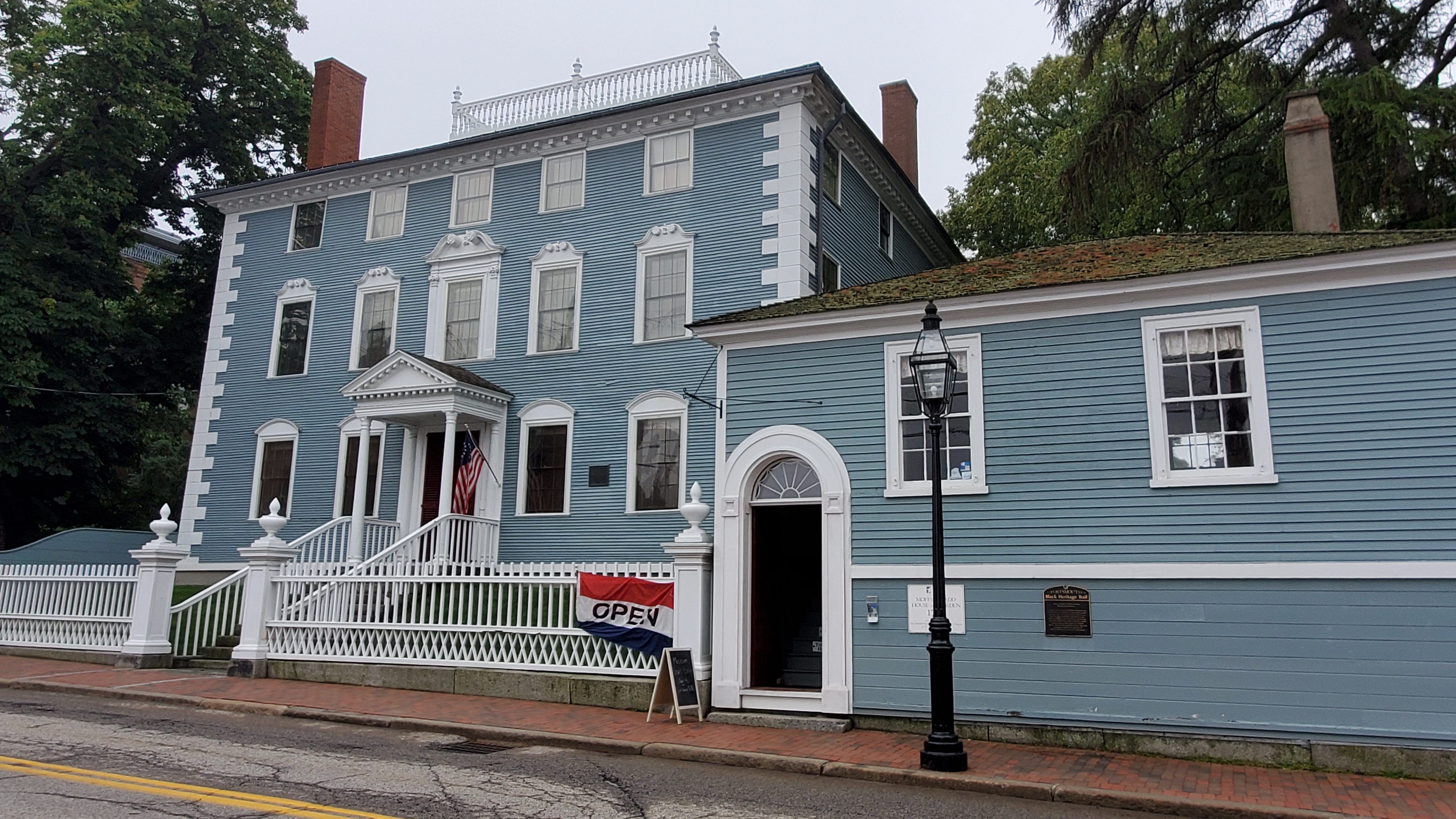
Today, the c. 1740 house, still bearing musket ball holes in the remaining structure from the fight, is at the heart of the Arlington Historical Society’s regional history museum, offering guided tours and engaging exhibits that highlight the lasting impacts of the American Revolution and Arlington’s broader history.
Explore more at: https://arlingtonhistorical.org/
Matt Beres
Executive Director
Arlington Historical Society
“The Robin Hood of the American Revolution” Walt Disney’s The Swamp Fox
Emerging Revolutionary War welcomes guest historian Tom Elmore. Brief bio is at the bottom of the post.
When Walt Disney’s Disneyland anthology series, featuring shows inspired by the themes of the park’s sections, debuted in 1954 it ended the television season at #6 in the Nielsen television ratings and improved to #4 the next season. Much of that success was due to the Davey Crocket episodes, one of the first major television phenomena.[1]
But the series dropped to #14 in the third season and was out of the top twenty in the fourth and fifth seasons. The American Broadcasting Company (ABC) which carried the program, renamed Walt Disney Presents, pressured Disney to come up with another Crockett and more westerns which made up most of the top 20.[2]
Disney later complained that “I found myself in a straightjacket. I no longer had the freedom of action…They kept insisting that I do more and more westerns and my show became loaded…with every western myth.” Consequently, relations between Disney and ABC became strained.[3]
Disney turned to one of his passions, American history, to create a series based on the partisan leader, General Francis Marion, “the Swamp Fox,” who harassed British troops in South Carolina during the American Revolution.[4]
Continue reading ““The Robin Hood of the American Revolution” Walt Disney’s The Swamp Fox”