

Propaganda, imperial ambitions, and one small ear caused a flare-up in the New World between the European powers of Great Britain and Spain. In one of the most comical, bewildering, and interesting causes for war, the conflict known as the War of Jenkins’ Ear began eight years after the incident itself. The connections that this conflict would have with the successful outcome of the American Revolutionary War is what is most striking. Continue reading “War of Jenkins’ Ear and the Washington Connection”
Category: Revolutionary War
Revolutionary Projects in Concord, Massachusetts
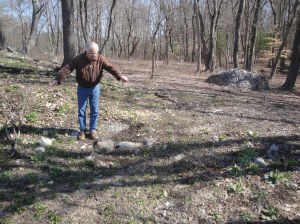
Recently, ERW members Phil Greenwalt and Rob Orrison spent the 241st anniversary of the opening of the American Revolution in the outskirts of Boston in Concord, Massachusetts. It was a whirlwind trip of research, photos and most importantly meeting the stakeholders in historic preservation and public history in the region. We already knew how active Concord was in promoting and preserving its history, but each time you visit you are blown away by their efforts and their appreciation for their past.
While in Concord, our more than gracious host was Jayne Gordon. Jayne has been involved in almost every public history project or initiative in the Concord area. A native of the area, everyone in Lexington and Concord knows Jayne. Jayne took the time to introduce us to many people and organizations in the area. I wanted to focus on two organizations that are doing great work in the region to promote local history with a national impact.
The Robbins House
Formerly the Drinking Gourd Project, The Robbins House is introducing people to the story of African Americans in the region. The all-volunteer board and staff are breaking new ground. Facing misconceptions of slavery in 18th century Concord head on, Robbins House President Maria Madison has led the charge to change the narrative.
The Robbins House is an early 19th century house that was inhabited by the first generation

of descendants of formerly enslaved African America Revolutionary War veteran Caesar Robbins. Using the story of Caesar Robbins as a base, Maria and her fellow volunteers interpret the role of African Americans in 18th and 19th century Concord. Most forget that 18th century Massachusetts was a colony that supported and practiced slavery. The Robbins House also interpret stories of how literary icons, such as Ralph Waldo Emerson and David Henry Thoreau, dealt with slavery and prejudice. Again, most visitors (including me!) have their preconceived notions challenged. The Robbins House also provides exhibits on other aspects of African American history of Concord, as well as lectures, programs and self-guided tours of Concord.
The Robbins House’s location next to the famous North Bridge provides an interesting juxtaposition on freedom and liberty. Just a few hundred yards away the dream of American freedom and independence began and the Robbins House is filling the void of how that liberty equated to a large portion of the American population. On your next visit to Concord, it is a worth your time and support. I really enjoyed my time meeting with Maria and look forward to future conversations and visits. Visit their website at for more information www.robbinshouse.org.
Friends of Minuteman National Park
Many of our readers are aware of the recent “Parker’s Revenge” project and preservation project with the Civil War Trust’s “Campaign 1776.” Also, I bet all of our readers are aware of Minuteman National Historical Park, but how many know about the great efforts of the Friends of Minuteman National Historical Park? I must admit, until my recent visit I include myself if that “unknowing” category. Jayne introduced us to Robert Morris, President of the “Friends,” and Bob spent a morning going over the organization and their recent efforts to promote new historic research, archaeology and restoration of the area known as “Parker’s Revenge” along the Battle Road.
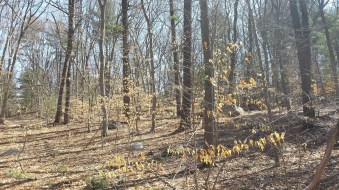
“Parker’s Revenge” occurred on the afternoon of April 19, 1775 along the road between Concord and Lexington. Captain Parker, who earlier that day confronted the British on the Lexington Green, regrouped his militia and prepared for an attack on the British column as it made its way back to Boston. As they marched through Lincoln and approached Fiske Hill, Parker’s men opened up a deadly fire from behind rocks. Up until last year, historians have always interpreted the event to take place along the Battle Road next to the modern Minuteman National Historical Park Visitor Center. But now, thanks to fundraising and manpower efforts of the “Friends”, the history of “Parker’s Revenge” is being rewritten. With new archaeology, the area of “Parker’s Revenge” will be reinterpreted a few hundred yards west of the current location. Bob and his team of volunteers also plan to work with the National Park Service to assist in restore the historic landscape in the area.
The “Friends” also fundraise to support interpretation projects, grounds projects, and support the large volunteer corps at the park. One of the most important tasks for the organization is advocating on behalf of the national park. My morning spent with Bob and Jayne walking the newly discovered “Parker’s Revenge” battlefield was a highlight of my trip. Being one of the first people to walk the “new” battlefield and hear how the project developed was a special treat.
I highly recommend you follow along the many projects the “Friends” have on going to support Minuteman National Historic Park. They are always looking for new members, no matter where you may live. Visit their website at www.friendsofminuteman.org
Again, I cannot thank Jayne Gordon enough for showing me around Concord and sharing her passion for history. I appreciated my short time with Maria Madison of the Robbins House and Robert Morris of the Friends of Minuteman National Park. Both are breaking new ground and supporting preservation and interpretation of the events surrounding spring 1775. These are the people on the front lines and that meshes well with one of the established goals of Emerging Revolutionary War is to share and promote these public history organizations. They are instrumental in telling the story of the American Revolution.



Dorchester Heights
On a recent trip to Boston, I was shown by fellow Emerging Revolutionary War historian Rob Orrison, Dorchester Heights. One of my favorite quotes of the entire American Revolutionary War was in reference to the Continental Army’s move to fortify the very heights at Dorchester.

“My God, these fellows have done more work in one night than I could make my army do in three months.” Uttered by General William Howe the morning after the Americans had used the night to build an entire fortification network on the commanding hillsides of Dorchester.
This move, conducted in the secrecy of the night, led to the British evacuation of Boston, after an aborted offensive by the British do a providential snowstorm. Less than two weeks after that influential night, on March 17, 1776, the British evacuated Boston, never to return.
I did not get to spend too much time on the heights but I was able to snap a few pictures, shown below. But, I did have the great fortune to be on the heights at night, looking out over Boston, which has grown just slightly since 1776. A few moments of silence ensued, where I had the chance to mull over what that view must have looked like and what the soldiers who hurriedly dragged the fascines and gabions, and shoveled dirt that night must have worried about as they feverishly tried to finish their duties.

The cannon that bore down on Boston from the heights of Dorchester Heights were a product of one of the greatest feats of the entire war. Former Boston bookseller turned artillerist extraordinaire had brought the heavy armament on an arduous trek, through the late stages of winter from upstate New York to the Continental Army besieging Boston.
Henry Knox was the man behind the delivery and he would serve as George Washington’s Chief of Artillery before the war was over. Afterwards, Knox would become the first Secretary of War in Washington’s Administration. At Dorchester Heights, with Washington’s planning and Knox’s delivery the city of Boston was liberated without firing a shot.

The heights retained its military importance through the end of the War of 1812. By the end of the 19th century, in 1898, the General Courts of Massachusetts had commissioned a monument to stand on what remained of the heights. The white marble Georgian revival tower that stands 115 feet, commemorates that night in 1776 that American soldiers did what British soldiers would take months to complete. By 1978, after a listing on the National Register of Historic Places, the monument and remaining hill site was handed to the National Park Service by the city of Boston. Dorchester Heights became part of Boston National Historical Park which was established in 1974.
When planning a visit to Boston National Historical Park and to Dorchester Heights, which is open to visitation, both during the day and at night please consult the website for the national park here. That way you can familiarize yourself with the regulations and how to make the most of your visit.

Hessian Camp, Reading, Pennsylvania: A Childhood Mystery Solved
I grew up in a suburb of Reading, Pennsylvania. Reading is the county seat of Berks County, and is located about sixty miles northwest of Philadelphia. Reading is an old town; Richard and Thomas Penn, the sons of William Penn, founded the town in 1743. It is situated on the banks of the Schuylkill River, and has always been an important logistics center as a result. German immigrants settled much of Berks County, and many in the area spoke the language. Today, Reading remains the gateway to the so-called Pennsylvania Dutch region.
There’s a part of the east side of the city, situated at the base of Mt. Penn, the dominating high ground that overlooks the city, called Hessian Camp. This is what a local newspaper writer said about that part of town a few years ago: “Reading’s Hessian Camp section is arguably the city’s finest neighborhood. Mansions line the curvy, hilly streets…The neighborhood, tucked into the side of Mount Penn, is hidden from the hustle and bustle of the downtown.” My mother’s favorite aunt and uncle lived in Hessian Camp.

A historical marker erected by the Commonwealth of Pennsylvania in Hessian Camp stands out. As a child, I thought it an odd name, so I started asking questions. I eventually learned that it was the site of a Hessian prisoner of war camp during the Revolutionary War. That satisfied my youthful curiosity, but as an adult who has traveled back to Reading regularly since moving away in 1983, I retained my interest in it and remained curious about it. Consequently, I decided to tackle it and see what I could learn of it. Eventually, the story took shape.
After George Washington crossed the Delaware River and surprised Hessian mercenaries at the Battle of Trenton, the Hessian prisoners of war were take inland for detention. Due to the heavy German presence in Reading, it was a perfect place to house these men because so many of the locals spoke the language and could converse with these men. They also hoped that the Hessians would desert and take up residence—and perhaps their loyalty—with the Patriot cause. Further, as a result of Reading’s location, it would require a determined campaign to free the prisoners of war.
The initial prisoners of war were housed in a temporary prison along the banks of the Schuylkill River. They spent a cold, rough winter, and many died of disease and/or cold. After the Battle of Saratoga, when it became obvious that more Hessian prisoners of war would be heading to Reading for detention, the local citizenry demanded that the POW’s be moved to a more remote location. The original campsite was about 12 acres in size, and housed about 1,000 detainees—about the same as the permanent population of Reading. There was plenty of fresh water from a spring and plenty of lumber to construct huts, so the site was chosen.
There are two surviving accounts from German POW’s housed in Reading. Johann Bense, from the Duchy of Brunswick, arrived in Reading on June 16, 1781:
On the bank of the Schuylkill, we had been camping on a meadow in the open air for 8 weeks and were plagued by the great heat during the day and by rain and cold during the night. On August 9, we marched from the Schuylkill via Reading onto a high, rocky mountain.
We were supposed to build barracks there. But because we did not want to agree to that right away, but rather made ourselves straw huts, we were treated very severely. A sharp command from the corporal forced us to build the barracks and it was our good fortune because all our straw huts were consumed by fire on October 21, 1781.
Therefore, those who had not yet completed their barracks, had to do more now to get them ready. Through that, the men got some freedom to go into the country and work and so they kept their supplies. They are read out twice a month [report for roll call twice a month].
On April 26, 1782, we received money, linen trousers, shirts, and 1 pair of shoes from Lieutenant du Roi [of the Regiment Prinz Friederich]. Now, our situation was pretty good.
It did not last long, however, that they locked us up and all who were in the country and worked there, had to come in [to the city].
In the month of July, they read us an order from Congress. Any one of us wanting to be free, and that immediately, should give 80 silver talers [one British pound was worth 5 5/6 talers] as ransom and if he did not have that much money, a citizen should pay it for him with whom he should work in bondage for 3 years.
But if we wished to enter service with them [in the American army], each would get 8 silver talers as gratuity and after the end of the war, he would be given 100 acres of land. This now was voluntary, to be sure, but because our men did not want to agree to that, we were treated very harshly.
Since a few of us deserted, 356 men [of ours] were suddenly taken to the Reading jail and because there was not enough room, they had to lie in the court yard in the rain and the cold. They had to buy wood and water.
Two hundred of our men were sent to the prison in Lancaster; the artisans were also taken there. Afterwards another 100 men were taken into prison, among them was myself. Because a few non-commissioned officers deserted, 42 sergeants and non-commissioned officers were also taken to jail. These had to lie in the cellar and below in the dungeon [at Lancaster]. Many of our men who could not stand it entered [American] service or sold themselves as indentured slaves for 3 years. The rest, who had been prisoners since September 11, were let out on December 16 but each had to give 1 taler.
The non-commissioned officers were let out after 17 days but because some deserted right away again, those having been in jail before were quickly taken back to prison and had to remain there up to the exchange.
Some of our men took up service on a pirate ship which was captured immediately at its departure from Philadelphia, and taken to New York. In the last year of our captivity, we thus were the most wretched and most miserable men. None of us could go out and none of the inhabitants were allowed to see us…
On February 13, we had our first news of peace [from a Hessian Quartermaster]. We continued being in doubt until finally in March a French ship arrived in Philadelphia with the same message. It was made known to us at the barracks on the 26th that there was peace with France, Spain, Holland, and England and now we were daily hoping for our release. . . On April 16 in the afternoon, the non-commissioned officers came out of the city jail and [returned] to the barracks.
On April 21, which was also the second day of Easter, at 12 Noon, 13 cannon shots were fired for the 13 free colonies. The whole city was illuminated in the evening and fires were made on April 24. In the morning the English Commissary Maclean came to give us each a blanket. Other staff officers came and we prisoners found out we would march to New York.
Bense departed Reading on May 3, 1783, and by May 10, had arrived in New York City. He eventually returned home to the Duchy of Brunswick,
The second account comes from a letter by Sgt.-Maj. Samuel Vaupel, who served in the Leib Company, Erbprinz Regiment of Hessen-Hanau. He reported to his commanding officer, Lt. Col. Lentz, in New York:
Your Excellency, I have a report to humbly send you, also a resolution from the Board of War of Congress and the address of Captain Thomas Bowen. From these, your Excellency will see in what a depressing situation we are in….We were told everyone must choose to either buy himself free or join the American service. The king would not help us, and our prince did not want us… Nobody [from the ranks] responded to this reading and speech. It was immediately ordered that now nobody could leave camp and the proclamation read three times daily. But our people pretty much stuck together.
On August 7, 1782, we were visited by Major-General [Benjamin] Lincoln and Brigadier-General [Moses] Hazen from Lancaster. The Corps had to form up and we were reviewed but they didn’t speak. They rode our regimental street and around the barracks, then went on to Reading.
On the morning of the 10th instant, Brigadier-General Hazen returned with a German Captain [Anthony] Selin from his regiment. The troops had to turn out again and form a circle. The General spoke, which was translated by the above mentioned captain. We should choose to either make ourselves free by paying 80 Dollars or join the American army; the King of England did not care enough about us to exchange us or pay for our provisions; they cannot provide for us any longer when they have problems feeding their own men; and if we continue refusing to make our decision, serious measures will be taken.
After the speech we NCOs said that we could not agree to these conditions, and asked if he would allow two NCOs from our Corps to go to New York to report these conditions to our commanding officer. If he says all hope is gone and doesn’t need us any longer, then every man can do as he wishes. The general’s answer was: He wanted to report it to Congress, but we have not heard anything as of now and don’t expect to.
The above mentioned Captain Selin is Swiss-born and cannot be described badly enough; he was introduced to us as our commander. The new captain called together all the NCOs and gave orders that nobody will dare go 10 paces beyond the post without being termed a deserter and when the provost guard calls and they don’t stop, the guard should fire on them
The water is located just outside the post, but nobody may go for it alone. The NCO of the guard has to call for water and one of his armed guards goes along to the well. This captain has ordered the guard to allow nobody out of camp, not even a woman or child, without permission. [Some of for-hire soldiers were allowed to have wives and children with them.]
He also said he has forbidden the local residents into the camp. It is not permitted to openly bring us an apple. Since all this did not help, the above mentioned captain announced the NCOs were to blame for the lack of enlistments – that they discouraged the men from enlisting.
This lasted until September 7, when he unexpectedly came to the barracks at daybreak and gave the order to march; our people were to go to the mountain with sack and pack. We all packed our things and when we were formed up on the barracks mountain, the captain went from right to left without saying anything. Finally, with the Brunswickers, he began pulling young people from the ranks.
When he came to our regiment he only said the married men and NCOs should step forward. The remainder dressed ranks, were turned right and joined up with the Brunswickers to march to the jail in Reading.
There were 142 men of our regiments and 158 Brunswickers, 300 in all. They filled up the jail and the remainder had to camp in the jail yard. The first day these people had to pay 2 pence for a pail of water and also had to pay for firewood to cook with. They were in this jail through the 10th instant.
On the 11th instant 102 men from the regiment and 84 Brunswickers were taken to the jail in Lancaster.
On the 24th instant, 21 men from the regiment and 25 Brunswickers were again taken to the jail in Lancaster. There is now nobody from the regiment in the Reading jail except the baker Muller from the Lt. Colonel’s Company.
Private Wiskermann of the Leib Company was employed in Reading by a rich widow. On September 2, the captain had him brought in from the widow and asked him to enlist, buy himself free, or be sent to an underground prison or dungeon as the English call it. He decided he would rather be free and the above mentioned madam, named Mifflin, ransomed him.
Fourteen men from the regiment who were employed at an iron smelter, have returned to the barracks. On September 23, 10 of these men were taken to the Reading jail. The other 4 men remained sick in the barracks; the other 10 men were taken, with others, on September 24 to Lancaster. They also had to each pay the jail keeper in Reading 1/4 Dollar for the one night lodging.
Concerning us here in the barracks, we expect daily and hourly to go to the jail. Captain Selin indicated, when the others went to jail, that at the slightest incident or attempt at desertion, the others would also go into the jail. We have to hear daily from this captain how our tyrannical prince no longer needs us and that we will not get any more clothing or money from him. We collectively humbly beg your Excellency to have mercy on us and rescue us from this unhappy and depressing situation.
Should this be impossible, we beg you to have the grace to send us uniforms, blankets, and money. Otherwise it will be impossible to withstand the coming winter as our blankets are torn and so little firewood is issued that we can’t make the fires small enough. . . nobody is allowed out to gather firewood.
Sergeant-Major Vaupel ransomed himself on or about December 8, 1782. His fate is unknown. The fates of the poor German soldiers sent to fight in North America remains a fascinating mystery.
Other than large, handsome houses, there is nothing left of the Hessian campsite in Reading. The historical marker and the name of the neighborhood are the only reflection of the former occupants of the area. However, the presence of those prisoners of war was among the earliest things to draw my interest in the Revolutionary War.

*Source for quotes: Henry J. Retzer, “The Hessian POW’s in Reading Revisited,” Berks History Center, http://www.berkshistory.org/multimedia/articles/hessian/*
Through the Lense of History: May 3, 1775
 Often the study of history can ground us and make us feel less “unique.” This allows us to hopefully put our own experiences into perspective and be able to hopefully learn from lessons of the past. Many today complain about how print and social media can distort facts to support a particular agenda. This is not a modern phenomenon. Many in the Sons of Liberty (such as Paul Revere) used print media to their advantage to promote resistance to and then independence from Great Britain.
Many pro-Patriot newspapers printed nothing less than propaganda pieces after the battles of April 19, 1775. Here is part of what was printed by the Massachusetts Spy on May 3, 1775.
“Americans! forever bear in mind the BATTLE of LEXINGTON! where British Troops, unmolested and unprovoked wantonly, and in a most inhuman manner fired upon and killed a number of our countrymen, then robbed them of their provisions, ransacked, plundered and burnt their houses! nor could the tears of defenseless women, some of whom were in the pains of childbirth, the cries of helpless, babes, nor the prayers of old age, confined to beds of sickness, appease their thirst for blood! – or divert them from the DESIGN of MURDER and ROBBERY!”
Obviously a historic study of the events on April 19, 1775 disputes much of what is claimed by the Massachusetts Spy. But when you have a point to make, an agenda to promote and a local population to rally to a cause…why should truth get in the way?! We have come a long way since 1775, but in many ways not much has changed.

The Greatest Leaders of the American Revolution You Have Never Heard Of
Sitting under a tree in north-central New York, suffering from a painful and mortal leg wound, yet still managing a successful defense after a powerful ambush, is a characteristic of a great military leader. All the while nonchalantly smoking his pipe!

Nicholas Herkimer was the epitome of a successful militia commander. The Battle of Oriskany was a turning point. Herkimer, sitting on a once innocuous hillside, was a major reason why.
Even George Washington recognized the importance of Herkimer and made mention of his decision to not seek a commission in anything more than the militia of his home state. Not only that simple fact of service recognized by the commander-in-chief, but also his pivotal role in the Northern campaign of 1777.
“It was Herkimer who first reversed the gloomy scene of the Northern campaign. The hero of the Mohawk Valley served from love of Country, not for reward. He did not want a Continental command or money.”
Herkimer would succumb to the mortal leg wound ten days after the battle, but his role in what was described as “one of the bloodiest battles of the war” solidified his place in the category of “greatest leaders of the American Revolution you have never heard of.”
Born in the Mohawk Valley of New York to Palatinate immigrants, Nicholas was described as a slender built, dark complexioned, dark haired individual. When he was finished growing, he stood near six feet tall, a rather tall height in 18th century Colonial America. He could also boast of being multilingual, fluently speaking English, German, and Iroquois.
He saw action in the French and Indian War, helping to repel the French and Native American attack on German Flatts, New York on November 12, 1757. Although a disastrous day for the German community, as many were taken prisoner by the French and Native Americans, Herkimer’s role led to his promotion to captain in the militia within two months of the fighting on January 5, 1758. Thirty-years after his promotion to captain the town would be renamed “Herkimer” for the actions of this New Yorker during the subsequent war.
In April of 1758, Herkimer was present and assisted in the successful repulse of the French and Indian force.
With peace established in 1763, Herkimer looked toward personal matters, building a house on the south side of the Mohawk River in 1764. He married two ladies, both named Maria. One died and the other would remarry and move north of the border to Canada, after Herkimer’s death in 1777.
With tensions increasing in the 1770s between Great Britain and the colonies, Herkimer led the Tryon County, New York Committee of Safety and was elected colonel of the local militia. The Provincial Congress on September 5, 1776 promoted him to brigadier general of the militia. One of his first roles was to meet with Joseph Brant, a Mohawk military and political leader in an effort to try and keep the Native Americans neutral in the conflict between the colonies and Great Britain. He was unsuccessful.
During the Northern Campaign of 1777, with the thrust southward by British General John Burgoyne being the main column on its way to its destiny at Saratoga, a secondary column entered the Mohawk Valley under British General Barrimore”Barry” St. Leger. The combined British, German, Loyalist, and Native American force laid siege to Fort Stanwix, in present-day Rome, New York.
Herkimer heard about this and marched his militia to help raise the siege. His force was ambushed on August 6, as they were nearing Fort Stanwix. After the initial surprise, in which Herkimer received his wound, the militia responded well and a drawn out battle ensued.
Part of the reason that the majority of the militia recovered from the shock and endured the ensuing bloody carnage was directly related to the inspired leadership of Colonel Samuel Campbell who led one of the militia regiments in the force and Herkimer himself.
Herkimer, after having his horse shot and receiving his mortal wound in the opening shots of the engagement asked to be propped under a tree on the hillside his forces had utilized for their defensive stand He then calmly lit a pipe and with a continued cool demeanor directed the rest of the engagement.
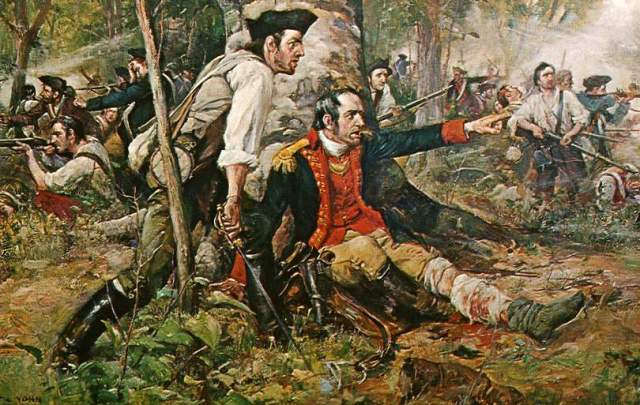
After the day-long battle, Herkimer ensured he was the last to leave the field, after all the wounded that could be collected had been removed.
Although his wound was dressed on the field, the injury became infected and amputation was the only course of action. In the woods of western New York, the surgeon doing the operation was inexperienced and the wound bled tremendously. Herkimer would succumb to the wound on August 16, at the age of 49. He was buried near Little Falls, where he had built his home in the 1760s. The cemetery today is known as the “Herkimer Home Burial Ground.”
*Nicholas Herkimer’s role in the war and the Battle of Oriskany and the St. Leger campaign is described wonderfully by Michael O. Logusz in Volume 2 of “With Musket and Tomahawk” published by Savas Beatie LLC in March 2012.*
Campaign 1776 Presents….The Revolutionary War Animated Map
 Debuting yesterday, the Campaign 1776, an initiative by the Civil War Trust, released an animated map that covers the “entirety of the American Revolution,” according to Civil War Trust Communications Manager Meg Martin.
At eighteen minutes in length, the video is a “succinct and engaging” access to gaining an overview of the entirety of the American Revolution, from the first shots in Massachusetts at Lexington and Concord to the culmination of the Siege of Yorktown in 1781. The video even includes a segment entitled “The Twilight Years” which explains the two years the war continued on after the victory at Yorktown; from 1781 to 1783. One can also jump to different parts, as the video has subheadings at the bottom to break the eighteen minute video into segments.
The video combines modern photography,with “live-action footage, 3-D animation, and in-depth battle maps” to give the viewer a sense of what the American Revolution, the pivotal event that “shaped America” was like.
To check out the video, click here.
Furthermore, “The Revolutionary War” animated map is part of a larger series of animated battle maps of battles on Civil War battles, which can be found here.
This animated map may be the first in the series of American Revolution and War of 1812 battles that the Campaign 1776 and Civil War Trust team is contemplating doing. We will all have to stay tuned and find out.
Yet, this animated map, of the entire American Revolution, is a great beginning introduction, so sit back, dedicate eighteen minutes, and learn about this defining moment in American history.
*Emerging Revolutionary War would like to thank Meg Martin of the Civil War Trust for the information about this release.*
Reflections of April 19, 1775
On this date, 241 years ago, the first salvo of what would become the American Revolutionary War, was fired on Lexington Green and North Bridge in Concord.
Historian John Galvin once wrote about the Battles of Lexington and Concord that they were the “least known of all American battles.” I never really understood what Galvin meant, as I had read extensively about April 19, 1775 and thought I understood the details of that day in history.
Yet, until this past weekend, when I spent the better part of four days touring the sites and walking the trails, talking to the historians around the towns, I did not realize how much more there is to what actually happened on that April day.
For starters, did you realize that Paul Revere did not go town-to-town calling out, “The British are Coming” to homesteads and roadside taverns? Instead, he was the catalyst that started a chain reaction of messengers and runners to different towns throughout the countryside that cast the alarm in a wide net.
He also would have told farmsteads and meetinghouses along the way that the “Regulars are Coming,” since the colonists still thought of themselves as British.
Or that the unofficial birth of the United States Army is attributed to the militia that followed Colonel James Barrett and Colonel John Buttrick down the hill toward the British at the North Bridge?

That was the first time that men, formed in regiments with officers, made an advance against what they perceived as an enemy force, and did so in a “very military manner.”
What prompted the various militia companies, which came from other towns than just Concord, to sally forth from the hill toward the now infamous North Bridge? The main reason was what was happening in Concord was the mistaken reason behind the smoke emanating from the town?
In the town, the British were burning military supplies and the wooden gun carriages found in the hamlet. Sparks landed one of the nearby dwellings and British soldiers actually put down their muskets to form a bucket brigade, with civilians, to help put out the flames. The smoke that billowed from the doused fires is what prompted the militia and minutemen response.
With water being dumped on the flames, smoke billowed up, which prompted milita Adjutant Joseph Hosmer to ask the officers; “Will you let them burn the town down?” That prompted the forward movement of the militia down the hill and against the British.
Or did you realize that some of the militia, from the nearby town of Acton, suffered some of the first casualties at North Bridge, including their militia captain, Isaac Davis, who was one of the first killed in the engagement?

Somewhere in the midst of the action in Concord was Reverend William Emerson, the grandfather of Ralph Waldo Emerson who would later write that the action on April 19, would be known as the “shot heard round the world” years later.
These are just a few of the interesting tidbits that I picked up this past weekend. Altogether, they reinforce the historic events that I knew unfolded on this day in American History. However, along with reflecting on what transpired in my visit to Massachusetts, these new tidbits of valuable information underscore the important stories and accounts that shape this spring day that are beckoning to be told.
There is so much to be gained by walking the grounds, talking to the historians and historical enthusiasts of the area, and just taking time to appreciate what this day, April 19th, meant to the future of the United States and the era it was leaving behind as part of the British Empire.
Civil War Trust Park Day
For the last nineteen years, the Civil War Trust has done their own sort of “spring cleaning.” On the first weekend of April, the Trust has promoted clean-up at various battlefields and historic sites across the nation. Officially called “Park Day” this year’s date is April 2nd.
This year, the Civil War Trust is expanding their park clean up day to include American Revolution and War of 1812 battlefields, as part of their “Campaign 1776” initiative. Hallowed ground such as Guilford Court House and River Raisin Battlefield are just two of the battlefields on the list.
Volunteer activities include everything from picking up trash to building trails to painting. All ages are welcome and even groups, such as Boys Scout packs, Lions Club members, and like-minded groups are encouraged to seek out the opportunities close to their home.
In return for volunteering, a free t-shirt commemorating your work in Park Day along with the chance to hear local historians describe the history that unfolded on that sacred ground.
For more information on participating in this “annual hands-on preservation event” and to find a historic site and/or battlefield near you, click the link below.
*Information kindly provided by Civil War Trust/Campaign 1776 and Chris Mackowski*
The Greatest Leaders of the American Revolution You Have Never Heard Of
When a historian, author, or student of the American Revolutionary War mentions the following three words, “Green Mountain Boys” there is usually one name that comes to the forefront.
Seth Warner is usually not that name. Yet, he is one of the two names that should be forever linked with the great history of the “Green Mountain Boys.”
For those that are drawing a blank, the other name usually associated with this famous unit is Ethan Allen.

Warner, born in hilly Woodbury, Connecticut on May 17, 1743, the fourth of ten children to Dr. Benjamin Warner and Silence Hurd Warner. The young Seth was a product of the western frontier, growing up on the fringes of the English world, and thus learning from an early age to live and survive in the woods, rivers, and hills of Connecticut and what would become Vermont.
He did attend what limited schooling was available and from his father, rudimentary medical practice. In an 18th century biography, Warner was remembered to have vast information on the nature and uses of indigenous plants.
During the French and Indian War, Warner served two summers fighting in the cause of the British and would serve as a captain in the “Green Mountain Boys” following the French and Indian War. One biography states that Warner was part of the famous ranger outfit known as Major Roger’s Rangers, yet there is no primary evidence that supports this biographical claim.
With war on the horizon following the action at Lexington and Concord, Warner was elected third in command, with Ethan Allen being elected in top command, on May 8, 1775 for the task of capturing Fort Ticonderoga in western New York.
Born where Native American still threatened the westward-minded colonists, with the training during two summers in the last major war on the American Continent, Warner would now play a major role in the upcoming American Revolution.
With that, Seth Warner and the “Green Mountain Boys” marched off to help make the dream of American independence a reality. Following Ethan Allen, Warner found himself embroiled in the first campaign outside the environs of Boston when on May 10, 1775 he took part in the American capture of Fort Ticonderoga in western New York. Following up the next day, Warner, serving as second-in-command, attacked and captured the British garrison at Crown Point, approximately 13 miles away from Fort Ticonderoga. When news broke of the exploit, the “Green Mountain Boys” and subsequently Warner quickly became a household name for the patriot cause.
With the turn of the season to summer, Allen and Warner appeared in Philadelphia to appeal directly to the Continental Congress. Their aim was to achieve recognition as a regiment for the “Green Mountain Boys.” On June 23, 1775, the day the two men appeared in front of the governing body of the American cause, the Congress agreed and sent the endorsement to the state of New York. After some debate in provincial Congress of the Empire State, the endorsement was finally agreed upon.
With the ensuing vote of officers, surprisingly, Allen was not elected as commander, but Warner survived in an officer capacity, garnering 41 of 46 votes for lieutenant colonel. No reason or notes from this convention, held on July 6, 1775 has ever surfaced.
Before 1775 was out, Warner, who would lead the command, found themselves on the way to Canada. Initially stationed along the St. Lawrence River on the way to Montreal and near the end of October, Warner’s men repulsed an amphibious landing and attack by Sir Guy Carleton, the British Governor-General of Canada. With the repulse, at the Battle of Longeuill led to the surrender of Fort St. John on November 3, 1775.
Ten days later Montreal fell to the American forces and Warner and his “Green Mountain Boys” entered the fallen city later that same day. The American commander, General Richard Montgomery wanted this crack unit to continue with him by canoe to Quebec but because of the lack of winter clothing, the command was forced to head south, for supplies.
Not to stay in a support role for long, Warner’s men marched north shortly after the turn of the year in January 1776 to reinforce the Americans laying siege to Quebec. While there Warner showed the depth of his concern for the welfare of his men. With the smallpox epidemic ravaging the American ranks–in fact more American soldiers would die of that disease than any single other cause–Warner allowed his men to be inoculated, which was not not akin to what inoculations are like today.
Click this link, courtesy of Mount Vernon, on what smallpox inoculation was like in Colonial America.
After the return from Canada, on July 5, 1776, Warner was elevated to the rank of colonel and tasked with raising another regiment from the New Hampshire Grants (the area now comprising Vermont). Yet, it was one year and one day later that Warner showed how valuable his role as a general officer was.
During the Battle of Hubbardton, Warner oversaw the rearguard of General Arthur St. Clair’s retreating American forces. Outside this frontier settlement, Warner’s men suffered more casualties and eventually yielded the field to the British, but the toll extracted from the British (over 200 killed, wounded, and captured) was high enough to cause the British to stop their pursuit of the retreating American army.
A month later, on August 16, 1777, Warner played another critical role in the American victory at Bennington. Under the overall command of General John Stark–another of the fiery, yet competent, and overlooked American general officers–Warner provided invaluable assistance because of his familiarity with the region. His home was a scant few miles from where the engagement would unfold.
Warner would oversee the left wing of the American assault and have as his goal the “Tory Redoubt” that fell on the east side of the Walloomsac River, which would be a dominant feature in the ensuing battle.
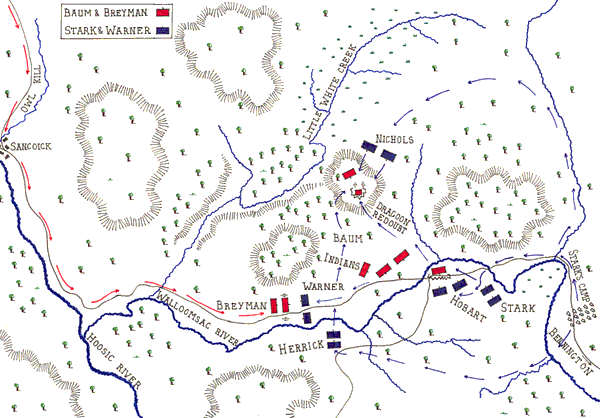
The Americans routed the German, British, and Loyalist forces, even halting a 600-man reinforcement column under German Lieutenant Colonel Heinrich Breymann who arrived on the field in the latter stages.
Stark reported to Congress that Warner showed “superior skill in the action.”
Unbeknownst to Warner at the time, the campaign that culminated with British General John Burgoyne’s surrender at Saratoga, was the defining moment in Warner’s American Revolutionary War career. Warner would stay in the service, reaching the rank of brigadier general, bestowed upon him in 1778 by the new state of Vermont courtesy of the state legislature. That made him the only brigadier general in the newly formed state. On September 6, 1780 Warner received his only wound of the war, in an ambush by Native Americans outside Fort George in New York.
Unfortunately for the old “Green Mountain Boys” commander, the years after his retirement in 1780 were not kind. He fell out of favor with his former commander, Ethan Allen which led Warner to confront him in 1781 about contact with the British when Allen was a prisoner-of-war. This was all in conjunction with some contact Vermont had with British Canada about possible negotiations in reunifying Vermont with the British Empire. The extent of the negotiations and the seriousness of the idea has been in question by historians ever since.
Regardless, Warner, in failing health in 1784, returned to Woodbury, where he died on December 26, 1784, at the age of 41. Warner’s remains lay in Roxbury, Connecticut.
*For more information on the campaigns of New York in which Warner played a role in, consult Michael O. Logusz’s two-volume “With Musket and Tomahawk” series published by Savas Beatie LLC. at http://www.savasbeatie.com*
 Emerging Revolutionary War Era