On June 9, 1772, a group of prominent Rhode Islanders rowed out to His Majesty’s schooner Gaspee, which had run aground six miles south of Providence while on an anti-smuggling patrol. After threatening and shooting its commanding officer, the raiders looted the vessel and burned it to the waterline.
An often overlooked event that occurred between the Boston Massacre and the Boston Tea Party, join us this Sunday evening at 7 p.m. ET on our Facebook page when we will speak with historian Steven Park, author of the book “The Burning of His Majesty’s Schooner Gaspee” about the events that occurred 250 years ago.
Can’t make it this weekend? You can catch this and all our previous Sunday night chats on our YouTube page and our podcast!
Been a bit since we checked in and shared what our good friend Tom Hand has been doing at Americana Corner. The blog, dedicated to sharing “informative stories of the great events, founding documents, and inspirational leaders” routinely has a new post up every Tuesday. Below is what was on the blog for the month of May. Click the title to read the entire post.
Patriots, Loyalists and America’s First Civil War With the Battles of Lexington and Concord in 1775, the actual fighting of the American Revolution was underway. As it turned out, this open warfare was not reserved just for the new Continental Army formed around Boston and the British Army trapped in the city. It soon spilled over into a fight between neighbors.
Americans Divide Over Independence According to the Merriam-Webster dictionary, a civil war is a war between opposing groups of citizens of the same state or country. By this definition or any objective measure, our nation experienced a civil war from about 1773 to 1783. It was much worse in its intensity and cost than anything from the Civil War, including Sherman’s infamous March to the Sea.
The Quasi-War and Its Aftermath The only fighting in the Quasi-War occurred at sea, and mostly in the Caribbean. But with war at a fever pitch and French interests so close by in Louisiana, there was a very real concern in Congress about a possible French invasion of the United States from the west.
Escalating Tensions with France Lead to Quasi-War The Quasi-War was an undeclared war between France and the United States, largely fought at sea in the Caribbean and along the southern coast of America, between 1798 and 1800. It developed because of a series of related events that soured the formerly strong relationship between the two nations.
Join us this Sunday (May 29) at 7 p.m. ET on our Facebook page as we welcome our good friend John Adams of Liberty Cigars. John takes inspiration from the Founding Fathers and Revolutionary War figures to create his cigars. We will talk about his love of history and how it evolved into a cigar company and some of his upcoming projects. Can’t make it this weekend? You can catch all our previous Sunday night chats on our YouTube page and our podcast!
Debuting this week on Fox Nation is a new documentary series that highlights some of the important battles in American history. From Fox Nation: “In Kelsey Grammar’s Battles for America: Crucial Conflicts, Kelsey Grammar takes a deep dive into eight key battles that left an indelible mark on this nation. This series will reveal the tactics and strategies that led to victory or defeat, the motivations and emotions of the soldiers and officers who fought it, the decisions and conditions that led to battle, and the long-term consequences that resonate long after the last shot was fired.”
Among those historians featured as a “talking head” in the Revolutionary War episodes that cover the Battles of Bunker Hill, Brooklyn, and Yorktown is Emerging Revolutionary War’s Mark Maloy, offering insights and information throughout the series.
Check out the new documentary episodes here. (Fox Nation is a subscription channel.)
It’s nearly 25 years ago now. I was driving through western North Carolina, on my way south to Cowpens National Battlefield located in Gaffney, SC, scene of the January 17, 1781, battle.
These were the days before the internet or GPS. Travelers of the day, such as I, depended solely on our wits and a good old-fashioned state map. I had recently finished reading a wonderful biography on the life of American frontiersman, Daniel Boone by John Mack Faragher. So, when I crossed a bridge over the Yadkin River, I knew I was in Boone country.
The Boone family had migrated south from Exeter Township, in Berks County, PA in 1750. The father of Daniel, Squire Boone, Sr, had purchased land in the Yadkin Valley. It’s where young Daniel Boone took his bride, Rebecca Bryan, and where the couple would be domiciled longer than anywhere else they would live during their long marriage. This is where they would start a family of their own.
After consulting my map and the copy of Faragher’s book, I knew I was near the small community of Mocksville, south of Winston-Salem, not far off I-40. There in the old Joppa Burial Ground, can still be found the graves of Squire and Sarah Morgan Boone; the parents of the famous frontiersman.
It’s almost 25 years now since I first pulled up to this ancient cemetery; I parked in a small strip mall adjacent to it. Souvenir hunters had chipped off pieces of the grave stones over the years, so they were later encased in a small masonry wall for protection. I had almost forgotten this impromptu stop; that is until quite recently when I found myself heading south again, this time on my way to visit the Guildford Courthouse battlefield in Greensboro. Remembering the area, I decided to stop off again to pay my respects to the Boones.
Lieutenant Colonel John Laurens of South Carolina had served as part of George Washington’s military family since early August 1777. Just 23-years-old during the summer of 1778, Laurens had established himself as one of Washington’s most trusted aides, as well as a close friend to Alexander Hamilton and the Marquis de Lafayette.
During the Battle of Monmouth Courthouse, fought June 28, 1778, Laurens was sent ahead of the army early in the morning to assist Baron von Steuben in reconnoitering the British Army’s position around the village. The party was fired upon and chased westward by the Queen’s Rangers back to a hedgerow defended by New Jersey militiamen. When the battle began in earnest later in the morning, Laurens found himself back at the same hedgerow assisting Continental troops in conducting a delaying action to by time for Washington to establish a strong defensive position further to the west. It was during this action that the young officer from the Palmetto State lost his mount.
The following letter was written by Lt. Col. Laurens on June 30, 1778, to his father, Henry Laurens, who was then serving as the President of the Continental Congress. It is a fascinating look at one soldier’s experience during a battle in which he was right in the thick of things, selflessly exposing himself to the enemy.
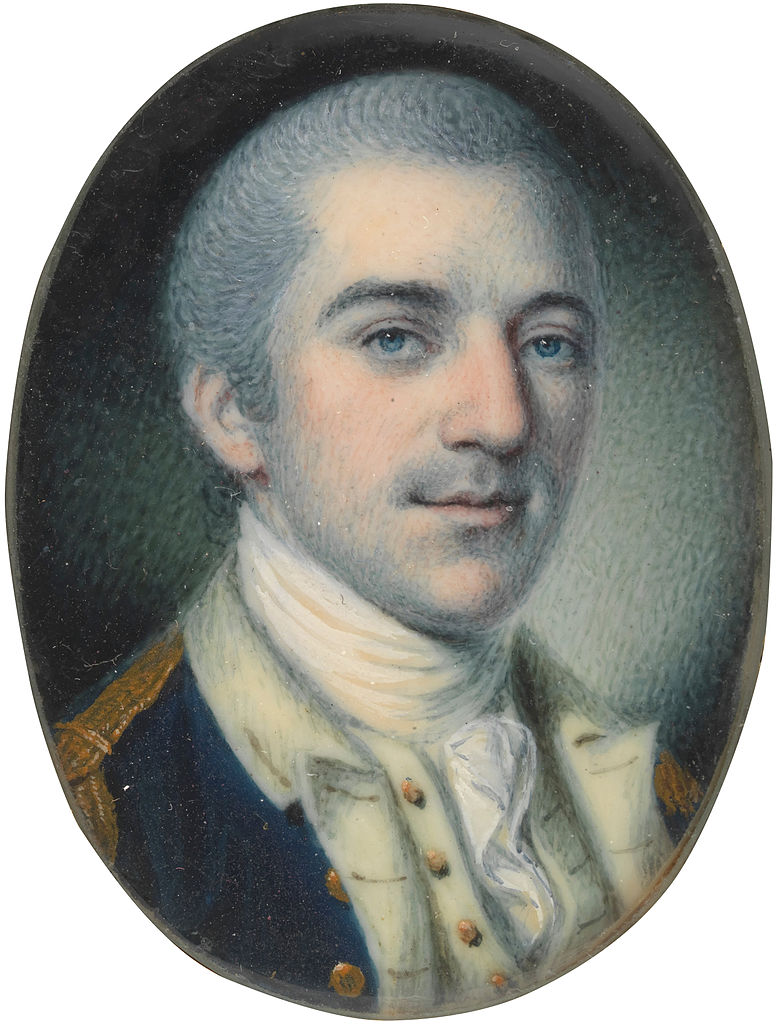
Portrait of John Laurens painted in 1780 by Charles Wilson Peale.
“HEAD QUARTERS, ENGLISH TOWN, 30th June, 1778.
My Dear Father:
I was exceedingly chagrined that public business prevented my writing to you from the field of battle, when the General sent his dispatches to Congress. The delay, however, will be attended with this advantage, that I shall be better able to give you an account of the enemy’s loss; tho’ I must now content myself with a very succinct relation of this affair. The situation of the two armies on Sunday was as follows: Gen’ Washington, with the main body of our army, was at 4 miles distance from English Town. Gen’ [Charles] Lee, with a chosen advanced corps, was at that town. The enemy were retreating down the road which leads to Middle Town; their flying army composed (as it was said), of 2 [battalions] of British grenadiers, 1 Hessian [grenadiers], 1 [battalion] of light infantry, 1 regiment of guards, 2 brigades of foot, 1 [regiment] of dragoons and a number of mounted and dismounted Jägers. The enemy’s rear was preparing to leave Monmouth village, which is 6 miles from this place, when our advanced corps was marching towards them. The militia of the country kept up a random running fire with the Hessian Jägers; no mischief was done on either side. I was with a small party of horse, reconnoitering the enemy, in an open space before Monmouth, when I perceived two parties of the enemy advancing by files in the woods on our right and left, with a view, as I imagined, of enveloping our small party, or preparing a way for a skirmish of their horse. I immediately wrote an account of what I had seen to the General, and expressed my anxiety on account of the languid appearance of the Continental troops under Gen’ Lee.
Some person in the mean time reported to Gen’ Lee that the enemy were advancing upon us in two columns, and I was informed that he had, in consequence, ordered Varnum’s brigade, which was in front, to repass a bridge which it had passed. I went myself, and assured him of the real state of the case; his reply to me was, that his accounts had been so contradictory, that he was utterly at a loss what part to take. I repeated my account to him in positive distinct terms, and returned to make farther discoveries. I found that the two parties had been withdrawn from the wood, and that the enemy were preparing to leave Monmouth. I wrote a second time to Gen’ Washington. Gen’ Lee at length gave orders to advance. The enemy were forming themselves on the Middle Town road, with their light infantry in front, and cavalry on the left flank, while a scattering, distant fire was commenced between our flanking parties and theirs. I was impatient and uneasy at seeing that no disposition was made, and [endeavored] to find out Gen’ Lee to inform him of what was doing, and know what was his disposition. Ile told me that he was going to order some troops to march below the enemy and cut off their retreat. Two pieces of artillery were posted on our right without a single foot soldier to support them. Our men were formed piecemeal in front of the enemy, and there appeared to be no general plan or disposition calculated on that of the enemy; the nature of the ground, or any of the other principles which generally govern in these cases.
The enemy began a cannonade from two parts of their line; their whole body of horse made a furious charge upon a small party of our cavalry and dissipated them, and drove them till the appearance of our infantry, and a judicious discharge or two of artillery made them retire precipitately. Three regiments of ours that had advanced in a plain open country towards the enemy’s left flank, were ordered by Gen’ Lee to retire and occupy the village of Monmouth. They were no sooner formed there, than they were ordered to quit that post and gain the woods. One order succeeded another with a rapidity and indecision calculated to ruin us. The enemy had changed their front and were advancing in full march towards us; our men were fatigued with the excessive heat. The artillery horses were not in condition to make a brisk retreat. A new position was ordered, but not generally communicated, for part of the troops were forming on the right of the ground, while others were marching away, and all the artillery driving off. The enemy, after a short halt, resumed their pursuit; no cannon was left to check their progress. A regiment was ordered to form behind a fence, and as speedily commanded to retire. All this disgraceful retreating, passed without the firing of a musket, over ground which might have been disputed inch by inch. We passed a defile and arrived at an eminence beyond, which was defended on one hand by an impracticable fen, on the other by thick woods where our men would have fought to advantage. Here, fortunately for the honour of the army, and the welfare of America, Gen’ Washington met the troops retreating in disorder, and without any plan to make an opposition. He ordered some pieces of artillery to be brought up to defend the pass, and some troops to form and defend the pieces. The artillery was too distant to be brought up readily, so that there was but little opposition given here. A few shot though, and a little skirmishing in the wood checked the enemy’s career. The Gen’ expressed his astonishment at this unaccountable retreat. Mr. Lee indecently replied that the attack was contrary to his advice and opinion in council. We were obliged to retire to a position, which, though hastily reconnoitered, proved an excellent one. Two regiments were formed behind a fence in front of the position. The enemy’s horse advanced in full charge with admirable bravery to the distance of forty paces, when a general discharge from these two regiments did great execution among them, and made them fly with the greatest precipitation. The grenadiers succeeded to the attack. At this time my horse was killed under me. In this spot the action was hottest, and there was considerable slaughter of British grenadiers. The General ordered Woodford’s brigade with some artillery to take possession of an eminence on the enemy’s left, and cannonade from thence. This produced an excellent effect. The enemy were prevented from advancing on us, and confined themselves to cannonade with a show of turning our left flank. Our artillery answered theirs with the greatest vigour. The General seeing that our left flank was secure, as the ground was open and commanded by it, so that the enemy could not attempt to turn it without exposing their own flank to a heavy fire from our artillery, and causing to pass in review before us, the force employed for turning us. In the mean time, Gen’ Lee continued retreating. Baron Steuben was order’d to form the broken troops in the rear. The cannonade was incessant and the General ordered parties to advance from time to time and engage the British grenadiers and guards. The horse shewed themselves no more. The grenadiers showed their backs and retreated every where with precipitation. They returned, however, again to the charge, and were again repulsed. They finally retreated and got over the strong pass, where, as I mentioned before, Gen’ Washington first rallied the troops. We advanced in force and continued masters of the ground; the standards of liberty were planted in triumph on the field of battle. We remained looking at each other, with the defile between us, till dark, and they stole off in silence at midnight. We have buried of the enemy’s slain, 233, principally grenadiers; forty odd of their wounded whom they left at Monmouth, fell into our hands. Several officers are our prisoners. Among their killed are Co’ Moncton, a captain of the guards, and several captains of grenadiers. We have taken but a very inconsiderable number of prisoners, for want of a good body of horse. Deserters are coming in as usual. Our officers and men behaved with that bravery which becomes freemen, and have convinced the world that they can beat British grenadiers. To name any one in particular wd be a kind of injustice to the rest. There are some, however, who came more immediately under my view, whom I will mention that you may know them. B. Gen’ Wayne, Col. Barber, Col. Stewart, Col. Livingston, Col. Oswald of the artillery, Capt. Doughty deserve well of their country, and distinguished themselves nobly.
The enemy buried many of their dead that are not accounted for above, and carried off a great number of wounded. I have written diffusely, and yet I have not told you all. Gen’ Lee, I think, must be tried for misconduct. However, as this is a matter not generally known, tho’ it seems almost universally wished for, I would beg you, my dear father, to say nothing of it.
You will oblige me much by excusing me to Mr. Drayton for not writing to him. I congratulate you, my dear father, upon this seasonable victory, and am ever
Your most dutiful and affectionate
JOHN LAURENS.
The [Honorable] Henry Laurens, Esqr.
We have no returns of our loss as yet. The proportion on the field of battle appeared but small. We have many good officers wounded.”
On the morning of September 25, 1779 from the deck of his new prize, the British frigate Serapis, John Paul Jones watched his former ship, Bonhomme Richard slide beneath the waves off Flamborough Head on Britain’s east coast. It had been a brutal fight before the Americans prevailed over a well-handled, better-armed British vessel and became one of the most famous sea-duels in American history. A floating wreck, Serapis’ condition made it unfit to continue with Jones’ original plan of taking the war to England by cruising for prizes. Moreover, he was due in the Texel, a roadstead near Amsterdam where ships gathered for safer transit over waters regularly patrolled by the British fleet. The French had a convoy gathering there and wanted an armed escort. After spending days repairing Serapis, Jones, his small naval squadron (Alliance, Pallas, Vengeance), and his prizes (Serapis, Countess of Scarborough), reached Dutch shores on October 3.
When studying history we tend to divide time periods up and compartmentalize them for our own ease of study and understanding. Yet when we step back and look, it becomes obvious how events flow one into another. There is a great deal of overlap and often events occurred concurrently.
April 19 will bring the anniversary of the opening of the Revolution at Lexington and Concord. While the conflict with Great Britain was growing and festering, other events were taking place in various colonies. The ending of the French and Indian War is seen as the close of an era and a neat stopping point before the coming of the Revolution. Yet on the heels of the war’s ending, Britain began implementing the taxes and regulations that would anger American colonists.
Happy St. Patrick’s Day from all us at Emerging Revolutionary War! The Irish contributed significantly to the cause of American independence. A large percentage of the Continental army was made up of Irish immigrants and Americans of Irish descent. One of Washington’s trusted aides in the war was the Irish Catholic patriot, Colonel John Fitzgerald.
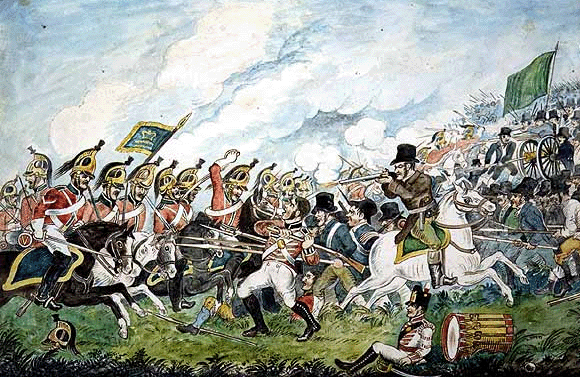
While American independence benefited greatly from Irish support, the American Revolution helped to inspire the Irish rise up for their own freedom back in Ireland. Following the American and French Revolutions, the Irish sought to break the sectarian divides between Catholics and Protestants and unite to drive the British out of Ireland at the end of the 18th century. The United Irishmen rose up in 1798 and fought a bloody conflict that was brutally suppressed by the British.
This Sunday, join us as we discuss the 1798 Irish rebellion and the dramatic battle that occurred on Vinegar Hill near Enniscorthy, Ireland. We will be joined by historian and archaeologist Damian Shiels from Ireland. He has worked at Vinegar Hill and will give some insights on the battlefield. Join us as we gear up for this year’s ERW Symposium where we will be discussing the international importance of the American Revolution.
The talk will broadcast live on Sunday, March 20 at 7 p.m. ET on our Facebook page. If you are unable to join live, you can catch it on our Facebook page, YouTube page, and podcast later.
Miss us this Sunday? Our “Rev War Revelry” Sunday evening discussions on all things Revolutionary War happen every other Sunday evening live on our Facebook page, and are available afterwards to watch on our YouTube channel. We now have uploaded every program on our podcast, available to stream from Apple Podcasts and Spotify!
That is 63 episodes, over 60 hours of content! You could listen to nothing but Emerging Revolutionary War on a road trip from Washington, DC to Los Angeles, and you would still have more than 20 hours of content left to listen to! So, whether you are at the gym, going on a road trip, or just commuting back and forth to work, be sure to check out the Emerging Revolutionary War podcast!







 Emerging Revolutionary War Era