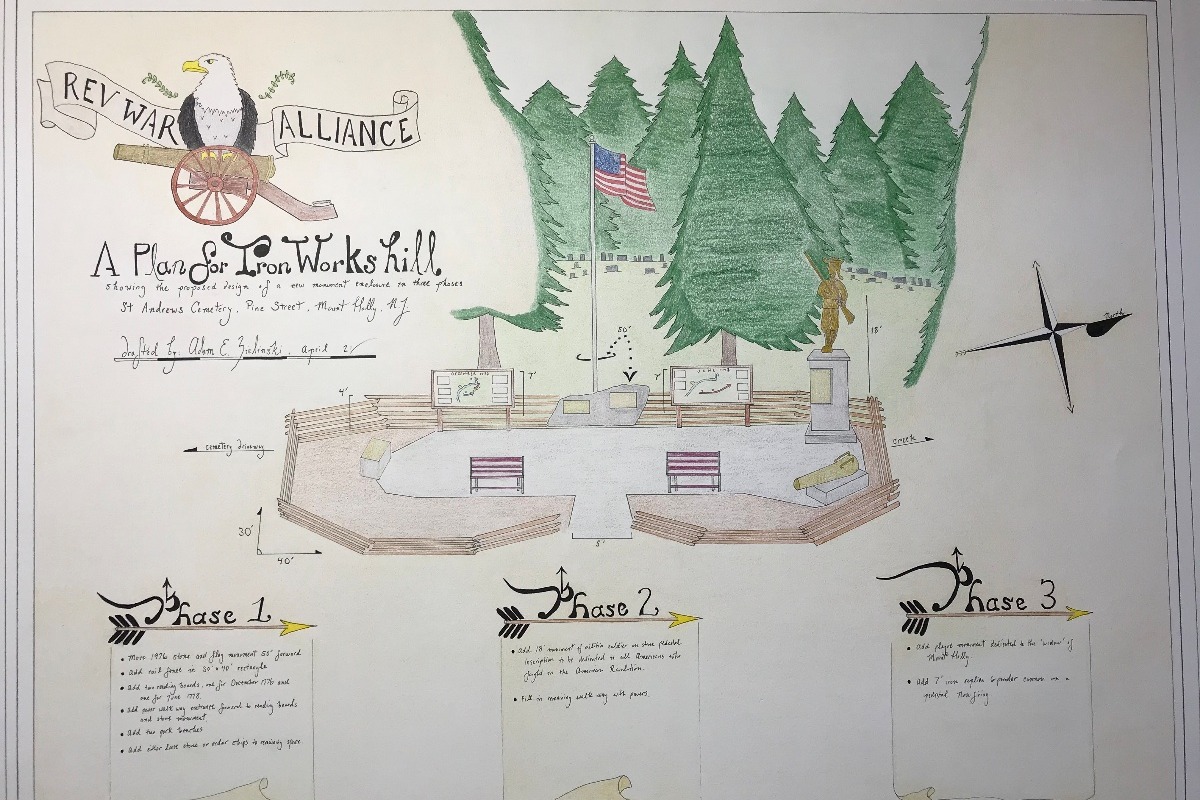
After a successful fundraising, the Alliance will be hosting a ribbon cutting for the public at the site of the monument (128 Pine St, Mt Holly, New Jersey) this Saturday (December 11) at 11 a.m. There will be reenactors and fife and drums. This project demonstrates how important local preservation groups are in memorializing the sites of our nation’s founding and the telling the story of the fight for freedom for future generations.
Searching for the perfect gift this year for the Revolutionary War enthusiast in your life? Looking to put something on your own list for Santa this year? Get one of the Emerging Revolutionary War books, or get them all! This year we have four titles available:
These heavily illustrated books offer a great, readable overview of these important military campaigns and include self guided driving tours of the battlefields.
Here’s some praise from participants on our first bus tour this year at Trenton and Princeton:
“Loved learning the story of what happened in Trenton and Princeton during that part of the Revolutionary War. I was amazed at the distances Washingtons men had to travel for each part of the battles. Wonderful presentations and the intelligent questions asked by participants!”
“You guys all did an excellent job. The live interp was why we came; and it was great.”
“Excellent tour; I tried to do both battles on my own several years ago but my self-tour was a complete failure compared to this ERW tour.”
“Loved the tour! Cannot wait for future tours!”
“Having toured some of these sites previously it was most enjoyable and I learned much more.”
We hope you all plan to join us in 2022 in exploring the battlefields where our liberty and independence was won!
Merry Christmas from all of us at Emerging Revolutionary War!
The group at Washington’s Crossing with George Washington himself!
Over the past weekend, Emerging Revolutionary War historians led a bus tour of the battlefields of Trenton and Princeton. Based on Mark Maloy’s book, Victory or Death, the tour took participants throughout Pennsylvania and New Jersey following in the footsteps of George Washington’s army. Led by Mark Maloy and Billy Griffith, attendees were treated first to a Friday night lecture that explained the American defeats in the summer of 1776 that put Washington and his army in a dire position. That night guests were given tour packets and free tee shirts provided by our friends at Americana Corner. People were also able to purchase books from the Emerging Revolutionary War series, as all the authors were in attendance.
On Saturday, guests from as far as Alabama, Maine, and Ohio piled into a sold out 56 passenger bus. First we visited Washington’s headquarters from early December 1776 at Summerseat in Morrisville, Pennsylvania before driving by Washington’s headquarters where he hatched the plan to attack Trenton. We then drove by Nathanael Greene’s headquarters where Washington informed his commanders at a council of war about the plan. We visited the Thompson-Neely House and the nearby soldiers’ graves where numerous unknown patriots lie buried. Our last stop before lunch was the location location where Washington crossed the Delaware River at McConkey’s Ferry on Christmas night.
After a picnic lunch, the group crossed the Delaware themselves and traveled the same path the patriots took to Trenton. As we arrived in downtown Trenton a sudden and severe storm blew through, which added a flash of drama to an already dramatic story. The attendees braved the gusty winds and raindrops to listen about how the battle played out from the location of Col. Henry Knox’s artillery and walk down the streets those brave men fought on almost 250 years ago.
Mark Maloy describes the Battle of Trenton.
After looking at the site of some of the heaviest fighting on December 26, 1776, the group traveled down to the banks of the Assunpink Creek. There we learned about the intervening time between December 26, 1776 and January 2, 1777 and the Battle of Assunpink Creek that occurred on that day. After looking at a statue to George Washington, we went and saw the house Washington held a council of war in and made one of the boldest decisions of the war: to disengage the British and make an overnight 12 mile march to strike the British rearguard at Princeton.
We then loaded on the bus and traveled most of the route of Washington’s army and made it back to our hotel. After a fun evening of enjoying the company of others, we were ready for our final day of touring.
Mark Maloy and Billy Griffith describe the lead up to the crossing of the Delaware River.
On Sunday, the day was cool and clear. We traveled to Princeton Battlefield State Park. Here we learned about the meeting engagement that occurred on the morning of January 3, 1777. We learned how Washington rallied his breaking troops and led a charge against the British regulars. Following in the footsteps of the patriots from 1777, we walked across the field they did and saw the Mercer oak and learned of the brutal hand to hand combat that occurred in that area. We then walked to the site of a mass grave of British and American troops and listened to how the battle and campaign ended.
Afterwards we were treated to a look inside the Thomas Clarke House, where General Hugh Mercer died, and then traveled to our final stop. At the Princeton Battle Monument, we closed out the tour focusing on how the campaign has been remembered over the years and the importance of keeping those memories alive for future generations.
The tour was an outstanding success with many positive reactions and many signups for next year. Next year we are planning a tour of Monmouth battlefield and Valley Forge. Emerging Revolutionary War loves connecting the stories from history to the places where they occurred. If you would like to have a fun, engaging, and unique experience learning about the Revolutionary War, sign up today, as we expect it will sell out again!
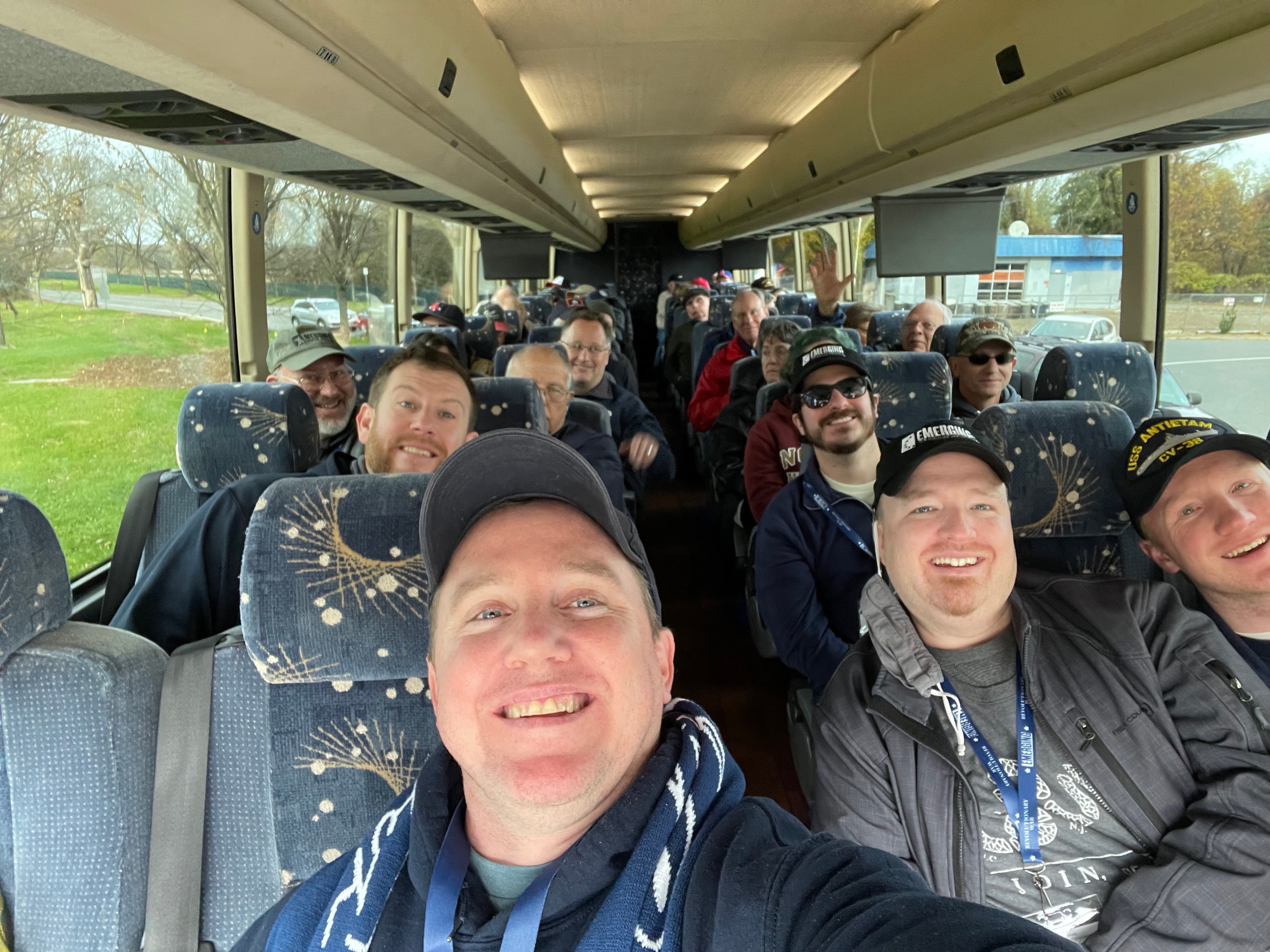
A happy bus full of people after two days of exploring the Ten Crucial Days!
The air was stifling on the morning of August 16, 1780. It was made worse by the acrid smoke from the musket and artillery fire that hung low under the canopy of tall, Long Leaf pines that grew on either side of the Great Wagon Road leading to the small town of Camden, South Carolina. The battle fought on that morning between the forces of American Major General Horatio Gates and British Lieutenant General Charles, Earl Cornwallis was short; less than an hour.
Most of the militia troops on the American left flank fled from the field shortly after the first shots were fired but the hard-bitten Continentals on the right, men from Maryland and Delaware, stood fast and paid a severe price, holding against the British regular and loyalist infantry until cavalry forces under the dreaded Lieutenant Colonel Banastre Tarleton swept in on their rear. Then, for the American regulars, it became a game of escape and survival.
For the American commander, Horatio Gates, the loss at Camden would be a nightmare. Having been swept from the field early in the battle with the retreating militia, he would ultimately leave his Continental troops to fend for themselves as he made his escape. Thus, the reputation of the former “Hero of Saratoga” would be marred forever. One officer who would not make his escape from this field, however, was the commander of the American right wing, Major General Baron Johann de Kalb.
Baron de Kalb
He was a seasoned veteran of many European battlefields. Commanding the Maryland and Delaware Continental troops at Camden, the German-born 59 year-old de Kalb would continue leading his troops, fighting valiantly throughout the battle until wounds brought him down, forcing him out of action. He would be later found on the battlefield by the British, having suffered 11 wounds in the engagement. According to his Aide-De-Camp, le Chevalier de Buysson, the Baron “having had his horse killed under him, fell into the hands of the enemy, pierced with eight wounds of bayonets and three musket balls.” The two officers were taken to Camden where de Kalb was treated by Lord Cornwallis’ own surgeon; he died on August 19. Of their captivity, de Buysson would write: “Lord Cornwallis and Rawdon treated us with the greatest civility. The baron, dying of his wounds two days after the action, was buried with all the honors of war, and his funeral attended by all the officers of the British army.”
Reportedly buried alongside British officers likewise killed in the battle, Baron de Kalb’s original grave site was located in a field near Meeting Street, between Broad and Church Streets “in the southwestern part of the town.” On his tour of the southern states in 1791, President George Washington visited the grave of the gallant Baron de Kalb. Over time though, the exact location of this site was forgotten. In the early 1820’s, an extensive search was begun to locate the grave. Leading the way in the search were the Masons of South Carolina who were intent upon finding the original resting place of this brother in freemasonry.
Baron de Kalb had come to America from France in 1777 to help in the fight for independence. Having fought with the French Army in the War of Austrian Succession and the Seven Years War, he’d had a distinguished military career in Europe. He traveled to America with the wealthy young French aristocrat, the 20-year-old Marie-Joseph Paul Yves Roch Gilbert du Motier, Marquis de Lafayette. These two men couldn’t have come from more different backgrounds. Lafayette was genteel and extremely well educated, having been born into a family known for their vast wealth. Johann de Kalb was a farmer’s son. But, along with his military accomplishments, he’d married well and amassed a fortune of his own. By all accounts, these two very different men had a mutual respect for one another and at least one thing in common; they were both Freemasons.
With the rediscovery of Baron de Kalb’s grave site in the early 1820’s, it was decided that his remains would be carefully removed to the yard of Bethesda Presbyterian Church in the center of Camden where a proper monument would be erected. The people of South Carolina contributed handsomely to the design of the monument and the accompanying dedication ceremony. The monument was designed by artist Robert Mills, who had likewise designed the church where it would be erected along with the United States Treasury Building and the Washington Monument in Washington City. The ceremony was planned and the cornerstone for the new monument to Baron de Kalb would be laid in March 1825. Laying the cornerstone would be none other than his brother Freemason, the Marquis de Lafayette.
Now in his late 60’s, the aged hero had made a triumphant return to the United States in August 1824 and begun a grand tour of the country. As part of his tour, the Marquis and his party arrived in Camden on March 8, 1825. On behalf of the Baron de Kalb Monument Committee, General Lafayette was invited to lay the cornerstone of the new monument to which he readily agreed. He was escorted into Camden with military honors; banquets and speeches would follow. On March 9, a procession bearing the remains of Baron de Kalb formed and marched to the monument site, in the yard of Bethesda Presbyterian Church. After an invocation, the remains were laid to rest in a vault. With members of the Kershaw Lodge offering appropriate Masonic honors, the Marquis de Lafayette laid the cornerstone. The final work on the marble monument that would be erected over the vault was completed in 1827. Inscribed on the monument are these words: “Here lie the remains of Baron De Kalb, German by birth, but in principle, citizen of the world”.
Grave of Baron de Kalb
After laying the cornerstone, nearly 50 years after the two men had first arrived together in America, Lafayette offered a few noble remarks about his friend. “His able conduct, undaunted valor, and glorious fall in the first battle of Camden, form one of the remarkable traits of our struggle for independence and freedom. He was cordially devoted to our American cause, and while his public and private qualities have endeared him to his contemporaries, here I remain to pay to his merits on this tomb, the tribute of an admiring witness, of an intimate companion, of a mourning friend.” It was certainly a fitting tribute.
In modern times, Baron de Kalb’s legacy continues. After nearly 200 years, a new statue bearing his likeness was unveiled in October 2021. Created by sculptor Maria J. Kirby-Smith, the new statue stands on the grounds of the Revolutionary War Visitor Center in Camden, SC. This will be one of the many stops along The Liberty Trail, a “unified path of preservation and interpretation across South Carolina” that will tell the story of the Revolutionary War in the South. The Liberty Trail is currently under development through a partnership between the American Battlefield Trust and the South Carolina Battleground Preservation Trust.
When one thinks of December 1776 in American Revolutionary War history, one’s mind immediately goes to Washington crossing the Delaware River and the Battle of Trenton, fought on December 26th. Historians refer to that engagement as the beginning of the “Ten Crucial Days” that culminated with the American victory at the Battle of Princeton on January 3, 1777.
However, days prior, American militia under Colonel Samuel Griffin fought an engagement with Hessian troops under the command of Colonel Carl von Donop. The actions occurred on December 22 and 23, 1776. Although the American forces were pushed out of their positions, the end result was the occupation of Bordentown by Donop and his troops, approximately 10 miles from their fellow Hessian comrades at Trenton.
To discuss these engagements, collectively known as the Battle of Iron Works Hill, Emerging Revolutionary War welcomes historian Adam Zelinski to “Rev War Revelry.” Zelinski is a writer and published historian and has worked on various projects with the American Battlefield Trust and the American Revolution Museum in Philadelphia. He will also speak on some exciting news coming out of the Iron Works battlefield too.
Emerging Revolutionary War looks forward to you tuning in, this Sunday, at 7 p.m. EST on our Facebook page as we discuss another component of the 1776 campaign season as we prepare for our inaugural bus tour of the Trenton and Princeton battlefields next month (only 4 tickets left!). If you can’t make it on Sunday night, you will be able to find it later (along with all our videos) on our YouTube page.
In another installment of #TrentonTuesday we look at Washington’s plan of attack. George Washington, who had been mulling the prospect of an attack for weeks, saw an opportunity in the Hessian outpost at Trenton. Much of his information was coming from his spies and he also realized that the British employed numerous spies in his own camp, so he would need to conceal his plans. Secrecy and stealth would be the most important aspects if he wished to keep the element of surprise on his side. Washington though needed to act. His aide, Colonel Joseph Reed wrote to Washington that “Our affairs are now hasting fast to ruin if we do not retrieve them by some happy event. Delay is now equal to total defeat.”
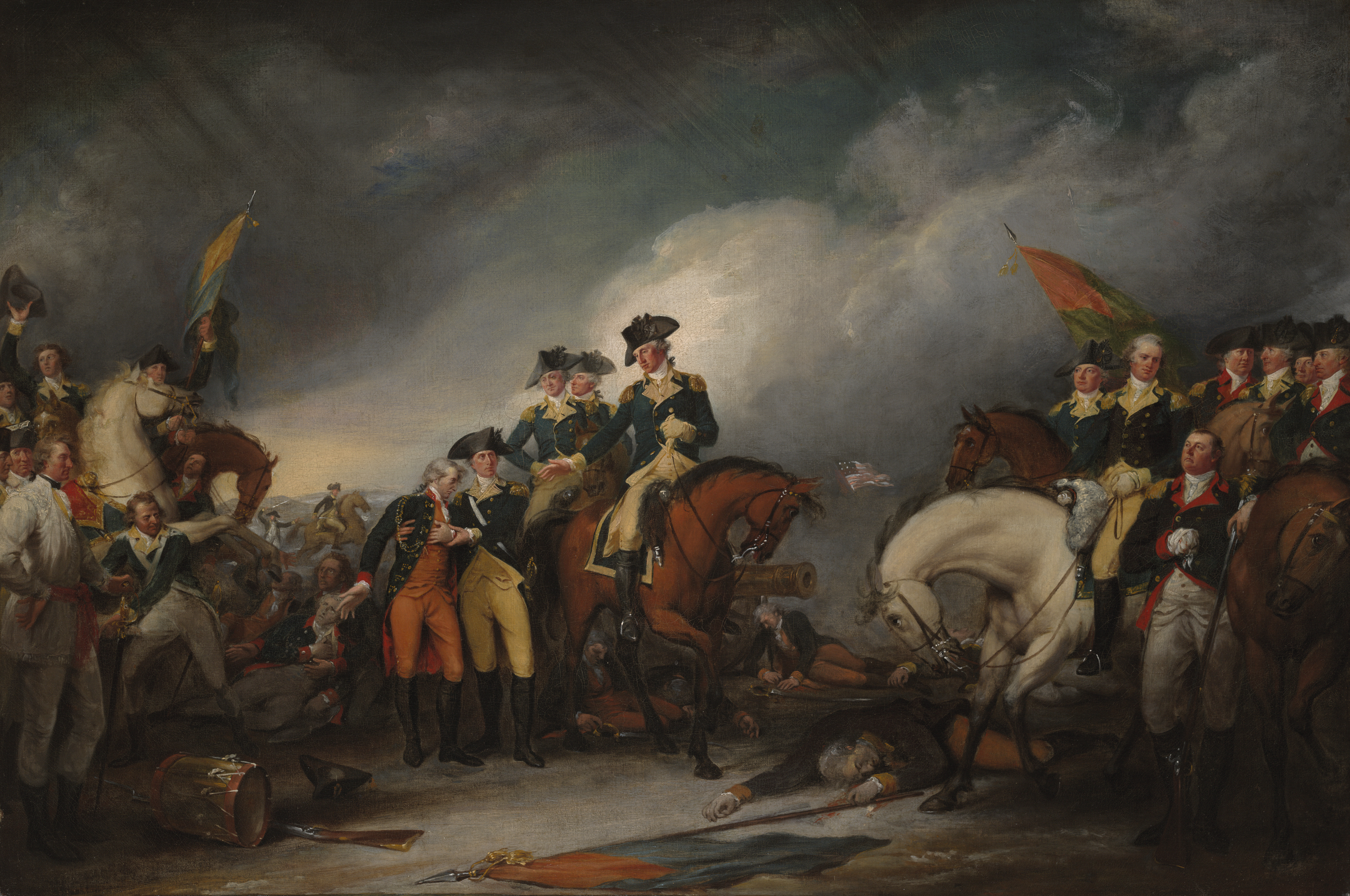
John Trumbull’s painting of the surrender of the Hessians at Trenton depicts a wounded James Monroe lying behind the dying Colonel Rall.
Join ERW historians Mark Maloy and Rob Orrison as we welcome Scott Harris, Executive Director of the James Monroe Museum, to discuss James Monroe’s service in the American Revolution. Monroe had a well-known and distinguished political career, but it all started as a solider in George Washington’s army. Leaving his studies at the College of William & Mary in 1776 he would distinguish himself on numerous battlefields during the war. We will highlight Monroe’s role in the Battle of Trenton as we gear up for our November bus tour! At the Battle of Trenton, Monroe was nearly killed in some of the fiercest fighting in that pivotal engagement. Tune in on Sunday to learn more and join us in November to see where it actually happened!
To watch it live, visit our Facebook page at 7p.m. EST on Sunday, September 19. If you can’t make it on Sunday, you can watch it and dozens of other programs on our YouTube page.
For this week’s edition of #TrentonTuesday, check out the recent presentation by ERW author Mark Maloy for the American Battlefield Trust’s 2021 Virtual Conference. In it he gives a broad overview of the campaign and touches on some of the places we’ll be visiting this November as part of our 2021 bus tour. If you haven’t already, check out the book here. Enjoy!:
In another installment of #TrentonTuesday, we look at the desperate situation George Washington found himself at in December of 1776. With the Delaware River serving as a barrier between his army and the British and Hessians, Washington was hoping to stave off the entire dissolution of the army. He had already seen his army melt away from over 23,000 to just about 5,000 soldiers due to battle casualties, disease, and desertion. By January 1, 1777, the enlistments of many of those remaining soldiers would be up, and he would lose the basic core of his army. Washington wrote on December 18 to his brother John Washington about how his army had “less than 3,000 men fit for duty owing to the dissolution of our force by short enlistments—the enemies numbers by the best accounts exceeding ten, and by others 12,000 men.” He added that “between you and me I think our affairs are in a very bad way.”
Washington deep in thought by a fireplace. (NYPL)
He needed to recruit more soldiers. In the same letter to his brother, Washington wrote that “In a word my dear Sir, if every nerve is not strained to recruit the new army with all possible expedition I think the game is pretty near up.” Here was the commander-in-chief of the Continental Army writing that war was nearly lost.
Today, we begin a series of #TrentonTuesdays. Every Tuesday for the next few weeks we’ll highlight interesting stories related to the Battles of Trenton and Princeton as we approach the inaugural Emerging Revolutionary War bus tour in November. Today we look at the story of Thomas Paine.
As Washington and his army marched quickly across the state of New Jersey from Fort Lee to Trenton in November and December of 1776, they were joined by a young writer. His name was Thomas Paine, and he was well known as the author of the famous patriot pamphlet “Common Sense” that was published earlier in 1776.
Statue of Thomas Paine writing the American Crisis (revolutionarynewjersey.com)
Paine, watching the American army melt away from more that 23,000 men in August of 1776, to less than 5,000 men by December, seemed to be witnessing the destruction of the nascent American nation. During the retreat Paine put quill to parchment to write another pamphlet that he would have published that December, titled “The American Crisis.” With Washington’s army on the verge of dissolution, it was an apt title. He started with a phrase that duly summed up the situation: “These are the times that try men’s souls.”
He goes on to exhort Americans to rally for the cause of liberty in spite of the hardships they faced, an exhortation that still evokes a sense of patriotism hundreds of year later. “The summer soldier and the sunshine patriot will, in this crisis, shrink from the service of their country; but he that stands it now, deserves the love and thanks of man and woman. Tyranny, like hell, is not easily conquered; yet we have this consolation with us, that the harder the conflict, the more glorious the triumph.”








 Emerging Revolutionary War Era