Finally, in the spring of 1777, Cresswell again decided to try returning to England. Thomson Mason, who had already intervened with two Committees of Safety to protect the Englishman, offered to help with Virginia authorities once more, provided that Cresswell swear not to join the British Army. Cresswell did. The best plan was to leave Leesburg, travel overland to Alexandria, then take a schooner down the Potomac and Chesapeake for Williamsburg and Hampton, where it might be possible go aboard a ship bound for British-occupied New York. As he made his preparations, the local Committee of Safety arrived on April 16 to search his possessions for treasonable items. They seized a shot pouch, powder horn, and bearskin he acquired from the Delaware Indians. Cresswell decided not to contest the seizure lest it complicate his departure.
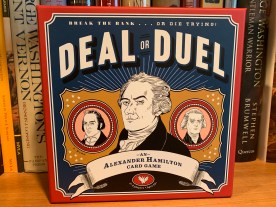
Among his many aphorisms, Ben Franklin reportedly said “games lubricate the body and the mind.” Given the large number of quotes attributed to the sage, it is suspect. But, his generation certainly understood games, both as a way of sharpening the mind and passing time in amicable company. Franklin was fond of chess, but not above games of chance and gambling. George and Martha Washington often played different card games with their guests. George, of course, also made an occasional wager, particularly when traveling on business. Even today, many parlors in restored colonial homes will contain a gaming table. Continue reading “Gaming Away Social Distancing. Deal or Duel: An Alexander Hamilton Card Game”→
Having failed to reach the British Army in New York, Cresswell spent a miserable autumn and winter of 1776/1777 in northern Virginia, often arguing with his host, James Kirk, a Patriot and the only man who had ensured the Englishman could keep clothes on his back and a roof over his head. Cresswell’s loyalist proclivities and extensive travels were widely known and on November 28, three men of the Committee of Safety in Alexandria “waited on me and informed me that the committee did not think it prudent to let me go out of the Country at this time and hoped that I would give my word of honour not to depart this Colony for three months. Otherwise they would confine me. I was obliged to do the first as the lesser evil of the two. They were polite enough not to search my chest.”[i] Depressed as ever and suspecting Kirk of arranging the entire affair in order to keep him in Virginia, Cresswell did what he usually did when he was unhappy. He got drunk.
The lead elements of Sir Henry Clinton’s army trudged into the village of Monmouth Court House, New Jersey throughout the day on June 26, 1778. There, the British force remained until the morning of the 28th, when it continued onward toward the safety of New York City.
Lt. Gen. Henry Clinton. New York Public Library Digital Collections.
Upon arriving in the area during the afternoon of June 26, General Clinton established his headquarters just southwest of town along the Allentown Road in the home of Elizabeth and William Covenhoven. The sight of thousands of British and Hessian troops marching by the front of her property must have been spectacular, but terrifying, for the elderly Elizabeth, who was in her seventies and alone when the general and his military family arrived (her husband’s whereabouts are unknown). Fearful that her home, animals, and other possessions would be in danger, Mrs. Covenhoven begged Sir Henry to spare them. Very gentlemanly, he promised her, “on his honour that every thing she had should be protected and nothing injured.” Elizabeth was satisfied with the general’s promise.
The Elizabeth and William Covenhoven House, Freehold, NJ
For the next two days, her home became the nerve center of the British army then making its way across New Jersey, and the personal quarters of the General in Chief of His Majesty’s Forces in North America. On June 28, as General George Washington’s pursuing Continental Army caught up with Clinton’s rearguard, the battle of Monmouth commenced, further scarring the surrounding landscape. Everything had changed for those who lived in the tiny courthouse village. Some were spared the hard hand of war, but others, including Elizabeth, suffered greatly. A little over a month later, she delivered her deposition to the court reagrding her experiences during the British occupation of present-day Freehold:
Trenton, August 12, 1778
Be it remembered, that on the 30th day of July, Anno Domini 1778, personally appeared before me, Peter Schenck, one of the Justices of Peace for the County of Monmouth, Mrs. Elizabeth Covenhoven, who being duly sworn on the Holy Evangelists of Almighty God, deposeth and saith, That on the 26th of June last, when the enemy came into that county, General Sir Henry Clinton, with his suite, made his quarters at her house, and promised on his honour that every thing she had should be protected and nothing injured; That some time after they had been there, she saw a soldier driving her horses away, upon which she applied to them to perform their promises, and one of the General’s Aids said she should be paid for them;she answered she could not spare them; he then took down the marks, and declared they should be returned; but she heard no more of them. Some little time after she perceived all her cattle, including her milk cows, driving by in the same manner; she then made a like application and said, the must go without milk themselves if their cows were taken away; they then gave orders to have them stopped; but before they went off they killed and took every one of them, not leaving her a single hoof. This deponent further saith, That the General and his Aids finding her furniture chiefly sent away, were exceedingly urgent to have them sent for, declaring it likely they would be destroyed where they were concealed, but if they were in the house they should be safe; she told them she had no way to send for them; upon which they ordered a wagon and guard to go with the Negro wench to bring the goods, and they brought one wagon load home and placed a guard over it, and refused absolutely suffering her to have any thing out of it; That the next morning she found almost every thing of value was taken out of the wagon, and only a bible and some books, with a few trifles, left, which were scattered on the ground; she then applied to the General himself to have liberty to take these few things his Honour had left her—he ordered one of his Aids to go to the guards and suffer her to have them—she followed him, and he said, here you damned old rebel, with one foot in the grave, take them. This deponent also saith, That, though a very old woman, she was obliged to sleep on a cellar door in her milk room for two nights, and when she applied for only a coverlet it was refused her; That by the time they went away her house was stripped of her beds, bedding, the cloaths of her whole family, and every thing of any value. The farm was also left in the same situation; and that at a moderate computation, her loss amounted to 3000 £. And that she lost this in trusting to the personal honour of Sir Henry Clinton, which threw her off her guard, and made her perfectly easy, having solemnly engaged to protect or pay for every thing they used; and this deponent declares that the sum of 5£. 2s. which one of the officers gave her for 50 pounds of butter he had, was all the money or satisfaction she received for any thing she lost. And further saith not.[1]
For more information on the home of my great-great-great-great-great-great-great-grandparents, William and Elizabeth Covenhoven, please visit: https://www.monmouthhistory.org/covenhoven-house. The house is preserved by the Monmouth County Historical Association and is open to the public for tours and living history programs.
[1] “Deposition of Elizabeth Covenhoven, taken July 30, 1778 (thirty-two days after the Battle of Monmouth)” New Jersey Gazette Vol. 1, No. 36, August 12, 1778.
When he arrived in Alexandria, Virginia in October 1775, Nicholas Cresswell, an Englishman visiting the colonies in search opportunity, found himself in dire straits. The war had cut off his father’s money, while his loyalist principles strained his acquaintances and put him in an awkward position. He summed it up: “if I enter into any sort of business I must be obliged to enter into the service of these rascals and fight against my Friends and Country if called upon. On the other hand, I am not permitted to depart the Continent and have nothing if I am fortunate enough to escape the jail. I will live as cheap as I can and hope for better times.”[i]
There’s a high probability that you’ve stumbled upon this blog post while trying to recon with a lot of changes to your daily routine. For many of us in the public history sector, a big change has been transitioning out of the office and into teleworking. If you’re anything like me, you’ve been trying to transpose your office setup and routine as much as possible somewhere in your home. For me, that means taking over the dining room table with a laptop, external monitor, calendars, to-do lists, Post-Its, and books, books, books. One thing that doesn’t translate so well to teleworking, though—our pets.
If there’s anything humorous to be gleaned from our great experiment in teleworking, it’s that for many of us, working from home and pets don’t mix well. The internet is (thankfully, I think) full of hilarious photos of our innocent pets loving the fact that we’re home, and eager to get into our new daily routines. From interrupting conference calls and showing up in our Zoom meetings, to walking all over our laptops and sending nonsensical emails, we love our pets but…maybe we don’t need to take them to work with us when this is all over.
Someone who might disagree, however, is revolutionary General Charles Lee. I think it’s safe to say that he’s one of the most controversial and polarizing figures of the American Revolution—you either love him for his enthusiasm or hate him for trying to finagle his way into the position of Commander-in-Chief of the Continental Army. Regardless of how scholars today nestle him into the annals of Revolutionary War history, Lee’s contemporaries were also a bit polarized about him and, largely, because of his deep (some say eccentric) attachment to his dogs.
In his excellent biography of Lee, Phillip Papas notes “the relationship between Lee and his dogs was more than a personal idiosyncrasy that charmed some people and shocked and made others feel uneasy.”[1] Lee was famous—then and now—for having his dogs with him everywhere. Military campaigns. The breakfast table. Anywhere General Charles Lee went, his dogs where sure to follow. While attending a dinner hosted by Thomas Mifflin, Lee nonchalantly brought his dogs along and they, apparently, sat down to dinner with the rest of the guests. Maybe we can give Charles a pass on that, if we’re accustomed in our own homes to let pets sit at our feet at the dinner table, but I’m not so sure that’s how the scene played out, given Lee’s penchant for ordering his dogs onto chairs to interact with guests.
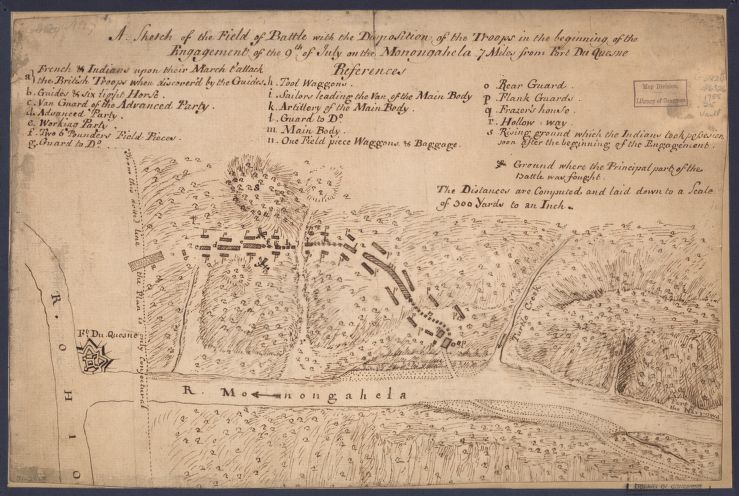
Nicholas Cresswell left Alexandria for the Illinois Country on March 16, 1775, his correspondence as yet unknown to the local Committee of Safety. The Ohio River served as a highway to the west, so he headed for its origin at Pittsburgh. Along the way, he stopped to visit the battlefield where French and Indian forces defeated Major General Edward Braddock in July, 1755. Cresswell and his traveling companions found “great numbers of bones, both men and horses. The trees are injured, I suppose by the Artillery…the greatest slaughter seems to have been made within 400 yards of the River…We could not find one whole skull, all of them broke to pieces in the upper part, some of them had holes broken in them about an inch diameter, suppose it to be done with a Pipe Tomahawk.”[i]
Initial Dispositions of the Battle of the Monongahela. Cresswell walked the battlefield on his way to Pittsburgh in 1775. (Library of Congress)
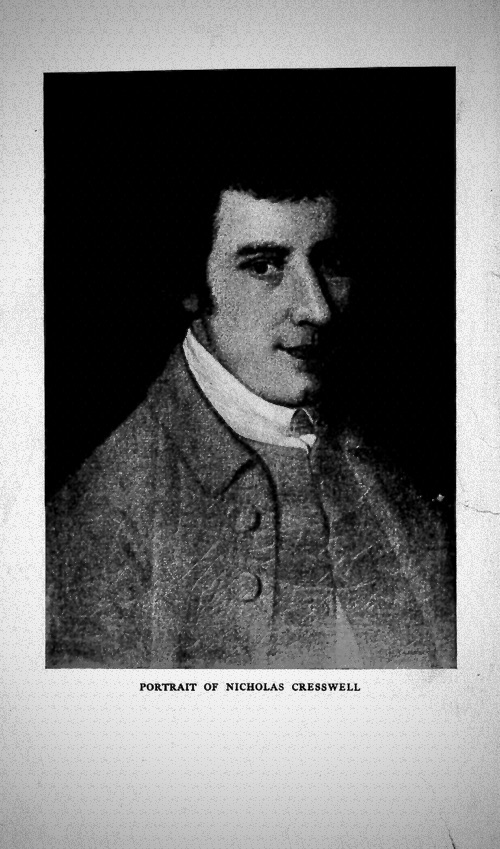
Nicholas Cresswell from the Frontispiece of his Memoir (Library of Congress)
For some Englishman, the political conflict between the United Kingdom and its American colonies was an afterthought that should not interfere with their plans to build a future based on American wealth. Nicholas Cresswell was one such person. He traveled to the colonies on the eve of the American Revolution and returned home in 1777, having kept an extensive diary of his travels, experiences, thoughts, and conditions in America during the war’s first years. Along the way, he met some of the most colorful and interesting people who played prominent roles in the war: George Rogers Clark, Delaware Indian leaders White Eyes and Killbuck, Thomas Jefferson, Patrick Henry, William Howe, Robert Rogers, and Charles Lee to name a few. Since its publication, Cresswell’s journal has become a touchstone for historians looking for insight into those people, how a loyal Englishman like Cresswell saw the world and the Americans around him interpreted events. In particular, he recounts the feelings and treatment of loyalists trapped in America during the war. With that in mind, reviewing Cresswell’s diary might help spread the word about a worthwhile primary resource.
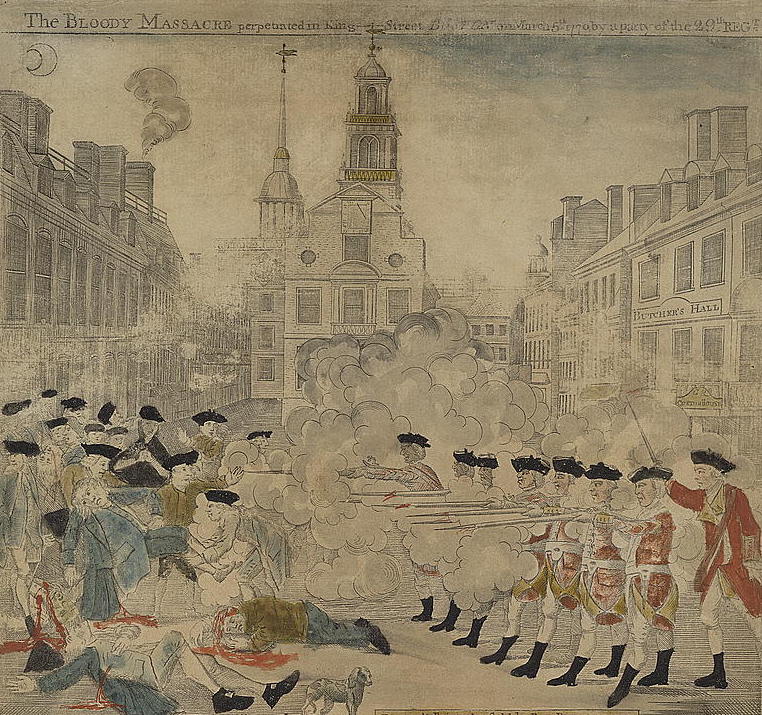
A detail from Paul Revere’s print of the “Bloody Massacre.” This widely circulated image gave the impression that the British soldiers fired in unison on command into a peaceful assembly. (Library of Congress)
“Fire if you dare, G-d damn you, fire and be damned!” the crowd of hundreds of Bostonians yelled as they pressed in around the nine British soldiers guarding the Custom House in Boston on the evening of March 5, 1770. The violence that was about to erupt in downtown Boston had been brewing for almost two years when British regular soldiers first entered Boston in 1768. It had gotten especially bad after February 22, 1770, when Christopher Seider, an 11-year-old boy, was killed while protesting with a group in front of the home of a loyalist. Thousands of Bostonians turned out for the boy’s funeral and the tension and distrust between the civilians and the British soldiers grew larger.
The presence of British regular troops in the streets of Boston enraged colonists, who now felt they were being occupied by a foreign army. It was just eleven days after Seider’s death, on March 5, 1770 when Private Hugh White of the 29th Regiment of Foot took up a sentry post outside of the Custom House on King Street in downtown Boston. The Custom House had taken on symbolic meaning as the center of British taxation. As a young wigmaker’s apprentice, Edward Garrick, passed the sentry, he yelled at a British officer that he had not paid his bill for a wig. The sentry, White, reprimanded the young man. The two engaged in a heated conversation when Private White swung his musket at Garrick, hitting him on the side of the head.
Word traveled through the streets about the altercation and a large mob began to descend on the lone British sentry at the Custom House. As the mob of people began to grow larger and larger, the sentry called for reinforcements. Seven British soldiers of the 29th Regiment of Foot, under the command of Captain Thomas Preston, marched to the sentry’s defense with fixed bayonets. As the nine British soldiers stood guard near the steps to the Custom House, passions enflamed and dozens more people joined the crowd surrounding the soldiers. Bells began ringing in the city and more people came out of their homes and into the streets. The crowd was estimated to have grown to as many as 300 or 400 people. They were yelling at the soldiers, shouting profanities and insults at the soldiers. Others threw rocks, paddles, and snowballs at the besieged men. One of those protestors near the soldiers was a former slave named Crispus Attucks. The crowd continued to hurl verbal abuse and challenged the soldiers repeatedly to fire their weapons. Preston’s men loaded their muskets in front of the crowd.
Following the September, 1777 battle of Brandywine, wounded soldiers were dispersed across southeastern Pennsylvania for treatment, and some ended up at a hospital in the small Moravian town of Lititz, near Lancaster. The Moravians had many settlements in this part of the state. The Moravians, like the Quakers, were pacifists, and also assisted in humanitarian efforts like treating the wounded.
General Washington sent army surgeon Dr. Samuel Kennedy here to establish the facility. The army took over the Brother’s House, home to the community’s single men, who were forced to find shelter elsewhere. Moravians lived and worked in separate groups: single women, single men, married women, married, men, etc. Wounded from Brandywine arrived, and more arrived following the November battle of Germantown.




 Emerging Revolutionary War Era