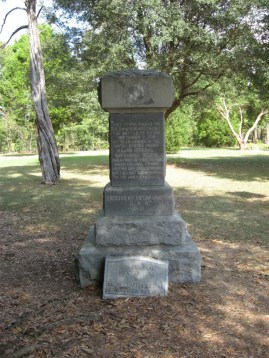
Daughter’s of the American Revolution (D.A.R.) Monument, Eutaw Springs Battlefield (author collection)
In many ways, the battle of Eutaw Springs was a disappointment for both commanders. Greene’s troops at one point broke through the British lines, but they recovered, and the Americans failed to drive them off the field. Stewart, in a letter to Cornwallis, wrote that there were two things he would regret the rest of his life: the loss of an early morning supply gathering party and his lack of cavalry. Having them, he felt, would have enabled him to decisively defeat Greene. Probably both commanders, and many of their officers, reflected upon these events and second guessed themselves for the rest of their days. Although both armies fought well at Eutaw Springs, a clear cut victory eluded both of them. Continue reading “After Eutaw Springs”→
Emerging Revolutionary War is honored to welcome back historian Katie Turner Getty. Biography of Ms. Getty is below the post.
On April 19, 1775, the placid farm of fifty-eight-year-old Jason Russell of Menotomy erupted into carnage when he, along with eleven other Americans, were shot and bayonetted by British soldiers in his home and yard.
Jason Russell House (author collection)
As American militia and minutemen poured in from surrounding towns, the British—fatigued yet furious—found themselves under increasingly heavy musket fire. As they pulled back from Concord and retreated to Boston, the main column passed near Russell’s house which stood near the battle road. Russell had just returned home after secreting his family at a nearby farm. Unbeknownst to him, American minutemen and British soldiers would soon converge upon his property and a desperate battle would occur within the walls of his own house.
Earlier that day, twenty-six-year-old Gideon Foster had set off from Danvers with a company of minutemen. The men had set a scorching pace and made the sixteen mile journey to Menotomy in four hours, running half the way.[1] Upon arriving, Foster’s men joined others from Lynn, Beverly, Salem, Dedham, and Needham.[2] Some took cover behind trees and others in Russell’s yard, where a breastwork was constructed out of shingles.
The Fight at the Jason Russell House, bicentennial painting by Ruth Linnell Berry (1974). Appearing with permission from the Arlington Historical Society.
The men focused their attention on the approaching main column of British troops and fired upon them. Capt. Israel Hutchinson, a seasoned French and Indian War veteran, warned that flank-guards would likely be traversing the fields alongside the road[3], helping the main column to pass unmolested. But before the men could reconsider their position or move to a more defensible location, the flank-guard was upon them, trapping the men against the main column.
In a frantic search for cover, many of the men bolted into Russell’s house. Jason Russell, too, attempted to dash inside but was slowed by his lame leg.[4] He was shot twice and fell on his doorstep. The soldiers tore inside the house in hot pursuit of the men, bayonetting Jason Russell’s body eleven times as they passed.
Once inside the house, the Americans had no choice but to fight for their lives in rooms with no egress, in very close quarters, against raging, bayonet-wielding soldiers. It was a bloodbath. With two rooms on the bottom floor, a narrow stairwell, and two rooms on the top floor, Jason Russell’s house offered very little refuge. Soldiers outside the house hailed musket fire into the windows.
Sign depicting what happened at the Jason Russell House on April 19, 1775
With nowhere else to go, several men rushed into the cellar. What at first would seem to be an ill-advised hiding spot turned out to be the only sanctuary that Russell’s home could offer. Taking position near the bottom of the stairs, the men raised their muskets and shot dead the first soldier who descended.[5] Any other soldiers who attempted to follow were met with blazing musket fire. Holes left by musket balls are still visible in the stairwell, attesting to the firestorm.
Soon, the house grew quiet. All of the men who had sought safety in the house had been killed, with the exception of the men who took refuge in the cellar. The British ransacked the house then left.[6]
In 1835, sixty years after the bloodbath at Russell’s house, a memorial was erected in Danvers to commemorate the townsmen who lost their lives in Menotomy that day. Danvers lost the second highest number of men, after Lexington[7], and all of them at Jason Russell’s house. Foster, the commander of the company of minutemen who had ran halfway to Menotomy, was by then the last surviving Danvers veteran of the war. Aged eighty-six, he addressed the crowd assembled for the dedication of the monument and recounted the events of April 19th:
On that morning, more than one hundred of my townsmen hastened to the field of battle…ready to offer their lives on the altar of their liberties. Seven of those who thus started in the prime of life and vigor of manhood, ere that day’s sun descended in the west, were numbered with the dead.[8]
Foster called the dedication of the memorial “One of the happiest days and most pleasing events of my life.”[9]
In total, twelve Americans were killed at Jason Russell’s house. Jason’s wife, Elizabeth, returned home to find her husband dead. He and the other fallen Americans, their bodies riddled with musket balls and slashed by bayonets, had been laid out on the floor in the kitchen, the blood from their wounds pooling around them. Elizabeth later said that “the blood in the room was almost ankle deep”.[10]
Musket ball damage to the staircase of the Russell House
*Biography: Katie Turner Getty is a lawyer, history enthusiast, and lifelong resident of Boston. She holds an A.A. from Bunker Hill Community College in Charlestown, Massachusetts, a B.A. in History from Wellesley College, and a J.D. from New England Law Boston. She can often be found exploring historic sites both on and off the Freedom Trail.
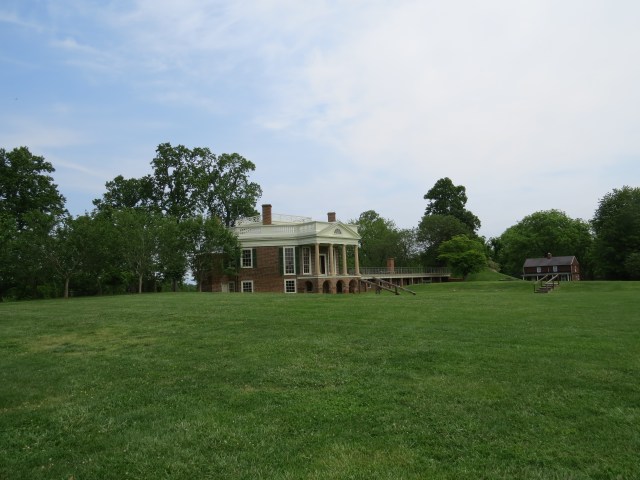
Although Jefferson was famous for his Virginia hospitality, sometimes the unending stream of visitors – especially after he retired from the presidency – just overwhelmed him and he needed to escape and have some peace. At such times, Jefferson retreated to his Poplar Forest home.
Long a destination on my bucket list, Poplar Forest struck me as a miniature Monticello at first glance. But on closer inspection, they are more dissimilar than I thought – despite initial appearances.
Although Jefferson and his wife Martha inherited the property in 1773, it was not until 1806 that construction on the home began. Much like Monticello, Jefferson designed the octagonal house from a number of architectural influences – Renaissance Palladian, 18th century French and some English. Even the privies are special octagonal structures.
Privy at Poplar Forest
The interior of Jefferson’s retreat is now undergoing renovation and restoration with completion just a few years away. It has been a long haul researching how Poplar Forest would have looked in Jefferson’s time. Until 1983, the property was in private hands. In fact, it was only two years after the great Virginian’s death that the plantation passed into private hands. Jefferson had given the property to his grandson Francis Eppes, but the young man quickly realized that the house was not practical to live in full time – so he sold it and moved to Florida.
Poplar Forest has some interesting history associated with it. It was where Jefferson and his family took refuge during the Revolution when the British were out to capture him. It is also where the Sage of Monticello wrote his only book – Notes on the State of Virginia.
Jefferson’s hide-away is open daily from mid-March through the end of December. During the winter, visitors can visit on weekends for self-guided tours.
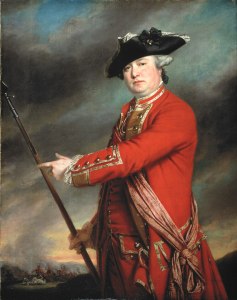
Finally, Gage put his plan into motion. The previous excursions taught him that this needed to be a quick strike, and secrecy was essential. Gage planned on a mixed force of elite Grenadiers and Light Infantry, picked from the several regiments in Boston. The Grenadiers were known to be fearless fighters and of big stock. While the Light Infantry tended to be smaller, they were less equipped so they could move fast. Both types of infantry were considered some of the most trained and effective troops. One possible problem was that these companies never served together since they were pulled from their various regiments. This could cause command issues if forced into combat. In command of these nearly 700 men, Gage placed Lt. Col. Francis Smith. Smith, a senior officer in the 10th Regiment of Foot, was chosen because he was cautious, prudent, and would not act rashly. Gage knew this was a precarious mission and wanted a level-headed man in command. Smith, one of the more overweight officers in Gage’s command, was not a dynamic leader. His ability to be flexible and think on the fly was questionable. Smith’s second in command was Maj. John Pitcairn of the Royal Marines. Pitcairn was considered a sharp officer and actually respected by many in Boston, even the Patriots.
Gage’s orders to Smith were direct. He was to march to Concord “with the utmost
Lt. Col. Francis Smith by Francis Cotes
expedition and secrecy to Concord, where you will seize and destroy all the artillery, ammunition, provisions, tents, small arms and all military stores whatever.” Gage also wanted to be sure the soldiers respected private property; their issue was with the rebels and their leaders, not the private citizens. They were also not to fire on any militia they encountered unless they were fired upon first. Gage knew that there might a possibility that armed militias would meet Smith’s force somewhere along the way as they had done previously in Portsmouth and Salem.
Left out of Smith’s orders were the capture of the Patriot leaders. One can only surmise why Gage did not carry out this directive from Dartmouth, but Gage knew the situation in Massachusetts better than his superiors. He might have wanted to avoid creating martyrs for the Patriot case. In either case, the men would cross Back Bay on long boats provided by the Royal Navy. From there, they would land at Lechmere Point and march through Cambridge, Menotomy through Lexington and to Concord. The other possible route, over the Boston neck, was deemed more hazardous and open to potential ambushes. The column wanted to keep its final destination a secret and crossing via water could possibly confuse the Patriot riders and spies that were surely out in the countryside after the first two false alarms that spring.
To try to prevent the Patriot riders from spreading the alarm, Gage ordered out a patrol of 25 men on April 18th to ride in the direction of Concord to cover all the major roads and intersections. As Gage told Smith, these men were “ordered out to stop all advice of your march getting to Concord before you.” Unfortunately, these men raised more suspicion than anything else. Locals began to wonder why these British men on horseback were out on patrol. Though these patrols did capture a few Patriot riders that night, they created more harm than good and added to the Patriot sense that something was about to happen on the night of April 18th.
Paul Revere at Lexington in Harper’s Young People
The precision and preciseness of the Patriot and Sons of Liberty spy network was proven on the night of April 18th. Gage, proud of his highly guarded secret, found out quickly through some of his junior officers, that the mission was not a secret. Many of the men did know their “secret” destination was Concord. How this information was released is lost to history. Some argue Gage’s wife, Margaret, might have informed Dr. Joseph Warren about the expedition. Margaret, a native of New Jersey might have had possible sentimental feelings towards the Patriots. However, there is no hard evidence that she betrayed her husband. What is known is that Warren did have informants close to Gage and, possibly through paid information, Warren was able to procure this important information. The Patriot leaders also had other clues that something was going to happen on the night of April 18th. The moving of all the Grenadier and Light Infantry companies from the barracks to the Boston Common, as well as the assembly of the Naval long boats on Back Bay notified the Patriots that the British were planning a move of some sort. Either way, as the British units were assembling on the Boston Common, the Patriot system of alarm riders was put into action.
This St. Patrick’s Day millions of people around the world will wear green and celebrate the Irish holiday. However there was a time when wearing the color green in Ireland could be punishable by death.
In the wake of the American Revolution, revolutions and rebellions began to breakout across Europe. While much has been written on how the American Revolution helped inspire the epic and violent French Revolution in 1789, the Irish rebellion of 1798 has largely been forgotten.
One of the green banners carried by Irish rebels in 1798. This one uses a phrase common in the American Revolution.
Arguably the most fascinating friendship in early America was between John Adams and Thomas Jefferson. Partners in declaring independence, the pair would become like brothers while on assignment in Europe. But the strain of political discord and partisan strife would first stretch and finally break the bonds first forged in Philadelphia. Only after both men were retired to their beloved homes, Adams at Peacefield in Quincy, MA, and Jefferson at Monticello in Charlottesville, VA, would the friendship be renewed. But a decade would pass in which the men did not meet nor correspond with each other. There was, however, a brief correspondence that passed between those locations in those silent years involving Thomas Jefferson and an Adams – Abigail, wife of the second president. Continue reading ““Abigail Adams and Thomas Jefferson: A Secret Correspondence””→
Emerging Revolutionary War welcomes back historian Derek D. Maxfield.
In March 1770 one of the most infamous events of the American revolutionary era took place outside the Custom’s House in Boston, when British soldiers fired into a crowd instantly killing three American civilians and wounding many others. It is, I hope, a familiar story. But this terrible tragedy was preceded, just a month earlier by a little-known event that took the life of a preteen boy.
John Adams by Mather Brown
While riding through the country-side attending to errands, John Adams stumbled upon, “a vast collection of people, near the Liberty Tree.” The large assemblage surprised the Bay State lawyer, who “enquired and found the funeral of the child, lately killed by Richardson.[i]”
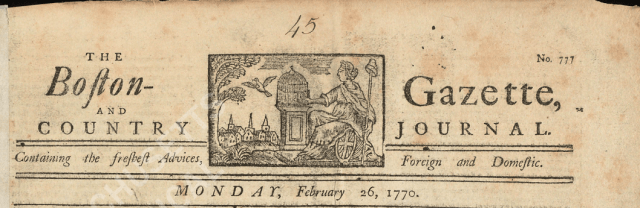
Adams happened upon the services for eleven year old Christopher Snider, who had been fatally shot by Ebenezer Richardson on Feb. 22nd, 1770 in Boston. The Boston Gazette carried the story of how this tragedy had come about. “On Thursday, late in the forenoon a barbarous murder attended with many aggravating circumstances, was committed on the body of a young lad.[ii]”
A group of boys of various ages had been demonstrating near the home of a merchant that was known to have violated the nonimportation agreement then in place in the colonies (which had been enacted in answer to the Townshend Duties). This “piece of pageantry” the Gazette explained, was witnessed by “one Ebenezer Richardson, who…was an officer of the customs, long known by the name of an INFORMER, and consequently a person of a most abandoned character.[iii]” Richardson apparently charged into the fray and tried to break up the demonstration unsuccessfully. Failing in this, he disappeared into the merchant’s house.
When Richardson reappeared and employing the most “profane language” prepared to “perpetrate a villany,” according to the Gazette. Threatening to fire upon the group of boys, Richardson “swore to God that he would make the place too hot for some of them before night, and that he would make a lane through them if they did not go away.” Witnesses to the scene later testified that the boys in no way answered with violence to that point, though soon Richardson was chucking brickbats and stones at them. “This, however, brought on a skirmish, and Richardson discharged his piece laden with swan shot[iv].” Snider, hit in several places, was mortally wounded as well as another boy with non-life-threatening wounds.
Boston Gazette Masthead (Courtesy of the Massachusetts Historical Society, Harbottle Dorr, Jr. Collection)
In April Richardson and another customs official, George Wilmot, were indicted and tried for murder in Suffolk Superior Court. Wilmot was acquitted; Richardson was found guilty but was pardoned by the King. The King’s pardon, coming as it did on the heels of the Boston Massacre, was met with extraordinary criticism from the people of Boston and contributed to tension that was already pregnant with possibilities for further disruption of the relationship between crown and colony.
Watching the long train of carriages at Snider’s funeral, John Adams was troubled. Although the Boston Massacre was still a few weeks into the future, the barrister observed “this shows there are many more lives to spend if wanted in the service of their country. It shows, too that the faction is not yet expiring – that the ardor of the people is not to be quelled by the slaughter of one child and the wounding of another.[v]”
The Gazette was scathing in it’s assessment of the shooting. “This innocent lad is the first, whose life has been victim to the cruelty and rage of oppressors!” Cut down by an “execrable villain,” in concert with, and with the apparent encouragement of, other British agents, they “could not bear to see the enemies of America made the ridicule of boys.[vi]”
The hostility of the people of Boston at the time to the presence of British soldiers is quite understandable. It was a city of occupation. The British encampment, after all, was in the heart of the city on Boston Common. Martial law reigned and off-duty soldiers began to even snatch up jobs along the docks, ordinarily the sustenance of native sons. But when you layer in the shooting of adolescents – and killing of one – at the hands of British agents not a full month before, the temperament of Bostonians is even easier to understand. As the Gazette put it, “the untimely death of this amiable youth will be a standing monument to the futurity that the time has been when Innocence itself was not safe![vii]”
*Sources
[i] L.H. Butterfield, ed. Diary and Autobiography of John Adams. Vol. I. (Cambridge: Belknap Press, 1962) 350.
[ii] Edes and Gill, Boston Gazette, February 26, 1770.
In Fincastle, nestled in the mountains of Virginia’s Botetourt County and once considered the “jumping off” spot for people traveling to the frontier, they tell a story about William Clark. Prior to his journey west with Capt. Meriwether Lewis and the Corps of Discovery, William Clark was in the village of Fincastle one day when, it is said, he spied two young girls on horseback. They were both pretty young things, the story goes, but Clark’s fancy was captured by only one of them.
William Clark
Her name was Julia Hancock; Clark called her “Judith”. She was the teenage daughter of former United States Congressman George Hancock of Santillane; one of Botetourt County’s most distinguished families.
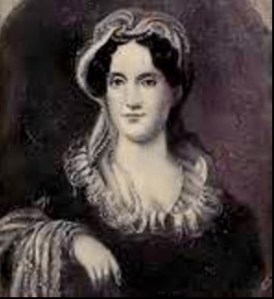
Julia Hancock
The story goes that Clark, who was twice her age, pledged his heart to the lass; it was his intention to marry her. While on his journey to the “western ocean’, Clark named a river in Montana in her honor. It was dubbed the Judith.
The Judith River
Upon his return to Fincastle, Clark was as good as his word and conducted the beautiful Miss Hancock to the alter.
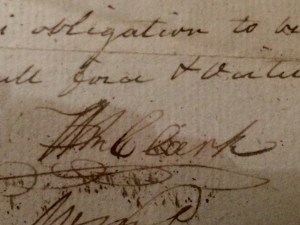
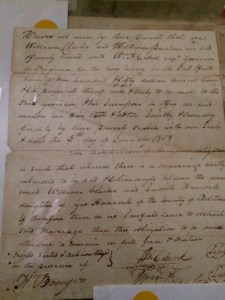
Among the historical documents that can still be found in the Botetourt County Circuit Court is the marriage bond for the two, signed by William Clark. The couple married on January 5, 1808.
William Clark’s SignatureMarriage Bond
Sadly, after 12 years of marriage and 5 children, Julia Hancock Clark died in 1820. Not long after however, in St. Louis, Clark happened to meet up with another Fincastle girl. She was a widow named Harriet Kennerly Radford. Needing a mother for his children, Clark would marry Harriet Radford on November 28, 1821. But still, there was a connection; Clark had known his new bride back in Virginia. Not only was Harriet Kennerly Radford a first cousin of Julia Hancock, she was also the other young girl Clark had first seen on horseback in Fincastle all those years before!! They tell the story in Fincastle.
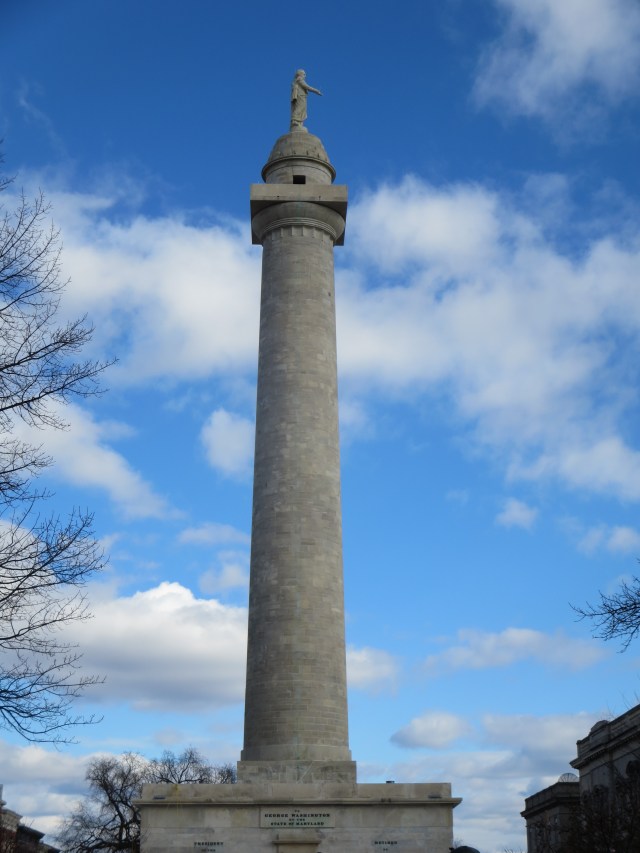
In Baltimore, Maryland stands one of the first monuments erected to the memory of George Washington. The 180-foot monument was finished in 1829, before the Washington Monument in D.C. was even begun. The impressive stone pillar is topped with a large statue of the General. Unlike most other statues of George Washington, the statue in Baltimore does not depict the Revolutionary War hero on horseback with his sword drawn, or as the First President of the United States. Instead it shows Washington, in his military uniform, simply extending a hand holding a piece of paper. Despite the simplicity of the scene, it is representative of one of the most important moments in the founding of the American nation: Washington resigning his military commission.
The Baltimore Washington Monument. Emblazoned on the sides are important dates in the Revolutionary War, including December 23, 1783. At the top, Washington resigns his commission.
On November 1, 1783, Washington learned that the Treaty of Paris had been signed and the Revolutionary War was over. On December 4, Washington bid an affectionate farewell at Fraunces Tavern in New York City to his officers and aides he had struggled and fought alongside for the previous eight years.
After the emotional farewell, Washington rode to Annapolis, Maryland where Congress was meeting at that time. He arrived at Annapolis on December 19 and was greeted as a hero. Congress agreed to accept his resignation on December 23, in a special ceremony.
The night before the ceremony, the town threw a celebratory ball for the General, complete with a dinner and dancing as well as thirteen cannon firings and thirteen toasts.
This famous painting of Washington Resigning his Commission by John Trumbull is on display in the United States Capitol Rotunda. The empty chair covered in robes is an allegorical depiction of the throne Washington was rejecting through the act of resigning.
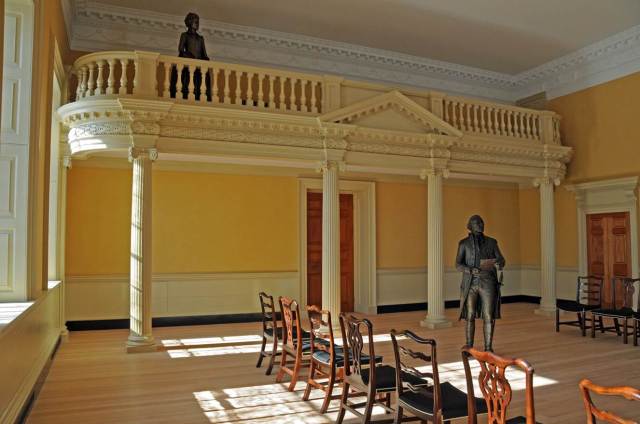
At about noon on December 23, 1783, George Washington entered the Old Senate Chamber in the Maryland State House. The importance of the moment was not lost on those who witnessed it, least of all, Washington himself. Washington is likely the only American who could have been made a king in America. In fact, in 1782, Colonel Lewis Nicola wrote a letter to Washington, suggesting that he should be king of America. Washington, quickly and emphatically crushed any notion of establishing a monarchy. More than a great general or leader, Washington believed in the ideals of American liberty and civilian rule.
In London, King George III remarked that if Washington gave up his power “he will be the greatest man in the world.”[1] Only a few times in human history before had a person at their zenith voluntarily surrendered all their power. Julius Caesar, William Cromwell, and Napoleon Bonaparte are prime examples of those who seized power at that same moment. Few men have been able to resist and became drunk with power. Washington was one of the few exceptions. One of the only precedents of rejecting the allure of that amount of power was in ancient Rome, when Cincinnatus gave up power after winning a war to become a simple farmer. Washington was about to become the American Cincinnatus.
Washington’s copy of his remarks delivered during his resignation on display in the Maryland State House.
Inside the chamber, Washington stood before the Continental Congress and its president, Thomas Mifflin, and read his concluding remarks. At one point, the power of the moment overtook Washington as he struggled through with a cracked voice the last few lines of his remarks. Washington finished his remarks: “Having now finished the work assigned me, I retire from the great theater of action; and bidding an affectionate farewell to this august body under whose orders I have so long acted, I here offer my commission and take my leave of all the employments of public life.”[2]
Those inside the chamber were overtaken with emotion and wept in the galleries. Concluding his remarks, Washington handed over to the Congress his commission dated June 15, 1775 and his remarks and left the building. And like that, Washington was once again a simple private citizen.
The Old Senate Chamber in the Maryland State House as it looks today. The room was just recently restored to the way it looked in 1783.
He rode from Annapolis and made it back to Mount Vernon the next day on Christmas Eve. It was the first time he had been home for Christmas since the beginning of the war. He could enjoy that Christmas with his family, but world history would never be the same again.
Today you can visit the location where this momentous event took place and see Washington’s hand written remarks on display at the Maryland State House in Annapolis. While the date of December 23, 1783 does not usually bring to mind a historic event, historian Ron Chernow described the event as “more extraordinary than any military feat during the war.”[3]
Washington would again be called back reluctantly to lead the nation as its first president in 1789. After serving two terms as president, Washington once again voluntarily gave up power in 1797. His disinterestedness in control and power set a precedent many have sought to emulate, and few have attained.
[1] Chernow, Ron. Washington: A Life. New York: Penguin Books, 2010. 454.
The City of Boston is known for many things and history is one of them. There are many sites within the city that interpret the story of the beginning of the American Revolution. Many sites are along the famous and popular “Freedom Trail.” The Freedom Trail winds through the city and connects historic sites, churches, monuments, museums and cemeteries that focus on the story of 18th century Boston. The trail can be identified by a double brick pattern located in the sidewalk. The 2 ½ mile trail begins at Boston Common and ends at the Bunker Hill Monument. Several sites in this book are included in the Freedom Trail, but there are others that are just as important that are not on the path of the trail. All the locations for this section are in walking distance, though we highly encourage you to use public transportation as driving in Boston can be challenging. Most attractions/sites in Boston are conveniently served by the “T” subway system.
For your first stop, visit the Old South Meeting House located at 310 Washington St, Boston (GPS: N 42.357078, W 71.058578). Built in 1729, the Old South Meeting House was one of the largest buildings in Boston at the time. It was here where the public meeting was held on the night of the Boston Tea Party. Today the building serves as a historic site and museum. The small admission fee is worth the price to see this historic site which includes exhibits on the history of the church, Boston and the Boston Tea Party.
From the Old South Meeting House, you can take the route of the “Mohawks” to the next stop, the Boston Tea Party Ships and Museum. Take Milk Street (next to the Old South Meeting House) for three blocks and take a right onto Congress Street. After six blocks the Boston Tea Party Ships and Museum will be on your left as you cross the bridge over Fort Point Channel (GPS: N 42.352071, W 71.051369). The Boston Tea Party Ships and Museum includes interactive exhibits and experiences where visitors can help throw tea over board one of the recreated ships (the Eleanor and the Beaver). There is also a tea room, theater and film and gift shop. Hours vary depending on the season.
Due to the expansion of the Boston shore lines over time, the actual location of Griffin’s Wharf is not near the water today. Some argue it was at the foot of Pearl Street near the intersection of Pearl Street and Atlantic Avenue. There is a plaque commemorating the Boston Tea Party located on Seaport Boulevard. To see the plaque, take Atlantic Avenue and make a right onto Seaport Boulevard, the plaque is located on the building to the right near the bridge (GPS: N 42.354147, W 71.050977).












 sites within the city that interpret the story of the beginning of the American Revolution. Many sites are along the famous and popular “Freedom Trail.” The Freedom Trail winds through the city and connects historic sites, churches, monuments, museums and cemeteries that focus on the story of 18th century Boston. The trail can be identified by a double brick pattern located in the sidewalk. The 2 ½ mile trail begins at Boston Common and ends at the Bunker Hill Monument. Several sites in this book are included in the Freedom Trail, but there are others that are just as important that are not on the path of the trail. All the locations for this section are in walking distance, though we highly encourage you to use public transportation as driving in Boston can be challenging. Most attractions/sites in Boston are conveniently served by the “T” subway system.
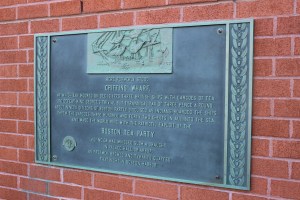 Due to the expansion of the Boston shore lines over time, the actual location of Griffin’s Wharf is not near the water today. Some argue it was at the foot of Pearl Street near the intersection of Pearl Street and Atlantic Avenue. There is a plaque commemorating the Boston Tea Party located on Seaport Boulevard. To see the plaque, take Atlantic Avenue and make a right onto Seaport Boulevard, the plaque is located on the building to the right near the bridge (GPS: N 42.354147, W 71.050977).
 Emerging Revolutionary War Era