On February 1, 2017 at 7:00 p.m. join Emerging Revolutionary War’s Derek Maxfield for the launch of the “Historical Horizons Lecture Series” sponsored by the Genesee Community College History Club.
Two of the most important men in American History are John Adams and Thomas Jefferson. From the time they met in Philadelphia in 1775 until their deaths in 1826, these two men had a most fascinating relationship; much of the time it was one of admiration and love, but it was interrupted by a period of intense partisan strife that nearly ended the friendship. Come hear the intriguing story of how the friendship was restored.
The lecture is part of the Historical Horizons Lecture Series sponsored by the GCC History Club. Get the complete spring semester line-up here: https://gcchistoricalhorizons.wordpress.com/
All events are FREE and open to the public at the Genesee Community College Batavia campus, room T102 of the Conable Technology Building.
Emerging Revolutionary War welcomes back guest historian Malanna Henderson
Part One
“It is not for their own land they fought, not even for a land which had adopted them, but for a land which had enslaved them, and whose laws, even in freedom, oftener oppressed than protected. Bravery, under such circumstances, has a peculiar beauty and merit.” – Harriet Beecher Stowe.
The words spoken by “the little woman who wrote the book that started this Great War,” so said Abraham Lincoln, according to legend, upon meeting Mrs. Stowe sometime in 1862, rang true for black patriots in the Civil War as well as those in the Revolutionary War.
The Smithsonian tome, The American Revolutionary War: A Visual History quotes a Hessian officer in 1777, as saying, “No regiment is to be seen in which there are not Negroes in abundance and among them are able-bodied and strong fellows.”
In every battle of the Revolutionary War from Lexington to Yorktown; black men, slave and free, picked up the musket and defended America; and yet, many historians as well as visual artists have omitted their contributions in the history books and their images on canvases depicting historic battles. The need for white historians to “overlook,” “underestimate,” and or “erase,” these sacrifices is a gross negligence that distorts and misrepresents American history; and furthermore, it continues to disenfranchise the patriotic heroes of the past and malign the self-image of millions of Americans today simply because of the color of their skin.
Black soldiers have always fought two wars simultaneously; wars declared by their government and the unspoken wars at home for liberty, equality and before the Civil War, for citizenship.
What kind of men fight for the liberty of others when their own liberty isn’t guaranteed?
True patriots: James Armistead Lafayette was one such person.
James Armistead Lafayette (1760-1832) Blackpast.org
Slaves serving in the rebel military was a question that manifested itself early amongst the colonial government agencies. Their presence rankled many, while others welcomed them and praised their bravery. Some men of color had fought gallantly and with distinction as they stood alongside their white compatriots, defenders of liberty on the Lexington Green in April of 1775.
For instance, in the Battle of Bunker Hill, Peter Salem, a slave, served with courage under fire, as varying accounts reported. Salem was introduced to George Washington as “the man who shot Pitcairn,” the British Royal Marine Major who shouted to his men before Salem shot him down, “The day is ours.” Despite the competence and bravery of such men on the battlefield their exploits didn’t convert the wide-spread reluctance of most colonists to accept black men as soldiers.
General George Washington, Commander-in-Chief of the Continental Army, harbored the same common prejudices of the southern-planter ruling class of which he was a member. In July, he instructed recruiters “not to enlist any stroller, negro, or vagabond, or person suspected of being an enemy to the liberty of America.” Commanders in each colony and regiment made up their own minds. Some ignored his command. Their decision was based on need and experience. Those who had already served successfully with black militia and minutemen may have seen no cause to alter their regiments.
By December of 1776, Washington back-pedaled on his decision, allowing for black veterans of Lexington, Concord and Bunker Hill to serve; but of the slave, he maintained his objection. However, some junior officers appreciated the contributions of blacks. Col. John Thomas wrote John Adams on October 24, 1775, “We have negroes, but I look upon them as equally serviceable with other men, for fatigue (labor); and, in action many of them have proven themselves brave.”
As the war raged on, the necessity for able-bodied men settled the question. White soldiers, who usually served for only a few months to a year, mustered out, died or were wounded; while others deserted. Black soldiers who expected to receive their freedom if they served were in the war for the duration. This was a positive factor for the commanding officers who had to re-train all new recruits. Around five-thousand blacks served in the Revolutionary War as soldiers. However, a vast unknown number provided a myriad of support services.
Another reason the colonials reconsidered enlisting blacks was the bold military tactic that occurred in November of 1775. Lord Dunmore, the last royal governor of Virginia, ratified a proclamation freeing all indentured servants and slaves of rebels if they would fight for the British. Thousands of people fled the plantations to gain their freedom. This single act struck a devastating blow on two fronts, it threaten their economic stability and increased the tension between master and slave, with the master fearing slave revolts and the permanent loss of their property. Moreover, it upset the social order. Enslaved men serving alongside whites put them on an equal footing in the battlefield, which violated the white supremacy dogma that governed current thought and practice.
Born into slavery on December 10, 1748, in New Kent, Virginia to owner William Armistead, James enlisted in the Revolutionary War under General Marquis de Lafayette in 1781. His owner was a patriot and most likely received the bonus James would have gotten for enlisting had he been free or white. Enlistment bonuses comprised of money, land or slaves.
By the time Armistead entered the war, the efforts of Benjamin Franklin and other colonial agents had secured a military and economic alliance with the French. A long-time imperial rival of British expansion, the French provided naval ships, money and personnel.
Marquis de Lafayette (born Marie Joseph Paul Yves Roch Gilbert du Motier) was a descendant of ancient French nobility. His father, a colonel in the French Grenadiers had died in the Seven Year’s War (known as the French and Indian War in America) when the young nobleman was only two years old. The political ideals of liberty and equality espoused by the colonials matched his beliefs and fired his military ambitions. Perchance, his yearning to play a role in America’s fight for independence from British rule may have been spawned by a desire to avenge his father’s death.
Since Lord Dunmore’s Proclamation, it was easy for Armistead to gain access in the enemy camps as a runaway slave seeking his freedom. While providing varied services to the British, he gained the confidence of Brigadier General Benedict Arnold, who by now had defected to the British. He charged Armistead with scouting, foraging and spying. Armistead was able to comfortably go between both camps, in essence becoming a double spy. He carried false and misleading information to the British but provided accurate intelligence on the movement of British forces and details of their military strategies to General Lafayette.
When Arnold left Virginia, Armistead was able to deceive General Charles Cornwallis as well, who rampaged through parts of Virginia and burned Richmond, the capital. He sent Colonel Banastre Tarleton to capture the entire legislative assembly, which included Daniel Boone, Patrick Henry and the governor. The plan was thwarted by an astute young man named Jack Jouett. Although, a few were apprehended, among them Daniel Boone; Jouett’s actions prevented the British from arresting the biggest prize: Governor Thomas Jefferson.
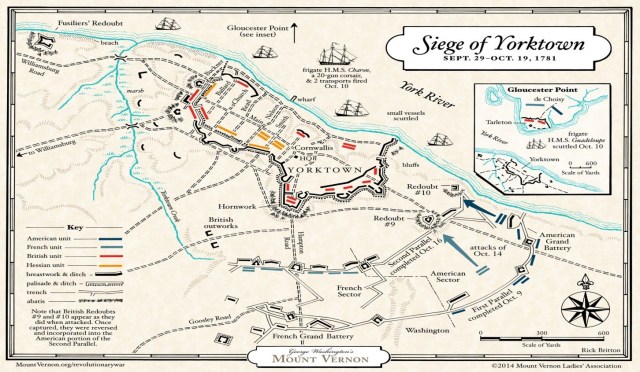
By early August, Cornwallis had made plans to establish fortifications in Yorktown, expecting reinforcements to increase his troops of approximately nine-thousand.
General Washington, in the meantime, had joined forces with Comte de Rochambeau to recapture New York. With intelligence supplied by James Armistead, they learned that Cornwallis was in Yorktown waiting for military support. French Admiral de Grasse, with a fleet of about twenty-eight naval ships, was on his way to the Chesapeake from St. Dominick (present-day Haiti). A plan to surround Cornwallis by land and sea appeared possible. The French naval fleet, along with the Washington’s Continental and Rochambeau’s French forces, headed to the enemy’s headquarters. Once Washington reached Yorktown, General Lafayette’s regiment joined him. Thus, Armistead’s accurate and meticulous reports were vital to the American victory that culminated in Yorktown on October 19, 1781.
Later Cornwallis met the Marquis at his headquarters and was flabbergasted to find his spy James Armistead present.
The Treaty of Paris in 1783 severed ties from Britain, the mother country, and established America as an independent nation. That same year, the Act of 1783 was passed freeing slaves who had fought in the Revolutionary War on their masters’ behalf. However, it excluded slave-spies. Ergo, James Armistead, who risked his life by providing information to help win the freedom of many, was himself denied freedom. Was his life in less danger operating under subterfuge as a spy amongst the British than it would have been, had he served as a soldier on the battlefield? I think not. Had his espionage been discovered, he surely would have had to forfeit his life.
After the war, Armistead was returned to slavery. Even his own master didn’t have the legal right to free him because of the Act of 1783, omitting slave-spies from emancipation.
When learning of his compatriot’s status, the Marquis penned a certificate to the Virginia legislator in October of 1784 imploring them to grant Armistead his freedom, declaring:
“This is to Certify that the Bearer By the Name of James Armistead Has done Essential Services to me While I had the Honour to Command in this State. His Intelligences from the Ennemy’s Camp were Industriously Collected and More faithfully deliver’d. He properly Acquitted Himself with Some Important Commissions I Gave Him and Appears to me Entitled to Every Reward his Situation Can Admit of. Done Under my Hand,” Richmond, November 21st 1784.
The legislator didn’t act upon the request straightaway. However, again in 1786, James Armistead applied for his freedom and it was duly granted on January 9, 1787, with a fair compensation to his master, William.
In honor of his benefactor, James Armistead added Lafayette to his surname. After emancipation, he moved a short distance south of New Kent, near Richmond, Virginia and acquired forty acres of less than suitable farmland. He married and had a family. He even owned slaves. History doesn’t tell us if he bought enslaved relatives to free them or if they were bought to farm his land as field hands.
It wasn’t until 1819 that he applied to the state legislature for financial assistance to ease his poverty. This time, the response was immediate; he received $60 and an annual pension of $40 for his service during the Revolutionary War.
Unlike James Armistead Lafayette, many blacks who worked as laborers, guides, messengers and spies were not as fortunate. Whether they were pressed into service or willingly answered the call, most neither received their freedom nor wages for their behind-the-scene contributions to the war.
In 1824, the Marquis de Lafayette visited the United States and was lauded as a hero of the American Revolutionary War in Richmond with festivities and a parade. Spying Armistead in the crowd, it is said he halted the procession, dismounted from his horse and embraced his old comrade.
Kareem Abdul-Jabbar and Alan Steinberg Black Profiles in Courage: A Legacy of African-American Achievement. (New York: William Morrow and Company, Inc.1996) pages 32-34.
Col. Michael Lee Lanning (Ret.) Defenders of Liberty: African Americans in the Revolutionary War. (New York: Kensington Publishing Corp. 2000) pages 45-46; 130
Emerging Revolutionary War is honored to welcome back historian Katie Turner Getty.
“Mr. Malcom, I hope you are not going to strike this boy with that stick.”[1]
George Robert Twelves Hewes portrait, entitled “The Centenarian” by Joseph G. Cole, 1835.
The speaker was 31-year-old Boston shoemaker and Tea Party participant, George Robert Twelves Hewes. Hewes had been walking along Fore Street in Boston on the afternoon of January 25, 1774 when he came across 50-year-old Loyalist and Customs officer, John Malcom, furiously shaking a large, heavy cane at the head of a small boy.
Five weeks earlier, on December 16, 1773, Hewes had “dressed [himself] in the costume of an Indian, painted [his] face and hands with coal dust in the shop of a blacksmith”[2] and participated in the Tea Party. Appointed boatswain, he and his company boarded one of the three ships and proceeded to soak 342 chests of East India Company tea in Boston Harbor. After dumping the tea that night, the men “quietly retired to [their] several places of residence… No disorder took place… and the stillest night ensued that Boston had enjoyed for many months.”[3]
Hewes had encountered no trouble when destroying the tea that night. But on this frigid Tuesday afternoon in January, trouble had found him—and was brandishing a cane.
Malcom turned his attention from the small boy to the shoemaker and exclaimed, “You are an impertinent rascal! It is none of your business!”[4]
Undeterred, five-foot, one-inch Hewes further protested Malcom’s rough treatment of the boy. Malcom called Hewes a “vagabond” and further declared that Hewes “should not speak to a gentleman in the street.”[5]
Hewes replied that he was “neither a rascal nor a vagabond, and though a poor man, was in as good credit in town as [Malcom] was.”[6] The exchange between the two men became even more heated.
Malcom called Hewes a liar and Hewes then retorted, “be that as it will, I never was tarred and feathered any how.”[7]
Malcom, overcome with fury, then struck Hewes in the head with his heavy cane, opening a bloody gash in the shoemaker’s forehead and causing him to fall to the ground unconscious.
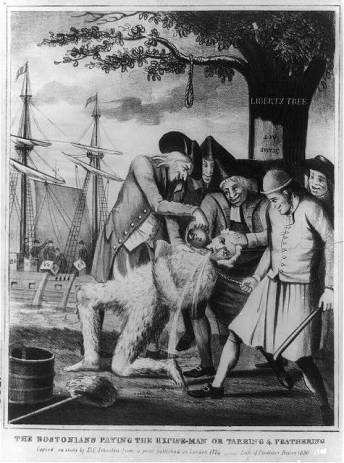
John Malcom was one of the few people in the American colonies who had been tarred and feathered. Before this night was through, he would earn the dubious distinction of having been tarred and feathered twice.
“A New Method of Macarony Making, as Practised at Boston”, 1774.
Malcom’s first encounter with a sticky suit of tar and feathers was in October of 1773 in Falmouth (now Portland, Maine). While working as a Customs officer, Malcom had overzealously seized a ship called the Brothers for not having a register. Once aboard the ship, he “heartily damned the sailors, menaced the mate, [and] threatened to sheath his sword in the bowels of any one who dared dispute his authority.”[8]
So enraged were local sailors by Malcom’s behavior, that he was “disarm’d of Sword, Cane, Hat & Wig”[9], tarred and feathered over his clothes, and paraded through the streets for about an hour before being released.
This episode was common knowledge in Boston. In a letter to the Earl of Dartmouth, Massachusetts Governor Thomas Hutchinson indicated that Malcom had complained to him on several occasions of “being hooted at in the Streets for having been tarred and feathered”[10] Clearly, the Boston populace was not sympathetic to Malcom. And after his assault on Hewes, they would become even less so.
When Hewes regained consciousness, he found himself surrounded by a crowd of onlookers who urged him to visit the prominent Boston physician, Dr. Joseph Warren, to have his wound treated. In the meantime, Malcom had “contrived to get a weapon in his hand and keep [the crowd] at bay, till he could flee to his house”[11] on Cross Street.
When Hewes visited Dr. Warren at his office on Hanover Street, the doctor made a cheerful comment relating to the fortuitous thickness of Hewes’s skull. He said, “you are the luckiest man I know of, to have such a skull—nothing else could have saved you.”[12]
Word of Malcom’s assault on Hewes had quickly spread through Boston and people had started gathering outside his house. Far from being cowed by the unfriendly crowd, Malcom “bullied the people”[13], slinging verbal taunts and threats. In response to jeers, Malcom shouted “You say I was tarred and feathered, and that it was not done in a proper manner, damn you let me see the man that dare do it better!”[14]
Even 243 years later, Malcom’s defiance of the crowd is astonishing. From inside his house, he ran his sword out through the window and inflicted a flesh wound on an unlucky bystander named Waddel. He threatened the crowd with pistols and proclaimed that he would receive a thirty pound reward for every person he killed[15]. The formidable Malcom was eventually removed from his house “amidst the huzzas of thousand[s]”[16] He was dragged on a sled to King Street, site of the Boston Massacre, and was stripped of his clothes.
In Falmouth, during his first tar and feathering in 1773, the tar was splashed onto his clothes. This time, Malcom’s clothing was torn off, exposing him to the frigid winter air. The tar was poured over his bare flesh. He was then transferred to a cart and gleefully hauled to various points across town.
Sixty years later, Hewes reflected upon the event in his biography. “Then they drove to Liberty Tree—to the gallows on the Neck—back to the Tree—to Butcher’s Hall again—to Charlestown Ferry—to Copp’s Hill—flogging the miserable wretch at every one of these places.”[17] Four hours later, he was unceremoniously deposited at the doorstep of his house, frostbitten and senseless.
The reader may feel a slight twinge of disappointment, or perhaps even a grudging respect, upon learning that throughout his ordeal, John Malcom comported himself with “Great Fortitude and Resolution”.[18] Malcom’s recovery was lengthy. When frostbite caused his tarred and feathered flesh to peel off in strips, Malcom packed the skin in a box to preserve it and present to the King as proof of his service and sufferings.[19]
In May, 1774 Malcom sailed for England (presumably with his box of tarred flesh and feathers). Once in England, Malcom embarked on a letter-writing campaign to request redress for all of the suffering and expense he endured in America in furtherance of his service to the King.
In 1776, Malcom wrote a letter to the Lords of the Treasury. In referencing the altercation with Hewes in Boston and his subsequent tarring and feathering, Malcom stated that in “endeavoring to do my Duty in getting the Tea landed, [he] was barbarously and inhumanely treated…[and] was obliged to quit America”.[20]
Also in the letter, he accused his former Customs supervisor in Falmouth, Francis Waldo, of various misdeeds. Waldo had strongly disagreed with Malcom’s seizure of the Brothers and the two had never reconciled.
Waldo’s ire is still palpable 240 years later as, in response, he meticulously dismantles Malcom’s claims in a letter to the Lords of the Treasury, point by painstaking point:
“Mr Malcom went to Boston and brought upon himself a second Taring [sic] and Feathering…which happened some time after the India Companys Teas were destroyed and was occasioned by his beating a Boy in the Street in such a manner as to raise a Mob”[21]
Many factors probably contributed to the second tarring and feathering of Malcom, but any efforts he might have made to land the tea were not among them. As Waldo pointed out, the tea had been destroyed over a month before Malcom was tarred. Malcom was already unpopular in town due to objectionable past actions such as the Brothers seizure. He was a particularly overzealous and aggressive Customs officer. And the man he assaulted was a Patriot and tea party participant.
“Bostonian’s Paying the Excise-Man, or Tarring and Feathering”, attributed to Philip Dawe, London, 1774.
Additionally, Bostonians felt a simmering resentment toward the authorities. When some men tried to persuade the crowd to stop tormenting Malcom, they refused to relinquish him.[22] They believed the government would fail to punish him for his wrongs—assaulting the boy and Hewes, threatening the populace, and sticking Waddel with his sword. Instead, the crowd chose to maintain possession of Malcom and mete out the justice that they believed the government would not.
Malcom was in England barely a year before he demonstrated a desire to return to Boston. In a petition to the King, Malcom states that he “long[s] to be sent out to my Family in Boston and to my Business in the Customs in the Boston Government…I would Humbly Implore your Majesty let Me be soon sent from London to Boston…”[23]
In the end, Malcom was assigned to the Independent Company of Invalids at the Plymouth Garrison. He penned several more letters and petitions asking for additional compensation from the British government.
In 1782, the Commissioners on American Loyalist Claims reviewed his case and decided to allow him another 60 pounds per year on account of his having been tarred and feathered, but in no small part because “he appears to be in some degree insane.”[24]
Malcom lived out the rest of his days in England, passing away in 1788 at age 65. He never went back to Boston, nor ever saw his wife or children again.
Hewes lived to be 98 years old. In 1775, after war broke out, he escaped from Boston in a fishing boat and went to Wrentham, Massachusetts. He served in the militia until the end of the war. Eventually he moved to upstate New York. He was married for 70 years until his wife, Sally, passed away at the age of 87. By all accounts, he was lively and spry until the end. On the 4th of July, 1840, he was preparing to attend a celebration as a special veteran guest. On that day, George Robert Twelves Hewes stumbled while stepping into a carriage and suffered a serious injury. He died that November.
*Sources
[1]Boston-Gazette and Country Journal, 31 January 1774. The Annotated Newspapers of Harbottle Dorr Jr., Massachusetts Historical Society http://www.masshist.org/dorr/volume/4/sequence/522 Hereinafter cited as Boston-Gazette.
[2] A Citizen of New York [James Hawkes], A Retrospect of the Boston Tea-Party, with a Memoir of George R. T. Hewes, a Survivor of- the Little Band of Patriots Who Drowned the Tea in Boston Harbour in 1773 (New York: S. Bliss, printer, 1834), 38. https://archive.org/details/retrospectofbost00hawk Hereinafter cited as Hawkes.
[8] Boston-Gazette and Country Journal, 14 February 1774, quoted in Frank W.C. Hersey, Tar and Feathers: The Adventures of Captain John Malcom, reprinted from the Transactions of the Colonial Society of Massachusetts, volume XXXIV, (Boston: D.B. Updike, The Merrymount Press, 1943), 440.
[9] Boston-Gazette and Country-Journal, 15 November 1773, quoted in Hersey, 440.
[10] Governor Thomas Hutchinson letter to Earl of Dartmouth, 28 January 1774, quoted in Hersey, 448.
[11] A Bostonian [Benjamin Bussey Thatcher], Traits of the Tea Party; Being a Memoir of George R. T. Hewes, One of the Last of Its Survivors; With a History of That Transaction; Reminiscences of the Massacre, and the Siege, and Other Stories of Old Times (New York: Harper & Brothers, 1835), 128. https://archive.org/details/traitsteapartyb00thatgoog Hereinafter cited as Thatcher.
[18] John Rowe, Anne Rowe Cunningham, Edward Lilly Pierce, Letters and diary of John Rowe: Boston merchant, 1759-1762, 1764-1779, (Boston: W.B. Clark Co., 1903), 261.
Emerging Revolutionary War welcomes back historian Derek D. Maxfield.
In March 1770 one of the most infamous events of the American revolutionary era took place outside the Custom’s House in Boston, when British soldiers fired into a crowd instantly killing three American civilians and wounding many others. It is, I hope, a familiar story. But this terrible tragedy was preceded, just a month earlier by a little-known event that took the life of a preteen boy.
John Adams by Mather Brown
While riding through the country-side attending to errands, John Adams stumbled upon, “a vast collection of people, near the Liberty Tree.” The large assemblage surprised the Bay State lawyer, who “enquired and found the funeral of the child, lately killed by Richardson.[i]”
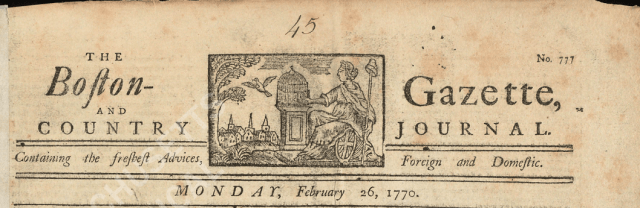
Adams happened upon the services for eleven year old Christopher Snider, who had been fatally shot by Ebenezer Richardson on Feb. 22nd, 1770 in Boston. The Boston Gazette carried the story of how this tragedy had come about. “On Thursday, late in the forenoon a barbarous murder attended with many aggravating circumstances, was committed on the body of a young lad.[ii]”
A group of boys of various ages had been demonstrating near the home of a merchant that was known to have violated the nonimportation agreement then in place in the colonies (which had been enacted in answer to the Townshend Duties). This “piece of pageantry” the Gazette explained, was witnessed by “one Ebenezer Richardson, who…was an officer of the customs, long known by the name of an INFORMER, and consequently a person of a most abandoned character.[iii]” Richardson apparently charged into the fray and tried to break up the demonstration unsuccessfully. Failing in this, he disappeared into the merchant’s house.
When Richardson reappeared and employing the most “profane language” prepared to “perpetrate a villany,” according to the Gazette. Threatening to fire upon the group of boys, Richardson “swore to God that he would make the place too hot for some of them before night, and that he would make a lane through them if they did not go away.” Witnesses to the scene later testified that the boys in no way answered with violence to that point, though soon Richardson was chucking brickbats and stones at them. “This, however, brought on a skirmish, and Richardson discharged his piece laden with swan shot[iv].” Snider, hit in several places, was mortally wounded as well as another boy with non-life-threatening wounds.
Boston Gazette Masthead (Courtesy of the Massachusetts Historical Society, Harbottle Dorr, Jr. Collection)
In April Richardson and another customs official, George Wilmot, were indicted and tried for murder in Suffolk Superior Court. Wilmot was acquitted; Richardson was found guilty but was pardoned by the King. The King’s pardon, coming as it did on the heels of the Boston Massacre, was met with extraordinary criticism from the people of Boston and contributed to tension that was already pregnant with possibilities for further disruption of the relationship between crown and colony.
Watching the long train of carriages at Snider’s funeral, John Adams was troubled. Although the Boston Massacre was still a few weeks into the future, the barrister observed “this shows there are many more lives to spend if wanted in the service of their country. It shows, too that the faction is not yet expiring – that the ardor of the people is not to be quelled by the slaughter of one child and the wounding of another.[v]”
The Gazette was scathing in it’s assessment of the shooting. “This innocent lad is the first, whose life has been victim to the cruelty and rage of oppressors!” Cut down by an “execrable villain,” in concert with, and with the apparent encouragement of, other British agents, they “could not bear to see the enemies of America made the ridicule of boys.[vi]”
The hostility of the people of Boston at the time to the presence of British soldiers is quite understandable. It was a city of occupation. The British encampment, after all, was in the heart of the city on Boston Common. Martial law reigned and off-duty soldiers began to even snatch up jobs along the docks, ordinarily the sustenance of native sons. But when you layer in the shooting of adolescents – and killing of one – at the hands of British agents not a full month before, the temperament of Bostonians is even easier to understand. As the Gazette put it, “the untimely death of this amiable youth will be a standing monument to the futurity that the time has been when Innocence itself was not safe![vii]”
*Sources
[i] L.H. Butterfield, ed. Diary and Autobiography of John Adams. Vol. I. (Cambridge: Belknap Press, 1962) 350.
[ii] Edes and Gill, Boston Gazette, February 26, 1770.
Over the years, it has been my pleasure to stop in at the old Yorktown Victory Center. The primary focus of the museum, as one might expect, was on the October 1781 siege, which not only brought about the surrender of British forces under General Charles, Lord Cornwallis, but also hastened the eventual end of hostilities between Britain and her former colonies. More recently, I’ve had the pleasure of working at the museum for special occasions as a volunteer for the Jamestown-Yorktown Foundation (JYF).
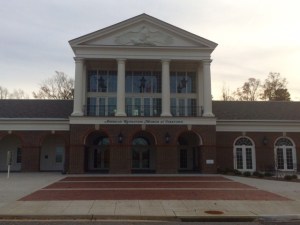
The Foundation has since expanded its view of Revolutionary America with a new museum, built upon the bones of the original, which looks beyond the confines of the Yorktown siege and takes a broader view of the conflict as a whole. In the fall of 2016, JYF opened its new American Revolutionary War Museum at Yorktown.
The building itself is large and impressive, with over 22,000 square feet (I’m told) of exhibition space. There is a natural flow between the various galleries, which chronicle our nation’s journey from subjugated colonies to Republic. Visitors, especially those who are not well versed in the history of the Revolutionary War, can more easily follow “the road” that led to our independence.
I started my visit by viewing the new introductory film, “Victory Forever”. The story of the Revolution is told by a 19th century showman who has visited many of the sites associated with the war and the events preceding its outbreak. As I began my own trip “down the road”, I was happy to see that the Foundation’s impressive collection of 18th century weapons and other artifacts are part of this new vision. There are new acquisitions on display as well, such as an original broadside of the Declaration of Independence which dates back to 1776.
There are new interactive films and exhibition galleries that tell the story first of the changing relationship between America and Britain after the end of the Seven Year’s War or, as it was known in America, the French and Indian War. This, of course, includes the rifts that arose beginning in the 1760’s over taxation.
The “Revolution” exhibition chronicles the weapons and tactics used in the conflict itself, from Lexington and Concord to Yorktown. And I was pleased to see an exhibition that focuses on the war in the south and the major players who led those events such as Daniel Morgan, the “Gamecock” Thomas Sumter, and the notorious Banastre Tarleton.
In prior years, the site also featured a Continental Army encampment and a 1780’s-era Virginia farmstead. The encampment has been expanded to include a small amphitheater for use in artillery and small arms demonstrations. This farm area is also undergoing considerable change as it will now represent a Virginia farmstead during the Revolutionary War era. Not yet completed, a conversation with friend and farm site manager Jay Templin gave me an idea as to some of the changes that are coming. “We’re now presenting life during the Revolution so we’ll need to scale back; there will be changes to what we’re growing.” Said Templin. “We’ll certainly still be growing some tobacco but not the large field as in years past.”
Although the American Revolutionary War Museum at Yorktown opened to the public in October, it is generally considered a “soft opening” as the entire site is not yet in its completed state. I’m told by staff there that the grand opening is slated for March 2017. I have to say that I was pleased with the new facilities and the fact that the focus of the museum is now on the broader era of the war. I wholeheartedly recommend a visit.
Emerging Revolutionary War is honored to welcome guest historian Derek Maxfield as the author of this post. A biography of Mr. Maxfield is at the end.
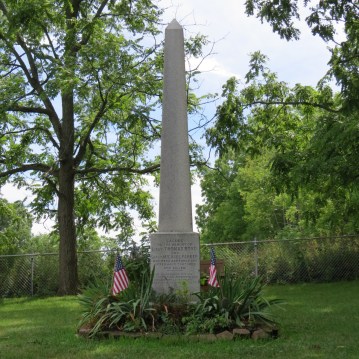
A trek to Conesus, NY, to pay my respects to Capt. Daniel Shays – who is buried in Union Cemetery – resulted in a revolutionary discovery: Groveland Ambuscade Park and Monument. Set atop the western ridge overlooking Conesus Lake is an obelisk dedicated to the memory of a group of scouts from Gen. Sullivan’s army who were ambushed there in 1779.
Monument commemorating the ambush (author collection)
Quite off the beaten track, the park has seen better days. In 1901 The Livingston County Historical Society erected a large monument commemorating the ambush of American troops near that spot. A small park, complete with a pavilion and picnic area was added – though these amenities are no longer present. More recently a wooden stairway was added leading up to the monument, which stands on high ground.
Gen. John Sullivan, under orders from Gen. Washington, mounted a punitive raid against the Iroquois in Western New York in 1779. When Sullivan’s army sought to cross the inlet at the southern end of Conesus Lake, they stalled while engineers worked to create a reliable bridge across the mire. Wishing to know the location of the British and Indian army, under Col. Butler and Chief Joseph Brant, Sullivan sent a scouting party over the western ridge. Leading the scouting party of Lt. Thomas Boyd, who was assisted by a Native American scout named Han Yost.
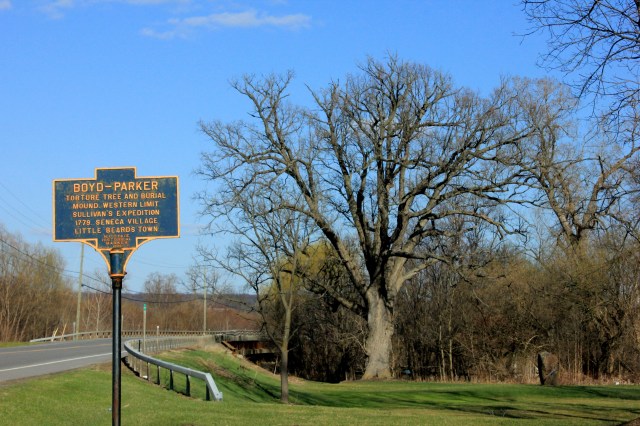
Boyd and his men were lured into a trap and ambushed on September 13th, 1779. Only a handful survived to bring word back to Sullivan. In subsequent days Boyd’s body was found in a Native American village mangled and mutilated. Boyd and Sargent Michael Parker had been captured and interrogated, but gave up little information. This resulted in their torture – fingers and toes removed, they were disemboweled and beheaded. Finally, their entrails were flung over tree branches. This tree, still standing – nearly 300 years old, now is a monument to the brave Continental soldiers who died at the hands of the Seneca. The “Torture Tree” was designated a National Historic Landmark in 2009.
The “Torture Tree” (author collection)
Sixteen of Sullivan’s men were killed at Groveland plus Han Yost, the Native American guide. The scene of the ambush would prove to be the western limit of Sullivan’s penetration into the Iroquois homeland.
Seemingly just a footnote in the history of the Revolution, it is nice to see that this courageous band that died so ingloriously is remembered today.
*Derek Maxfield is an associate professor of history at Genesee Community College in Batavia, NY, where he is also coordinator of the college’s Civil War Initiative. For his work with the Initiative, Maxfield was awarded the SUNY Chancellor’s Award for Excellence in Scholarship and Creative Activities in 2013.
Maxfield holds a Bachelors of Arts degree from SUNY Cortland and a Master of Arts degree from Villanova University. He is also a PhD candidate at the University of Buffalo, where he is ABD (all but dissertation). Among Maxfield’s research interests are 19th century politics and culture, especially Victorian death ways and the Civil War.
Maxfield lives in Churchville, NY, with his wife, Christine, two children—Quincy, 13, and Jesse, 11—a basset hound, three cats and a tortoise.*
In Fincastle, nestled in the mountains of Virginia’s Botetourt County and once considered the “jumping off” spot for people traveling to the frontier, they tell a story about William Clark. Prior to his journey west with Capt. Meriwether Lewis and the Corps of Discovery, William Clark was in the village of Fincastle one day when, it is said, he spied two young girls on horseback. They were both pretty young things, the story goes, but Clark’s fancy was captured by only one of them.
William Clark
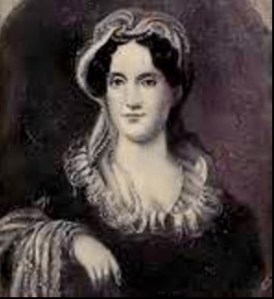
Her name was Julia Hancock; Clark called her “Judith”. She was the teenage daughter of former United States Congressman George Hancock of Santillane; one of Botetourt County’s most distinguished families.
Julia Hancock
The story goes that Clark, who was twice her age, pledged his heart to the lass; it was his intention to marry her. While on his journey to the “western ocean’, Clark named a river in Montana in her honor. It was dubbed the Judith.
The Judith River
Upon his return to Fincastle, Clark was as good as his word and conducted the beautiful Miss Hancock to the alter.
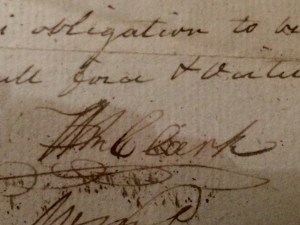
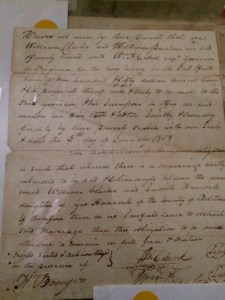
Among the historical documents that can still be found in the Botetourt County Circuit Court is the marriage bond for the two, signed by William Clark. The couple married on January 5, 1808.
William Clark’s SignatureMarriage Bond
Sadly, after 12 years of marriage and 5 children, Julia Hancock Clark died in 1820. Not long after however, in St. Louis, Clark happened to meet up with another Fincastle girl. She was a widow named Harriet Kennerly Radford. Needing a mother for his children, Clark would marry Harriet Radford on November 28, 1821. But still, there was a connection; Clark had known his new bride back in Virginia. Not only was Harriet Kennerly Radford a first cousin of Julia Hancock, she was also the other young girl Clark had first seen on horseback in Fincastle all those years before!! They tell the story in Fincastle.
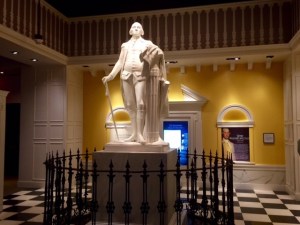
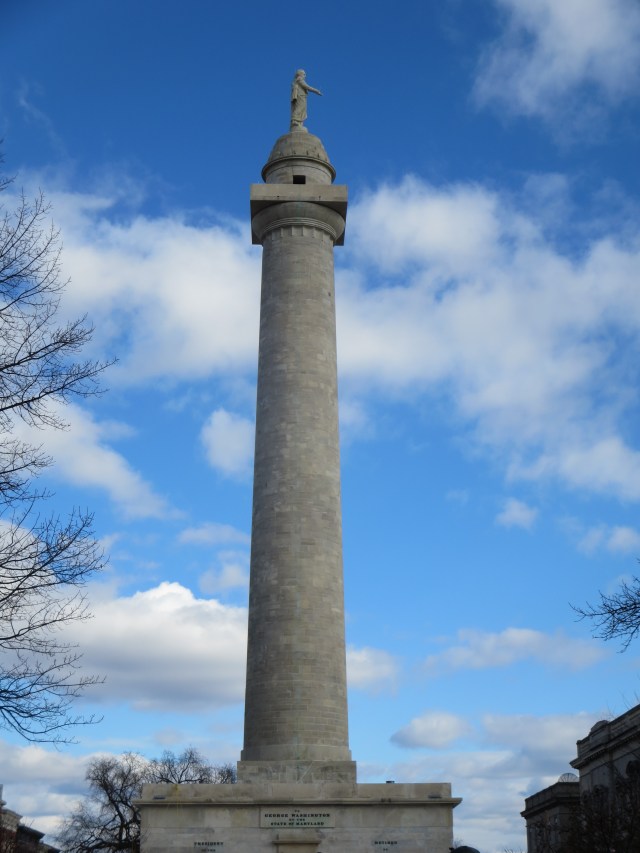
In Baltimore, Maryland stands one of the first monuments erected to the memory of George Washington. The 180-foot monument was finished in 1829, before the Washington Monument in D.C. was even begun. The impressive stone pillar is topped with a large statue of the General. Unlike most other statues of George Washington, the statue in Baltimore does not depict the Revolutionary War hero on horseback with his sword drawn, or as the First President of the United States. Instead it shows Washington, in his military uniform, simply extending a hand holding a piece of paper. Despite the simplicity of the scene, it is representative of one of the most important moments in the founding of the American nation: Washington resigning his military commission.
The Baltimore Washington Monument. Emblazoned on the sides are important dates in the Revolutionary War, including December 23, 1783. At the top, Washington resigns his commission.
On November 1, 1783, Washington learned that the Treaty of Paris had been signed and the Revolutionary War was over. On December 4, Washington bid an affectionate farewell at Fraunces Tavern in New York City to his officers and aides he had struggled and fought alongside for the previous eight years.
After the emotional farewell, Washington rode to Annapolis, Maryland where Congress was meeting at that time. He arrived at Annapolis on December 19 and was greeted as a hero. Congress agreed to accept his resignation on December 23, in a special ceremony.
The night before the ceremony, the town threw a celebratory ball for the General, complete with a dinner and dancing as well as thirteen cannon firings and thirteen toasts.
This famous painting of Washington Resigning his Commission by John Trumbull is on display in the United States Capitol Rotunda. The empty chair covered in robes is an allegorical depiction of the throne Washington was rejecting through the act of resigning.
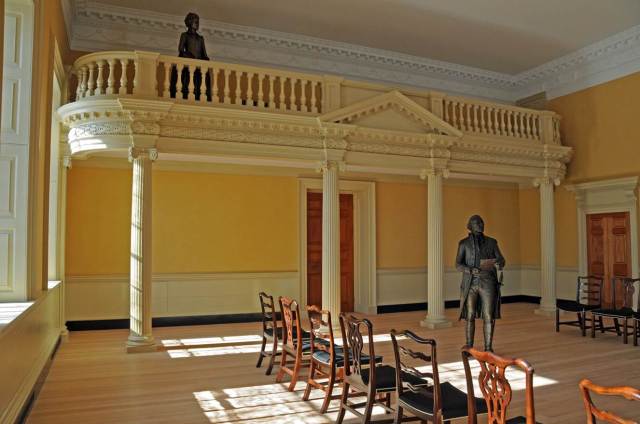
At about noon on December 23, 1783, George Washington entered the Old Senate Chamber in the Maryland State House. The importance of the moment was not lost on those who witnessed it, least of all, Washington himself. Washington is likely the only American who could have been made a king in America. In fact, in 1782, Colonel Lewis Nicola wrote a letter to Washington, suggesting that he should be king of America. Washington, quickly and emphatically crushed any notion of establishing a monarchy. More than a great general or leader, Washington believed in the ideals of American liberty and civilian rule.
In London, King George III remarked that if Washington gave up his power “he will be the greatest man in the world.”[1] Only a few times in human history before had a person at their zenith voluntarily surrendered all their power. Julius Caesar, William Cromwell, and Napoleon Bonaparte are prime examples of those who seized power at that same moment. Few men have been able to resist and became drunk with power. Washington was one of the few exceptions. One of the only precedents of rejecting the allure of that amount of power was in ancient Rome, when Cincinnatus gave up power after winning a war to become a simple farmer. Washington was about to become the American Cincinnatus.
Washington’s copy of his remarks delivered during his resignation on display in the Maryland State House.
Inside the chamber, Washington stood before the Continental Congress and its president, Thomas Mifflin, and read his concluding remarks. At one point, the power of the moment overtook Washington as he struggled through with a cracked voice the last few lines of his remarks. Washington finished his remarks: “Having now finished the work assigned me, I retire from the great theater of action; and bidding an affectionate farewell to this august body under whose orders I have so long acted, I here offer my commission and take my leave of all the employments of public life.”[2]
Those inside the chamber were overtaken with emotion and wept in the galleries. Concluding his remarks, Washington handed over to the Congress his commission dated June 15, 1775 and his remarks and left the building. And like that, Washington was once again a simple private citizen.
The Old Senate Chamber in the Maryland State House as it looks today. The room was just recently restored to the way it looked in 1783.
He rode from Annapolis and made it back to Mount Vernon the next day on Christmas Eve. It was the first time he had been home for Christmas since the beginning of the war. He could enjoy that Christmas with his family, but world history would never be the same again.
Today you can visit the location where this momentous event took place and see Washington’s hand written remarks on display at the Maryland State House in Annapolis. While the date of December 23, 1783 does not usually bring to mind a historic event, historian Ron Chernow described the event as “more extraordinary than any military feat during the war.”[3]
Washington would again be called back reluctantly to lead the nation as its first president in 1789. After serving two terms as president, Washington once again voluntarily gave up power in 1797. His disinterestedness in control and power set a precedent many have sought to emulate, and few have attained.
[1] Chernow, Ron. Washington: A Life. New York: Penguin Books, 2010. 454.
The City of Boston is known for many things and history is one of them. There are many sites within the city that interpret the story of the beginning of the American Revolution. Many sites are along the famous and popular “Freedom Trail.” The Freedom Trail winds through the city and connects historic sites, churches, monuments, museums and cemeteries that focus on the story of 18th century Boston. The trail can be identified by a double brick pattern located in the sidewalk. The 2 ½ mile trail begins at Boston Common and ends at the Bunker Hill Monument. Several sites in this book are included in the Freedom Trail, but there are others that are just as important that are not on the path of the trail. All the locations for this section are in walking distance, though we highly encourage you to use public transportation as driving in Boston can be challenging. Most attractions/sites in Boston are conveniently served by the “T” subway system.
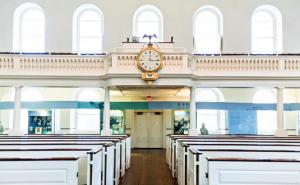
For your first stop, visit the Old South Meeting House located at 310 Washington St, Boston (GPS: N 42.357078, W 71.058578). Built in 1729, the Old South Meeting House was one of the largest buildings in Boston at the time. It was here where the public meeting was held on the night of the Boston Tea Party. Today the building serves as a historic site and museum. The small admission fee is worth the price to see this historic site which includes exhibits on the history of the church, Boston and the Boston Tea Party.
From the Old South Meeting House, you can take the route of the “Mohawks” to the next stop, the Boston Tea Party Ships and Museum. Take Milk Street (next to the Old South Meeting House) for three blocks and take a right onto Congress Street. After six blocks the Boston Tea Party Ships and Museum will be on your left as you cross the bridge over Fort Point Channel (GPS: N 42.352071, W 71.051369). The Boston Tea Party Ships and Museum includes interactive exhibits and experiences where visitors can help throw tea over board one of the recreated ships (the Eleanor and the Beaver). There is also a tea room, theater and film and gift shop. Hours vary depending on the season.
Due to the expansion of the Boston shore lines over time, the actual location of Griffin’s Wharf is not near the water today. Some argue it was at the foot of Pearl Street near the intersection of Pearl Street and Atlantic Avenue. There is a plaque commemorating the Boston Tea Party located on Seaport Boulevard. To see the plaque, take Atlantic Avenue and make a right onto Seaport Boulevard, the plaque is located on the building to the right near the bridge (GPS: N 42.354147, W 71.050977).
The town meeting held on the night of December 16, 1773 at the Old South Meeting House was no ordinary meeting. Boston was well known for its public meetings, but this one was different. Frequently city leaders called town meetings to discuss important political, economic and social decisions facing the city or colony. The town meeting was a foundation of the political process for Massachusetts and much of the New England colonies. Royal authorities had watched these meetings more closely since the 1760s during the opposition to the Stamp Act. Colonial Whigs (anti Royal leaders) had used these meetings to protest British policies that they saw as threats to their liberties.
This town meeting was a follow up assembly to previous meetings held in November originally called for Faneuil Hall. The large turnout, however, required the crowd to move to the more spacious Old South Meeting House. Nearly 5,000 people attended the meeting to discuss the city and colony’s response to a new tax on tea and more directly, the ships in the harbor that held tea from the East India Company. The colonial Whigs did not want the cargo unloaded but the captain of the ships could not leave the harbor with the tea unless they had approval from the Governor. Governor Thomas Hutchinson did not believe he had the authority to allow the ships to leave without unloading the tea. Adding to that decision, Hutchinson was more than frustrated with those who had rejected Royal authority over the years. Thus, a legal and theoretical standoff ensued. That night, the people of Boston took the matter into their own hands.
On the surface, the Tea Act of 1773 was rooted in helping pay off the debt of the British Empire, caused in part by fighting the Seven Year War (French and Indian War) with France. Also, the revenue raised would pay British officials in the colonies, thus making them more loyal to Parliament and the British Crown. The Tea Act was one of many Parliamentary laws or “Acts” passed to raise revenue in the colonies. More importantly, the underlying purpose was for Parliament to display their authority to pass laws that were binding on the British colonies. Due to colonial opposition and resistance, many of these acts were repealed. However, the Tea Act, passed in 1773, sparked an immediate response throughout the colonies.
The Tea Act was also seen as a mode for saving a British held company, the British East India Company. Before 1773, the company had to sell its tea in London and was subject to duties. The company had collected large quantities of tea in warehouses in London and was looking for a way to disperse the tea at a bargain. The Tea Act allowed the company to sell directly to American ports without paying the duties. This also forced American buyers to only purchase their tea from the East India Company, which was subject to a tax. The good news was the price of tea was reduced because the Company no longer had to pay the duties in London. Colonists resisted the notion that Parliament could force them to buy tea from the East Indian Company (many made a good living off of smuggled tea sales) and that they were required to pay a tax on the tea.
The popular notion, “taxation without representation,” had been around since the 1750’s and became well-known in 1764 in response to the highly unpopular Sugar Act and Stamp Act. Colonial Whigs believed they had no representation in Parliament because they did not elect representatives to Parliament. British political theory and law believed in the model of “virtual representation” which meant the colonists did not vote for individual members of Parliament though that body, as a whole acted in the best interest for all British subjects. Colonial leaders, who for decades were allowed to vote for their representative bodies in their respective colony, did not accept this theory. The opposing views on representation began to open opposition to British authority over colonial matters.
Though passed in May 1773, the Tea Act did not impact the people in the colonies until fall. Seven ships of tea were sent to four American ports, Boston, New York, Philadelphia and Charleston. Meanwhile, colonial Whig leaders began to organize a resistance to the East India Tea that was en route. In fact, in every other city but Boston the tea was refused and forced to either be returned to England or confiscated by local officials. It was in Boston that a determined governor and history of Royal opposition led to a signal event in American history.
On November28th, the ship Dartmouth arrived loaded with tea. British law gave ships with imports twenty days to pay the duties or the local custom officials could confiscate the cargo. Hutchinson, when petitioned, would not allow the ship to leave the port without paying the duty. His sons, who acted as the Tea Consignees (authorized to receive the tea and see to its distribution) for Boston, also refused to back down and resign their positions, which happened in other American ports. Soon two more ships arrived in the harbor with the unwanted tea. Unable to return the tea to England and without being able to unload the tea due to the threats of local groups such as the Sons of Liberty, the captains of the ships were in a tight and dangerous spot.
On the night of December 17th, one of the largest public meetings in Boston convened at the Old South Meeting House. Speeches by Sam Adams, John Hancock, Joseph Warren and other Boston Whig leaders called for the return of the tea to England. Later in the evening, word came that a last minute plea to Governor Hutchinson to let the ships return was refused. Sam Adams announced publicly, “This meeting can do nothing further to save the country.”
The events that happened next have been debated since 1773, soon men arrived outside the Meeting House disguised as Mohawk Indians. Whether or not these men were signaled to move towards the ships with tea is unknown. As the “Mohawks” marched down Milk Street towards Griffin’s Wharf where the three ships of tea were docked, the thousands gathered inside the Old South Meetinghouse began to pour out of the building. Chants of “Boston a Teapot Tonight” and “Hurrah for Griffin’s Wharf” were reportedly heard. Some people followed the “Mohawks”, others continued to protest in the streets, while still others headed home believing that a confrontation was about to take place.
Many details remain unknown about who exactly the “Mohawks” were that marched on Griffin’s Wharf that night. The men used lamp soot and red ochre to disguise their faces and carried a wide assortment of weapons. As they made their way to the wharf, they yelled and “whooped” as Indians in a war party. If they had coordinated the timing with leaders in the Old South Meetinghouse, it is still unknown. The identities of most of these men either were never recorded or are lost to history; that is how tight their veil of secrecy was coupled with their sophisticated organization. As they made their way to the ships, the Whig leaders inside the Old South Meetinghouse stayed behind and were never directly part of what happened next.
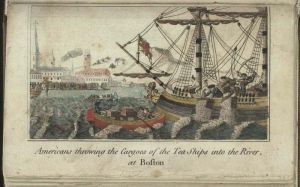
The men, with a crowd behind them, approached the wharf. There they divided into three different groups, one for each of the ships, Dartmouth, Beaver and Eleanor. Being a port city, most of the men knew where to find the cargo they were looking for and how to operate on a ship. Respectively, most of the other cargo and private property on the ships were not touched. They were only after the tea. Hauling the chests to the deck, they were broken open and dumped into Boston Harbor. Some of the men watched to make sure no one was trying to steal any of the tea that they were dumping. The group of approximately 150 men worked quickly as the crowd of spectators grew.
The American Revolution did not just “happen.” It was the culmination of various events and acts that individually did not guarantee separation. As a collective, one can retroactively see how the accumulation of these events led to the inevitable. The Boston Tea Party was one of these events. This time it was different; this time Great Britain would respond in a way it never had before. The Tea Party gave the tinder box of revolution in America more fuel and many believed a small incident would cause a spark leading to open war between colonies and mother country. The spark would come on April 19, 1775 in the Massachusetts countryside.







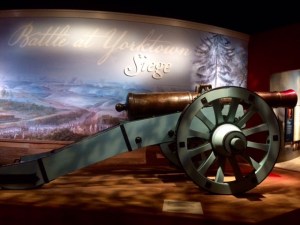
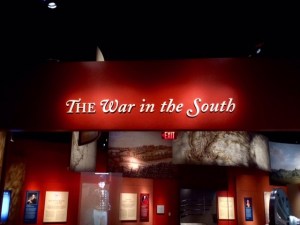 The “Revolution” exhibition chronicles the weapons and tactics used in the conflict itself, from Lexington and Concord to Yorktown. And I was pleased to see an exhibition that focuses on the war in the south and the major players who led those events such as Daniel Morgan, the “Gamecock” Thomas Sumter, and the notorious Banastre Tarleton.
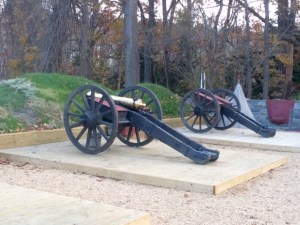 This farm area is also undergoing considerable change as it will now represent a Virginia farmstead during the Revolutionary War era. Not yet completed, a conversation with friend and farm site manager Jay Templin gave me an idea as to some of the changes that are coming. “We’re now presenting life during the Revolution so we’ll need to scale back; there will be changes to what we’re growing.” Said Templin. “We’ll certainly still be growing some tobacco but not the large field as in years past.”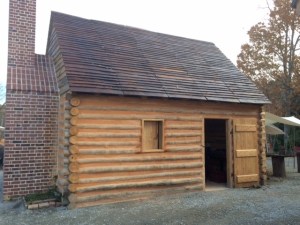





 sites within the city that interpret the story of the beginning of the American Revolution. Many sites are along the famous and popular “Freedom Trail.” The Freedom Trail winds through the city and connects historic sites, churches, monuments, museums and cemeteries that focus on the story of 18th century Boston. The trail can be identified by a double brick pattern located in the sidewalk. The 2 ½ mile trail begins at Boston Common and ends at the Bunker Hill Monument. Several sites in this book are included in the Freedom Trail, but there are others that are just as important that are not on the path of the trail. All the locations for this section are in walking distance, though we highly encourage you to use public transportation as driving in Boston can be challenging. Most attractions/sites in Boston are conveniently served by the “T” subway system.
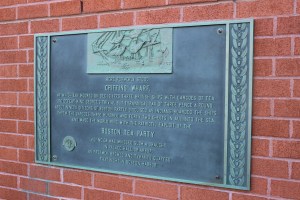 Due to the expansion of the Boston shore lines over time, the actual location of Griffin’s Wharf is not near the water today. Some argue it was at the foot of Pearl Street near the intersection of Pearl Street and Atlantic Avenue. There is a plaque commemorating the Boston Tea Party located on Seaport Boulevard. To see the plaque, take Atlantic Avenue and make a right onto Seaport Boulevard, the plaque is located on the building to the right near the bridge (GPS: N 42.354147, W 71.050977).
 The town meeting held on the night of December 16, 1773 at the Old South Meeting House was no ordinary meeting. Boston was well known for its public meetings, but this one was different. Frequently city leaders called town meetings to discuss important political, economic and social decisions facing the city or colony. The town meeting was a foundation of the political process for Massachusetts and much of the New England colonies. Royal authorities had watched these meetings more closely since the 1760s during the opposition to the Stamp Act. Colonial Whigs (anti Royal leaders) had used these meetings to protest British policies that they saw as threats to their liberties.
 India Company. Before 1773, the company had to sell its tea in London and was subject to duties. The company had collected large quantities of tea in warehouses in London and was looking for a way to disperse the tea at a bargain. The Tea Act allowed the company to sell directly to American ports without paying the duties. This also forced American buyers to only purchase their tea from the East India Company, which was subject to a tax. The good news was the price of tea was reduced because the Company no longer had to pay the duties in London. Colonists resisted the notion that Parliament could force them to buy tea from the East Indian Company (many made a good living off of smuggled tea sales) and that they were required to pay a tax on the tea.
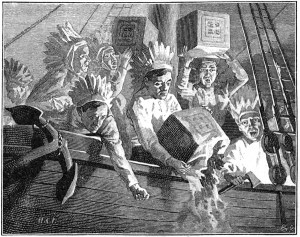 Many details remain unknown about who exactly the “Mohawks” were that marched on Griffin’s Wharf that night. The men used lamp soot and red ochre to disguise their faces and carried a wide assortment of weapons. As they made their way to the wharf, they yelled and “whooped” as Indians in a war party. If they had coordinated the timing with leaders in the Old South Meetinghouse, it is still unknown. The identities of most of these men either were never recorded or are lost to history; that is how tight their veil of secrecy was coupled with their sophisticated organization. As they made their way to the ships, the Whig leaders inside the Old South Meetinghouse stayed behind and were never directly part of what happened next.
 Emerging Revolutionary War Era