Emerging Revolutionary War welcomes back guest historian Katie Turner Getty.
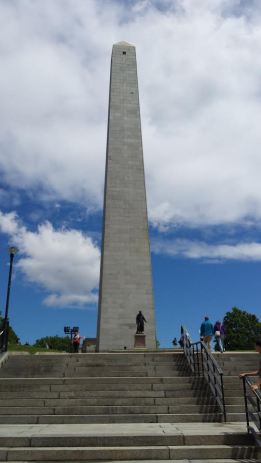
Towering over Charlestown, Massachusetts, its foundation set in sacred battleground soil, the Bunker Hill Monument is a 221 foot obelisk commemorating the Battle of Bunker Hill. The cornerstone of the monument was laid by the Marquis De Lafayette in 1825, fifty years after the battle was fought on June 17, 1775.
Bunker Hill Monument (author collection)
Although the land surrounding the monument has been greatly developed since the battle, visitors today can get still get a sense of the 18th-century landscape just by walking through Charlestown and climbing the hill to reach Monument Square. Approaching visitors are greeted by the statue of Colonel William Prescott, the gray granite of the monument serving as an impressive backdrop behind him. Continue reading “ERW Weekender: Bunker Hill Monument & Museum”→
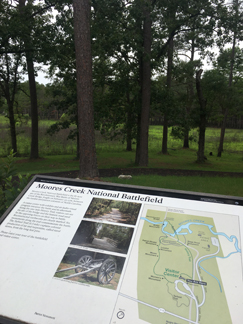
The Moores Creek battlefield manages to look simultaneously well manicured and primordial. Encompassing only 87 acres, it’s a landscape from before the dinosaurs that happens to have a rubberized pathway winding through its tall, thin pines.
Tucked away in a forest some 22 miles northwest of Wilmington, North Carolina, the battlefield sits along a darkwater creek that spills its banks into even darker patches of swamp. This is Moores Creek itself, where, in February 1776, Patriots and Loyalists squared off with muskets, broadswords, and a pair of cannons. (And, yes, I did say “broadswords.”) Continue reading “A Visit to Moores Creek”→
Memorial Day, the last Monday of May, commemorates the men and women who gave the ultimate sacrifice in defense of this country. I wanted to take the moment to remember all those who gave their life in service to this country. Thank you!
The picture below is of Chalmette National Cemetery, which is now preserved by the National Park Service, as part of Jean Lafitte National Historical Park and Preserve. In total, over 15,300 United States veterans are interred there, serving in armed conflicts from the War of 1812 through the Vietnam War.
Chalmette National Cemetery (author collection)
In the theme of the Revolutionary War Era, in which this blog is dedicated, one of the most famous quotes to come out of any soldiers’ mouths about giving their life for the cause of American independence was from Nathan Hale.
Hale, about to be executed for espionage, uttered the now famous words;“I only regret that I have but one life to lose for my country.”
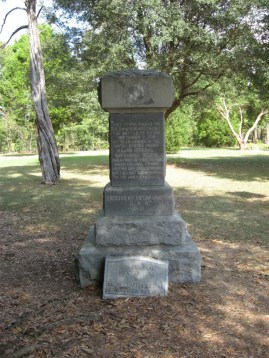
Daughter’s of the American Revolution (D.A.R.) Monument, Eutaw Springs Battlefield (author collection)
In many ways, the battle of Eutaw Springs was a disappointment for both commanders. Greene’s troops at one point broke through the British lines, but they recovered, and the Americans failed to drive them off the field. Stewart, in a letter to Cornwallis, wrote that there were two things he would regret the rest of his life: the loss of an early morning supply gathering party and his lack of cavalry. Having them, he felt, would have enabled him to decisively defeat Greene. Probably both commanders, and many of their officers, reflected upon these events and second guessed themselves for the rest of their days. Although both armies fought well at Eutaw Springs, a clear cut victory eluded both of them. Continue reading “After Eutaw Springs”→
Emerging Revolutionary War is honored to welcome back historian Katie Turner Getty. Biography of Ms. Getty is below the post.
On April 19, 1775, the placid farm of fifty-eight-year-old Jason Russell of Menotomy erupted into carnage when he, along with eleven other Americans, were shot and bayonetted by British soldiers in his home and yard.
Jason Russell House (author collection)
As American militia and minutemen poured in from surrounding towns, the British—fatigued yet furious—found themselves under increasingly heavy musket fire. As they pulled back from Concord and retreated to Boston, the main column passed near Russell’s house which stood near the battle road. Russell had just returned home after secreting his family at a nearby farm. Unbeknownst to him, American minutemen and British soldiers would soon converge upon his property and a desperate battle would occur within the walls of his own house.
Earlier that day, twenty-six-year-old Gideon Foster had set off from Danvers with a company of minutemen. The men had set a scorching pace and made the sixteen mile journey to Menotomy in four hours, running half the way.[1] Upon arriving, Foster’s men joined others from Lynn, Beverly, Salem, Dedham, and Needham.[2] Some took cover behind trees and others in Russell’s yard, where a breastwork was constructed out of shingles.
The Fight at the Jason Russell House, bicentennial painting by Ruth Linnell Berry (1974). Appearing with permission from the Arlington Historical Society.
The men focused their attention on the approaching main column of British troops and fired upon them. Capt. Israel Hutchinson, a seasoned French and Indian War veteran, warned that flank-guards would likely be traversing the fields alongside the road[3], helping the main column to pass unmolested. But before the men could reconsider their position or move to a more defensible location, the flank-guard was upon them, trapping the men against the main column.
In a frantic search for cover, many of the men bolted into Russell’s house. Jason Russell, too, attempted to dash inside but was slowed by his lame leg.[4] He was shot twice and fell on his doorstep. The soldiers tore inside the house in hot pursuit of the men, bayonetting Jason Russell’s body eleven times as they passed.
Once inside the house, the Americans had no choice but to fight for their lives in rooms with no egress, in very close quarters, against raging, bayonet-wielding soldiers. It was a bloodbath. With two rooms on the bottom floor, a narrow stairwell, and two rooms on the top floor, Jason Russell’s house offered very little refuge. Soldiers outside the house hailed musket fire into the windows.
Sign depicting what happened at the Jason Russell House on April 19, 1775
With nowhere else to go, several men rushed into the cellar. What at first would seem to be an ill-advised hiding spot turned out to be the only sanctuary that Russell’s home could offer. Taking position near the bottom of the stairs, the men raised their muskets and shot dead the first soldier who descended.[5] Any other soldiers who attempted to follow were met with blazing musket fire. Holes left by musket balls are still visible in the stairwell, attesting to the firestorm.
Soon, the house grew quiet. All of the men who had sought safety in the house had been killed, with the exception of the men who took refuge in the cellar. The British ransacked the house then left.[6]
In 1835, sixty years after the bloodbath at Russell’s house, a memorial was erected in Danvers to commemorate the townsmen who lost their lives in Menotomy that day. Danvers lost the second highest number of men, after Lexington[7], and all of them at Jason Russell’s house. Foster, the commander of the company of minutemen who had ran halfway to Menotomy, was by then the last surviving Danvers veteran of the war. Aged eighty-six, he addressed the crowd assembled for the dedication of the monument and recounted the events of April 19th:
On that morning, more than one hundred of my townsmen hastened to the field of battle…ready to offer their lives on the altar of their liberties. Seven of those who thus started in the prime of life and vigor of manhood, ere that day’s sun descended in the west, were numbered with the dead.[8]
Foster called the dedication of the memorial “One of the happiest days and most pleasing events of my life.”[9]
In total, twelve Americans were killed at Jason Russell’s house. Jason’s wife, Elizabeth, returned home to find her husband dead. He and the other fallen Americans, their bodies riddled with musket balls and slashed by bayonets, had been laid out on the floor in the kitchen, the blood from their wounds pooling around them. Elizabeth later said that “the blood in the room was almost ankle deep”.[10]
Musket ball damage to the staircase of the Russell House
*Biography: Katie Turner Getty is a lawyer, history enthusiast, and lifelong resident of Boston. She holds an A.A. from Bunker Hill Community College in Charlestown, Massachusetts, a B.A. in History from Wellesley College, and a J.D. from New England Law Boston. She can often be found exploring historic sites both on and off the Freedom Trail.
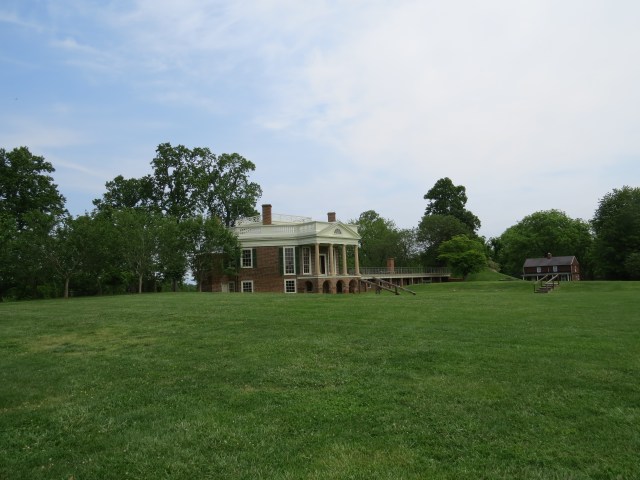
Although Jefferson was famous for his Virginia hospitality, sometimes the unending stream of visitors – especially after he retired from the presidency – just overwhelmed him and he needed to escape and have some peace. At such times, Jefferson retreated to his Poplar Forest home.
Long a destination on my bucket list, Poplar Forest struck me as a miniature Monticello at first glance. But on closer inspection, they are more dissimilar than I thought – despite initial appearances.
Although Jefferson and his wife Martha inherited the property in 1773, it was not until 1806 that construction on the home began. Much like Monticello, Jefferson designed the octagonal house from a number of architectural influences – Renaissance Palladian, 18th century French and some English. Even the privies are special octagonal structures.
Privy at Poplar Forest
The interior of Jefferson’s retreat is now undergoing renovation and restoration with completion just a few years away. It has been a long haul researching how Poplar Forest would have looked in Jefferson’s time. Until 1983, the property was in private hands. In fact, it was only two years after the great Virginian’s death that the plantation passed into private hands. Jefferson had given the property to his grandson Francis Eppes, but the young man quickly realized that the house was not practical to live in full time – so he sold it and moved to Florida.
Poplar Forest has some interesting history associated with it. It was where Jefferson and his family took refuge during the Revolution when the British were out to capture him. It is also where the Sage of Monticello wrote his only book – Notes on the State of Virginia.
Jefferson’s hide-away is open daily from mid-March through the end of December. During the winter, visitors can visit on weekends for self-guided tours.
Emerging Revolutionary War is pleased to welcome back historian Bert Dunkerly, who is the co-author (with Irene B. Boland) of the upcoming book; “Eutaw Springs; The Final Battle of the American Revolution’s Southern Campaign” slated to be released this month.
Part One
The weather was warm and the men had been marching for days, but their morale was high. They had been through a lot recently: caught off guard and defeated at Hobkirk’s Hill, a month of grueling siege work – and for naught, at Ninety Six. Not to mention the engagements that many of them had fought in previously: Kings Mountain, Cowpens, Guilford Courthouse, and dozens of smaller battles.
Yet the army that General Nathanael Greene led forward on the morning of September 8, 1781, was confident and ready to come to grips with its adversary. Everyone from the private in the ranks on up to the commanding general knew that ahead lay an opportunity.
Battles in the Revolution were, in fact, rare opportunities for commanders. Engagements were the short, pulse-pounding events that broke up the monotony of marching and maneuvering. An army spent most of its time in garrison, in camp, or on the road. In battle the infrequent opportunity came to crush an opponent and influence the outcome of a campaign, or the war. These chances were few and far between.
“Eutaw Springs” by Benson Lossing
Both commanders at Eutaw Springs appreciated this fact. General Nathanael Greene’s forces had experienced a series of close calls at Guilford Courthouse, Ninety Six, and Hobkirk’s Hill. The American army fought well in all of these engagements, save Hobkirk’s Hill, yet they met defeat in every one. Greene hoped Eutaw Springs would put the finishing touches on his South Carolina campaign, and end it with a clear cut victory.[i]
Eutaw Springs was a rare chance for Greene to pick the time and place of engagement, array his forces to his choosing, and initiate the battle, and control its \tempo. It was the only set engagement of the campaign, other than Guilford Courthouse, in which Greene chose the ground and initiated the battle. Commanders do not often have this luxury, and Greene earnestly hoped to make the most of it. Continue reading “Eutaw Springs”→
In southeast Pennsylvania on September 11, 1777, the largest battle, by number of combatants, was fought between the British forces under Lord General William Howe and the Continental and militia forces under General George Washington. After the day long engagement, one of the bloodiest of the entire American Revolution, approximately 1,900 men were killed, wounded, or captured. Washington lost 8% of his entire force that day, Howe 4%.
Brandywine, A Military History of the Battle that Lost Philadelphia but Saved America, September 11, 1777
Yet, the Battle of Brandywine has been eclipsed by the history that followed shortly thereafter the bloody engagement. Fifteen days after the battle along Brandywine Creek, Howe’s British and Hessian forces will capture Philadelphia and Washington’s army will spend the pivotal 1777-1778 winter at Valley Forge. Although the battle has been the subject of a few histories and folded into larger campaign studies, Michael C. Harris’s book-length treatment is the first to take an analytical and discerning eye to the engagement and separate myth from fact. Published by Savas Beatie, LLC, in 2014 in hardcover, the book has now been released in paperback. Continue reading “Review: Brandywine, A Military History of the Battle that Lost Philadelphia but Saved America, September 11, 1777 by Michael C. Harris”→
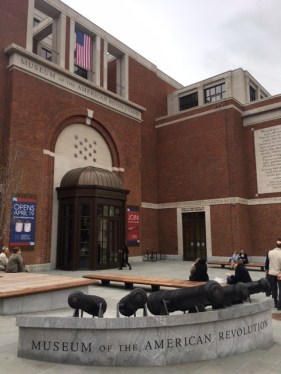
On April 19, 2017, symbolic in American Revolutionary War history, the Museum of the American Revolution opened in Philadelphia, Pennsylvania. The weekend before, I had the chance, to get a “sneak peak” of the new museum.
Museum of the American Revolution
I left thoroughly impressed as the museum fills in a critical need for telling this utmost important era in our nation’s history. Yet, the development of exhibits along with the myriad of learning styles and technology underscores the need in this 21st century to be approachable and inclusive to reach various levels of interest that the visitor may have.
Greeting visitors as they approach are a few murals depicting well-known scenes of the American Revolution–including the symbolic “Crossing of the Delaware” and the “Signing of the Declaration of the Declaration.” Along with one of the most important sections of the Declaration of Independence.
After entering the museum the exhibit area is on the second floor, beginning with the build-up to the war and ending with a nod to the upholding of the revolutionary ideals. Broken up into four segments, the exhibits cover the period of the “Road to Independence” from 1760-1775, “The Darkest Hour” 1776-1778, “A Revolutionary War” 1778-1783, and ending with “A New Nation” 1783 to present-day. A must-see is the short 15-minute film that is centered on George Washington’s command tent, which is shown behind the screen at the conclusion of the film.
Yet, do not shirk the exhibits, which include the a portion of the last remaining “Liberty Tree” from Annapolis, Maryland that fell during a hurricane a few years back. Small movie theaters dot the exhibit area depicting different aspects of the war and history. The Oneida Native Americans, the first allies of the United States are also prominently–and rightfully–highlighted as to their contributions.
Another of the interesting components of the museum is the use of interpretive questions, including “Why were they called Hessians?” with an accompanying multi-dimensional map that shows the different German principalities that contributed troops to the British war effort. Another interesting panel discusses the first use of acronym “USA.”
The museum’s display collection of artifacts is also truly amazing. From a few of the first flags carried by units in the war, to the aforementioned “Liberty Tree”, to a portion of the famous North Bridge, in Concord, Massachusetts.
Combined with the interactive displays, the chance to walk onto a privateer ship, and the assortment of artifacts on display, the museum exhibit area caters to all levels of enthusiasts and can definitely absorb a few hours of your time.
North Bridge segment
With the museum main attractions situated on the second floor, the first floor of the museum is free to house the orientation film, a cafe, and the gift shop. If you have never been to Philadelphia, the museum is another highlight to add to your bucket list itinerary. If you have ventured to the “City of Brotherly Love” before, the museum provides an excellent reason to journey back.
For information on the museum, including programs, exhibits, and the admission fee, click here.


 The Moores Creek battlefield manages to look simultaneously well manicured and primordial. Encompassing only 87 acres, it’s a landscape from before the dinosaurs that happens to have a rubberized pathway winding through its tall, thin pines.





 Another of the interesting components of the museum is the use of interpretive questions, including “Why were they called Hessians?” with an accompanying multi-dimensional map that shows the different German principalities that contributed troops to the British war effort. Another interesting panel discusses the first use of acronym “USA.”
 Emerging Revolutionary War Era